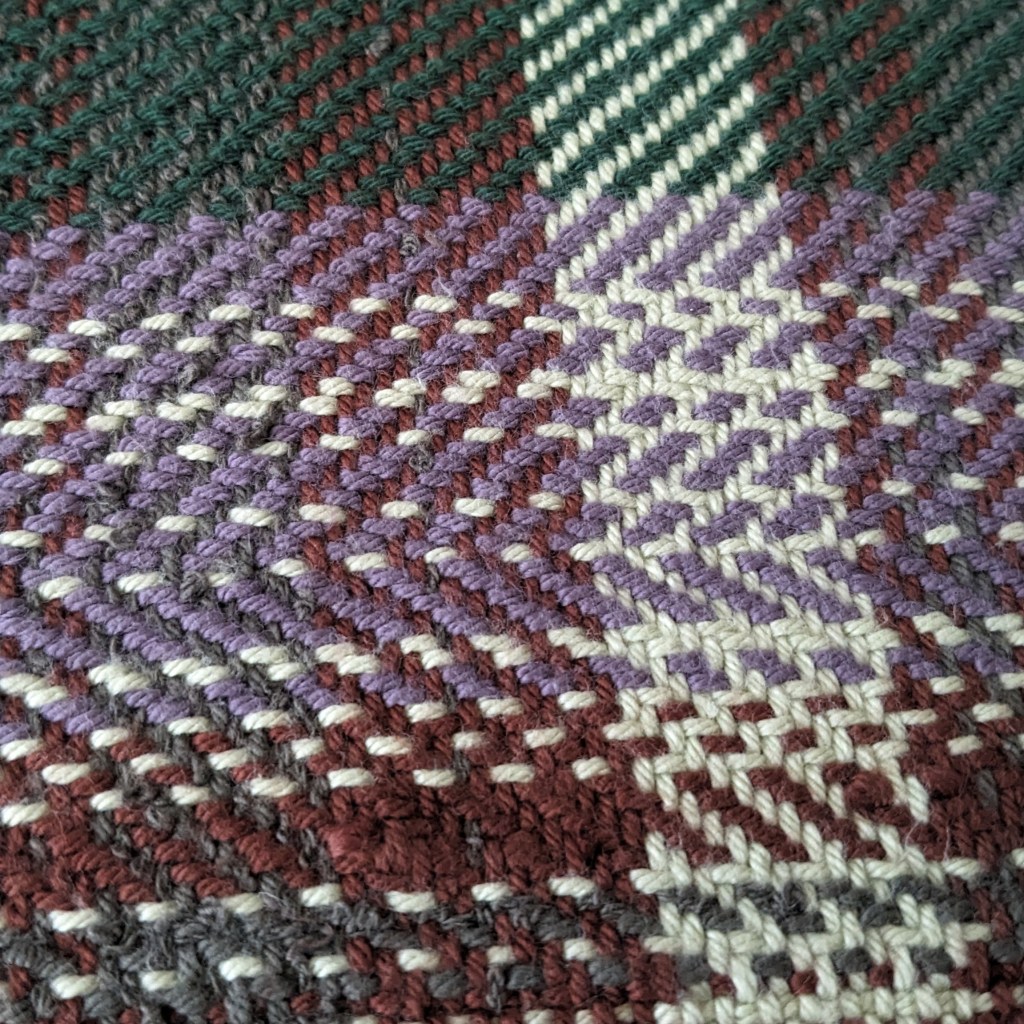
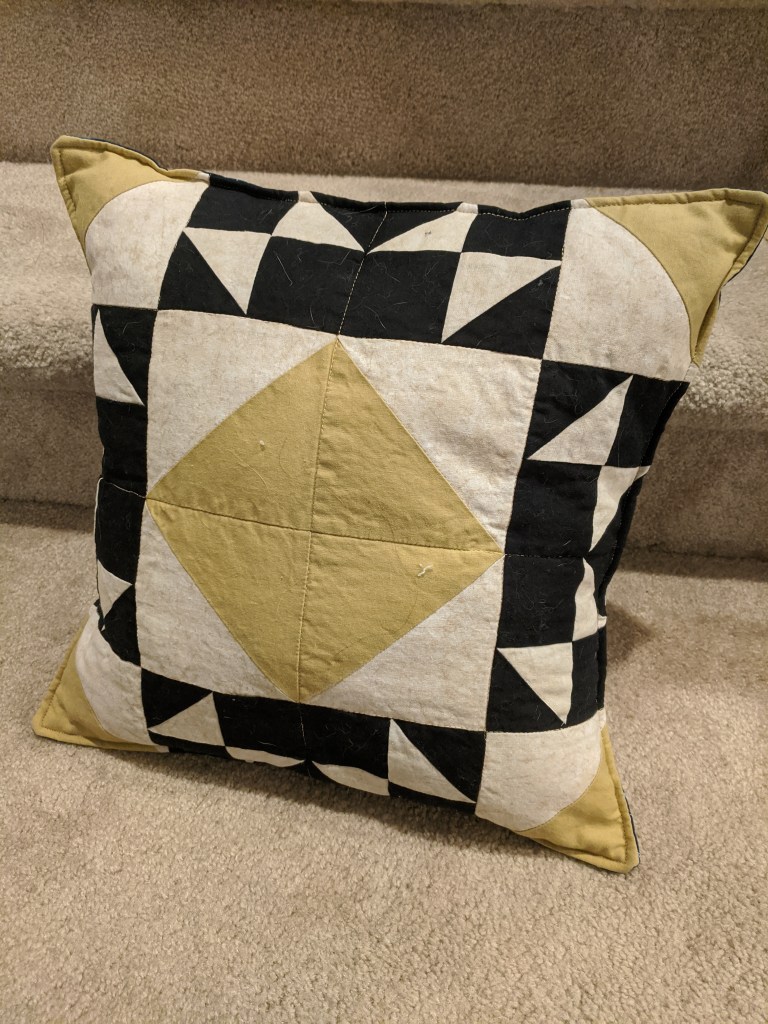
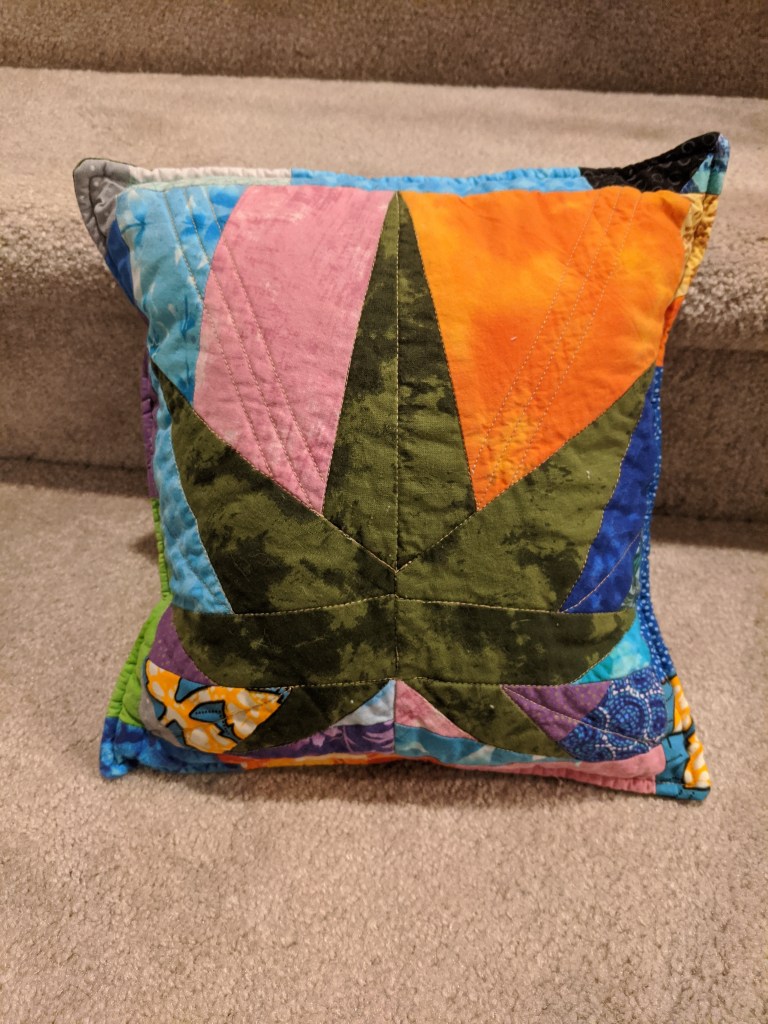
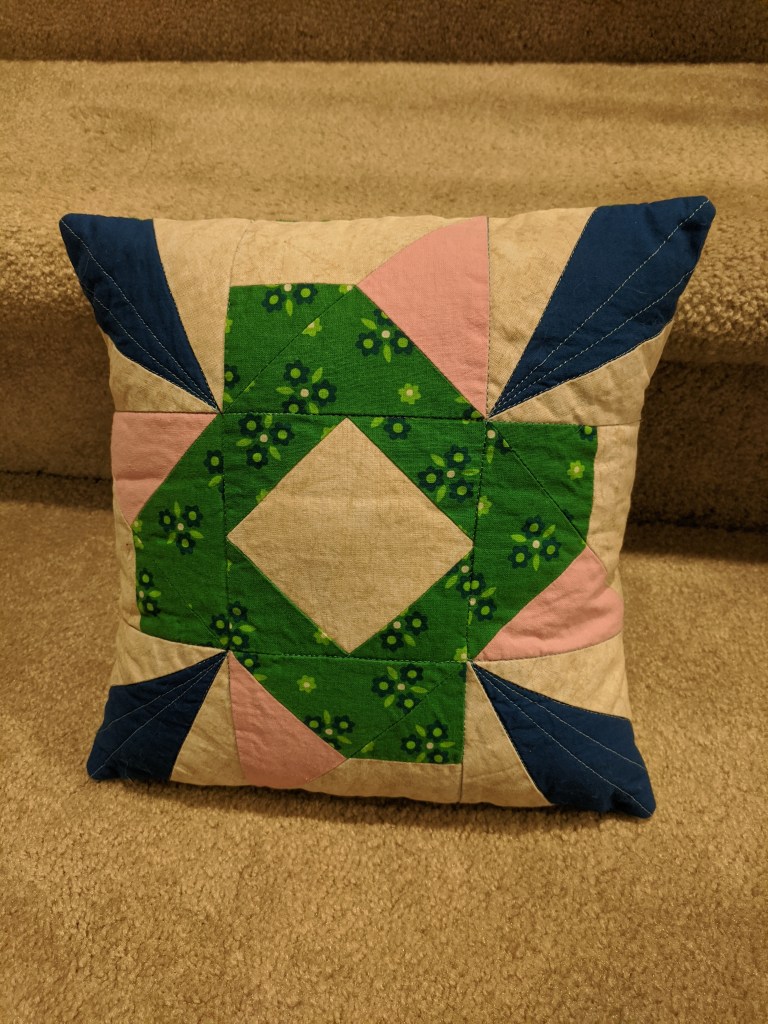
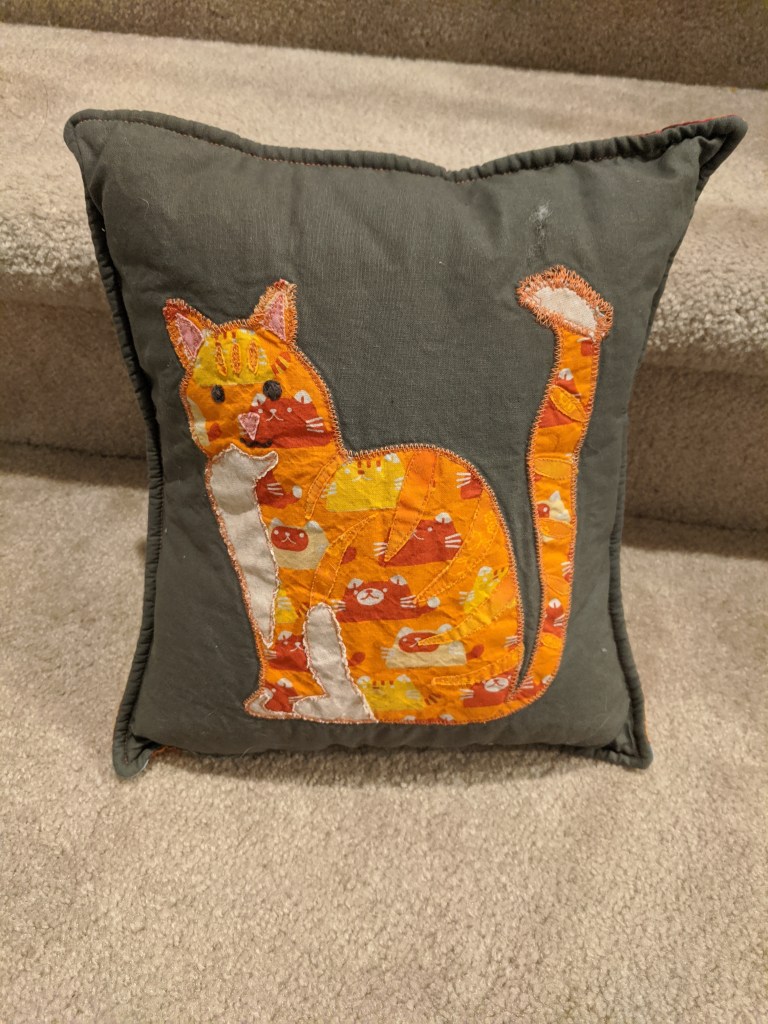
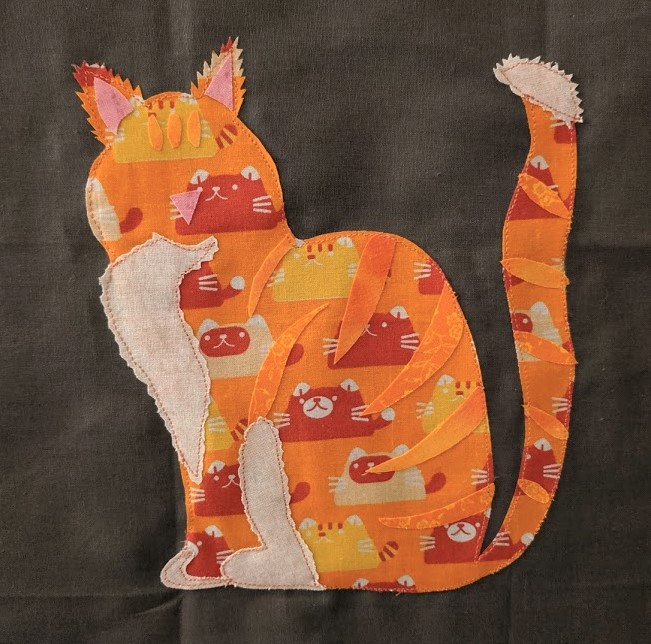
I’ve mainly been working on New Years gifts recently, so here are some sneak peeks:
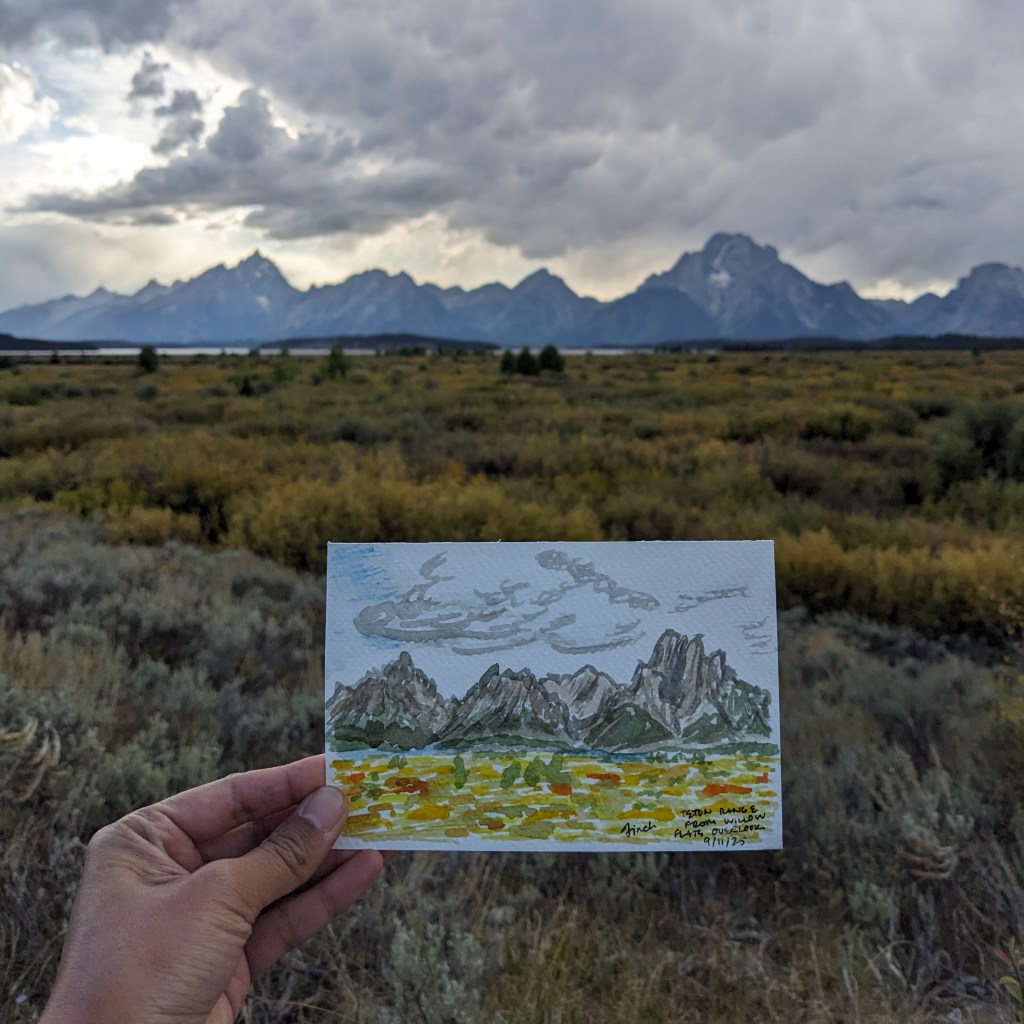
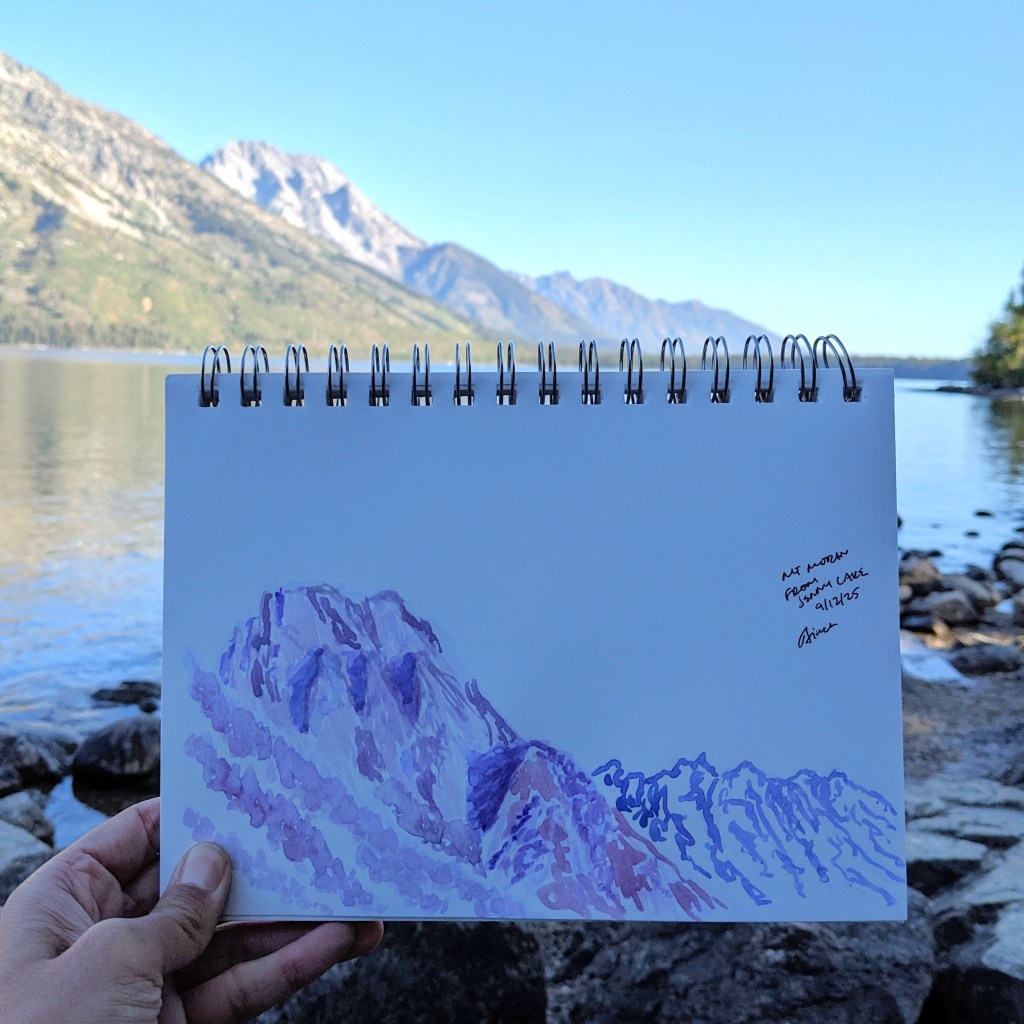
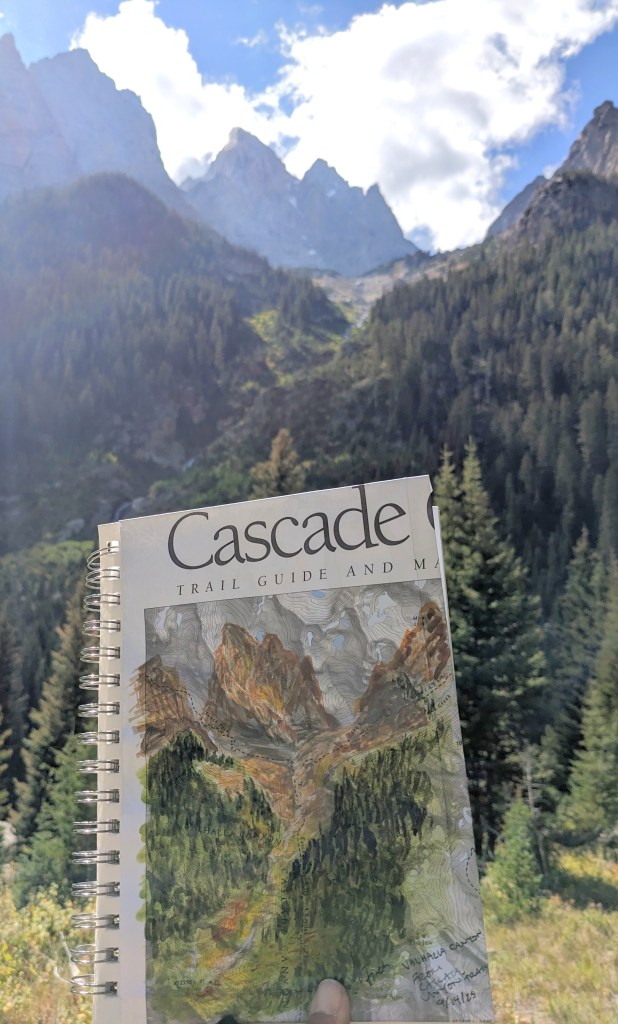
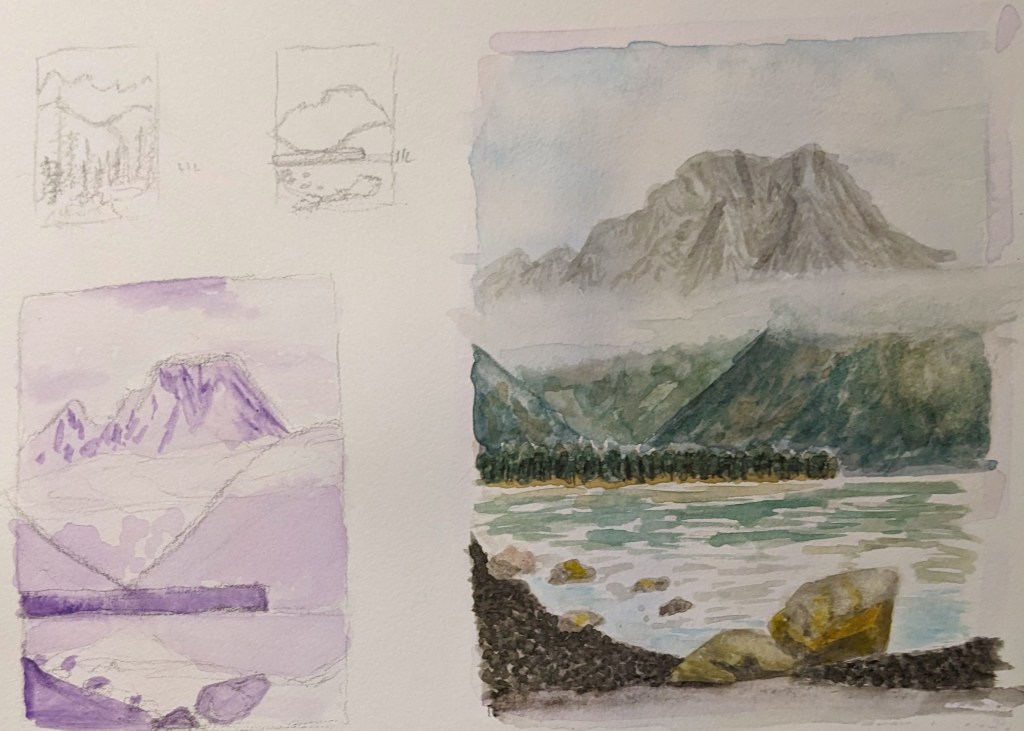
I jumped at the chance to go to the Grand Tetons again with family and did some fun watercolor:
from Willow Flats OverlookMt. Moran from Jenny LakeValhalla Canyon from Cascade Canyon Trail, LOVED painting on my map
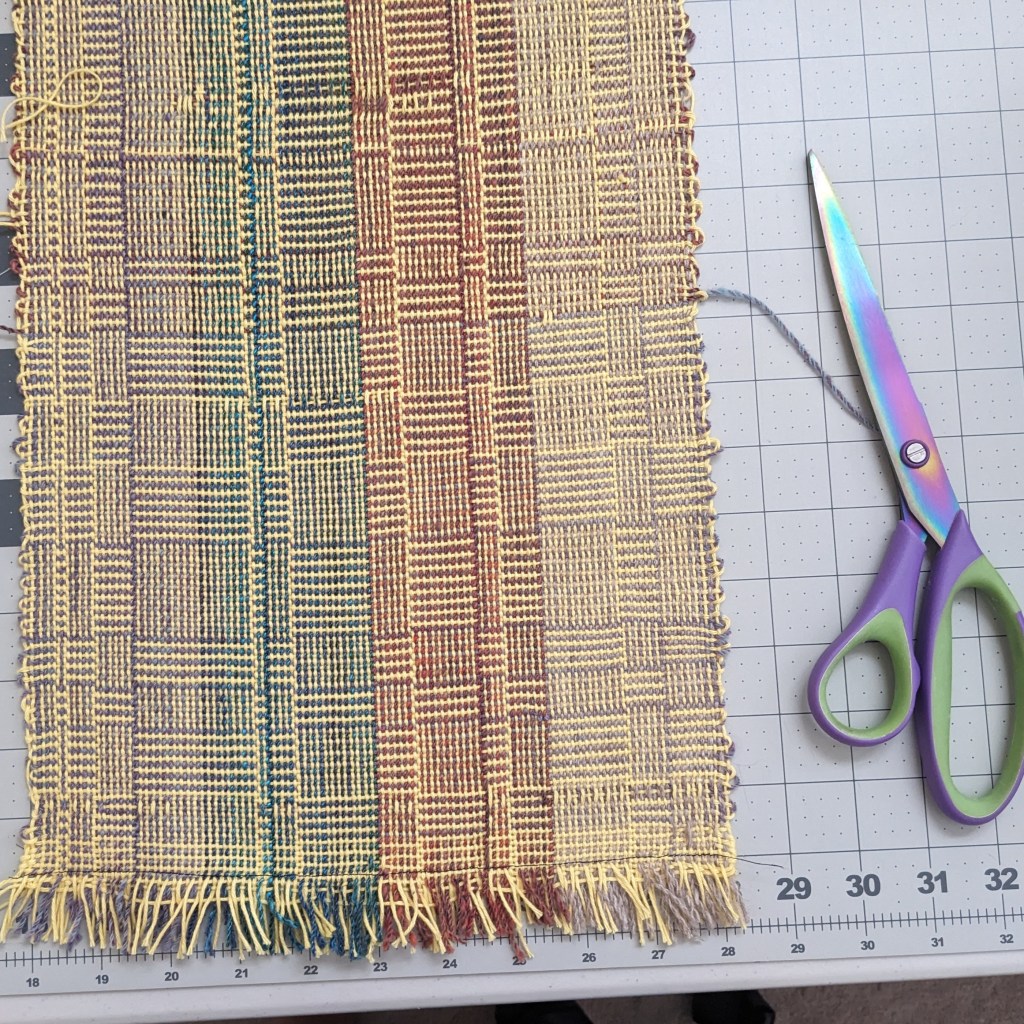
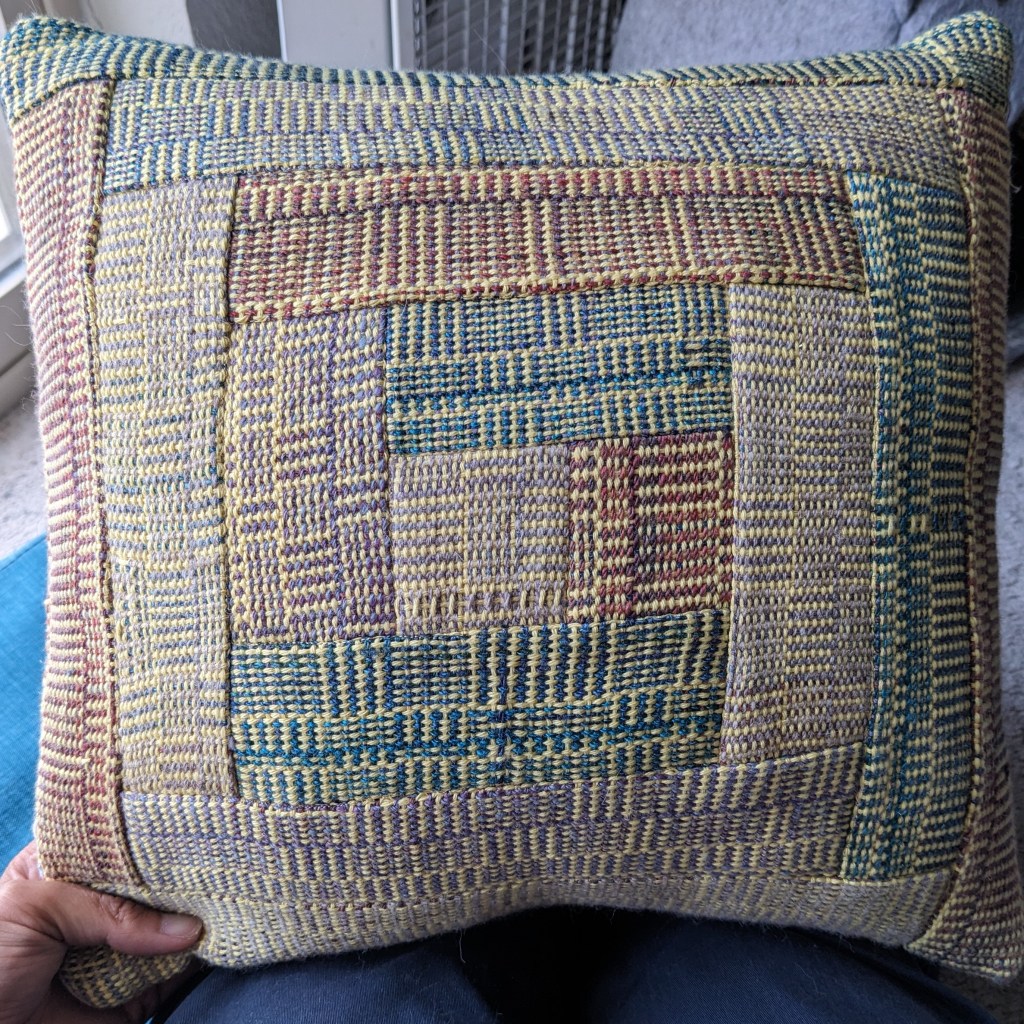
I wove my first “log cabin” pattern using handspun accent yarn and yellow commercial cotton, bravely cut it into strips, and quilted it using the “log cabin” block 🙂 so it’s my log cabin of log cabins pillow now.
I didn’t make my blocks even, it was much more fun to switch the pattern improvisationallyI could do with a little more contrast between the yellow and the other yarns, but I like it 🙂
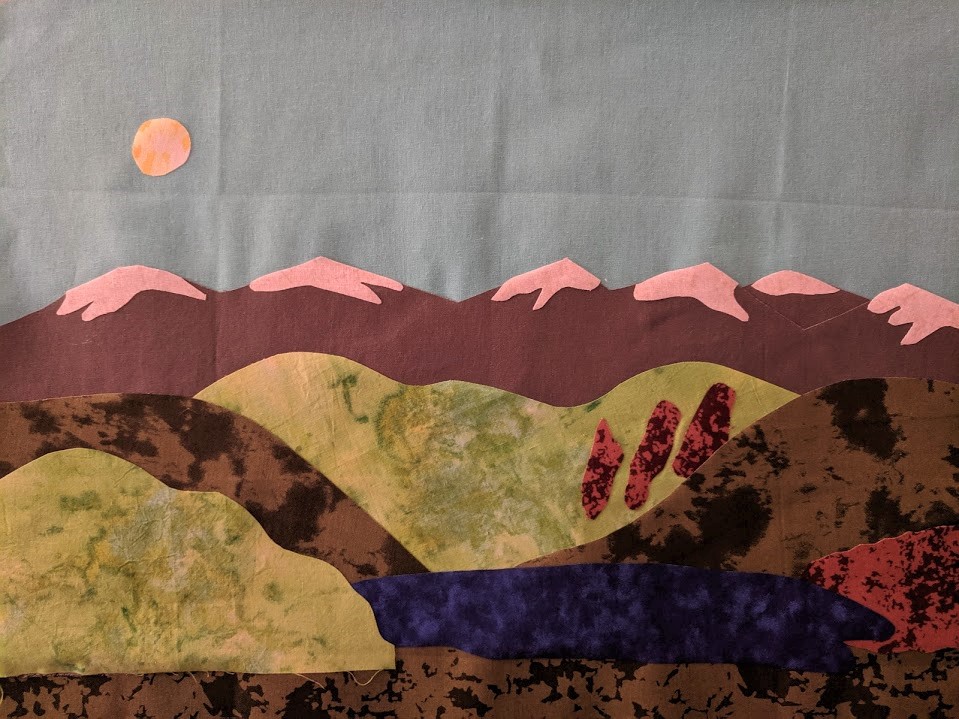
I attended a landscape watercolor class at my local art museum, which was SUPER helpful and taught me a lot of new techniques. I think one of my main takeaways is that planning a piece *does* help, and makes sure you’re capturing the things you find important. This includes planning the contrasts, and where your dark and light colors will be. I have been mainly preoccupied with shadows, but have ignored the contrast between back/mid/foreground, which helps guide the eye across the work as a whole. As I looked back through my field book, I found that I tend to ignore the mid and foregrounds, opting to simply look into the distance and draw the mountains I see. But… adding context adds depth and interest to the piece, so I’m now looking with new considerations in mind 🙂
I’m actually quite impressed with myself for this little piece… now to bring these skills outside
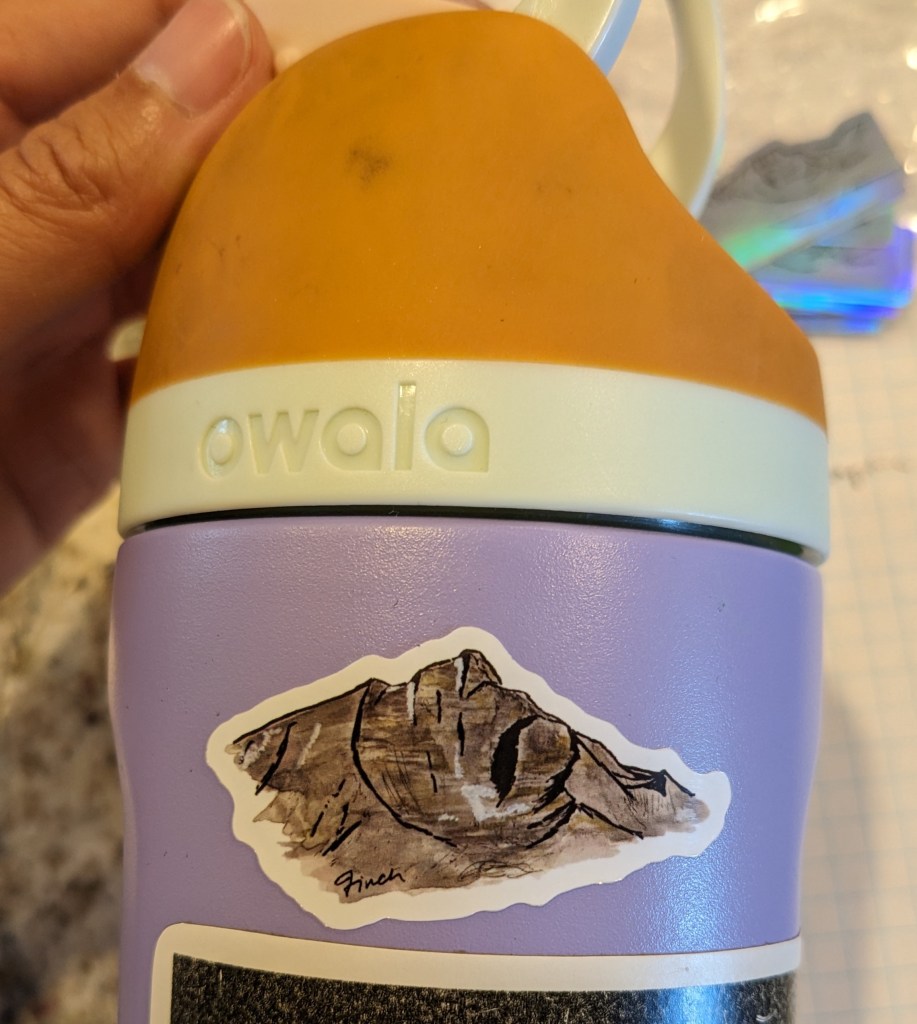
I also made some stickers of my art! Which is so fun!
My front door is not completely airtight. I tried getting some foam strips to put inside the doorframe, but then I couldn’t close the door. I thought about, and started, a crochet tube that I could hang on the hinges to block the most air from getting in…
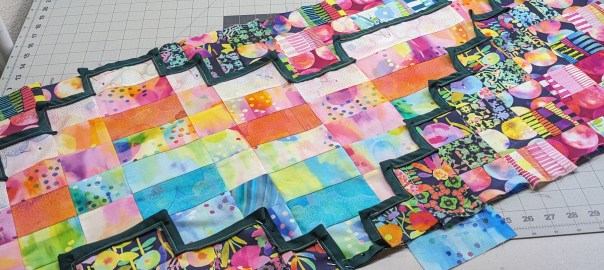
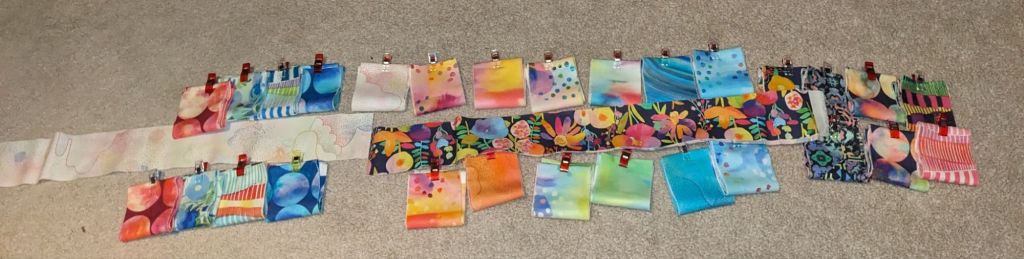
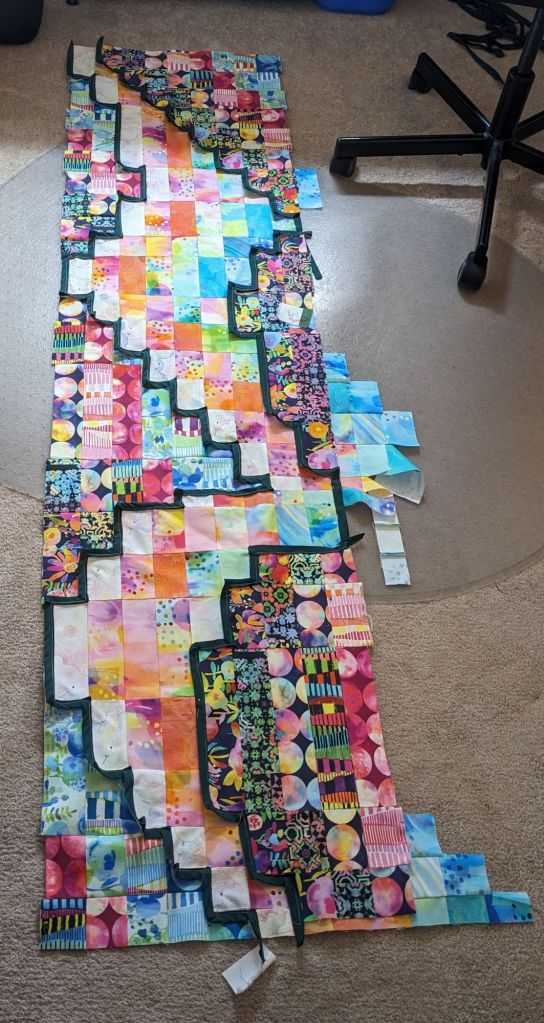
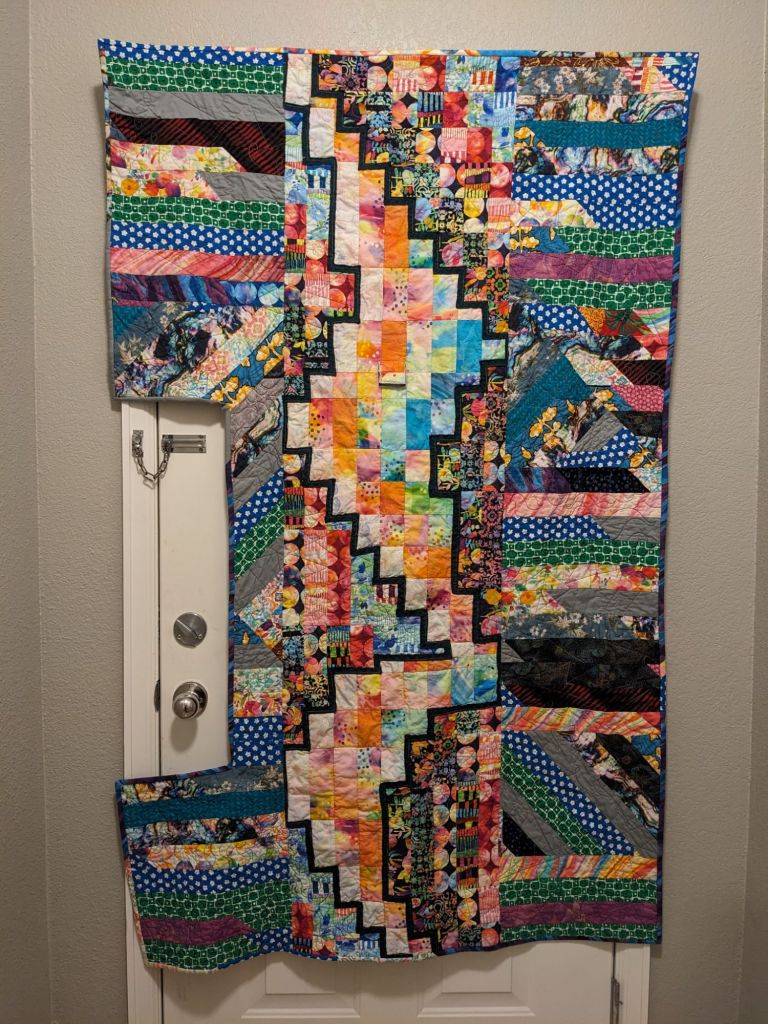
But in the end, I decided a quilt that could cover most of the frame/door gap would be the most effective, most fun, and most aesthetically pleasing. I had a jelly roll from Moda Fabrics and decided to do a bargello-ish quilt. I wanted to depict a quarter rest, since I am a musician and I want my home to be a place of rest. A place between all the noise and chaos and effort-giving to rest, restore, relax.
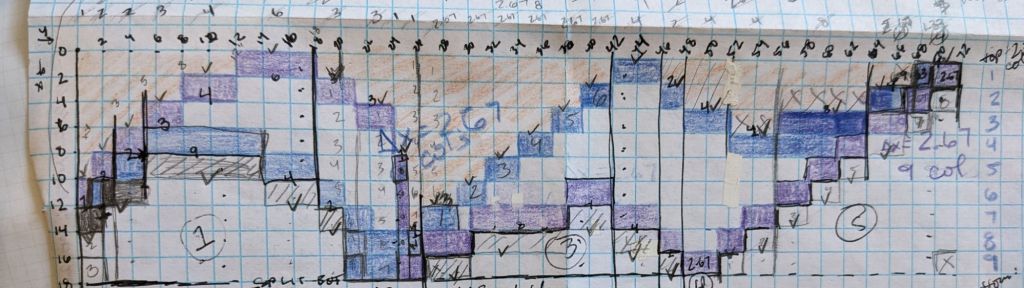
I sketched out the shape on graph paper and determined the widths of the strip sets. I used two “leading edges”, one for the left side of the rest (white) and one for the left side of the background that bounds the rest (dark flowers). I used lighter and less busy prints for inside the rest, and the darker and busy prints for the background.
The blue and purple edges are the rest, so the top edge in the picture is the left edge of the rest, and the gray blocks below the bottom edge are the background stripsRest fabric in the middle, with the busy background fabrics to both sides
As with a normal bargello, I assembled the strip sets and then cut them to the corresponding widths. The jelly roll didn’t have duplicates of all the fabrics, so I alternated the ones that didn’t have exact matches. Then I pressed the seams to alternate, and sewed the strip sets back together.
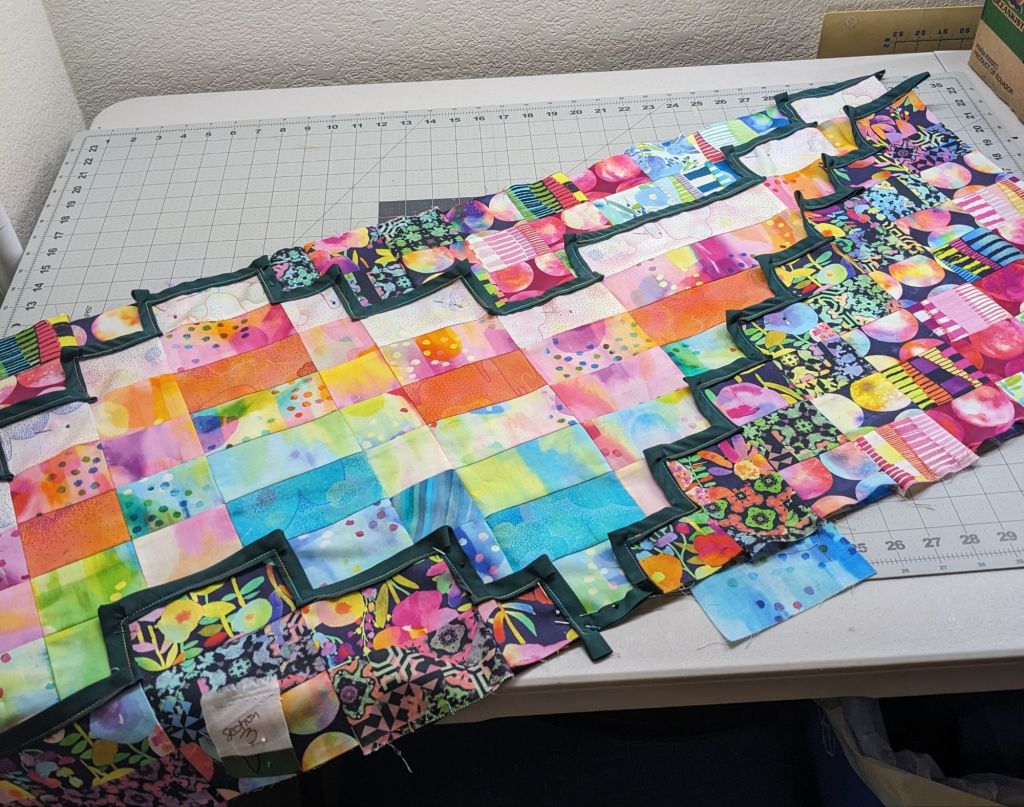
After some consideration, especially using a black and white filter on my camera, I decided the edges of the rest needed a tiny border to really make it stand out. I attached a strip of dark green as if it was bias tape, sealing the raw edges of the strip sets inside. Then I appliqued the background onto the right side of the rest, ripped off the unneeded background, and appliqued the rest into the extra background.
Pinned and ready to be appliqued – I used dark green thread and went right over the dark green stripsYou can see the excess strips from the “rest” bargello portion sticking out on the right side
So that was the rest part, the middle part, done. I still needed two sides to make the quilt large enough. I cut a bunch of 2.5″ strips out of scraps and did a “jelly roll race” type of construction to make a big panel of stripes. Seeing as this area was meant to be busy and chaotic, I cut the panel and re-sewed it together on an angle a couple times. Then I split the panel in two for the two sides, and sewed them onto the middle rest panel.
Then it was time to quilt! I did my most confident free motion motifs: loops, “toothpaste”, and abstract geometric, and switched thread throughout. I liked just doing some freeform, unstructured quilting and filling the space with whatever I wanted. For the rest, I did free motion stitch in the ditch because I needed to change angles often and didn’t want to deal with moving the whole quilt 90 degrees every few inches.
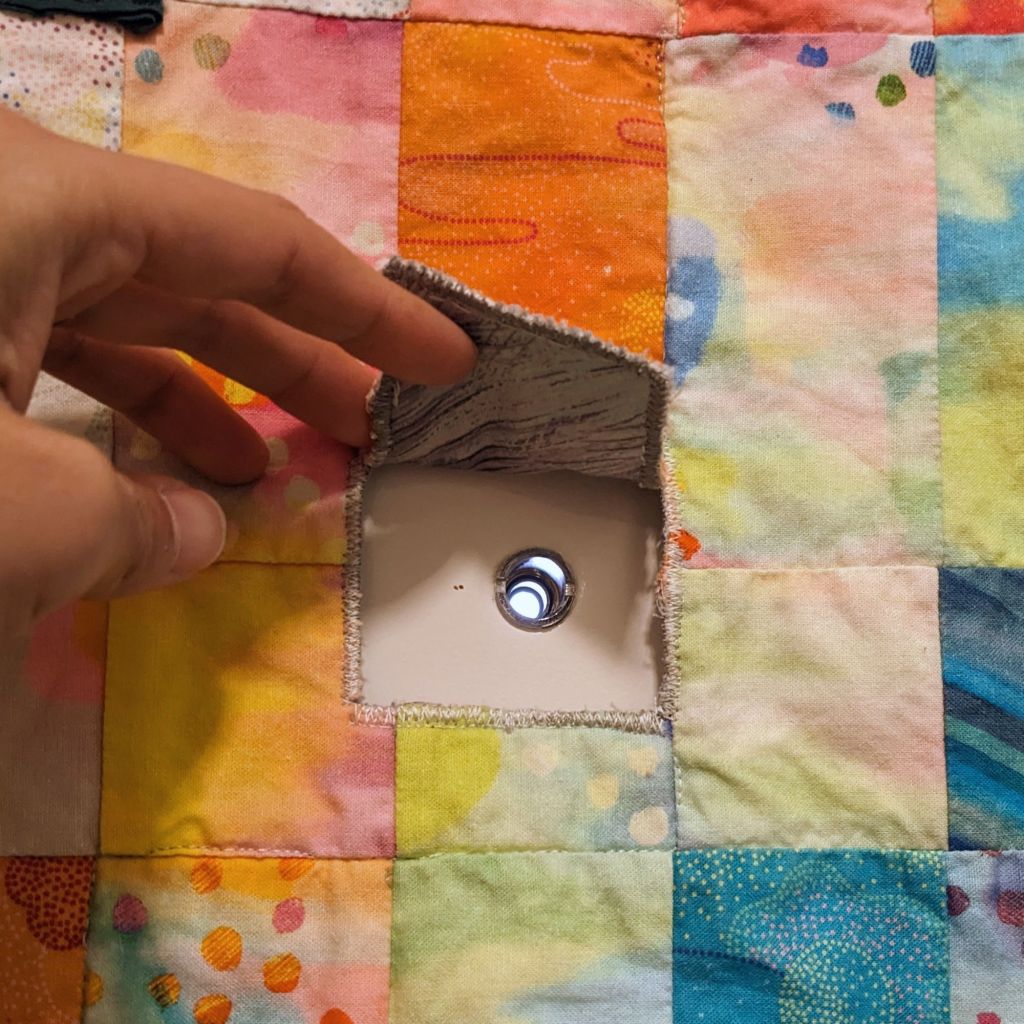
I had to do two nerve wracking cutouts – one for the door handle and chain, and another for the peephole. I measured multiple times and then bravely cut once. 🙂
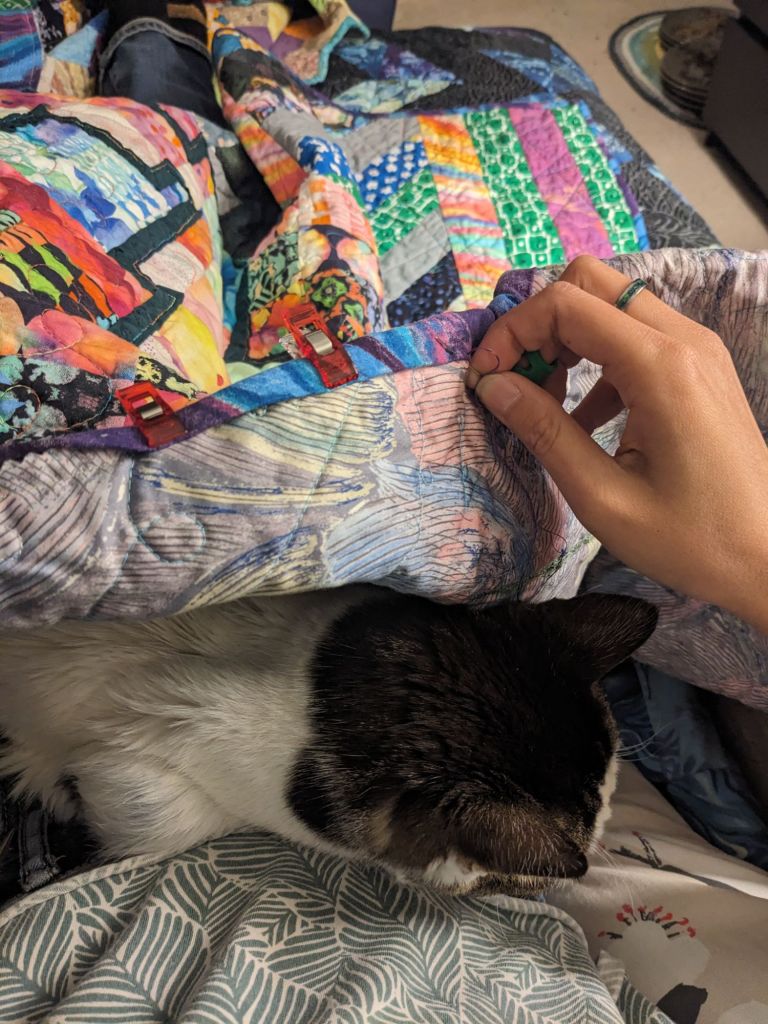
Peephole cutout 🙂 so strange to take the scissors to a finished quiltHand sewing the binding to the back with the friendly helper
To affix the quilt to the door, I made a little frame out of wooden yardsticks (my quilt hanging devices of choice) and screwed it into the door. I used fabric loops to hang the quilt on the frame. And thus, it was done, ready for the tail end of this winter and many winters to come.
For the longest time…. I have wanted to do a Missouri Star quilt. And finally, I have. I used the pattern from the Block of the Month, although I did figure out halfway through that I could have done it an easier way (less cuts), but it was fine. I wanted to do something bright and colorful to hang up in my bedroom.
Pressing my triangles and squares open
Squaring up my blocks – I like to trim my half-square triangles while they’re still a triangle, since it’s two cuts instead of the four I’d have to do if I ironed them open first. Squaring blocks is so tedious but it does make for an easier, flatter, and better finish. All the blocks are the same size, so they fit together the way they’re supposed to, no crookedness or extra fabric.
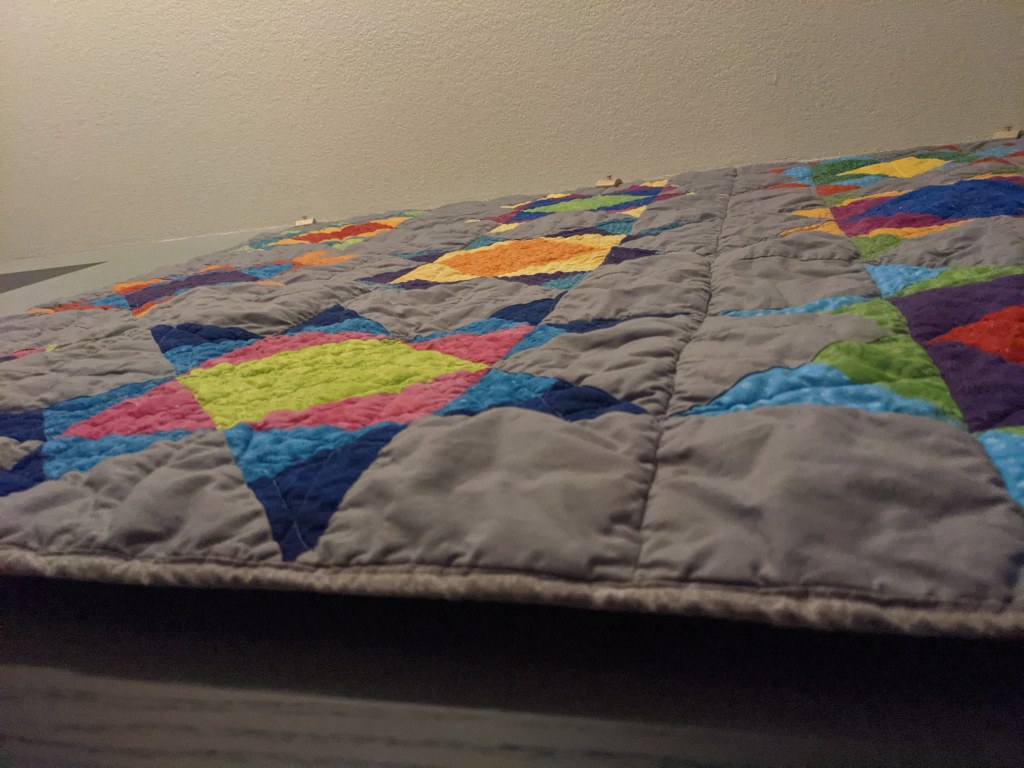
I did my normal stitch in the ditch for all of the vertical seams, and then did free motion quilting in each of the stars. In my layout, I put similarly-colored center squares across the quilt from each other, so I decided the do the same with my free motion designs. I did a radial pattern for the red center stars, an echo in the center for the dark center stars, an outside echo for the yellow center stars, my “abstract” design with straight lines bouncing around for the green center stars, and then a full echo swirl from the outside to the center for the center star.
I used the foot as an approximate guide to follow the outline of the star, and then follow that line, and then follow that one…. all the way to the middle. 🙂 As I got closer to the middle, I started making the space between the lines wider. You’ll see me fix a broken thread a few times in there. Anticipating those threads is why I sew with the end of my machine open now, since it’s easier to retrieve the broken thread.
As I expressed in my last post with the Plant Wall Hanging, I think I’m still moving too fast with my free motion quilting, which causes the thread to fray and then break. I had that happen less often with this quilt, since I was keeping it in mind, but it was still happening. I think it’s a combination of moving too fast and not moving at a consistent speed, which I want to work on with my next quilt.
I used hangers from The HangUps CompanyView looking up at it from my pillow 🙂
Overall, I’m really happy with how it turned out. I love the Missouri Star block and I have wanted a quilt like this for a while. I made 10 stars and used one as the label for the back. As usual, I hand sewed my label on. I like having that time under the quilt as it’s in progress – a sneak peek of what it will turn into. The backing is a purple flannel which did not hold up that well in the wash, but I didn’t worry about it since it’s a wall hanging anyway. 🙂
Completed March 2021.
Print: Wilmington Essentials – Magic Colors by Wilmington Prints
Background: Kona Cotton – Medium Grey by Robert Kaufman Fabrics
Binding: Wilmington Essentials – Crackle Stone by Wilmington Prints
Backing: Comfy Flannel – Tossed Unicorns Purple by A E Nathan Co INC
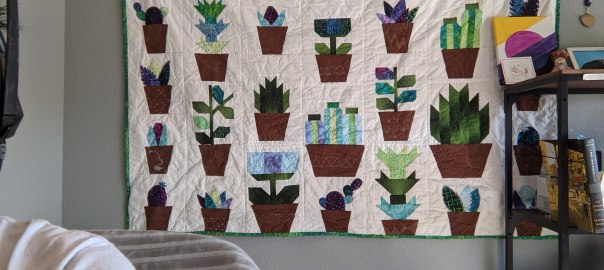
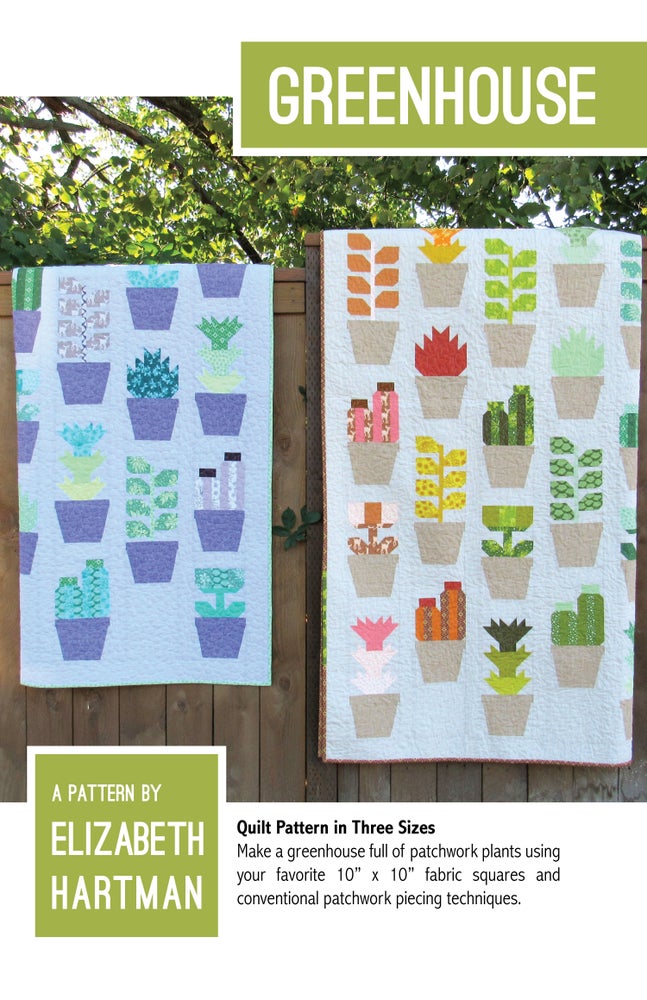
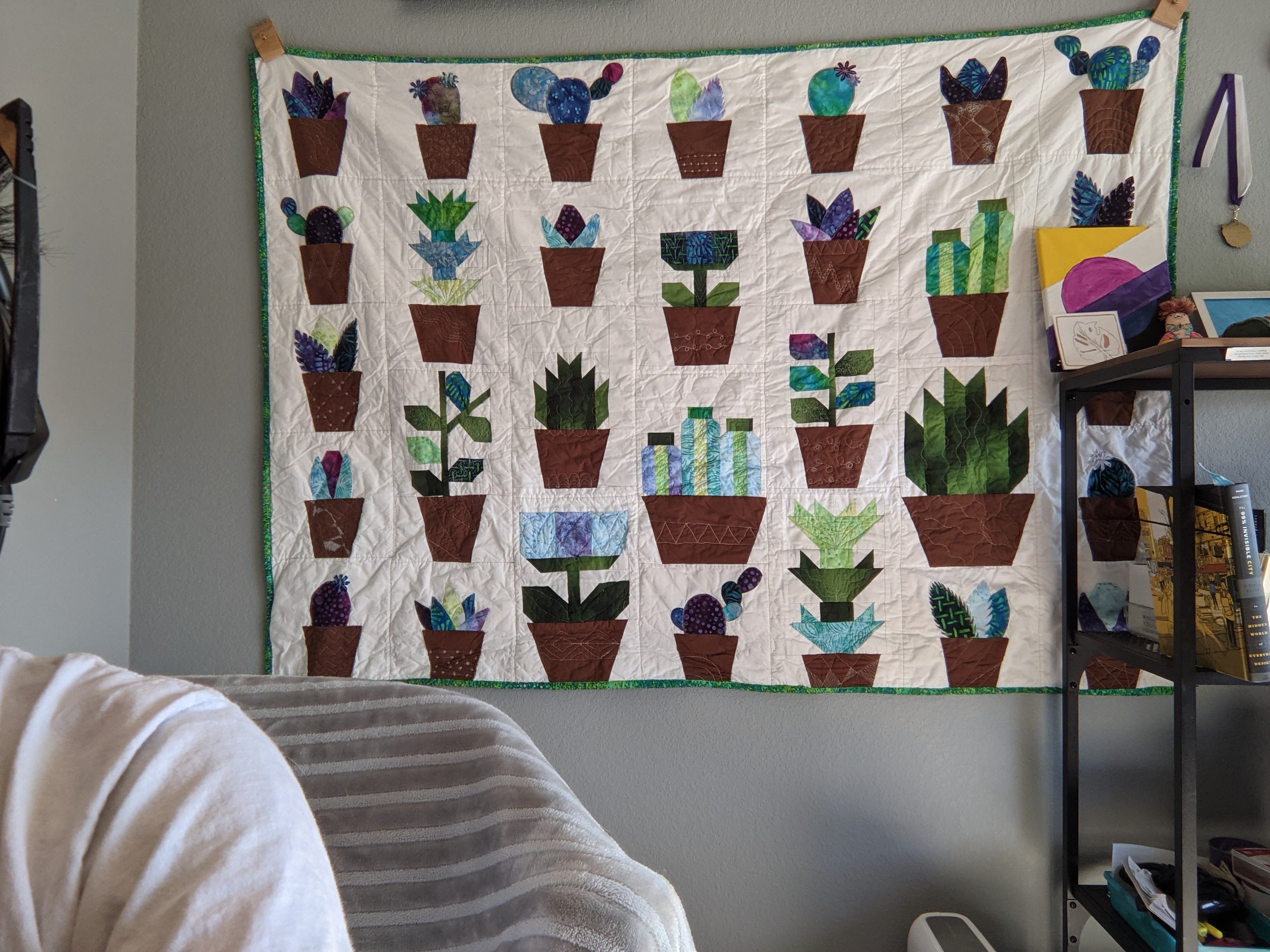
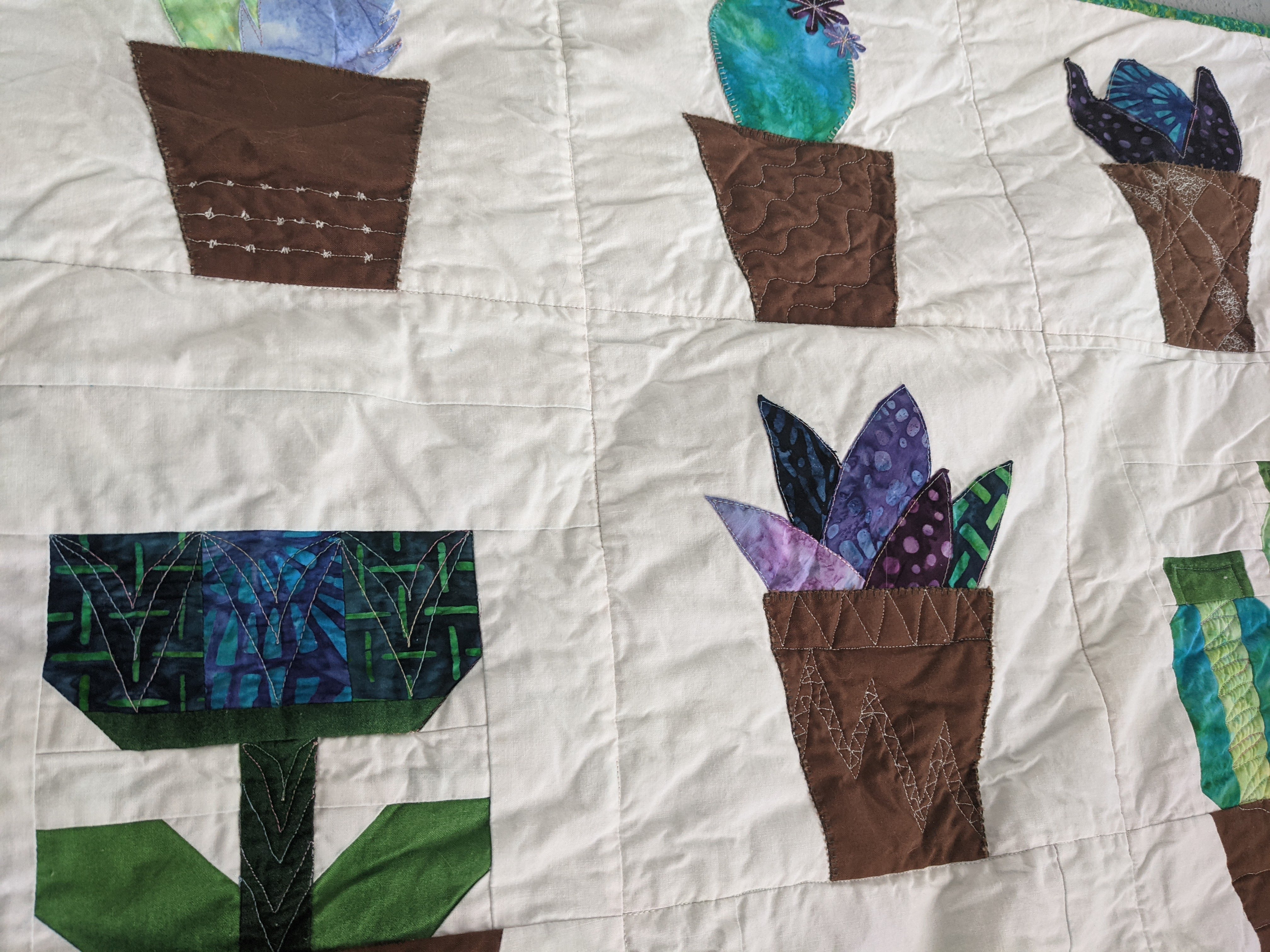
So I’m a big plant person. I love plants. I have had an ongoing collection of succulents for a couple years, and last summer my cousin (who I made the memory quilt for) gifted me a bunch of mature houseplants like pothos, monstera, and colocasia. So I’ve wanted to do a plant quilt for a long time, and I actually bought half the supplies I needed for this quilt in early 2020. At that time, I was planning on doing the entirety of Elizabeth Hartman’s “Greenhouse Quilt”. Hartman creates incredible patterns of actual animals and objects, all pieced, not applique. This means there’s a lot of cutting itty bitty pieces of fabric, sewing itty bitty pieces of fabric… and a lot of mental effort to stay organized and on track. I had done one block of hers a while ago as a pillow, and used one of the plant blocks as a bag for a friend (below).
Flower block from Elizabeth Hartman
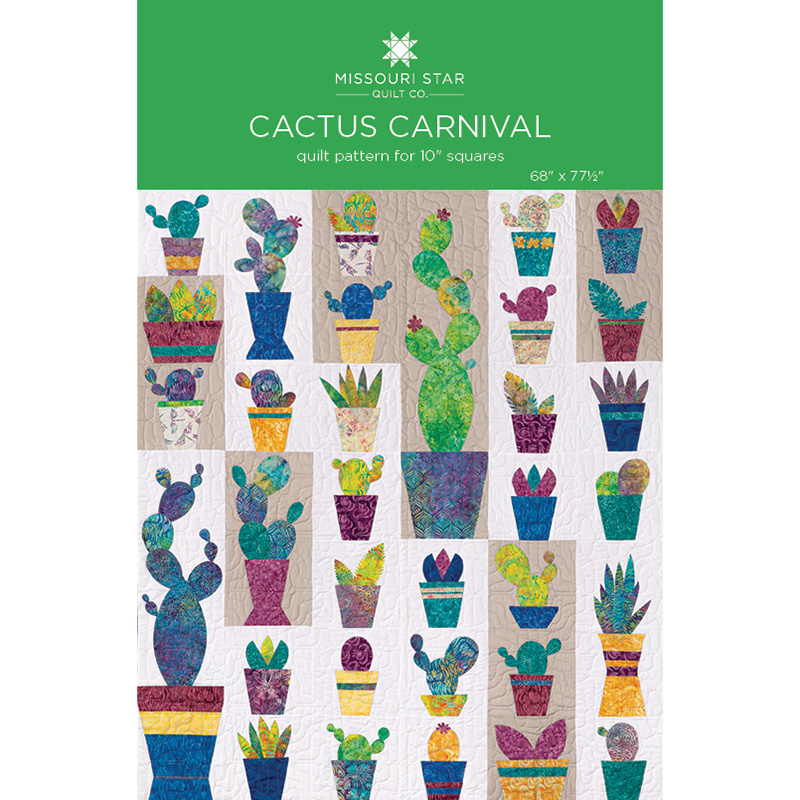
And then I saw MSQC’s “Cactus Carnival”, which is applique, and I knew I could combine both these patterns to create something that wasn’t too hard, and had hard angles and soft curves.
I attempted to standardize the sizes of the blocks, since MSQC’s pattern has a 10″ block, and Hartman’s pattern is based on a 6.5″ wide block with varying heights. I ended up adding borders to the Hartman blocks to make them 10″ wide and 15″ tall, so they could work in columns with the MSQC blocks.
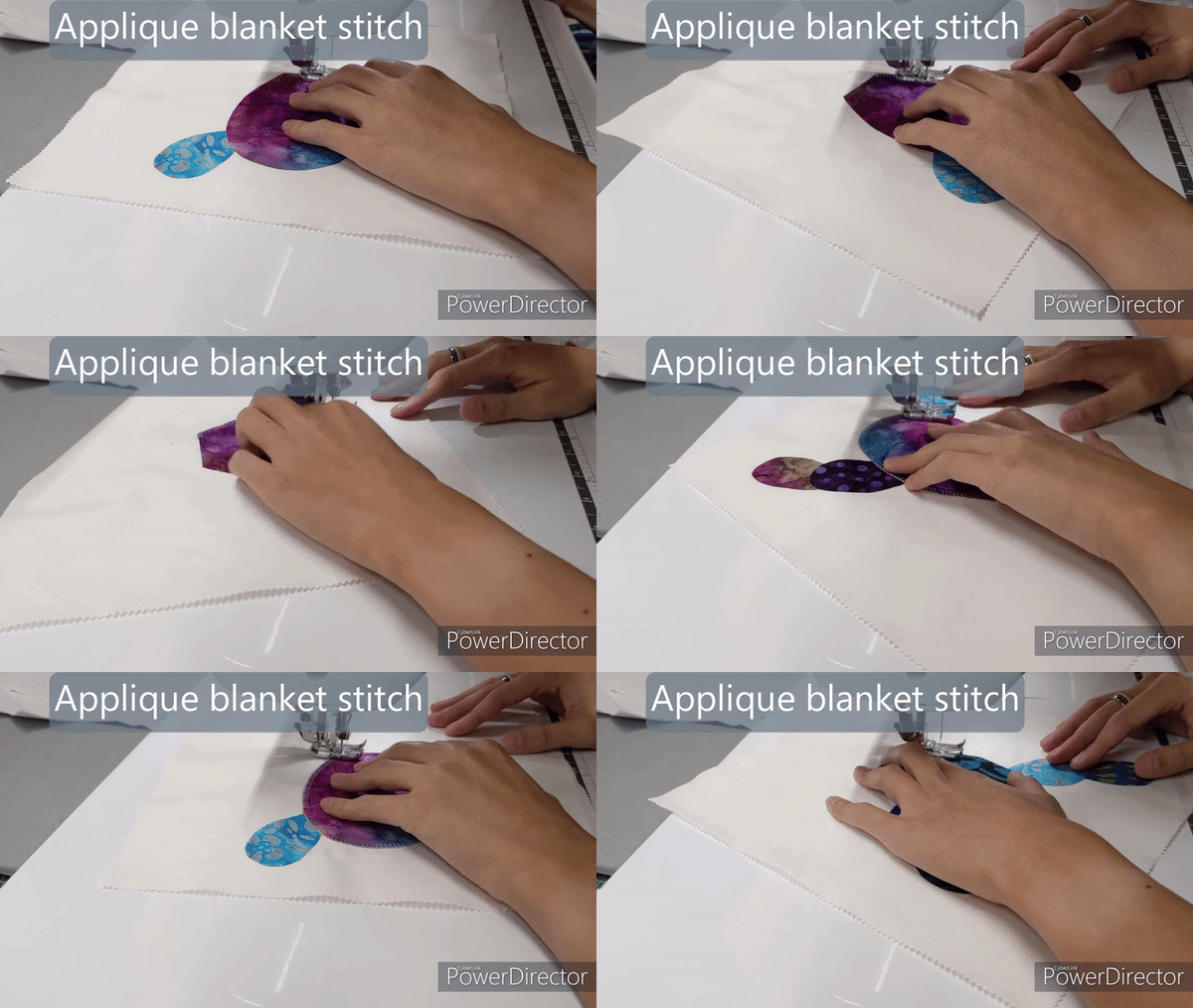
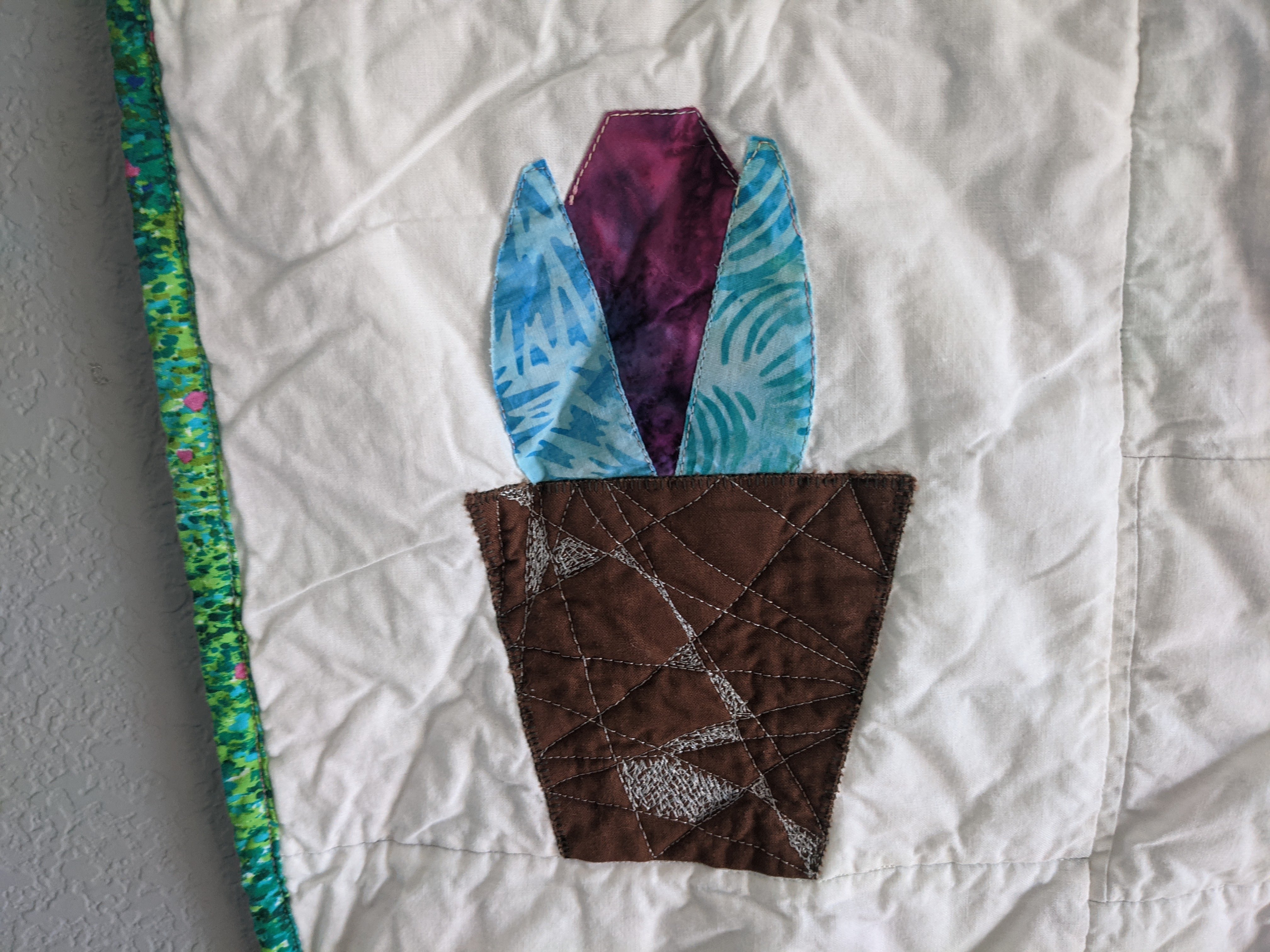
I made four blocks of each of the five general plants from MSQC, and used Heat N Bond for all the applique, which ended up going a lot faster than anticipated. I used my rainbow variegated thread (kind of my favorite thread, let’s be honest I’ve used it for probably half my projects) to outline all my applique’d plants with blanket stitch. I didn’t even have to use Heat N Bond for the pot pieces, and laid those gently on top of my applique’d plants.
I’m only applique-ing the plant pieces here, the pot was a placeholder because the fabric hadn’t come in yetHere I’m going around the main piece, but I come back later to go around every piece. The Heat N Bond doesn’t stay sticky through the washer and dryer, so you have to secure the pieces in another way.
Then I made two versions of each Hartman block – a standard size and an enlarged size. I used the normal pattern for the standard size block, and adjusted the plant to be 8″-9″ for the enlarged size block. The whole time I was kind of stressing because I didn’t think I had enough background fabric to all the blocks, but it ended up totally fine!
I put all the blocks together in a landscape orientation, which is kind of different for quilts! But I intended this to be a wall hanging in my room, behind where I Zoom/video chat from, so that it could be my background! So I arranged my blocks and sewed them together in columns. My first pass of quilting was just straight lines, stitch in the ditch up and down the columns, and then across horizontally.
Then, I did free motion quilting on the pots! I started off using this white thread I got, but it kept breaking, so then I switched to a shiny gray that I’ve had for a while, and that kept breaking too… Finally I figured out the problem was the needle! But that kind of just made the problem happen less often.
[Future Finch, who is writing this post, has completed the Plant Quilt and is working on the next quilt and running into the same problem while free motion quilting. I am now convinced that it’s because I was pushing the quilt through the machine too fast, which pulls the thread too tight and then it snaps. I have been working on slowing down and having patience, which is difficult! The machine is running very fast, so it’s kind of loud and the needle is moving quickly, but I have to move slowly and steadily. I’ve gotten to the point where it’s happening even less often than during the pots, but I’m still working too fast. I don’t know if I want to turn up the machine speed, although I think that could help. It just stresses me out because it’s so loud, which makes me go faster.]
But I persevered through my mistakes and the pots ended up so fun. I had six different “motifs”: swirls, abstract, wavy, rainbow, zigzag, and dots. Each pot, I rolled a die to decide which motif I’d use – as long as it wasn’t the same as the pot I just did or any adjacent pots. It was so fun to vamp on different motifs and find new ways to represent them. It was nice to not have to come up with an entirely new idea, but just a new take on the same motifs. So it was fun to do and fun to look at 🙂
As I was finishing up, I wasn’t sure if it needed more quilting or if I should quit while I was ahead. The applique plants and pots had their own blanket stitch outlines, and the pots had the FMQ, but the Hartman blocks were kind of empty. I called a friend and we decided that I should do limited quilting on the Hartman plants so they blended in with the whole quilt. I matched the designs between the standard and enlarged blocks, so the small cactus has the same quilting as the large catcus, etc. I think it really brought everything together! Last up was the binding and putting it through the washer and dryer. Since I found them at Target, I throw in a “color catcher” sheet with all my new quilts (and some of my more brightly colored clothes), which did come out a gray-ish green.
And now it’s hanging up behind my desk, courtesy of some quilt hanging clips my parents got me for Christmas a couple years ago. 🙂
Project completed February 11, 2021.
Colorful plant pieces: Artisan Batiks – Aviva by Lunn Studios for Robert Kaufman
Ombre Green: Wilmington Essentials – Ombre Washart Forest by Wilmington Prints
Brown pots: Bella Solids – Earth by Moda Fabrics
White background: Kona Cotton – Snow by Robert Kaufman Fabrics
Backing and binding: Painterly Petals – Textures Mint by Studio RK for Robert Kaufman
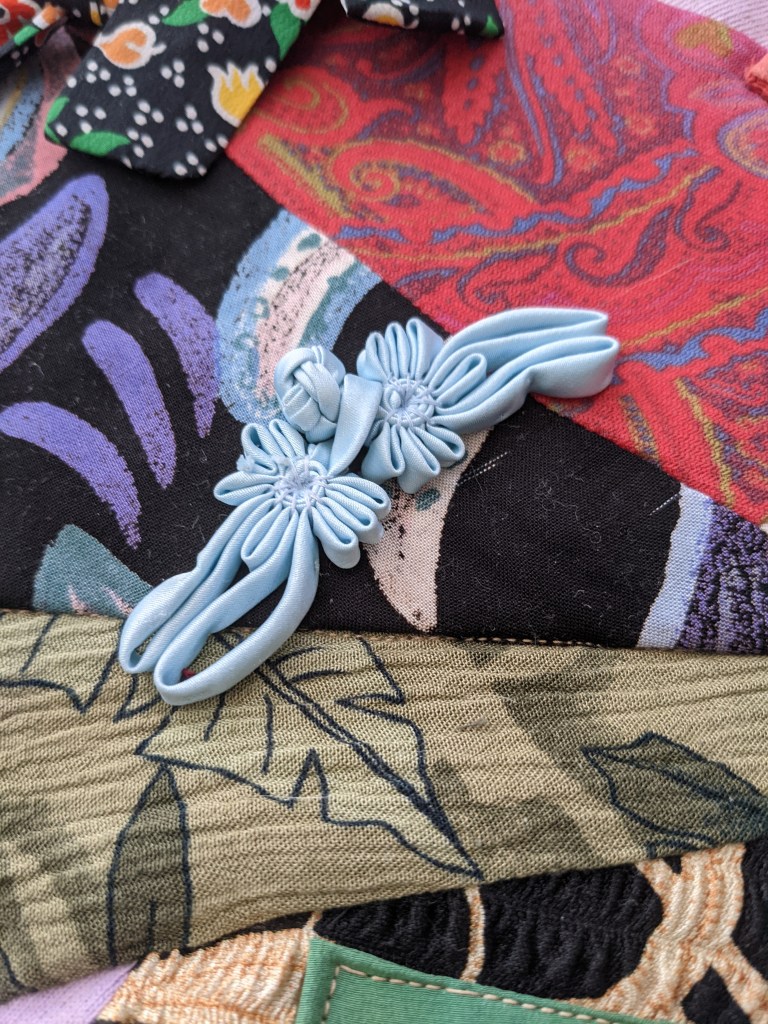
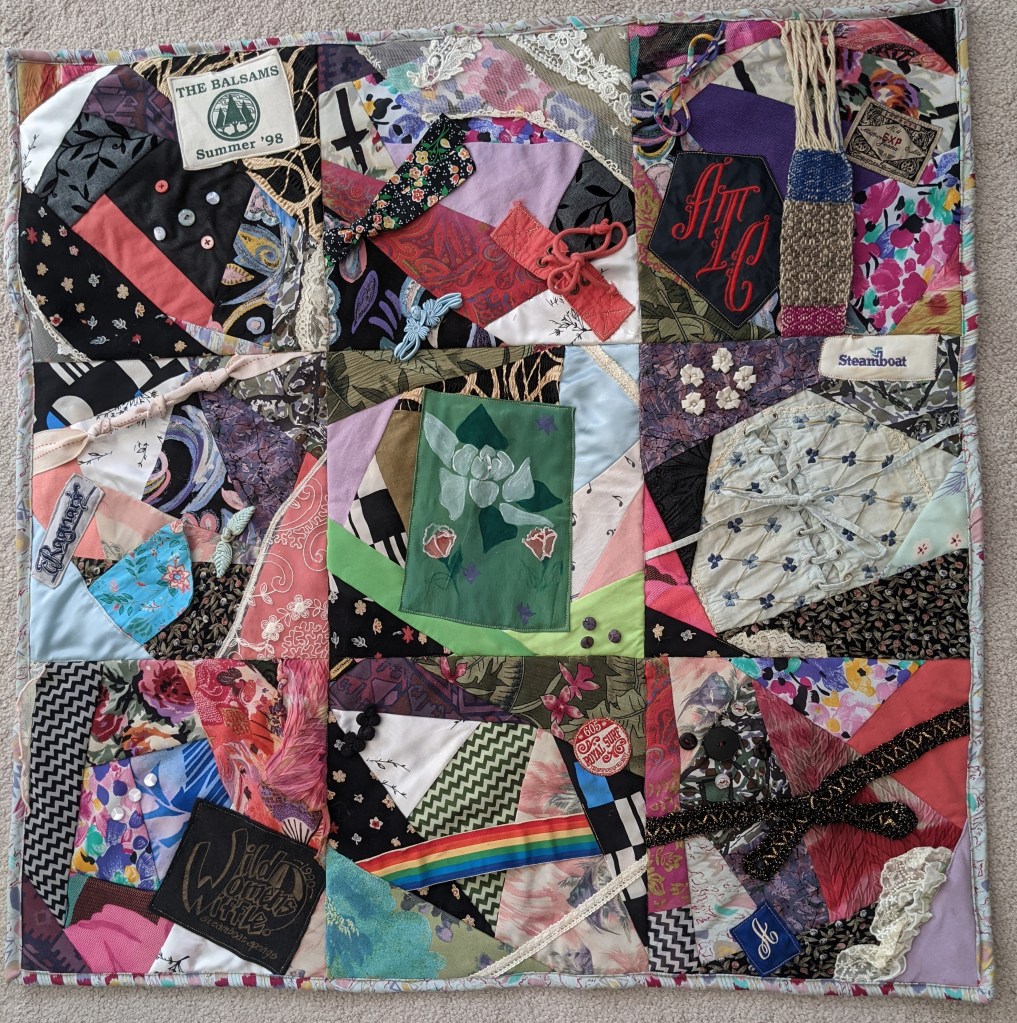
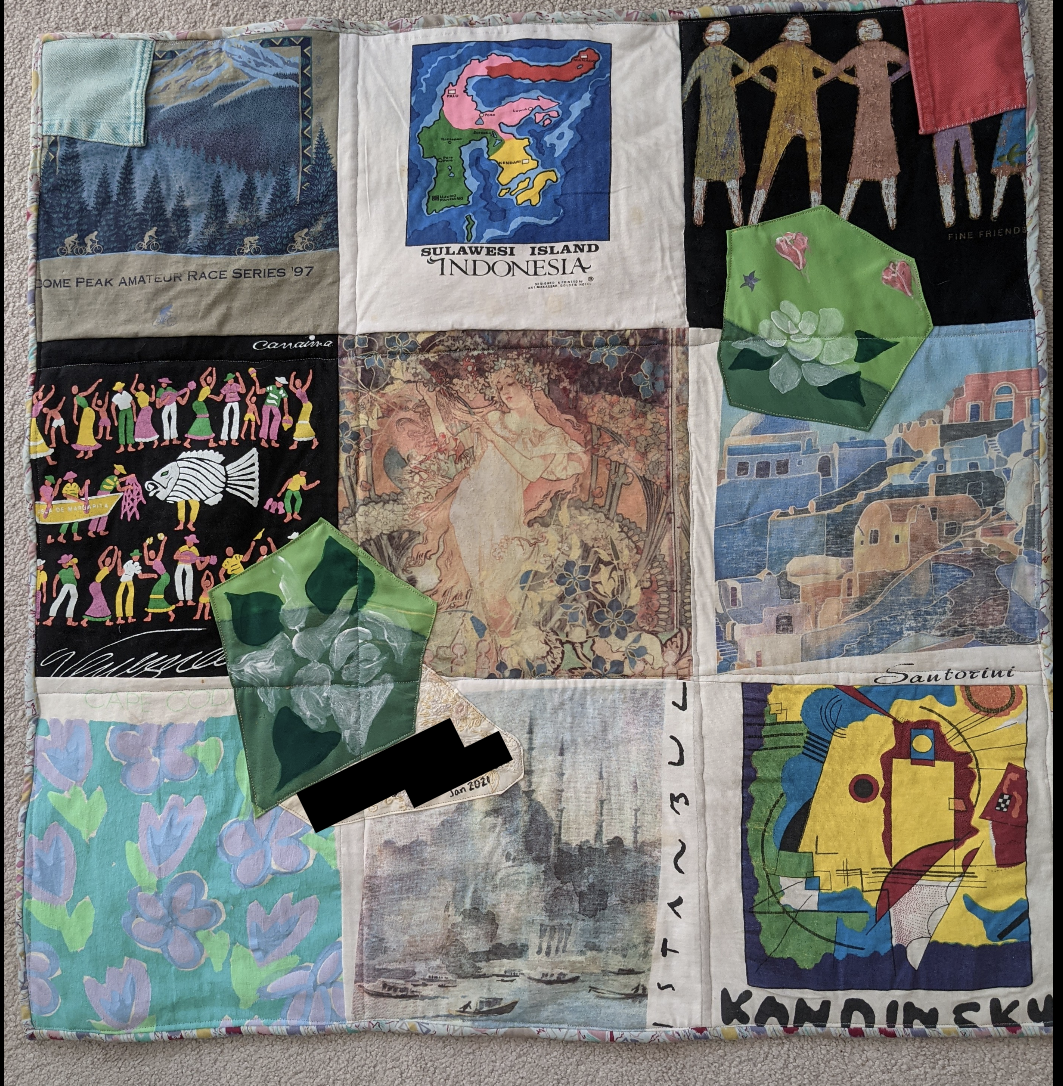
This memory quilt for my cousin was my other big project of 2020, finished in this first month of 2021. My cousin provided her mother’s clothes, which are incredibly fun and colorful. I knew I wanted to do a crazy quilt for my cousin, since she didn’t want something too big, and her mom’s clothes are truly too fun to do something simple with.
First, I inventoried all the fabric and cut off buttons and fasteners and other 3d elements I wanted to include. I chose a 3×3 layout for the back of 9 graphic t-shirts, and figured I’d do the crazy-pieced blocks to match on the front. Through the process, the front blocks ended up a bit smaller but it wasn’t a big deal.
For the piecing, I cut pieces with an uneven number of sides (a tip from the museum employee) for the center piece. Then I added on new fabric to each side, and continued until it was the right size. Since a lot of the fabric was stretchy and textured itself, I used some scrap fabric behind the block to stabilize everything.
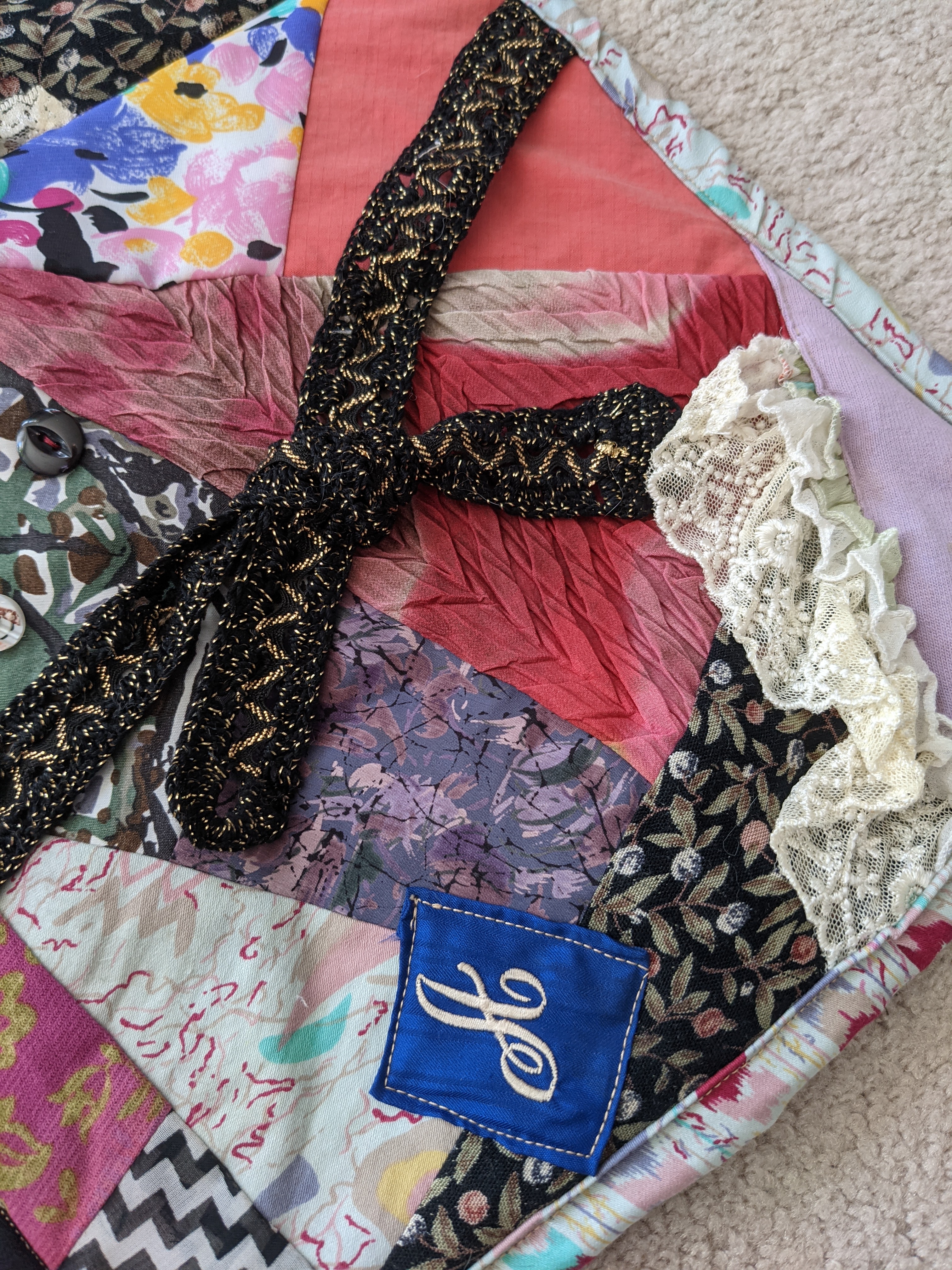
I chose some logos to applique, just like my other memory quilt. I appliqued them on the blocks, prior to piecing the 9 blocks together. At this point I also added some lace, belts/scarves, and other ties by machine.
Black and gold belt, some lace, and appliqued logo
Then I pieced it together because I wanted to add the buttons and fasteners between some blocks. I added the buttons and such by hand, since they’re a bit fiddly on the machine.
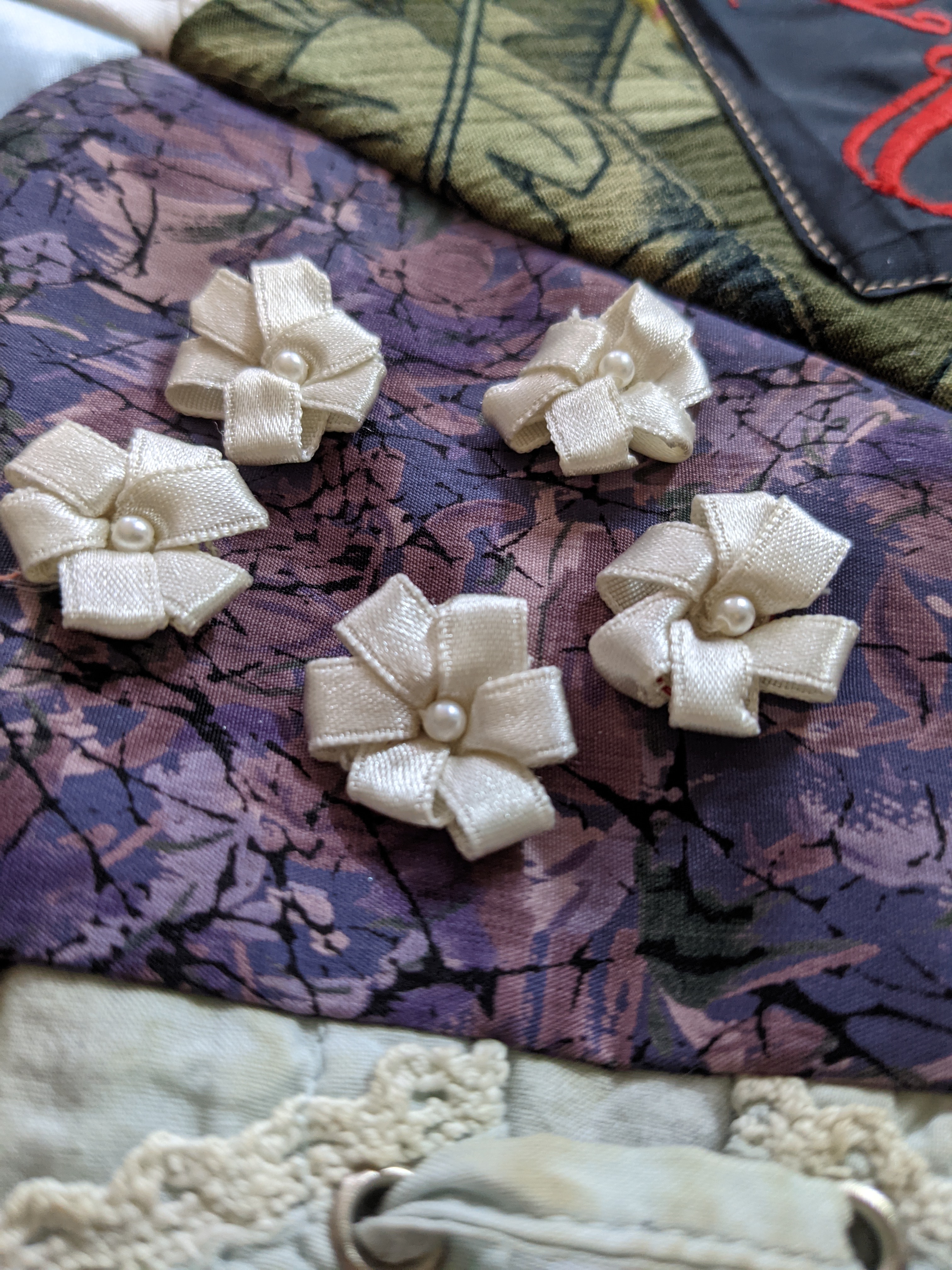
These were the buttons of the shirt seen in the background of the picture below 🙂These ribbon flowers were already part of a sweater, so I extracted them from the sweater and sewed them on! Cute little fastener from the leg of pajama pants
My cousin wanted to feature her mom’s beautifully hand painted wedding dress, so I appliqued one of the main flowers on the middle block and on the back of the quilt. I did simple stitch in the ditch quilting, since the top was already very busy.
I used jean pants pockets to allow my cousin to hang up the quilt if she ever chooses.
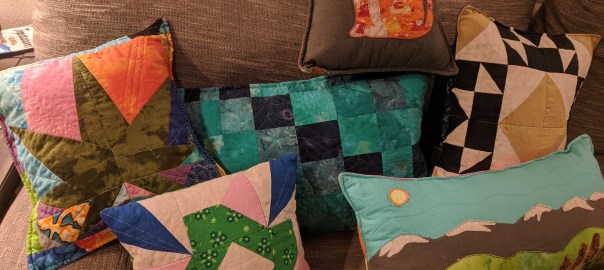
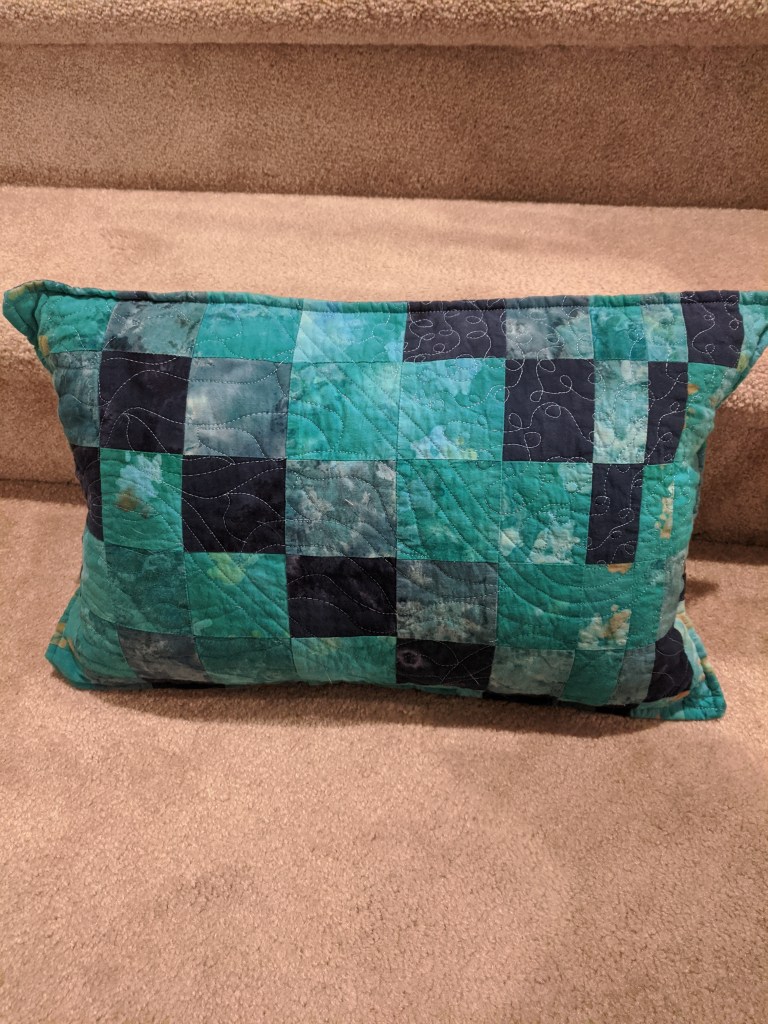
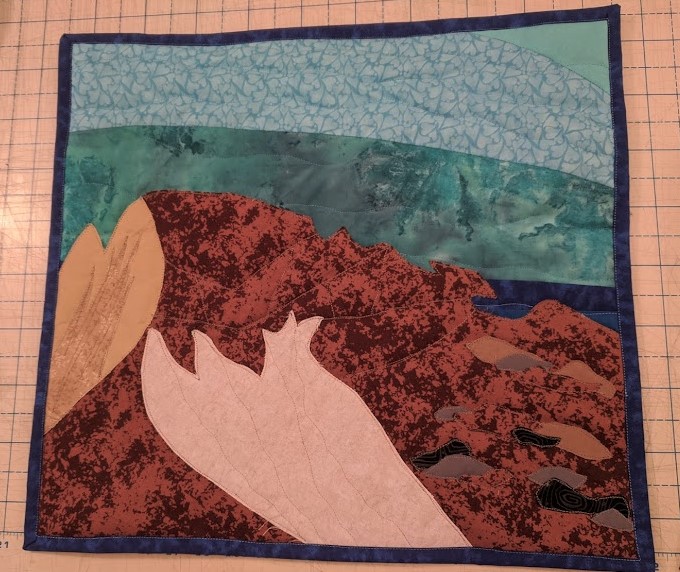
This year I did a bunch of little pillow projects for my friends and family 🙂 I got to learn some different techniques like fusible applique and paper piecing. I used lots of different fat quarters from Joann and scraps from previous projects. I generally used envelope backs and a little label to keep them closed. I stuffed them with some extra stuffing I had from pillows I’d bought previously, unfortunately none of them finished at a normal pillow form size.
My third big quilt! With the puffy batting I mentioned in the rainbow bargello post. This quilt is based on the MSQC “Night Sky” pattern, but I changed the dimensions a bit to make it rectangular and added more borders.
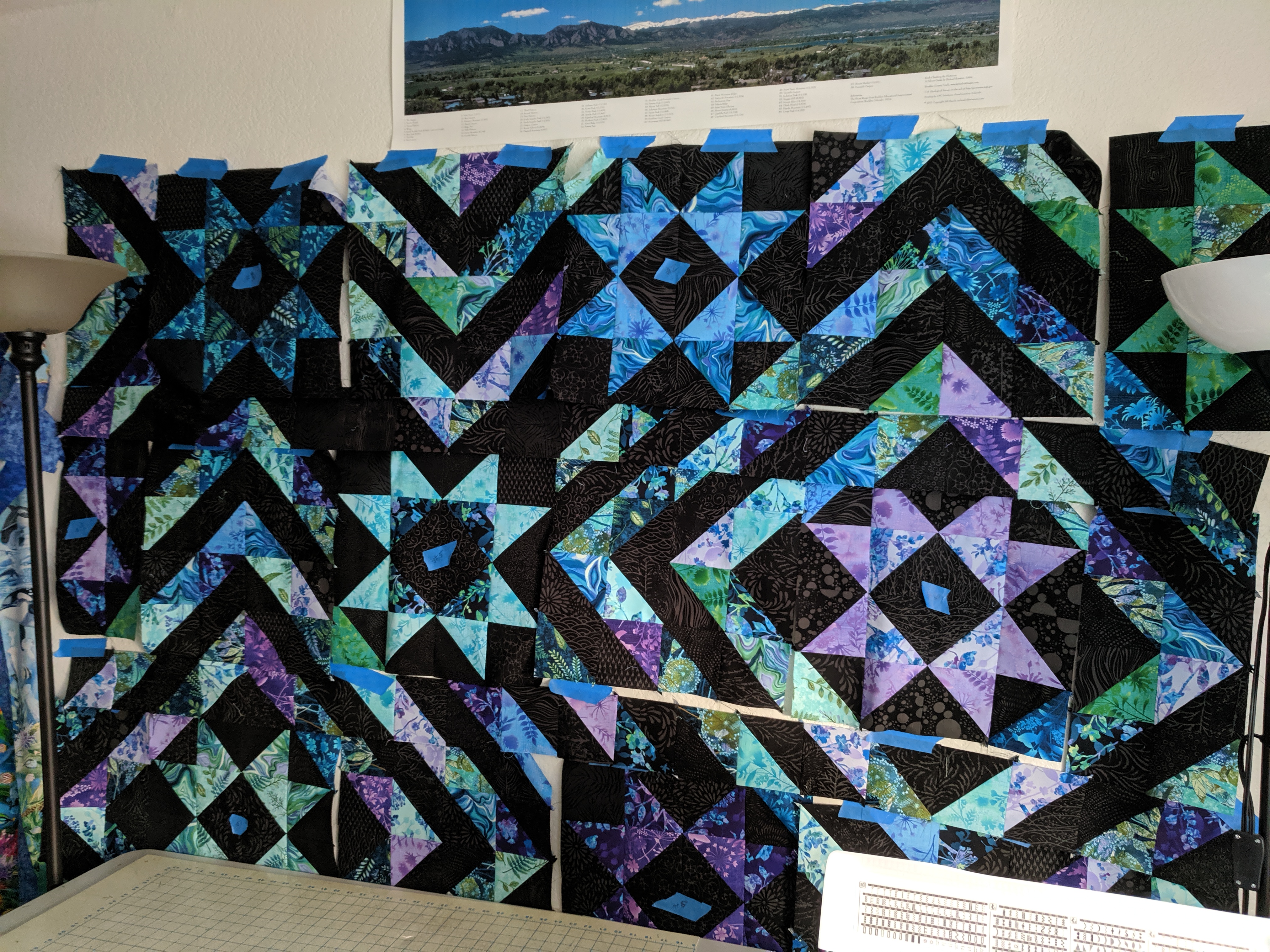
Taped up and planned on the wall
I bought two layer cakes (10″x10″ squares), one in Black Beauty Batik (hand printed high thread count cotton) and one in this whimsical Feather and Flora line from Studio E, and the backing is the Wildflower Toss Eggplant. I had bought the batiks for a different project that I didn’t end up doing, but I think they look great here. I love the black background to go with the stars 🙂 plus I was able to use the magic 8 method that grants you 8 HSTs from two 10″ squares and I didn’t have to cut as much fabric.
I made all the HSTs and squared them to 4.5″. I decided I wanted the insides of the star to be a different pattern than the outside points, like in the original pattern, and then the borders would be scrappy and random. I made a few stars and then figured out how many I would need to make the quilt big enough for my bed. It didn’t quite work, but I went with a general design that would be close enough and then I could add borders to increase the dimensions.
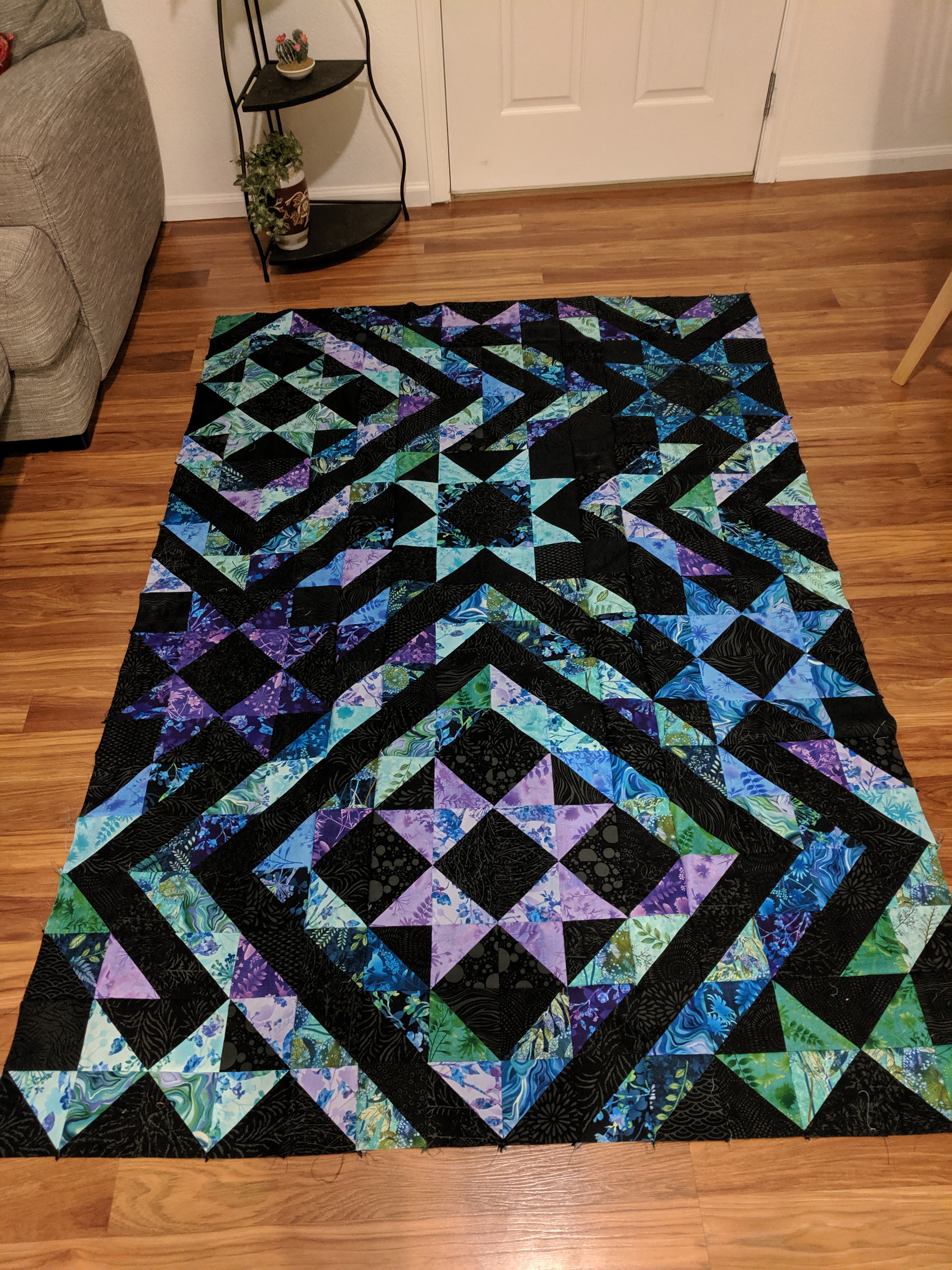
Top without borders – a bit more chaotic than I planned, but I really like it.
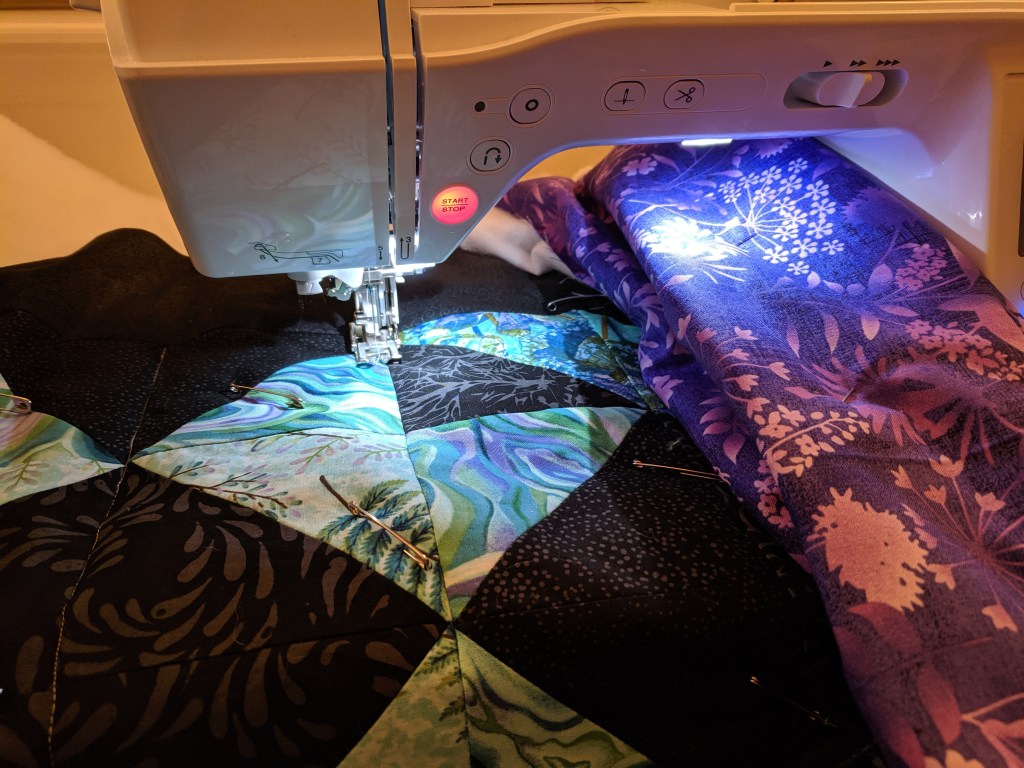
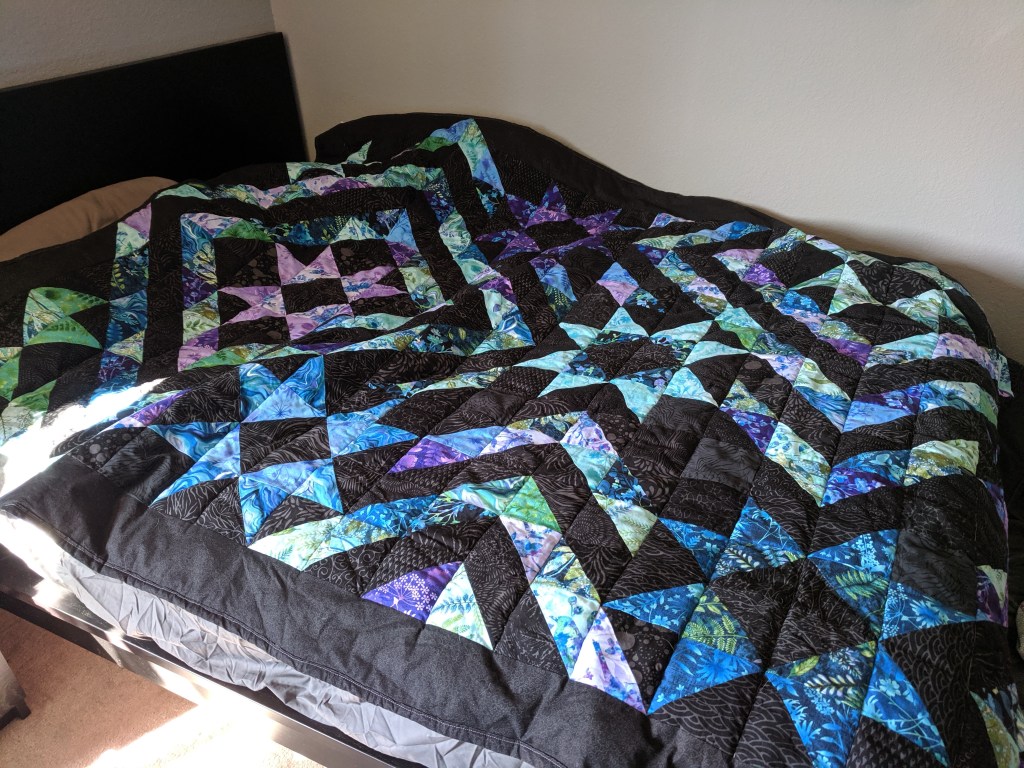
It kind of reminds me of ripples on a smooth pond, if you had dropped the stars in. I really wanted to take advantage of the new puffy batting I got, so I decided to quilt it in horizontal lines with my walking foot, which ended up being stitch in the ditch.
Working on SITD – on the right you see the folded up quilt that I will move to next
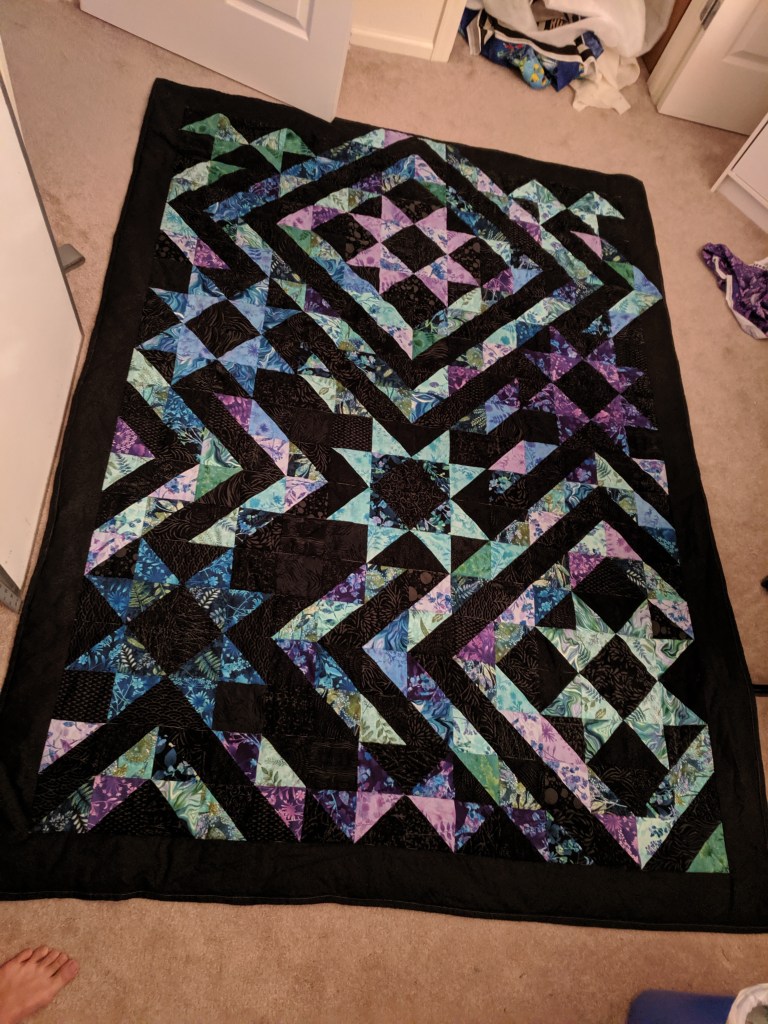
All done! I like it much better with the border
Time check: 5.5 hours to:
Cut fabric for binding (9) 2.5″ strips
Cut fabric for border (6) 4.5″ strips
Sew binding together to make one long strip
Press binding seams open
Iron binding in half hotdog style
Make HSTs for border and sew into border at correct measurements
Sew entire border on
Iron backing fabric
Cut backing fabric and sew middle seam
Iron backing seam and quilt top border seams
Baste quilt sandwich
Stitch in the ditch on all horizontal gridlines using walking foot
Sew binding to back
Sew binding to front
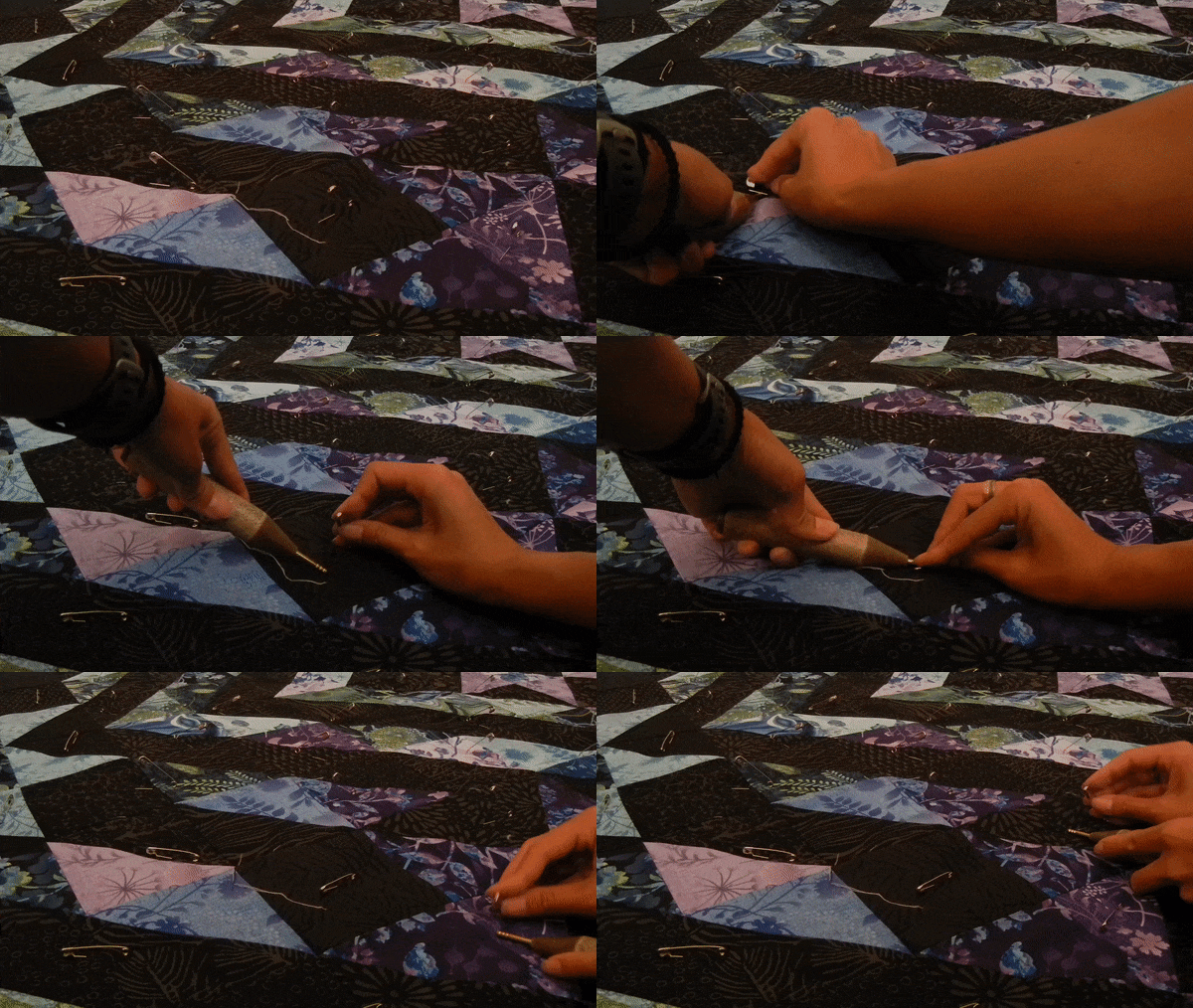
~5min, 16X: laying out quilt sandwich and starting to basteReal time: closing safety pins with Kwik Klip~1min, 4X: stitching in the ditch with walking foot. On the right, see the folded up quilt in the throat.~2min, 8X: putting binding on and turning corner (sealing sandwich together)On the bed 🙂 the rainbow bargello is on the couch now
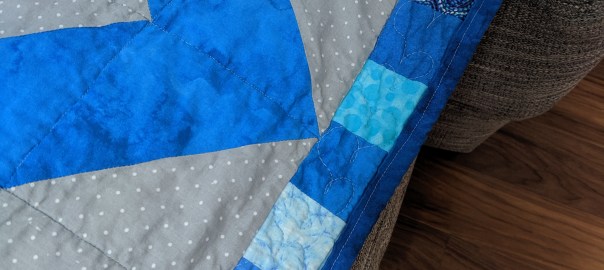
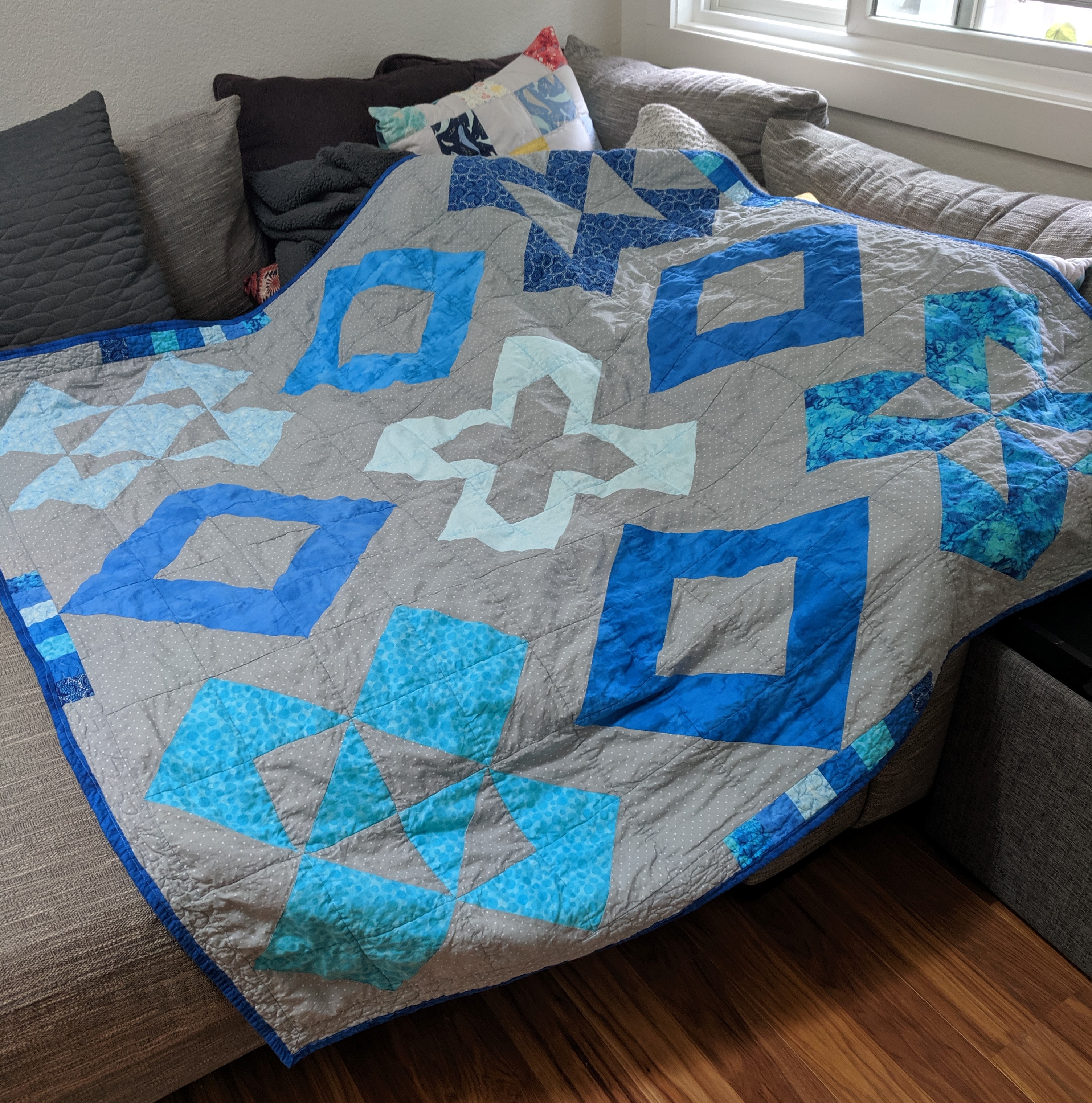
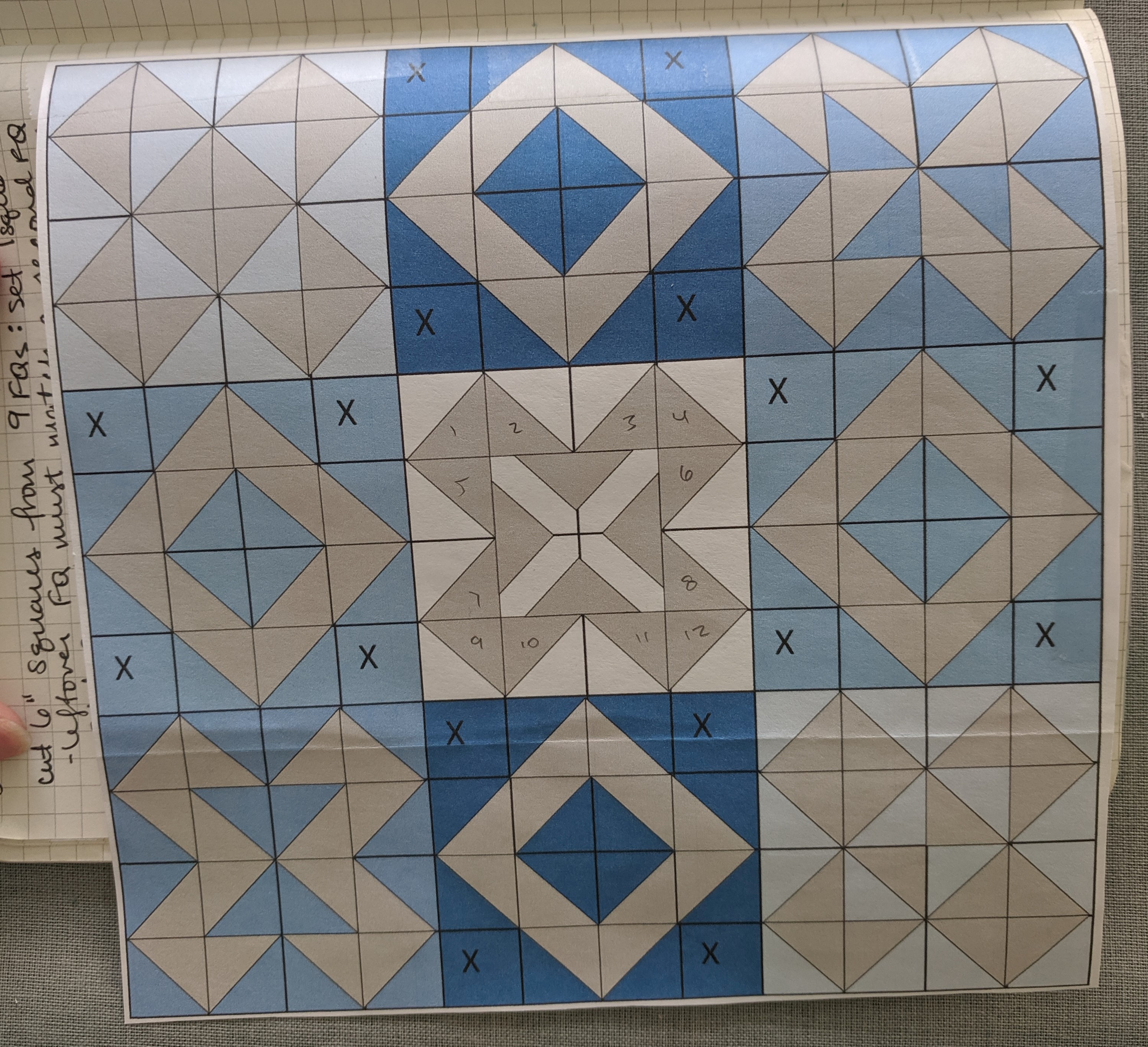
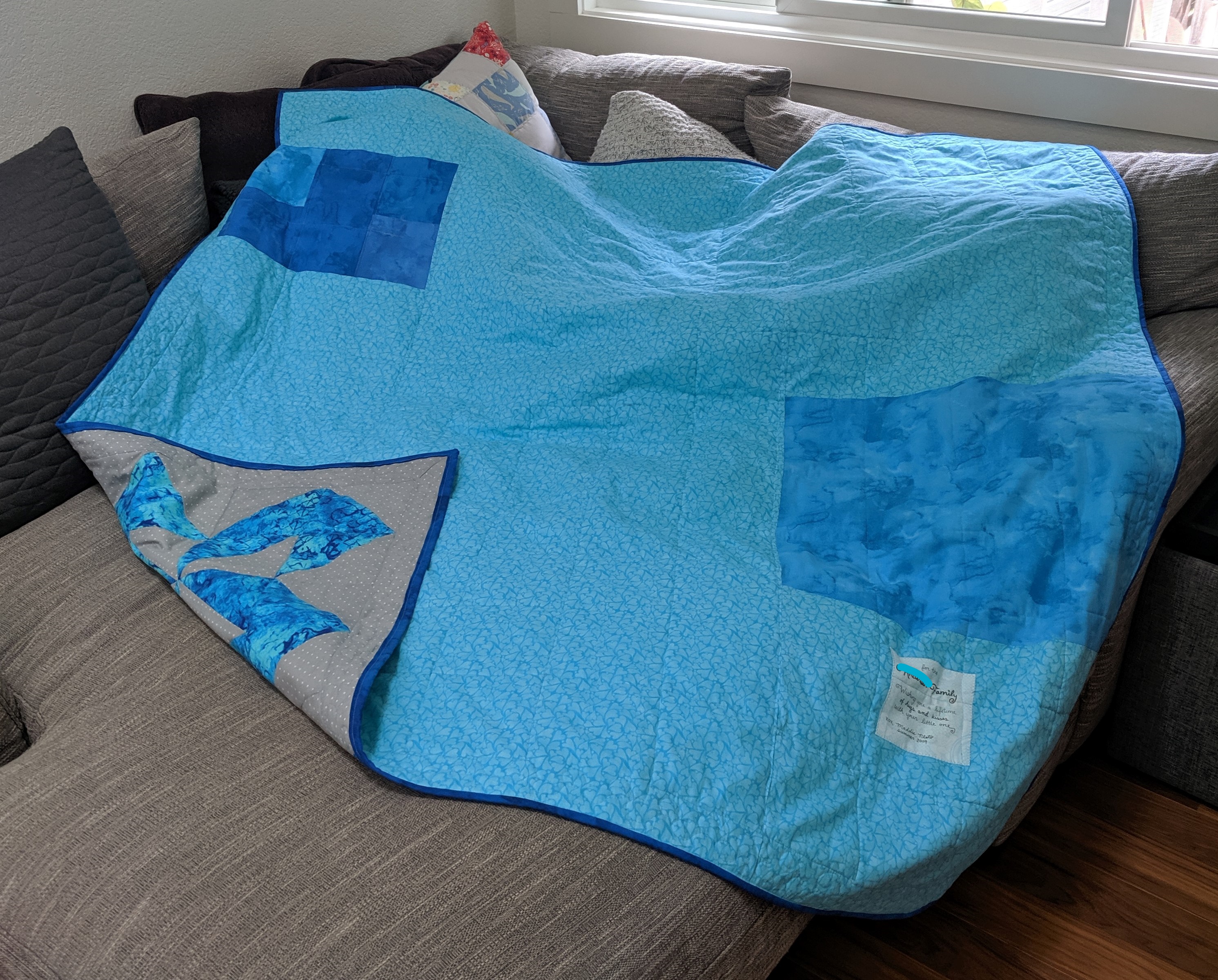
I made this quilt for my wonderful coworker whose wife had a baby 🙂 It is self drafted out of (primarily) HSTs. I based the pattern off “hugs and kisses XOXO” and used a fat quarter bundle from Joann. It ended up ~60″x60″, which is a bit large for a baby quilt but I don’t care.
Powerpoint design
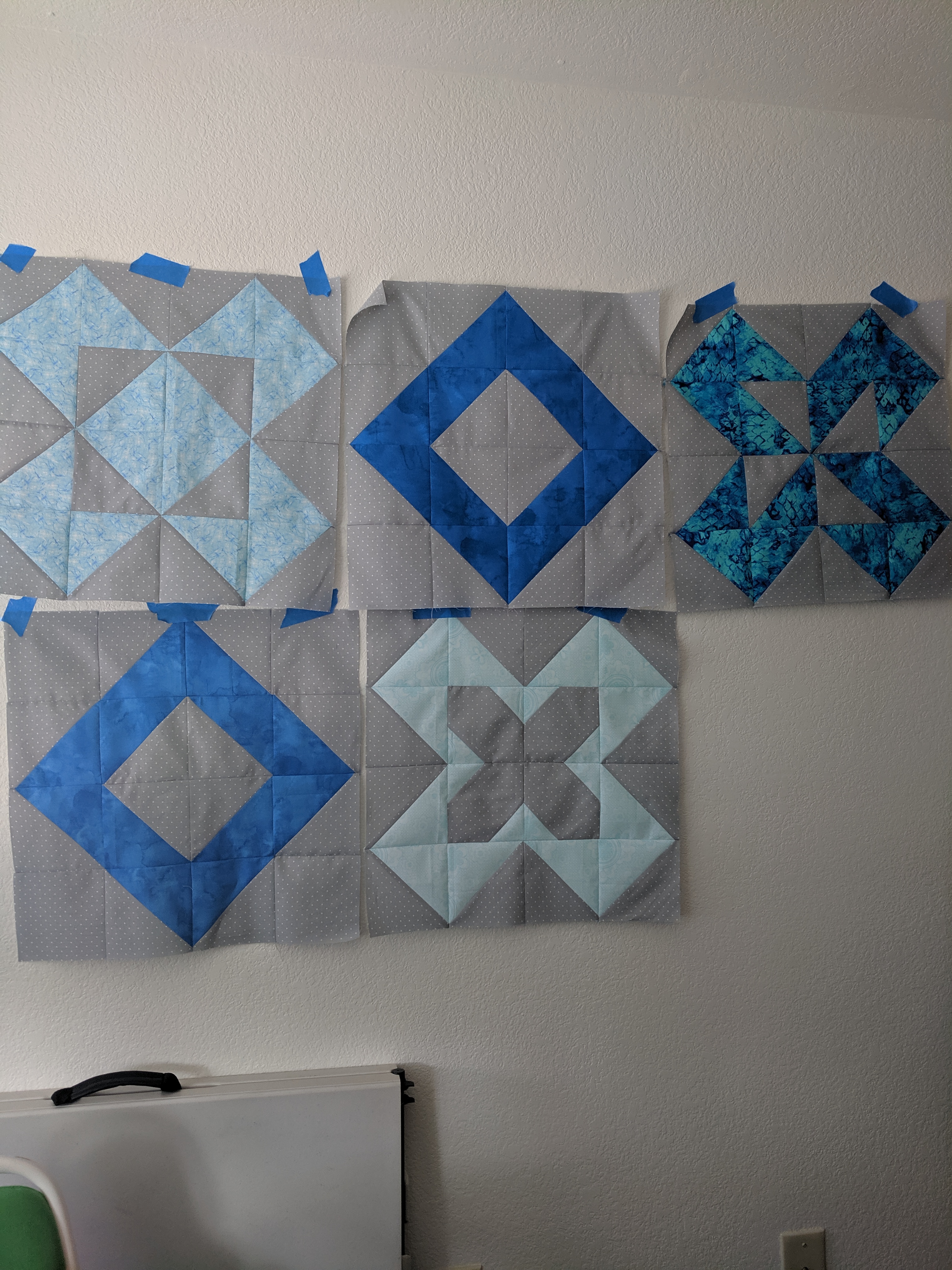
Finished blocks on my wall
HSTs ready to be laid out
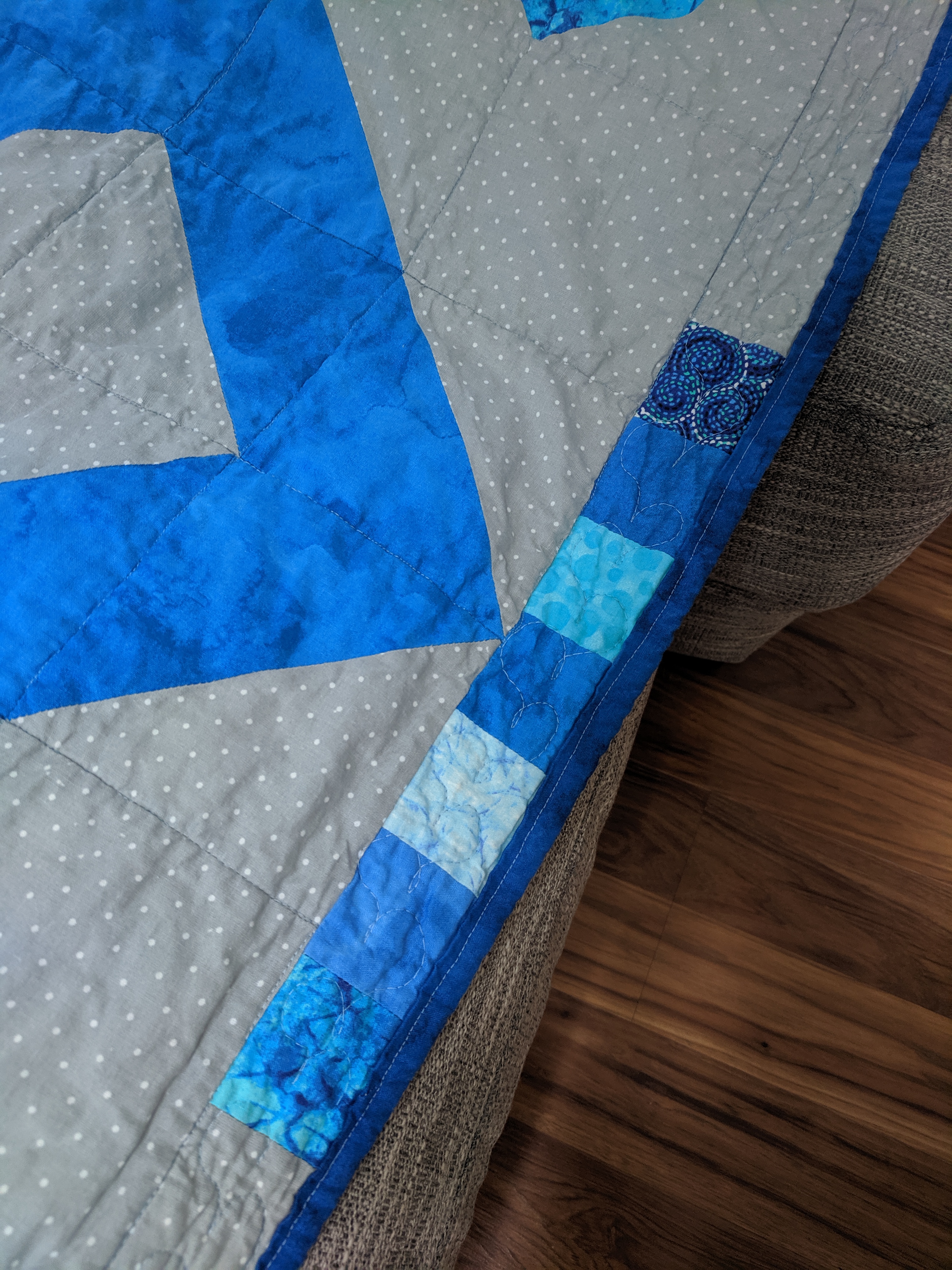
I ended up quilting the whole quilt with “stitch in the ditch”, where you quilt between units along the seam lines. For this to work, you have to iron both seam allowances to one side (instead of open). This makes one side of the seam a bit taller than the other, and the quilting goes on the lower side – the ditch. I used some scraps and the same background for the border, and quilted little heart shapes around the entire thing.
Stitch in the ditch on the left in the main blocks, heart shapes in the border on the right











 Finch's Creative Endeavors