Tag Archives: ruler quilting

Rest Quilt

My front door is not completely airtight. I tried getting some foam strips to put inside the doorframe, but then I couldn’t close the door. I thought about, and started, a crochet tube that I could hang on the hinges to block the most air from getting in…

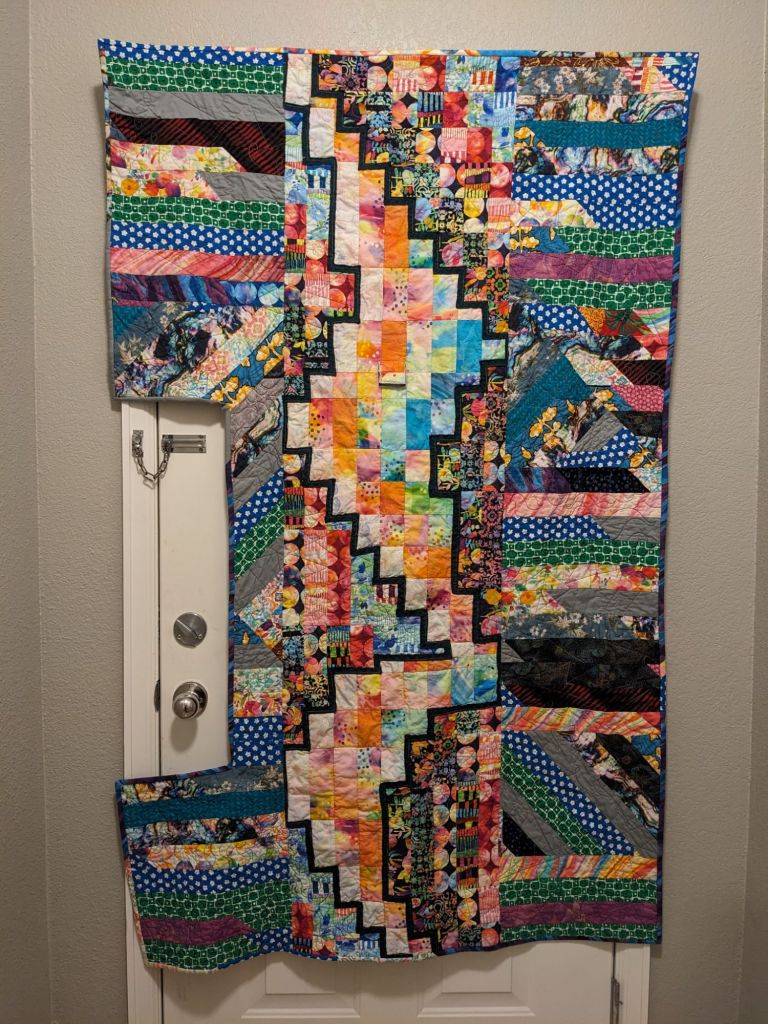
But in the end, I decided a quilt that could cover most of the frame/door gap would be the most effective, most fun, and most aesthetically pleasing. I had a jelly roll from Moda Fabrics and decided to do a bargello-ish quilt. I wanted to depict a quarter rest, since I am a musician and I want my home to be a place of rest. A place between all the noise and chaos and effort-giving to rest, restore, relax.

I sketched out the shape on graph paper and determined the widths of the strip sets. I used two “leading edges”, one for the left side of the rest (white) and one for the left side of the background that bounds the rest (dark flowers). I used lighter and less busy prints for inside the rest, and the darker and busy prints for the background.
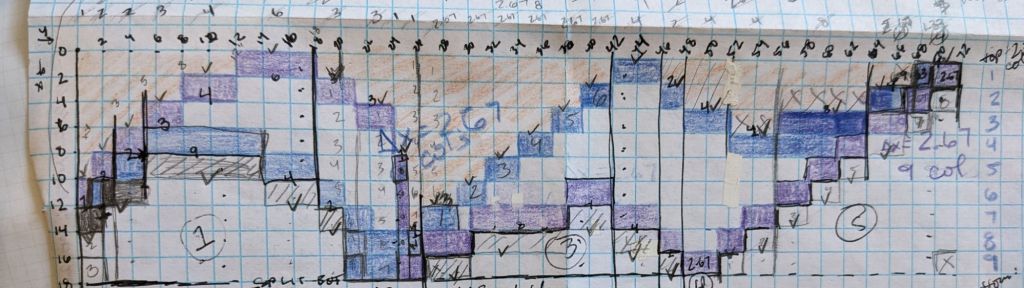
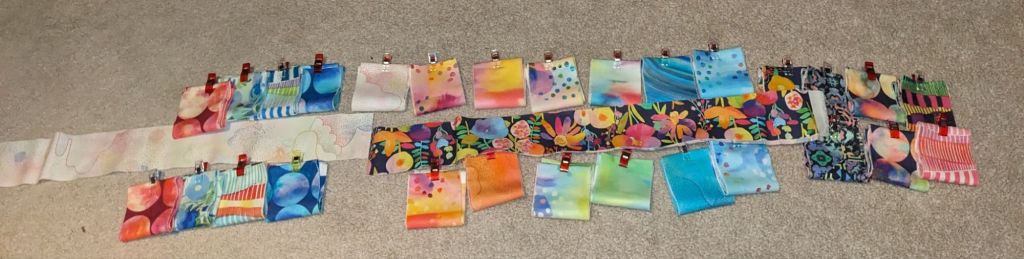
The blue and purple edges are the rest, so the top edge in the picture is the left edge of the rest, and the gray blocks below the bottom edge are the background strips
Rest fabric in the middle, with the busy background fabrics to both sides

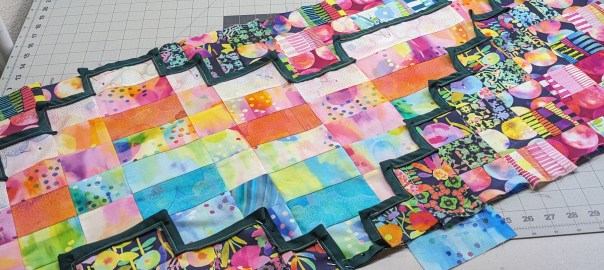
As with a normal bargello, I assembled the strip sets and then cut them to the corresponding widths. The jelly roll didn’t have duplicates of all the fabrics, so I alternated the ones that didn’t have exact matches. Then I pressed the seams to alternate, and sewed the strip sets back together.

After some consideration, especially using a black and white filter on my camera, I decided the edges of the rest needed a tiny border to really make it stand out. I attached a strip of dark green as if it was bias tape, sealing the raw edges of the strip sets inside. Then I appliqued the background onto the right side of the rest, ripped off the unneeded background, and appliqued the rest into the extra background.
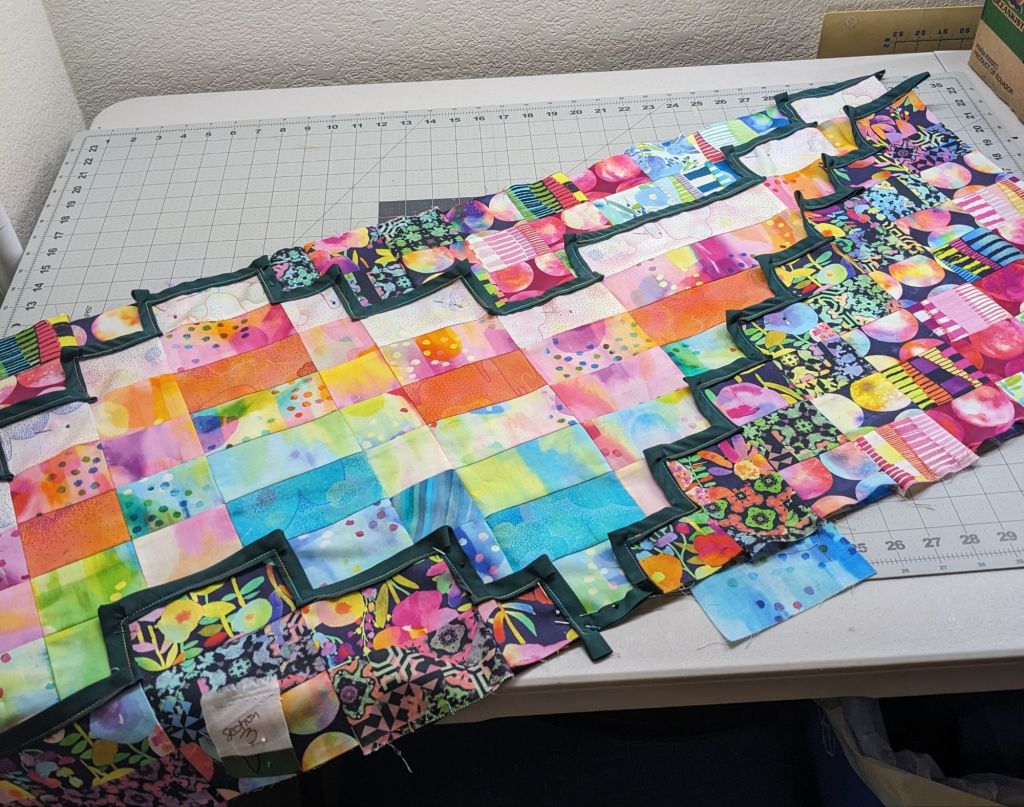
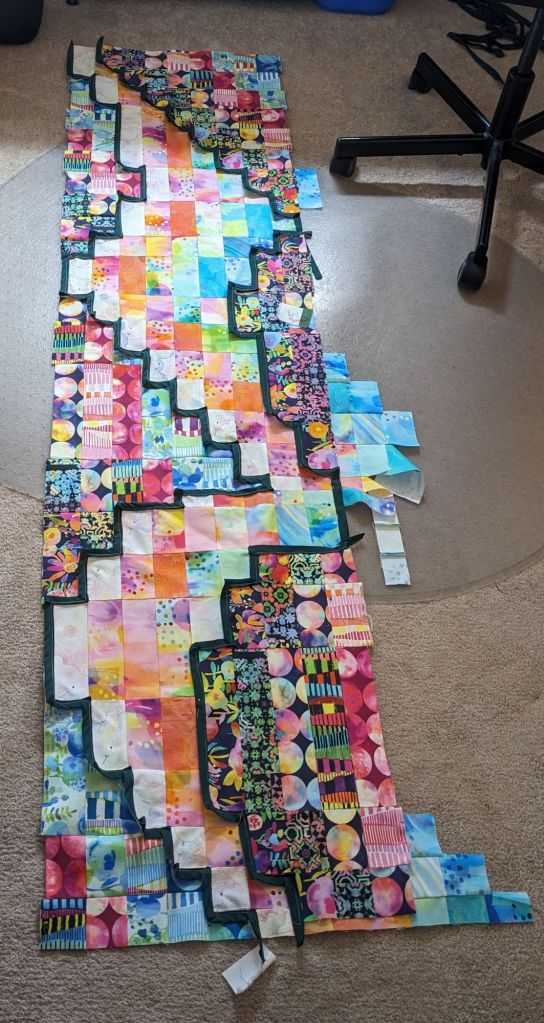
So that was the rest part, the middle part, done. I still needed two sides to make the quilt large enough. I cut a bunch of 2.5″ strips out of scraps and did a “jelly roll race” type of construction to make a big panel of stripes. Seeing as this area was meant to be busy and chaotic, I cut the panel and re-sewed it together on an angle a couple times. Then I split the panel in two for the two sides, and sewed them onto the middle rest panel.

Then it was time to quilt! I did my most confident free motion motifs: loops, “toothpaste”, and abstract geometric, and switched thread throughout. I liked just doing some freeform, unstructured quilting and filling the space with whatever I wanted. For the rest, I did free motion stitch in the ditch because I needed to change angles often and didn’t want to deal with moving the whole quilt 90 degrees every few inches.

I had to do two nerve wracking cutouts – one for the door handle and chain, and another for the peephole. I measured multiple times and then bravely cut once. 🙂
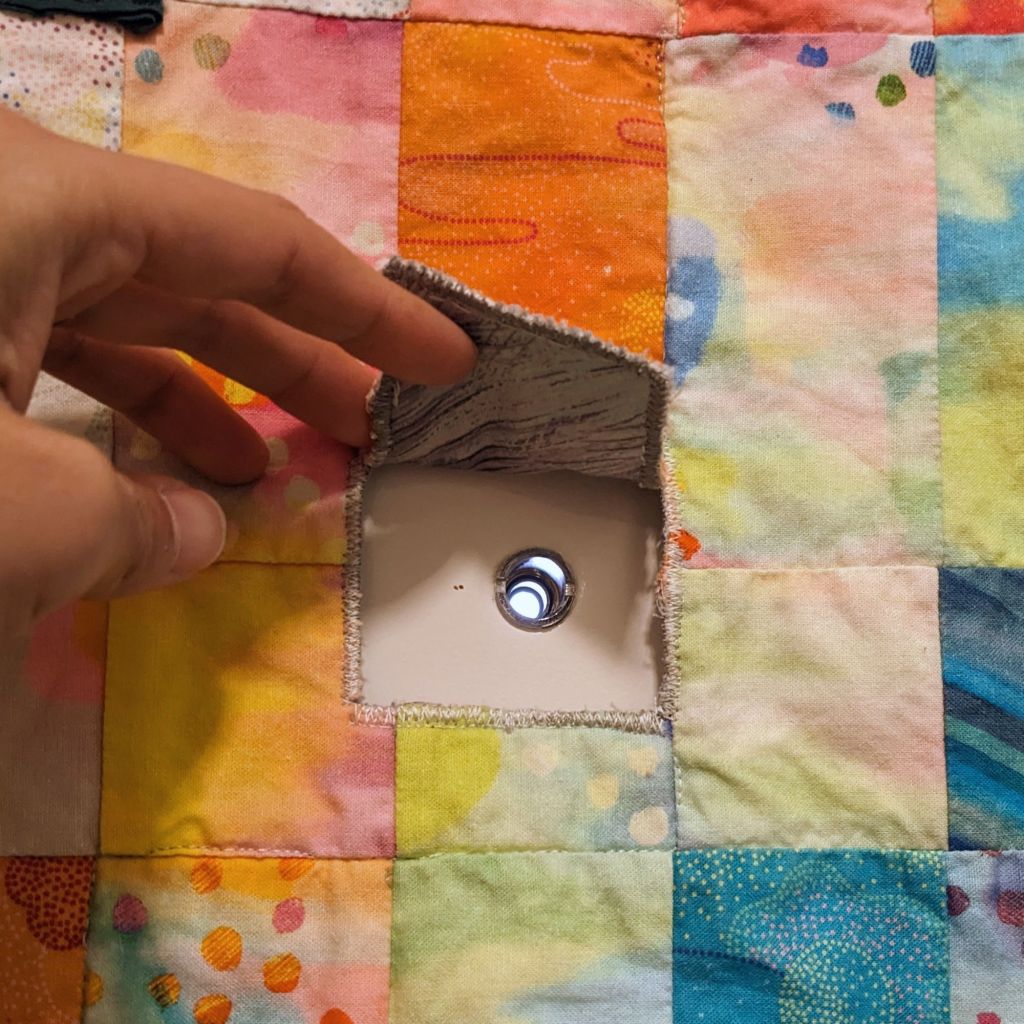
Peephole cutout 🙂 so strange to take the scissors to a finished quilt
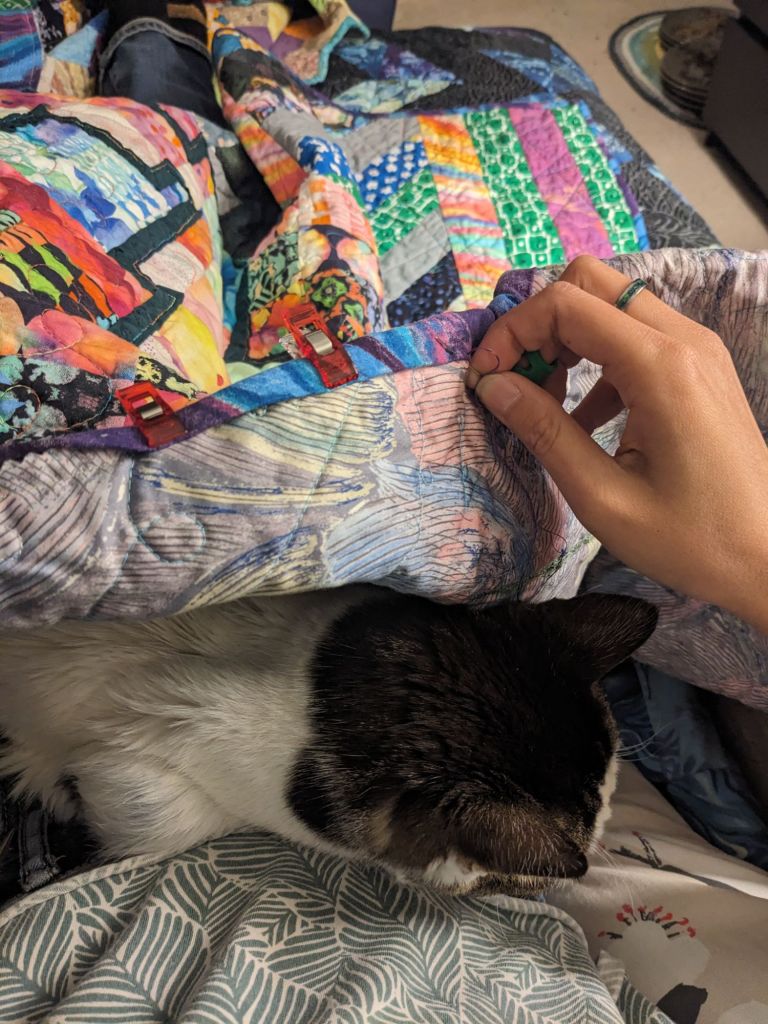
Hand sewing the binding to the back with the friendly helper

To affix the quilt to the door, I made a little frame out of wooden yardsticks (my quilt hanging devices of choice) and screwed it into the door. I used fabric loops to hang the quilt on the frame. And thus, it was done, ready for the tail end of this winter and many winters to come.
Project completed March 2025.
Celebratory T-Shirt Quilt

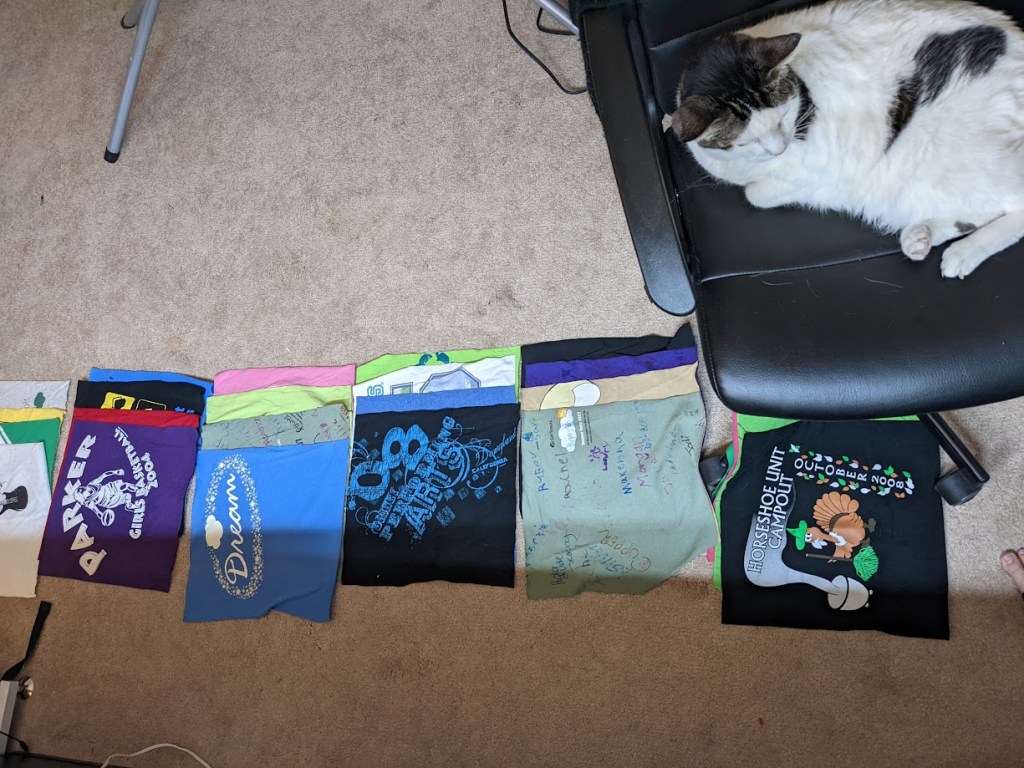
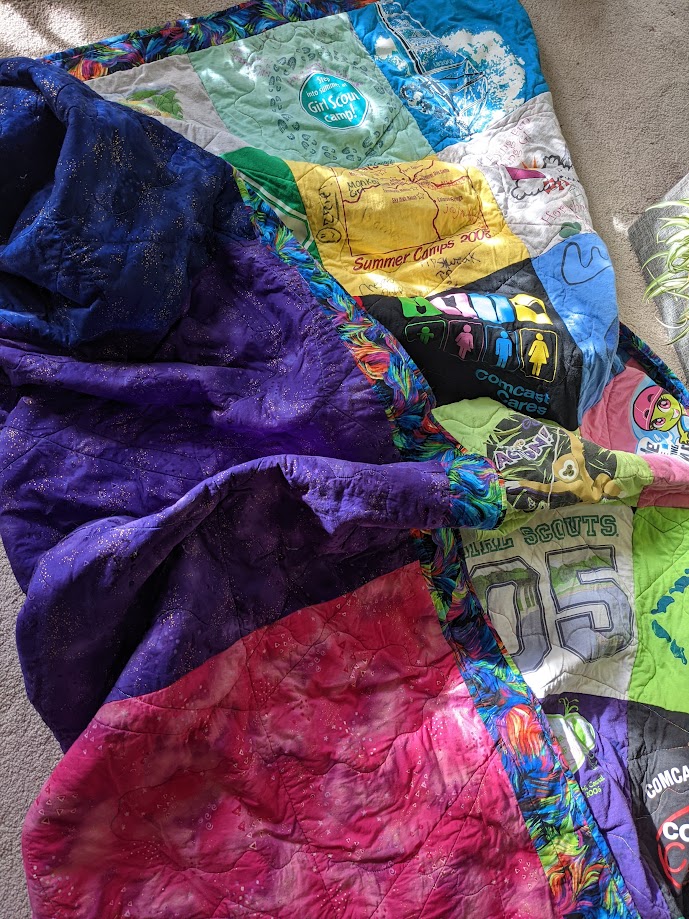
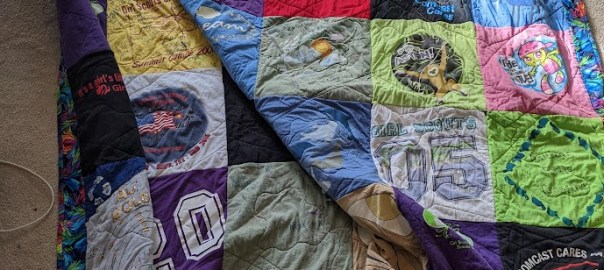
I made this quilt as a commission for my friend’s mom, for my friend 🙂 Their mom supplied me with a bunch of t-shirts from my friend’s childhood that otherwise weren’t being used, and I got to work!

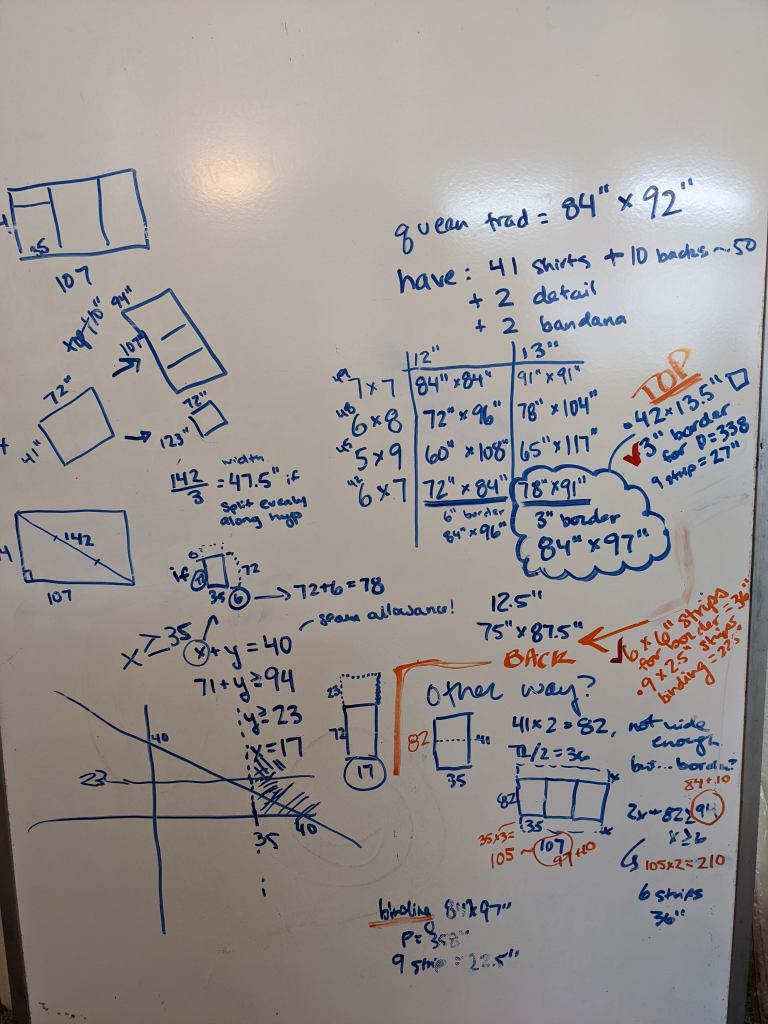
First, the idea was to have these shirts in a different format that my friend could actually appreciate and use. I did an inventory of the shirts, most of which only had designs on the front, but some had a front and back design. There were a couple repeats, so I figured I could put them in different areas on the quilt or exclude them, depending on how many squares I needed. Below I’ve included some of the calculations I did for this quilt – I had about 50 things I could make into squares, so I thought about different grids and calculated the dimensions for each. I settled on a 6 by 7 grid using 13.5″ squares, with a 3″ border for the quilt top (on the right of the picture).
For the back, their mom and I decided on a three colors in a stripe format, and I had to figure out what the widths of each panel would be. I thought about doing the stripes on a diagonal, but the math just didn’t work out that way (bottom left). I ended up doing straight stripes with a 6″ border (bottom right), using the same fabric for all the borders and the binding.

I think one of the main calculations I do for quilts is trying to figure out the correct aspect ratio, based on the square shape, the desired size, and the border. I also wanted to make sure the three stripe colors were equally represented; I originally thought the seams could be diagonal but I found I wouldn’t have enough fabric.

Then it was time to start cutting squares! I cut them out and lined them up in the order I wanted to sew them into the grid; I sewed the squares into columns and then the columns into the entire quilt top.

Lined up squares and the friendly helper!

After constructing the quilt top, I added some borders – to add size to the quilt and to stabilize the entire thing. Most of the shirts were made of stretchy woven fabric (honestly, very difficult to sew, I had to use tissue paper to make the edges stay flat so I could piece them together) so I wanted to have that non-stretch cotton around the edges to lock everything together.

I quilted the whole thing with zigzags across the row seams, and then went back to do some wiggly lines up and down and around the different designs to stabilize and add some fun.

Project completed February 2022

Follow your art heart

Been making a lot of different kinds of things! I’m reaching into multimedia and experimenting with new materials and techniques. 🙂

EPP Update!

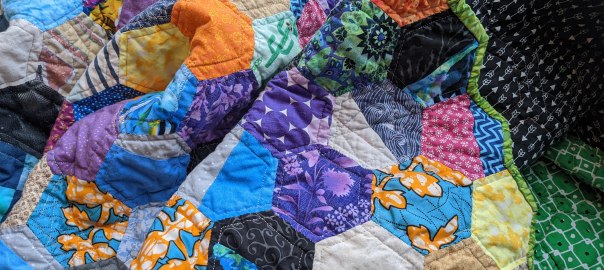
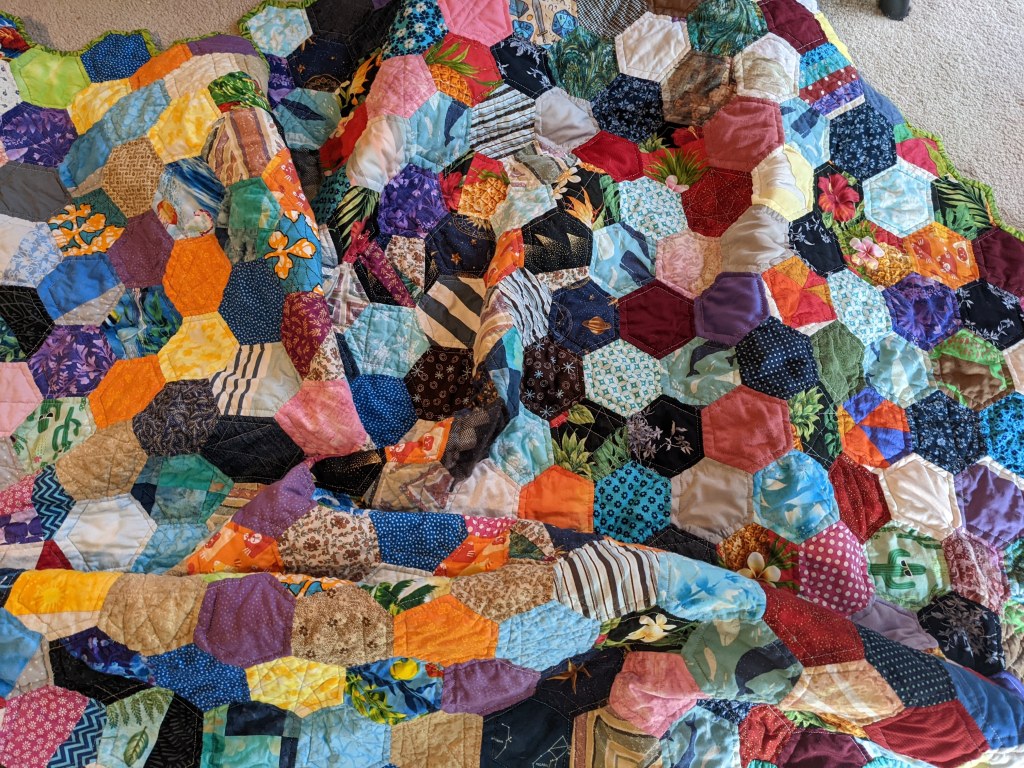
IT IS FINISHED!!!!! And oh, I do love it. When I look at it, I’m reminded of the hard work and enjoyment that sewing and quilting have given me, and that I’ve given myself. It reminds me that I enjoy hand sewing and machine sewing for different reasons, and they both have their place in my creative endeavors.

It was a lot of work, but it was spread out. And very worth it. This project brought me back to college when I was only doing hand sewing, since I didn’t own a machine. It was a slow and relaxing project, which was wonderful – I’d work on it whenever I felt like it, whether that was on the train to the city or sitting on the couch with my cat.

gluing fabric to hexagons

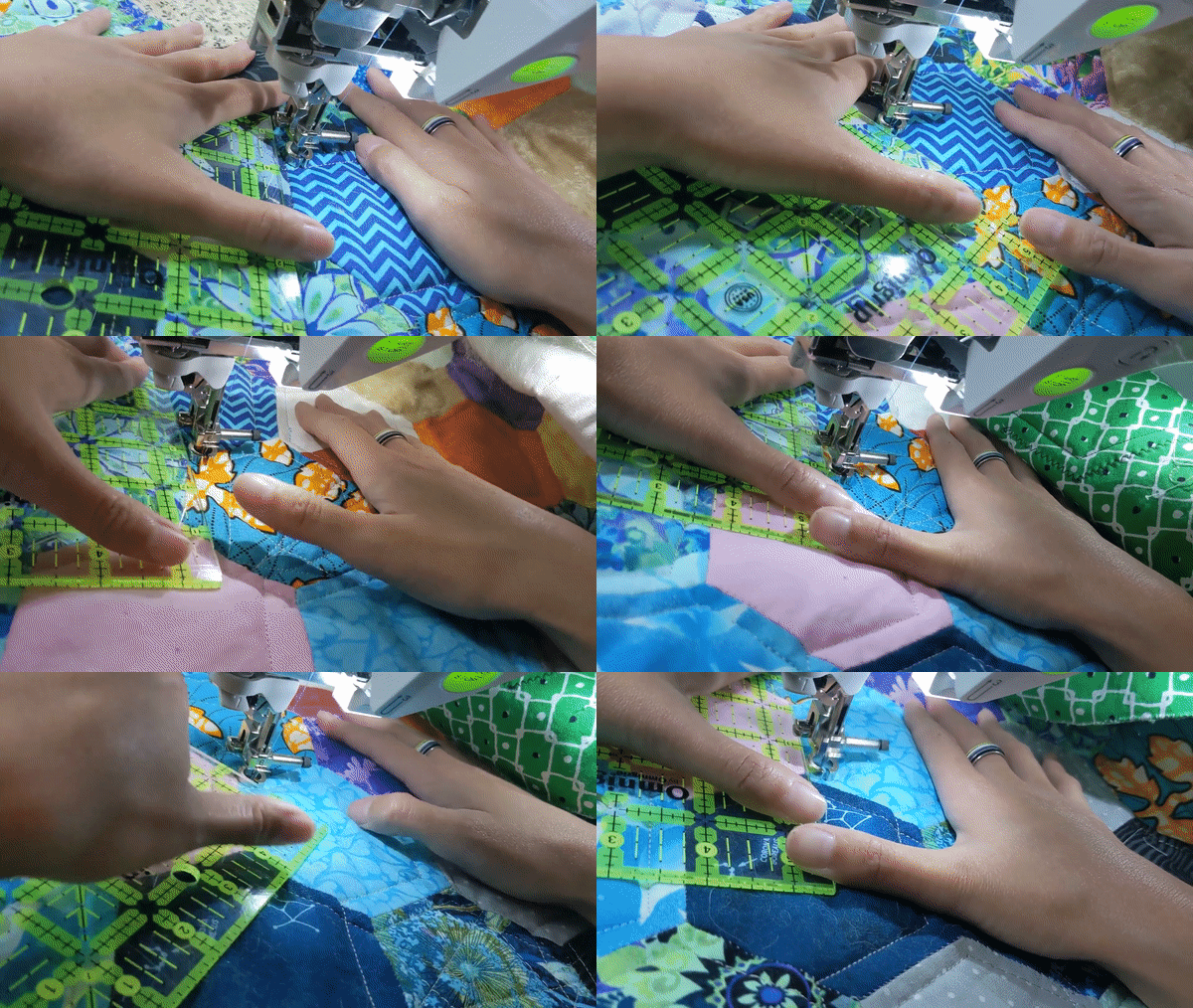
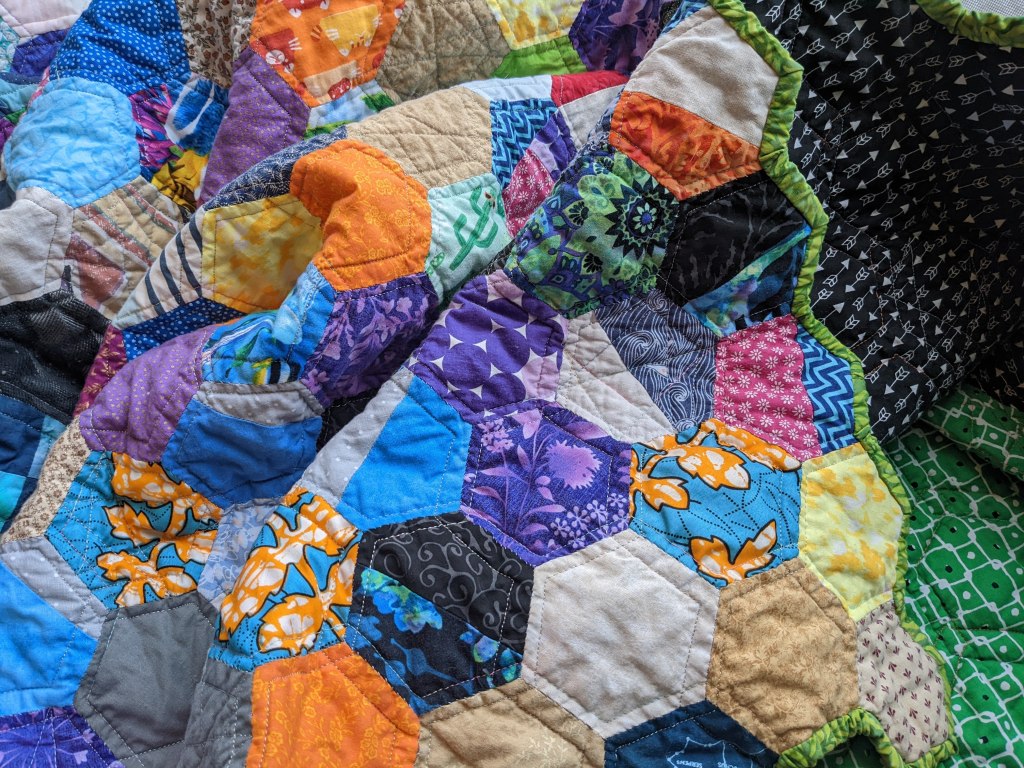
I wanted to keep the quilting really simple and highlight the fabrics themselves, since there are so many fun ones in this quilt! I decided to echo the hexagons, and made three passes across the quilt, echoing two sides at a time (three passes, two sides at a time – all six sides covered!). This allowed me to quilt long, uninterrupted lines, which is most effective. Quilting is pretty AND increases the structural integrity of the entire sandwich, so long lines are preferable to “isolated” designs that require cutting the thread. For a little fun, I added in my “random geometric” design in some hexagons.

Quilting by aligning the ruler against the edge of the hexagon and following it, creating a quarter-inch echo line. You can see here that I’m on my third pass, four of the sides are already echoed and I’m following the last two sides (easiest to see in the light blue heart block or light pink on the left).

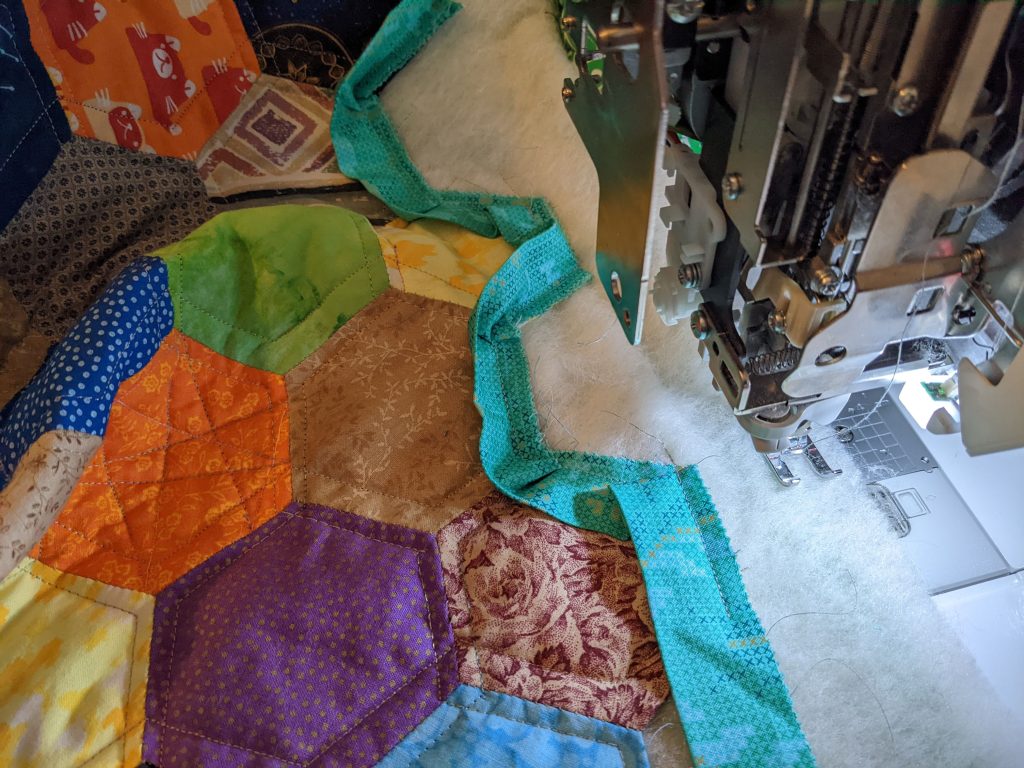
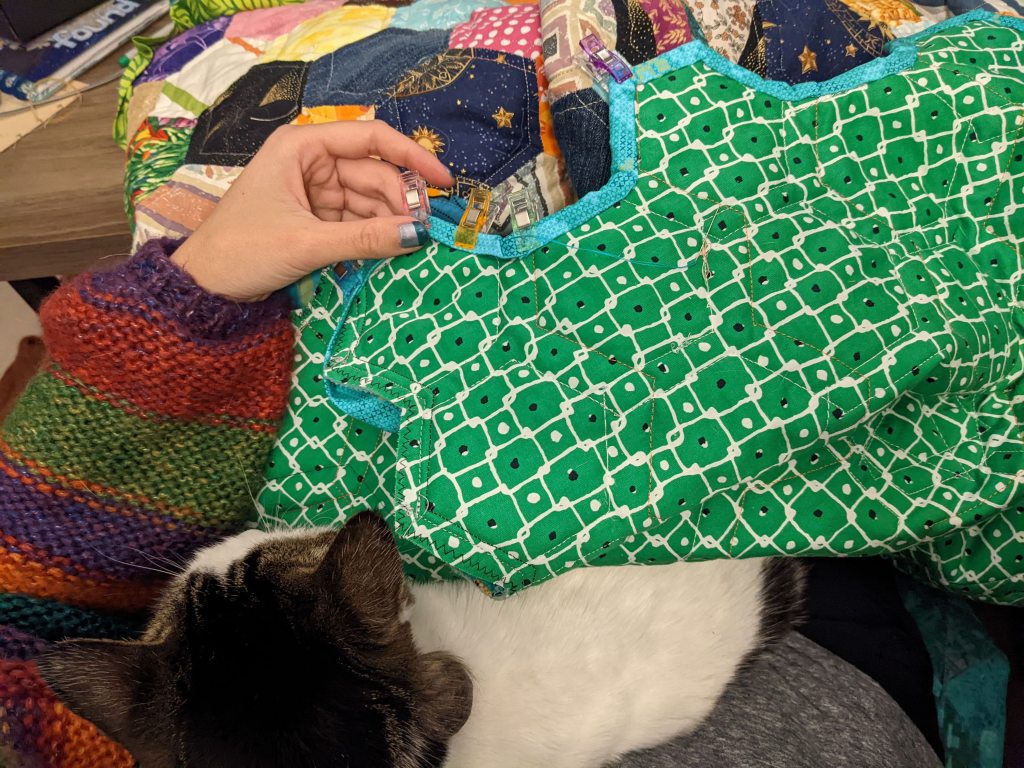
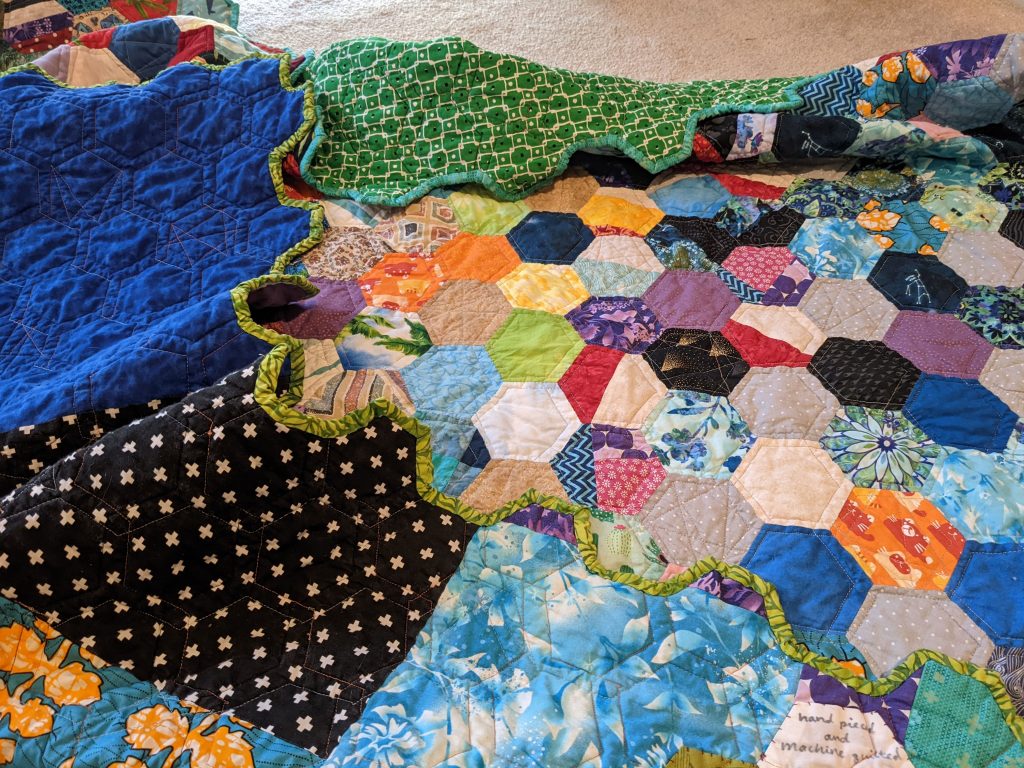
I decided that I would keep the hexagons on the border instead of cutting the quilt to rectangular, so I looked up how to apply binding to all the angles. It was a bit fussy, and I realized that I would have to then hand sew the binding to the back, but… it looks really cool. And it was nice to finish the quilt by hand, honoring the work I put in to the top.

Applying the binding with the machine
Hand sewing the binding to the back, with my friendly helper.
scraps from the back
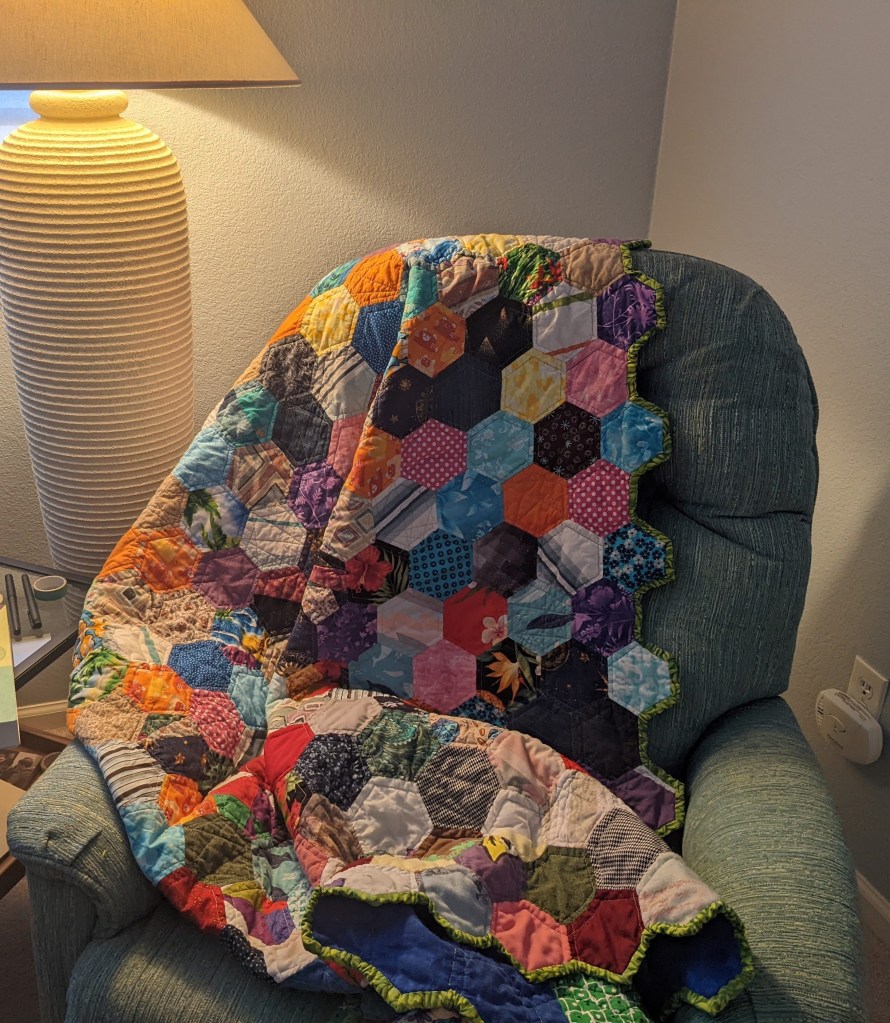
This quilt’s resting place – the analog room / reading chair ❤ It is wonderful and warm and cozy… and a project for me, of me, from me.

Project completed January 9, 2022.

  • Fabrics – so many. Sourced from MSQC, Joann, Bluprint, Etsy, eBay, thrift store, Spoonflower, memory quilt scraps
  • Batting – scraps, mostly cotton and cotton/poly blends
  • I didn’t buy any supplies for this quilt except machine needles. Which!! I figured out why my thread kept breaking all those times. Just need to use a bigger needle. 🙂 But it was a true joy to create something “for free”.

Colorful Log Cabin

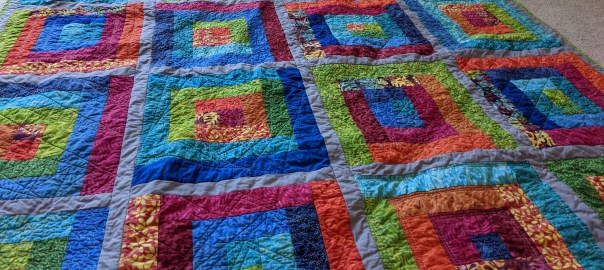
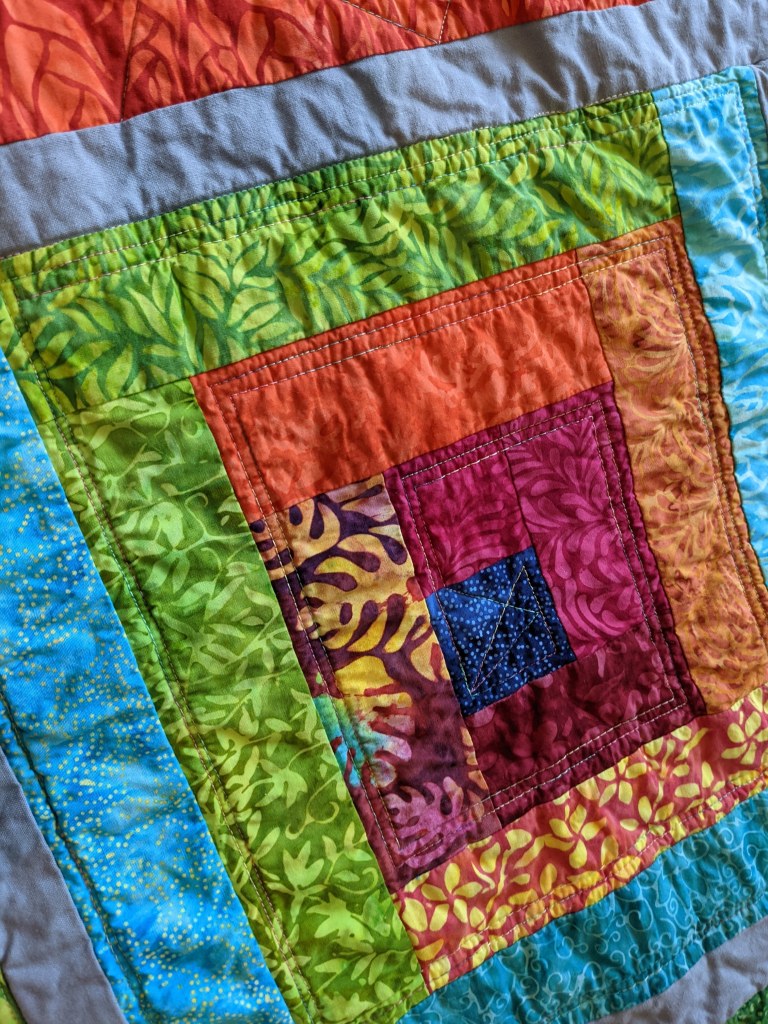
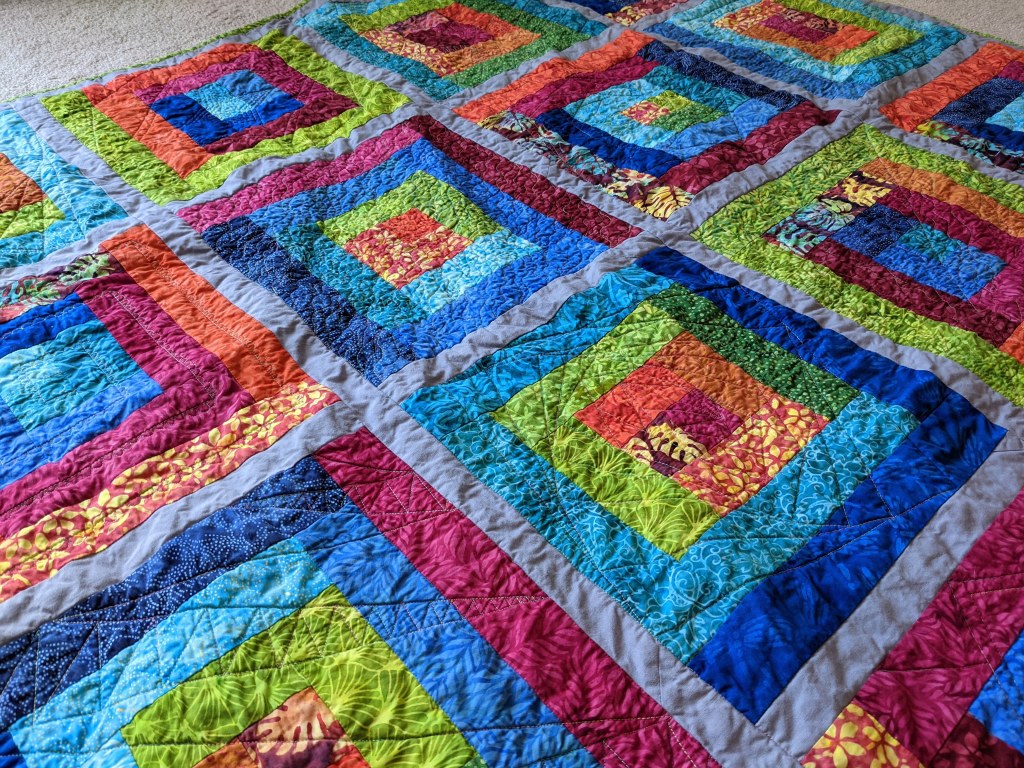
This was a gift for two of my best friends who got married last summer! For their gift, I was inspired by the log cabin block, since our friends often gather at their home. I’d never done a log cabin quilt, and it’s a very traditional quilt, constructed by sewing strips of (usually) the same width to a “rotating” block.

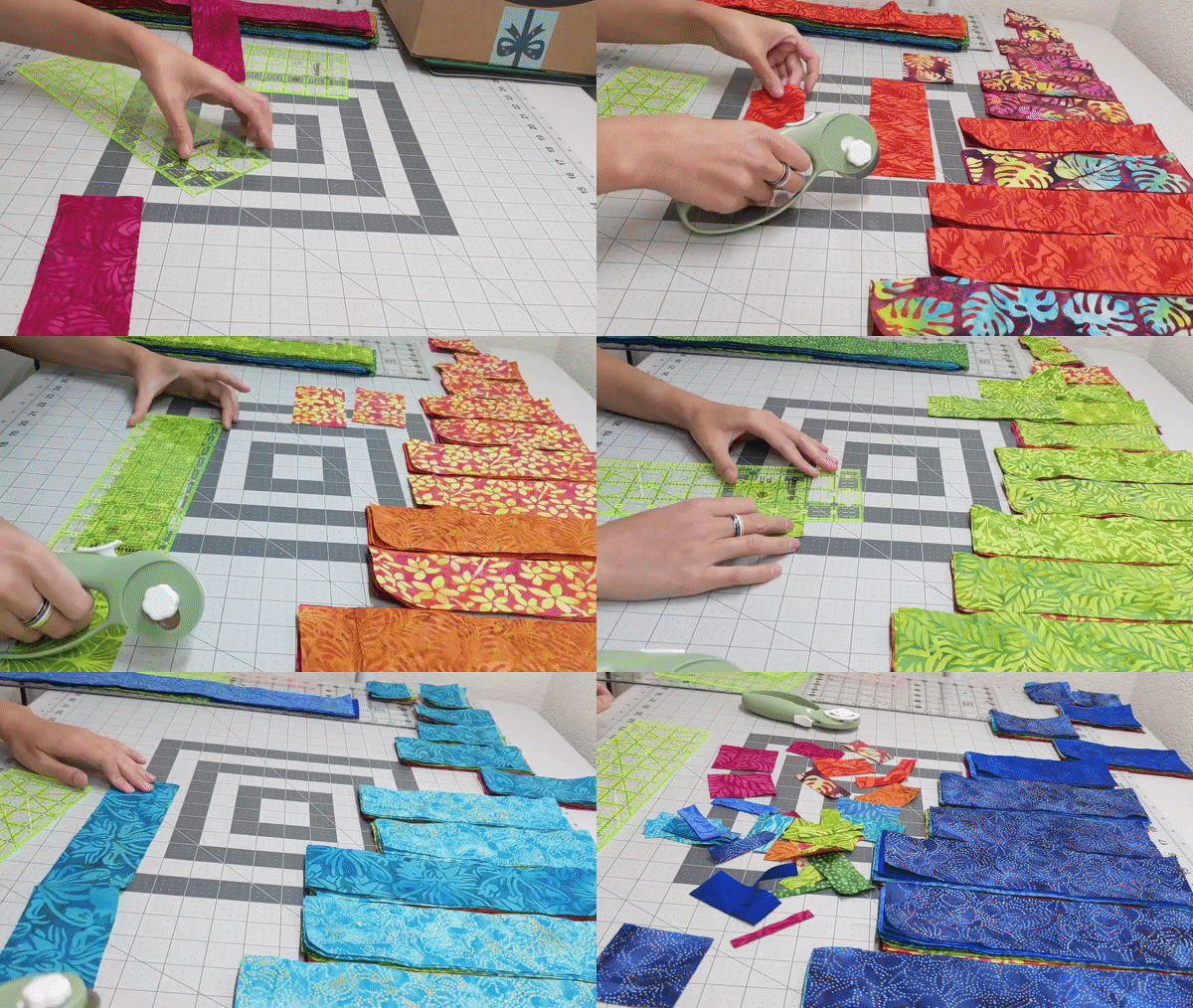
I wanted to minimize my cutting, so I used pre-cut 2.5″ strips define my block and calculated the lengths from there. My idea was to put the strips in rainbow order and have each color “march” around the block so that, say, red would start in the first position, then for the next block, purple would be in first position and red would be in the second position. (see below) This meant I cut all of the lengths from all of the colors, with some finagling (also, see below).

Log cabin blocks are constructed by adding strips to a center square (marked as 1). My idea was to have an approximate rainbow order moving clockwise around the block.
Cutting strips to the correct length

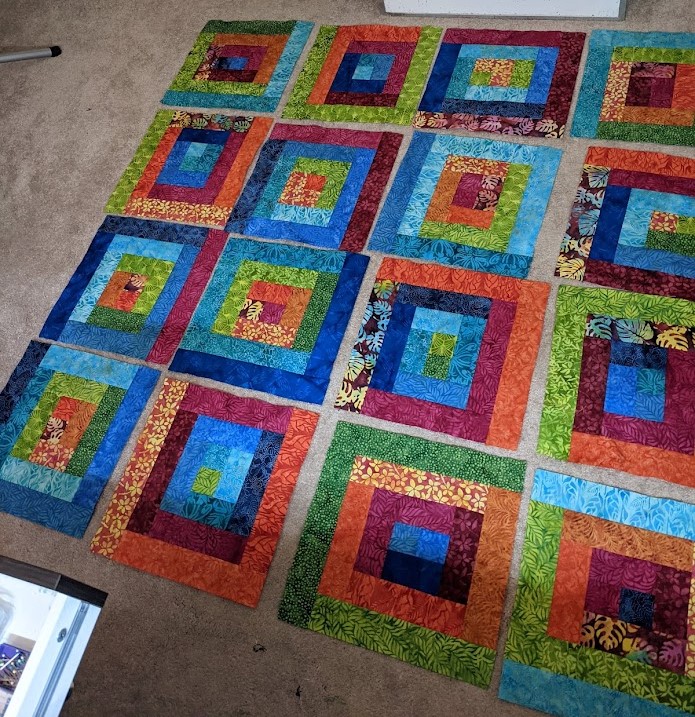
Then I was able to assemble my blocks, which I did one by one because I wanted to stay super organized with the color order. They weren’t all perfect but I am super pleased with the results.

Originally I wanted to arrange the blocks in the order I made them, with red in the first position in the first block, second in the second block, but that didn’t look that good 🙂 so I mixed them up and tried to design it by keeping busy prints scattered throughout and no prints touching each other.

This was my first quilt with sashing, the borders around the blocks. Sashing can make a quilt bigger without the need for more print fabric, and gives the eye places to rest between the busy blocks. I used a nice gray for the sashing, which ended up being really nice with such vibrant, saturated colors in the blocks.

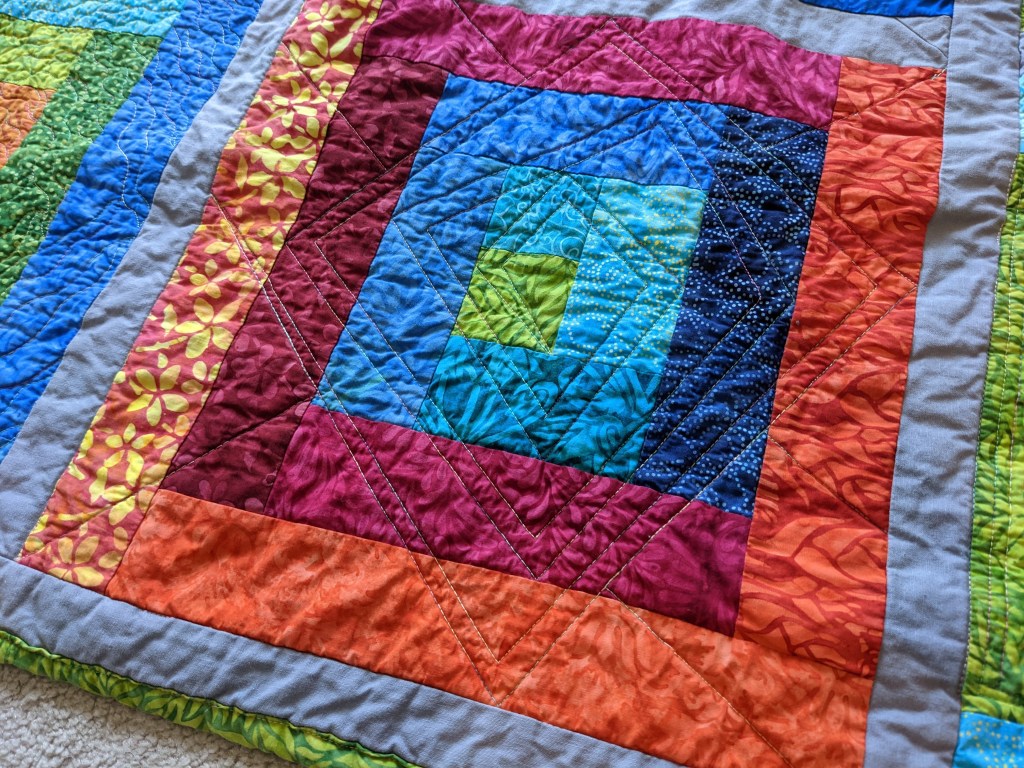
As usual, I vamped on a few motifs for the quilting – as illustrated below.

swirling polygon
swirl with echoing
echoing the strip lines
zigzag; echoing strip lines; curvy swirling polygon; curvy lines within strips

Overall, I’m really pleased with the final result and I was so happy to make a traditional quilt in a modern, bright way.

Completed June 2021.

Print: Punch Batiks by Kathy Engle for Island Batik
Binding: Wilmington Essentials – Crackle Stone by Wilmington Prints
Backing: Punch Batiks – Fern Green Apple by Kathy Engle for Island Batik