Tag Archives: quilting explanation

Tools and Notions

After all this talk of what I do in the sewing room, I think it’s high time to show you some of the tools I use. Most of my tools are from Joann or MSQC, the iron and ironing board are from Target.
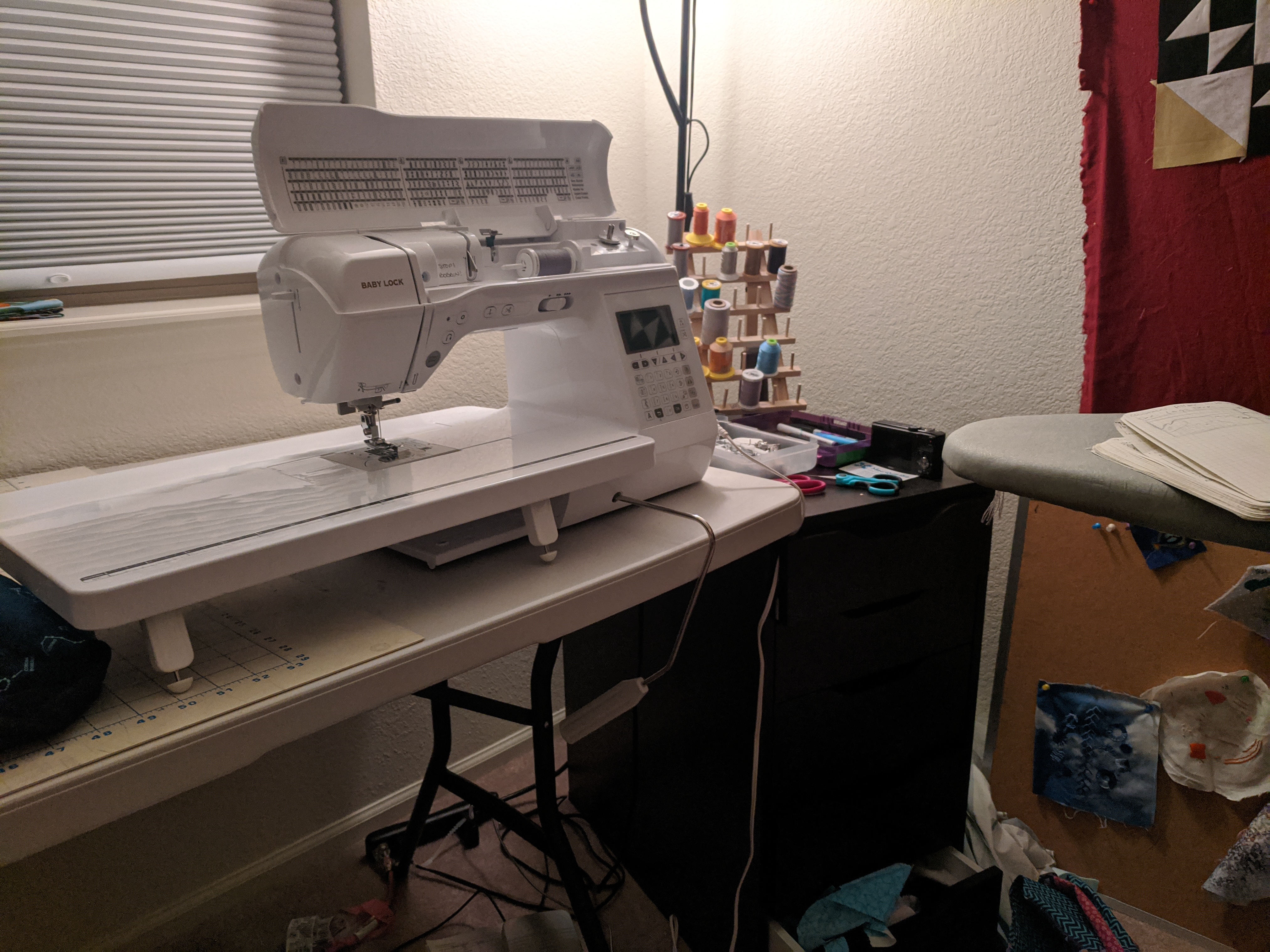
This is my sewing corner – the rest of the room is open and empty so I can lay out projects and fabric. I keep my ironing board right next to the machine because there is a lot of back-and-forth. Sometimes I’ll even put a cutting mat on the ironing board so I can go between cutting and pressing. The design wall is an old flannel sheet, and normal cotton will stick to it without pins, so I can look at layouts before committing to sewing them together. I have my large cutting mat on the table, but sometimes I’ll move it to the ground if I have a lot of fabric to deal with. Plus the table bends upward in the middle due to the weight of the machine on the right, so it’s not perfect.
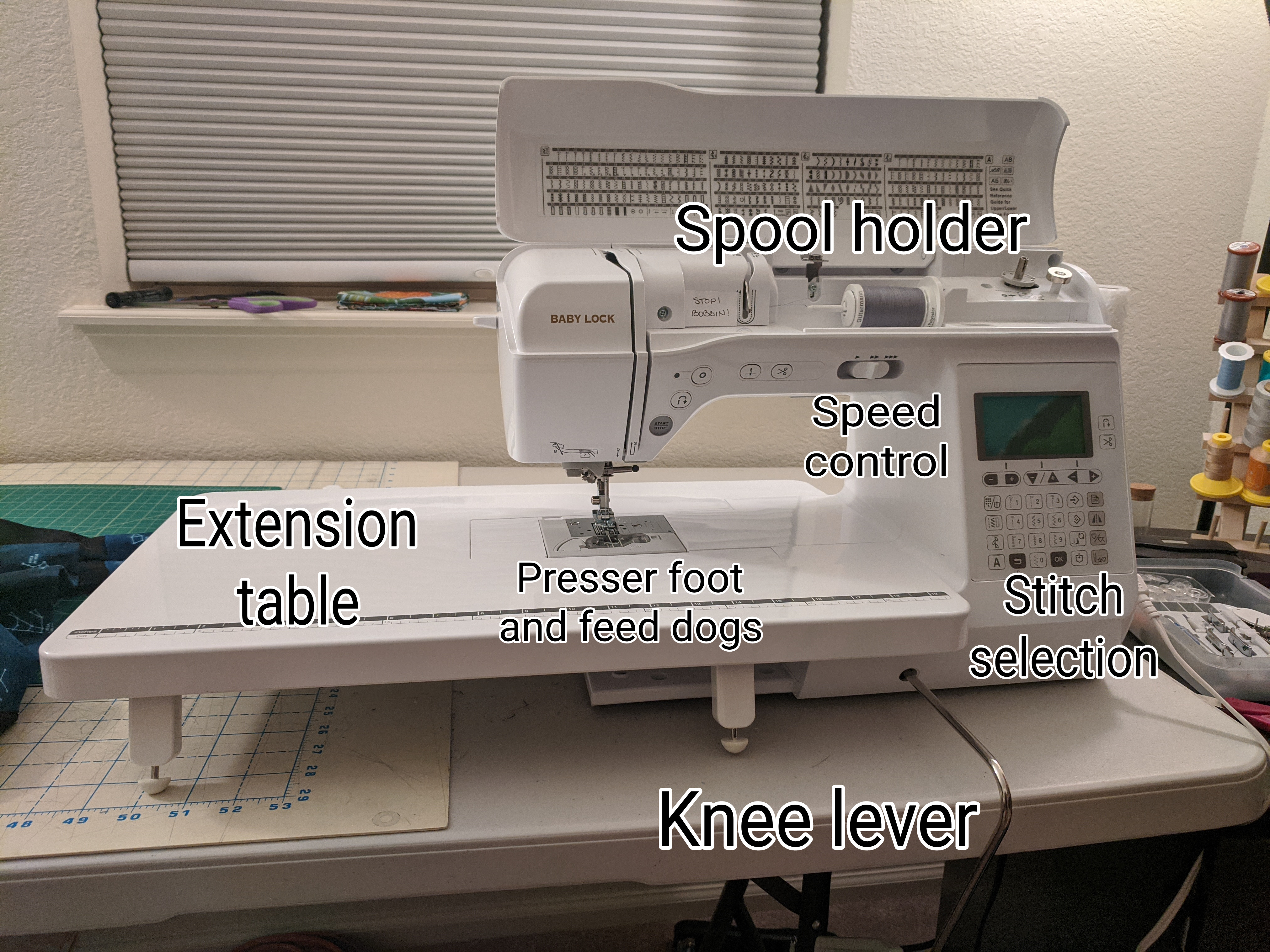
I own a Babylock Lyric, which I got semi-on-sale and semi-from-my-tax-return. It’s a computerized machine with lots of bells and whistles, but 95% of my sewing is a straight stitch on the default tension and length settings. I sometimes use an overlock or zigzag stitch to seal in clothing seams (professional clothes are finished with a serger, look at the inside of your shirt and you’ll see loops that hold in the raw edges of each seam) and I have the ability to do fun embellishments or letters if I wanted to. The machine is operated with a foot pedal, but it has a speed control switch so I can limit how fast it goes (I like to hang out at the middle speed).

It came with an extension table, which allows the fabric to lay flat as it gets sewn together; it makes it easier to guide the fabric through and prevents gravity from pulling the piece away from the needle. The extension table is near necessary for quilting, especially free motion since any gravitational pull will increase strain on the fabric and effort for me. Foot pedal controls the speed, spool holder holds the thread as it’s being used, and if I have a big spool I have a different attachment for it. You’ve seen the throat before in the Night Sky post, but this is where I have to stuff half the quilt as I quilt it. I’m always trying to quilt to my right so the fabric within the throat decreases over time. The knee lever allows me to raise the presser foot without using my hands, which is useful if I have to finagle something through the needle with both hands, or even if I’m just grabbing other stuff. The presser foot is the thing that secures the fabric to the table as it goes through the machine, so I raise the presser foot to turn corners or remove the fabric from the machine.

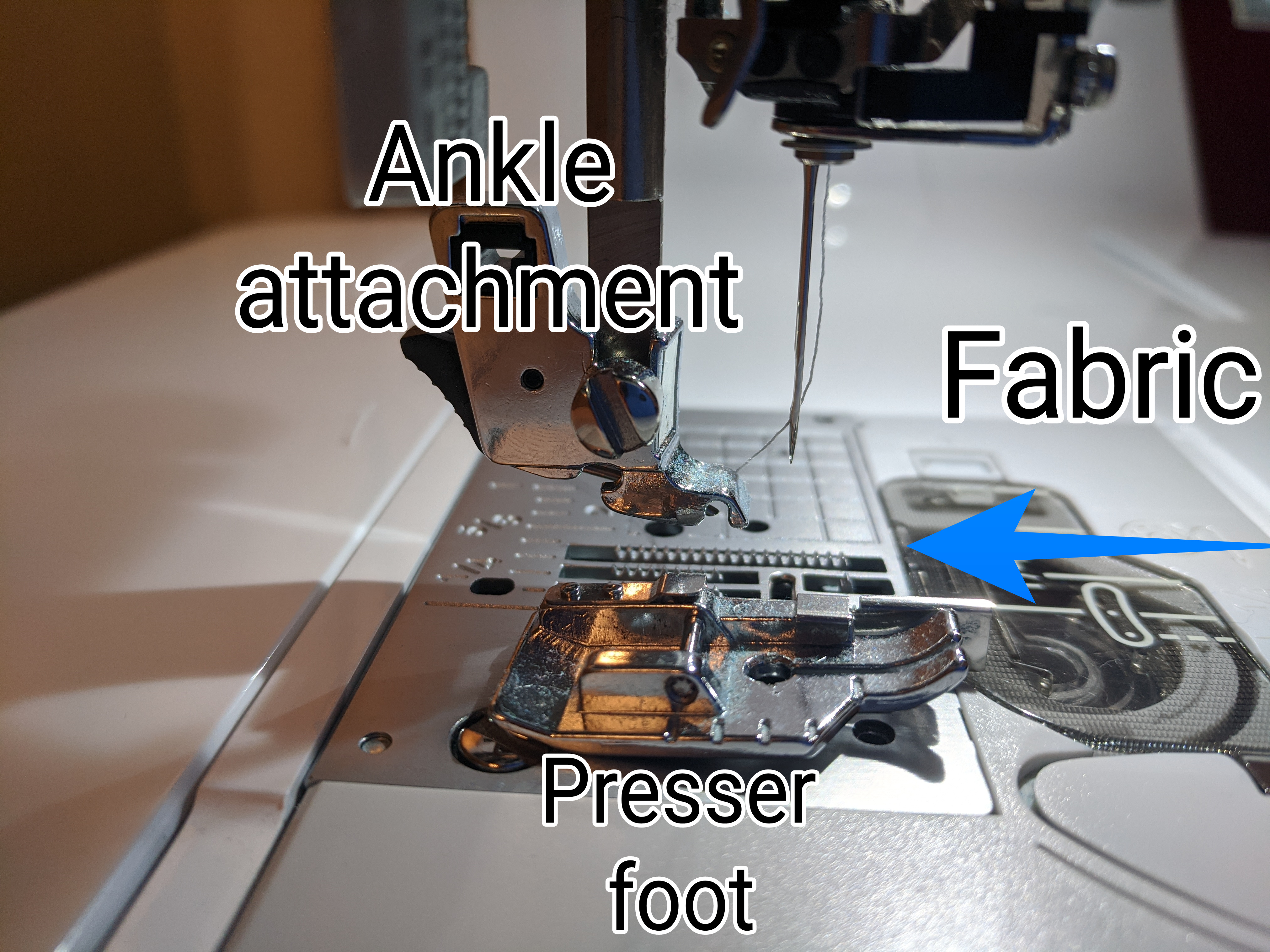
Here are some of those presser feet. They sit on the β€œankle” of the machine and help the sewist guide fabric appropriately. The ¼” foot has a guide for where to put the edge of the fabric so the needle is ΒΌ” away, which is the seam allowance most quilters use. The open toe foot allows you to see the needle as it goes down, and can be used for fancy stitches. The walking foot has its own ankle attachment and uses plastic pieces to guide the top of the fabric through the machine at the same rate as feed dogs on the bottom (more on that next). The free motion foot allows the fabric to move around easily, and the feed dogs are disengaged.
In this video, I am hand cranking the machine so it goes slow – the feed dogs complete one rotation for each stitch.

The feed dogs pull fabric through the machine. In a mechanical machine, they move via an elliptical gear on the same crankshaft as the needle. In a computerized machine, they move in a box pattern and therefore are completely flat as they move the fabric. This makes the motion very smooth and predictable, keeping the fabric flat and moving at a constant rate.
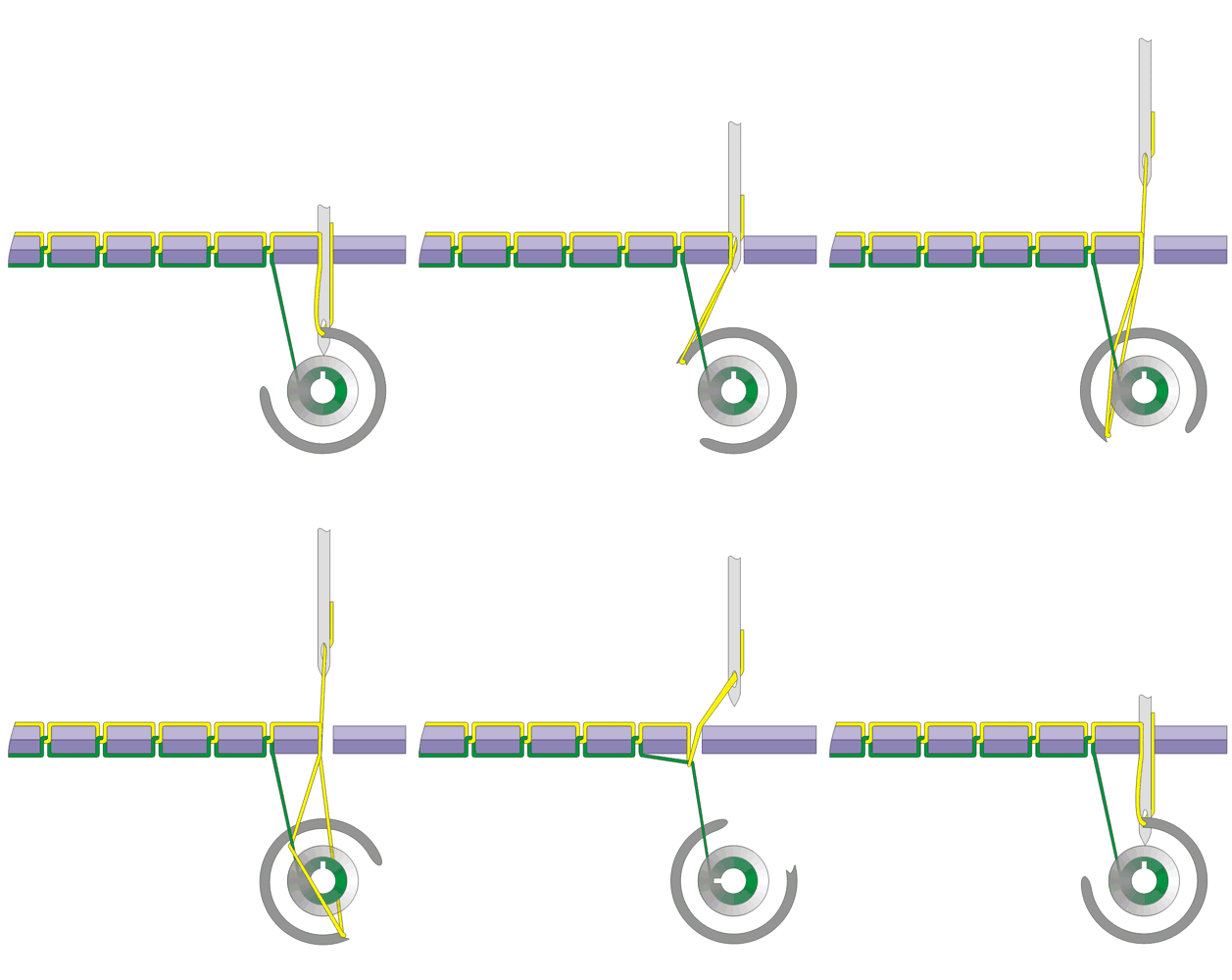
Most newer machines can wind the bobbin for you, which is neat. The bobbin holds the thread that is beneath the plate of the machine, and the thread from the top and bottom come together to create the stitches. In the above gif, the fabric is moving from right to left. Watch as the thread from the top (yellow) comes down, is caught by the hook, and in turn catches the thread from the bobbin (green). There are machines that can lay down perfect straight stitches like these at 1,000 stitches per minute, or 16 stitches per second.
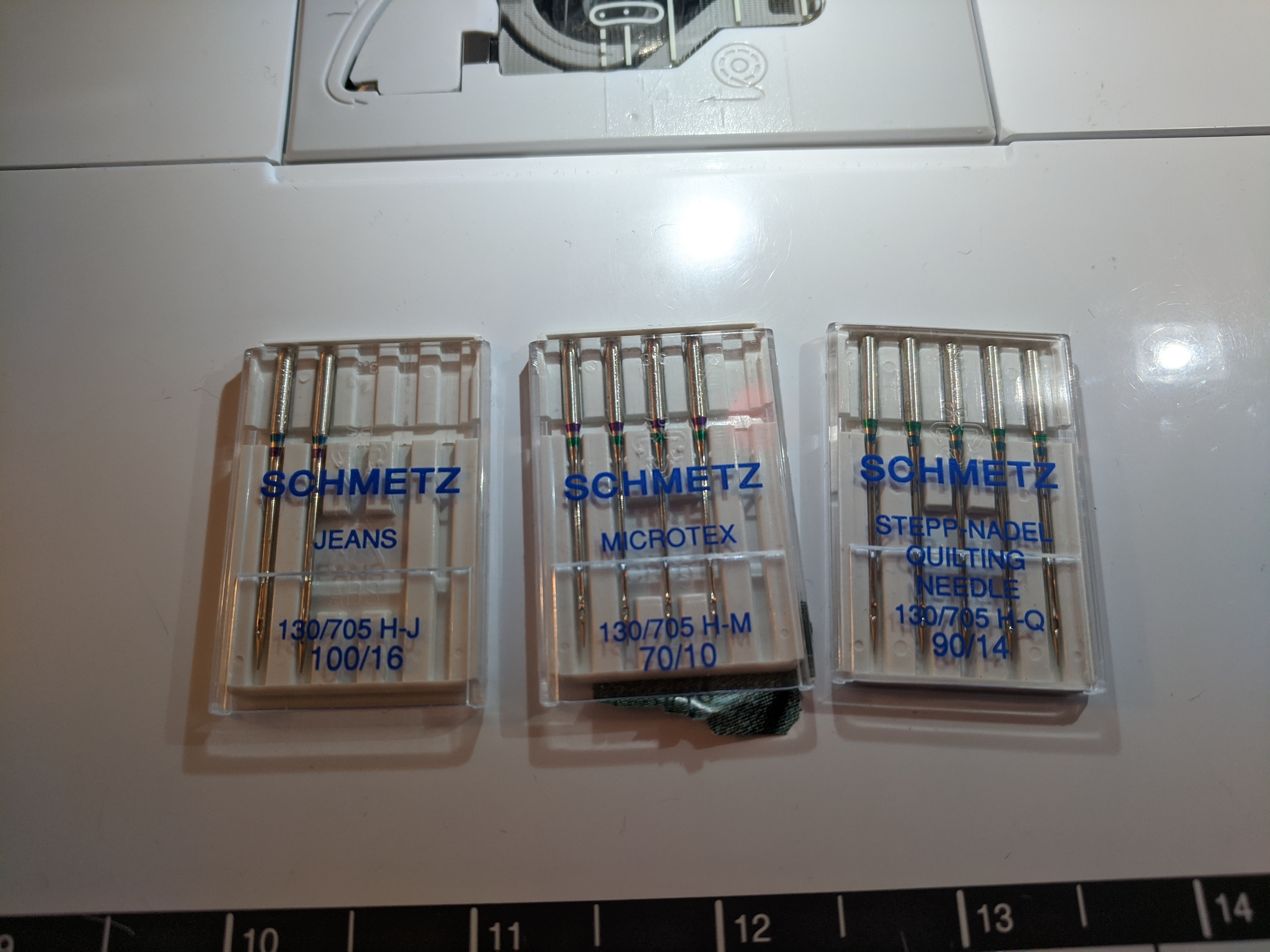
There are many different sizes and types of needles, I usually use a 70/10 for quilting and piecing, unless I’m using a thicker thread in which case I need a thicker needle. Microtex or sharps are useful for cotton, but they make ball point or duller needles for jersey and knit fabrics so the needle doesn’t break any threads. Over time, needles get dull, or I run over a pin and break them. They recommend using a new needle for every project, but it ends up being every two-ish projects for me.
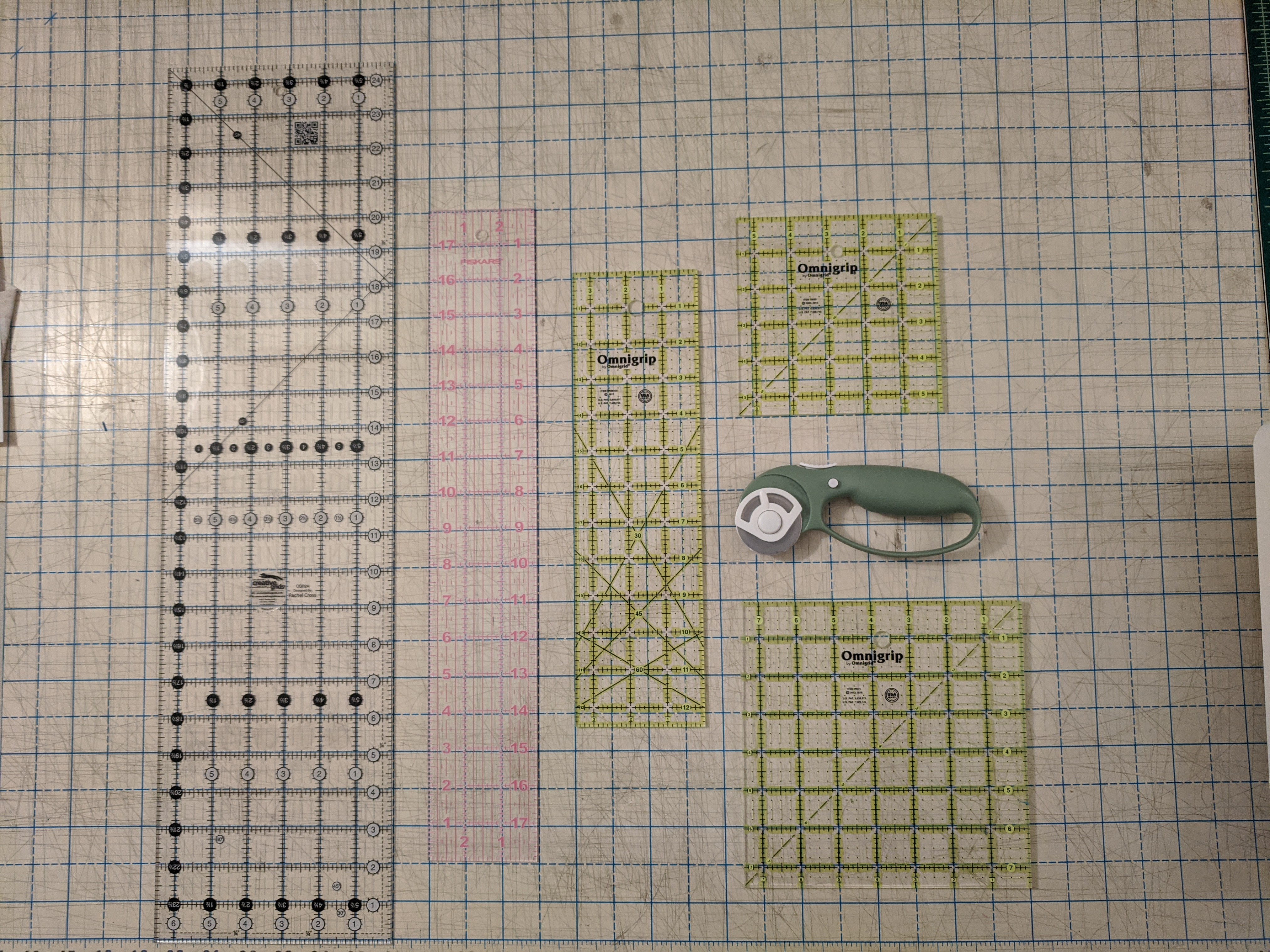
My rulers! So necessary for quilting, since everything is on a grid. Rulers are mostly used in conjunction with the rotary cutter and mats, which make cutting up fabric so easy. I have the big white mat that takes up half my table, and a few other mats that are smaller.
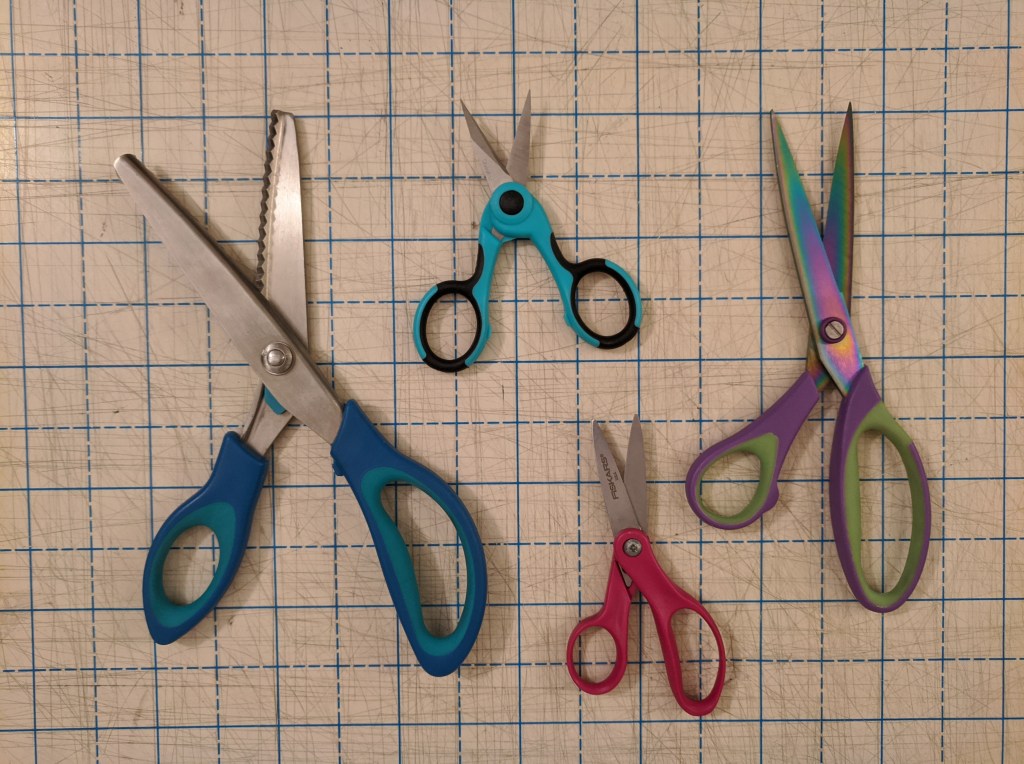
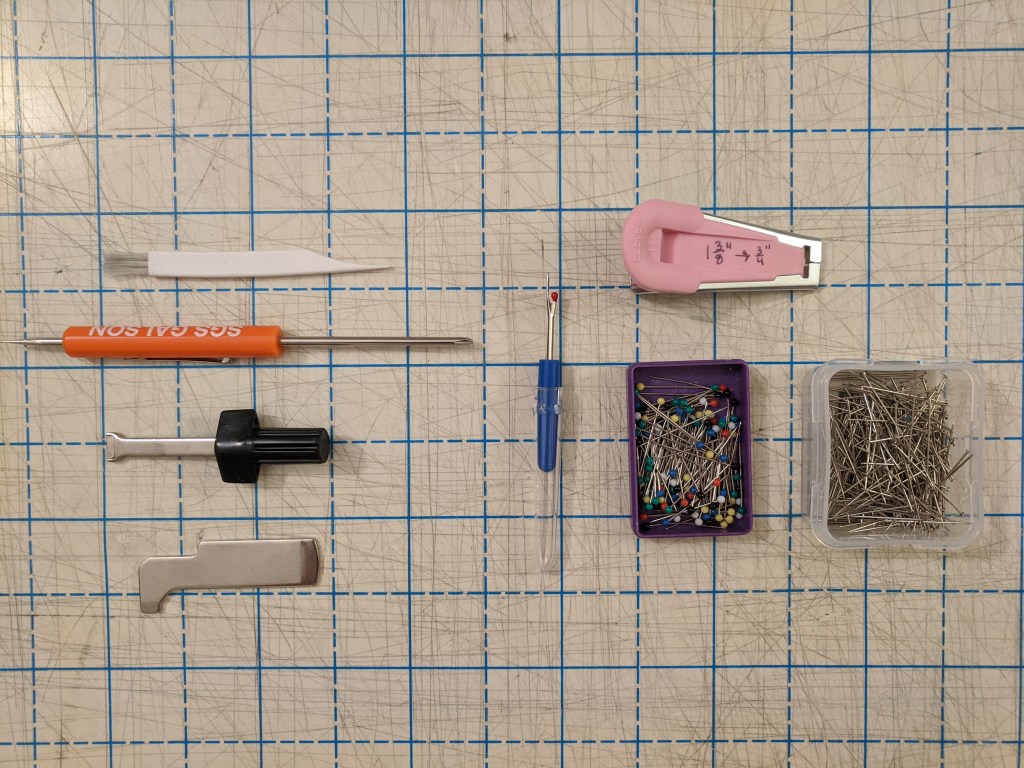
As with rulers, there are many different scissors πŸ™‚ I mostly use them for getting bits of thread and cutting batting. That said, paper dulls scissors very quickly, so fabric scissors are for fabric only! I use little ball head pins and satin pins (far right) to hold fabric together, usually for garments. I don’t usually pin when quilting. I also have my maintenance notions – the lint brush (top white) and various screwdrivers help me clean the inside of the machine from the lint that gets stuck in there. In the middle is my seam ripper, ever useful. The pink thing make bias tape, I can cut a strip, feed it through, and it folds the edges over for you.
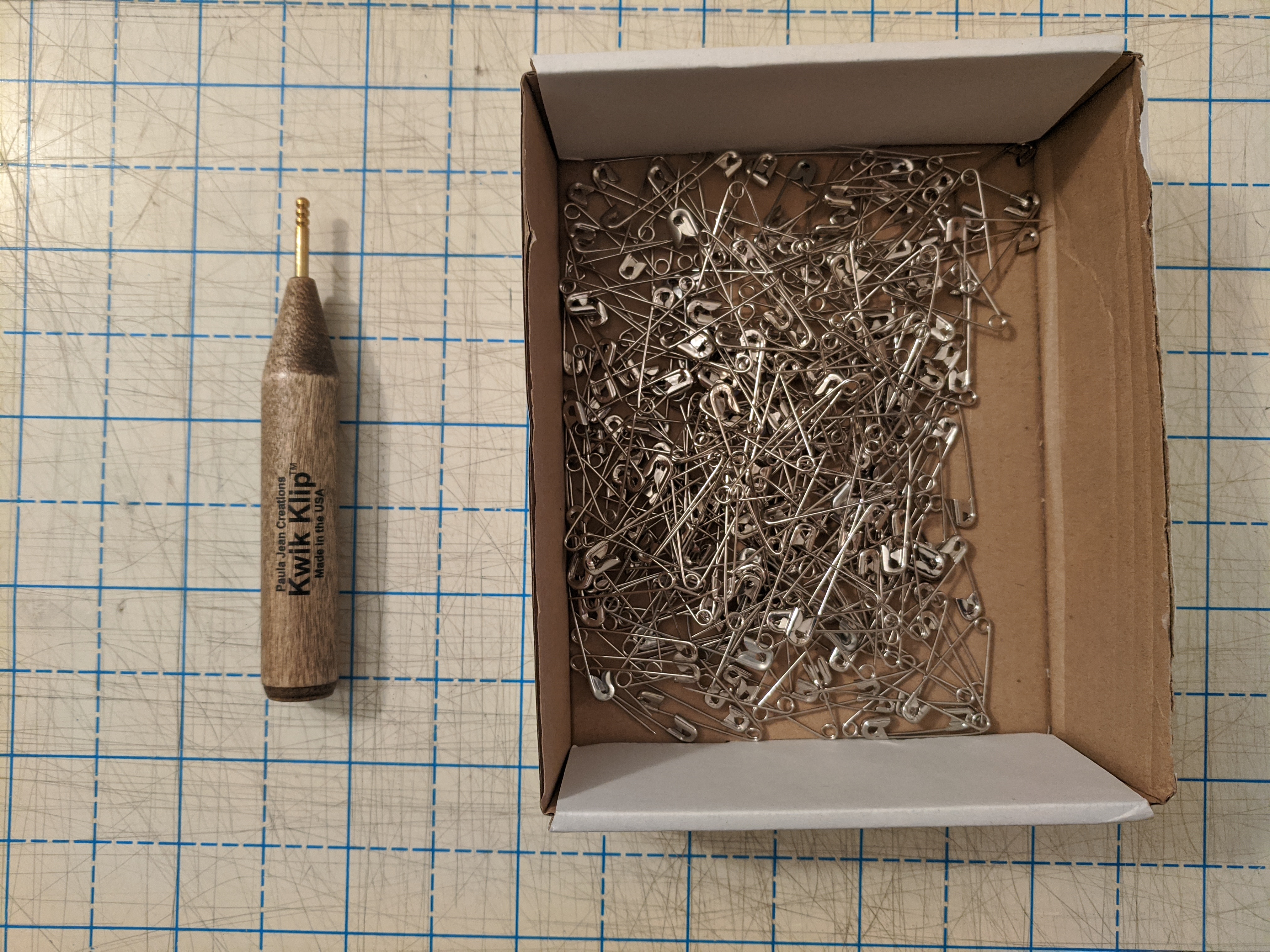
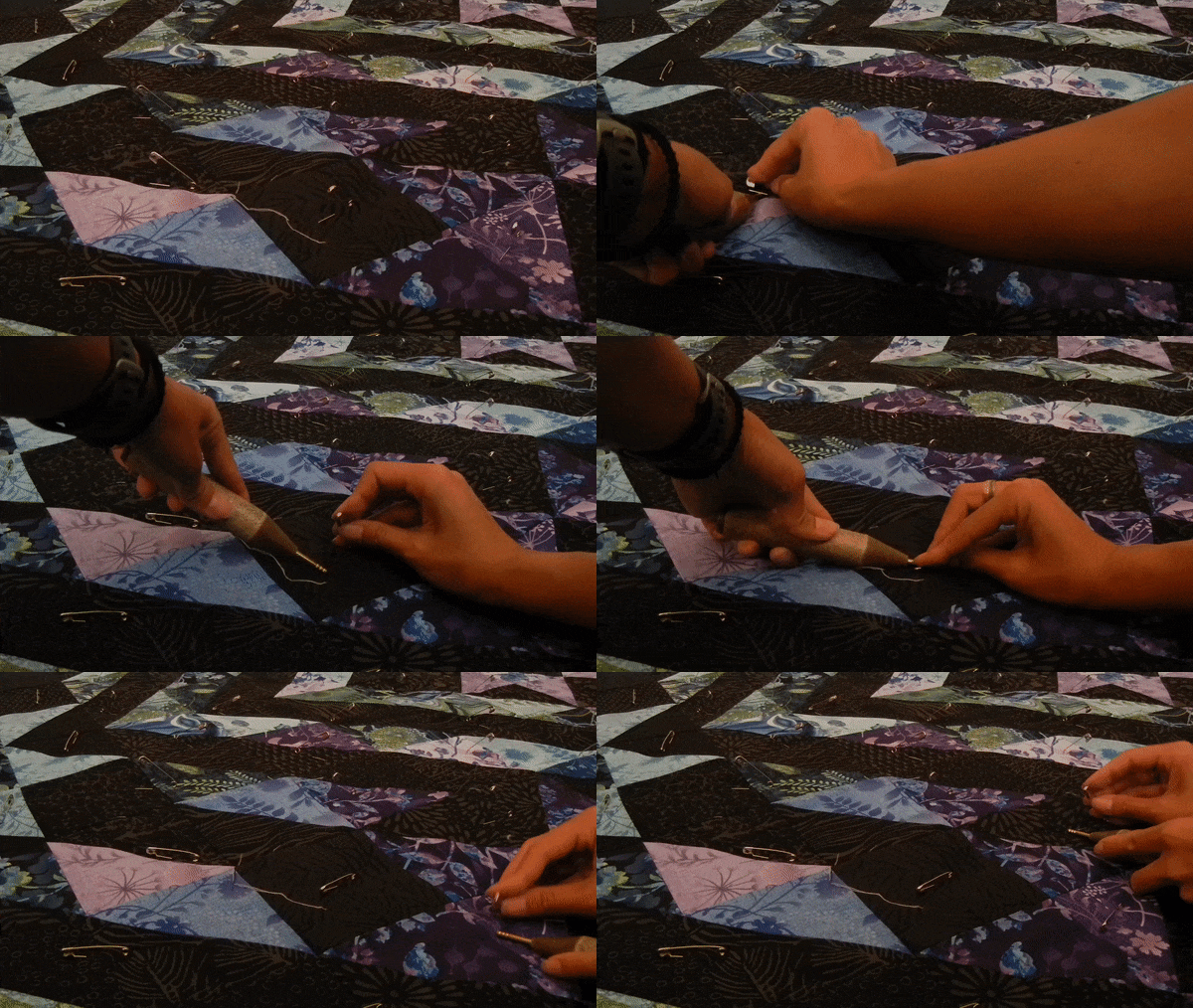
Kwik clip for closing safety pins during basting

Safety pins and the Kwik Klip are used during basting to keep the quilt sandwich together. Spray basting is another way to keep the quilt sandwich together, but I haven’t used it yet.
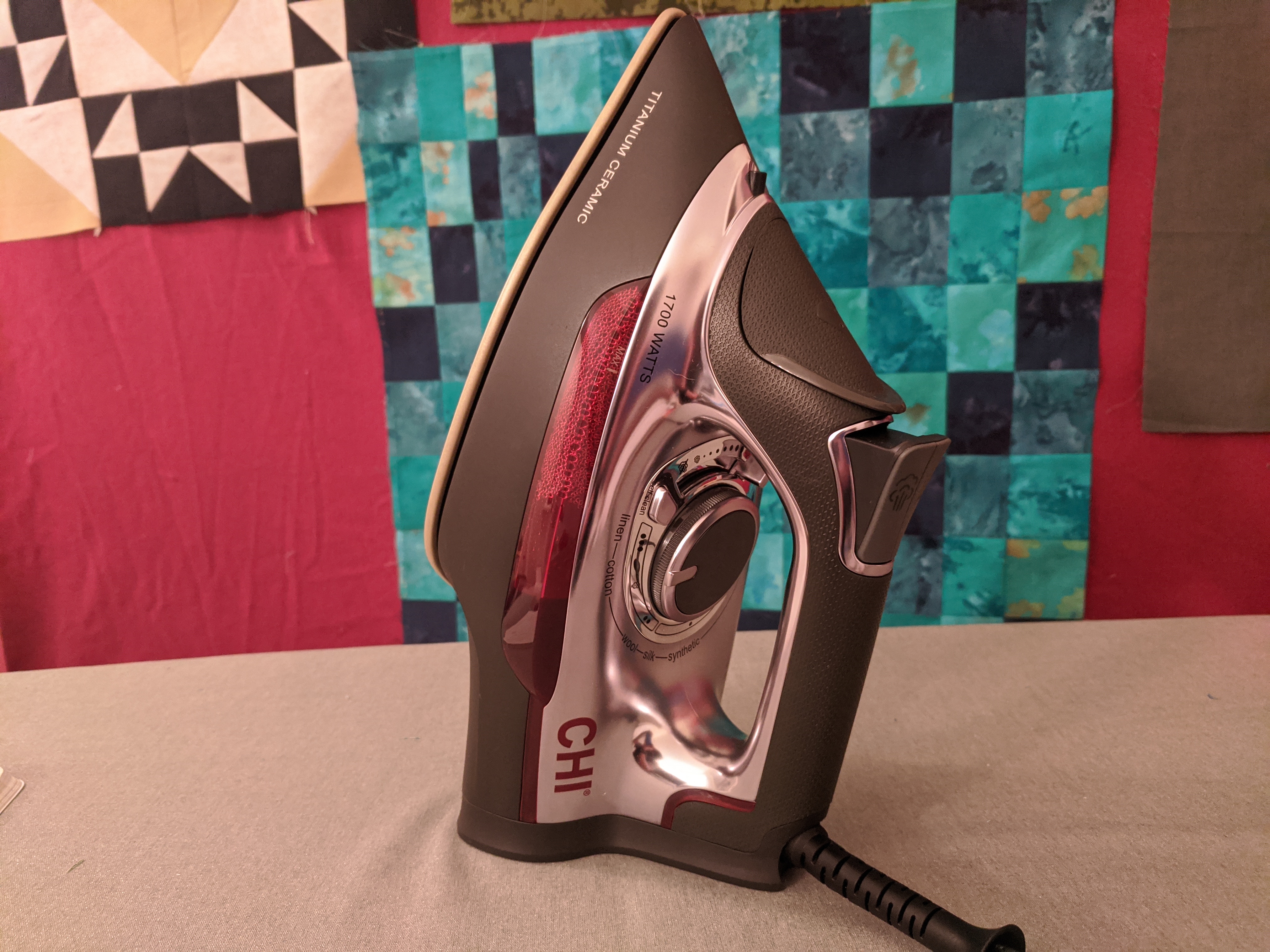
And last but absolutely not least, my iron πŸ™‚ the iron is critical in all sewing. The first press after sewing a seam helps the thread relax into the fabric, and reduces puckers – and in quilting, the idea is to have the top be as flat as possible. Most of the time, I’m on high heat with steam, since that’s the best for cotton. The iron can also be used for fusing interfacing or applique glue.
How Long Did That Take You?

Or, the true answer to my most frequently asked question… πŸ™‚

During the video, I’m working on the modified Anna Embroidery from Namaste Embroidery πŸ™‚ it’s my first time doing 3D wired slips, which I’m super excited about. Plus it’s my first big project with the color blending long and short stitch – each leaf uses 4 colors to blend from light to dark. Towards the end you’ll see me tie off my floss on the back.

The real answer is I don’t know, but a garment is on the order of 10 hours or a week, a quilt is more like 20-30 hours or a month?? But here are some other time considerations:

  • I’m usually working on 2-3 projects at one time
  • My usual sewing night or session lasts 2-4 hours, and I usually sew 2-3 times a week
  • I consolidate fabric shopping for multiple projects at once, a fabric trip takes 1-2 hours
  • I take time to find patterns and research (inside the black hole of the internet)
  • In the beginning I spent a lot of time flipping through library books to learn about techniques and collect patterns
  • My time in the sewing room includes cutting fabric, sorting fabric, ironing / pressing, measuring, arranging layouts, exchanging equipment like bobbins and needles, winding bobbins, looking for my scissors and ruler, pinning fabric together, doing mathematical calculations, and… sewing.

Green Diamonds Quilt

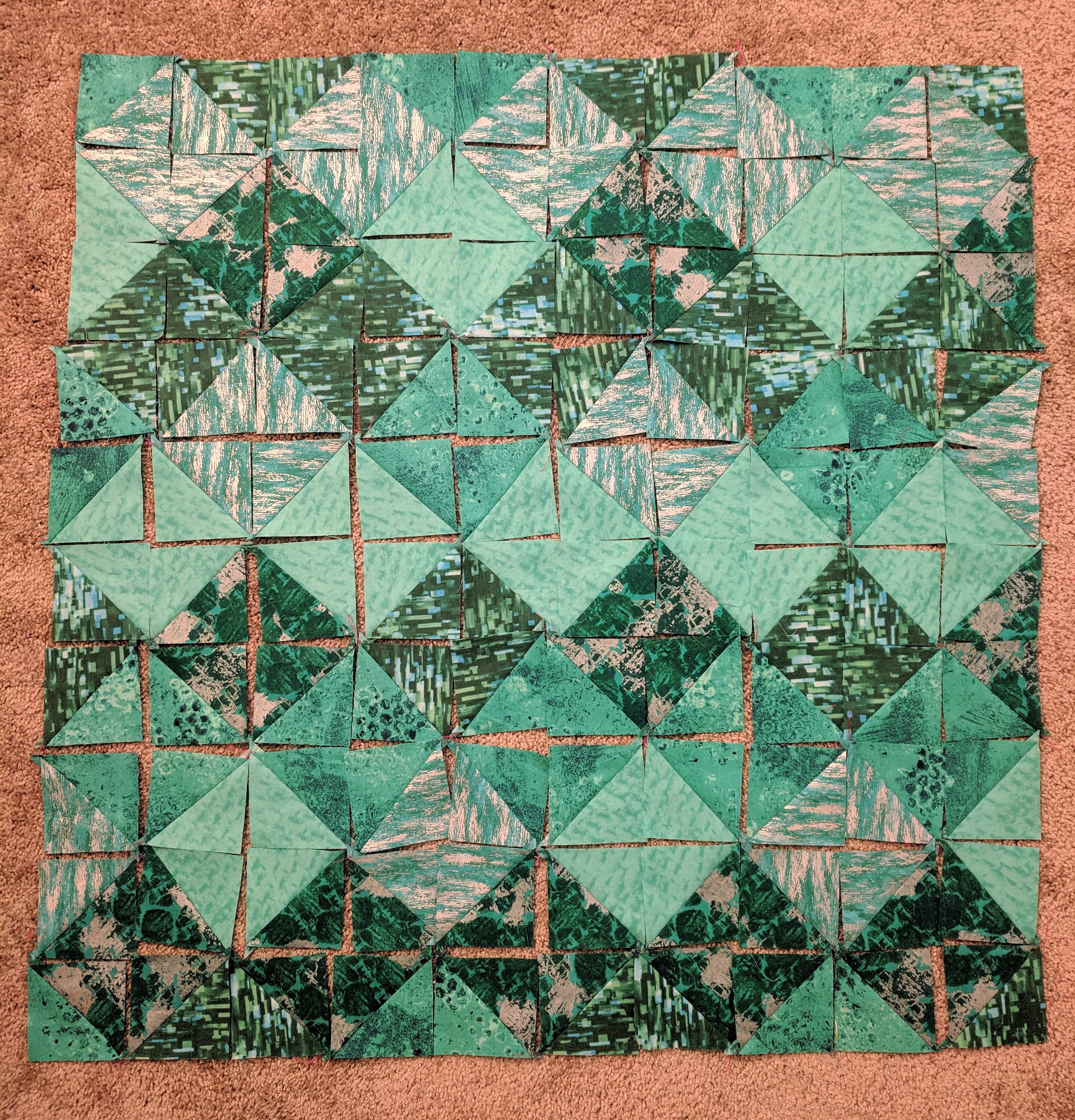
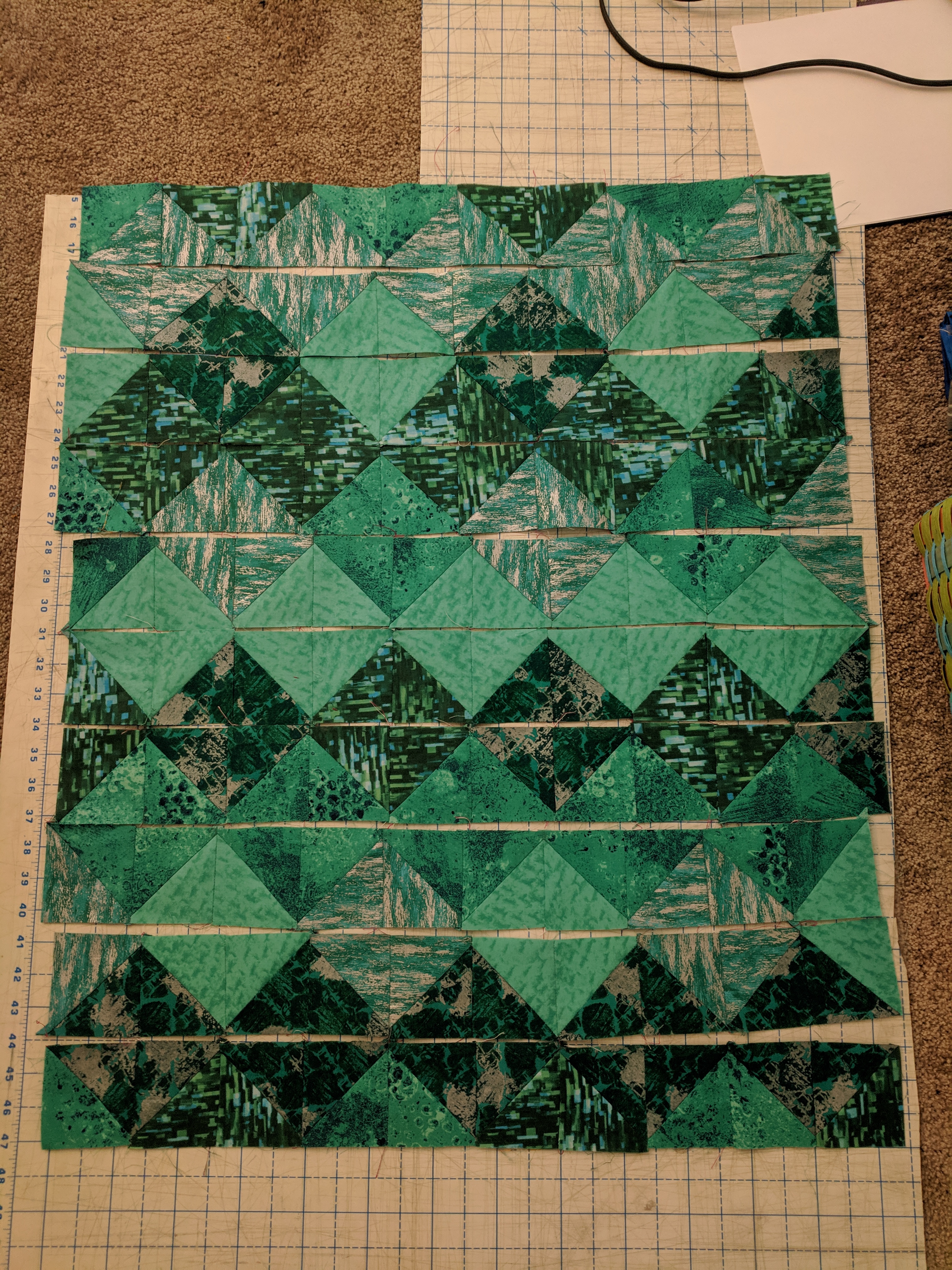
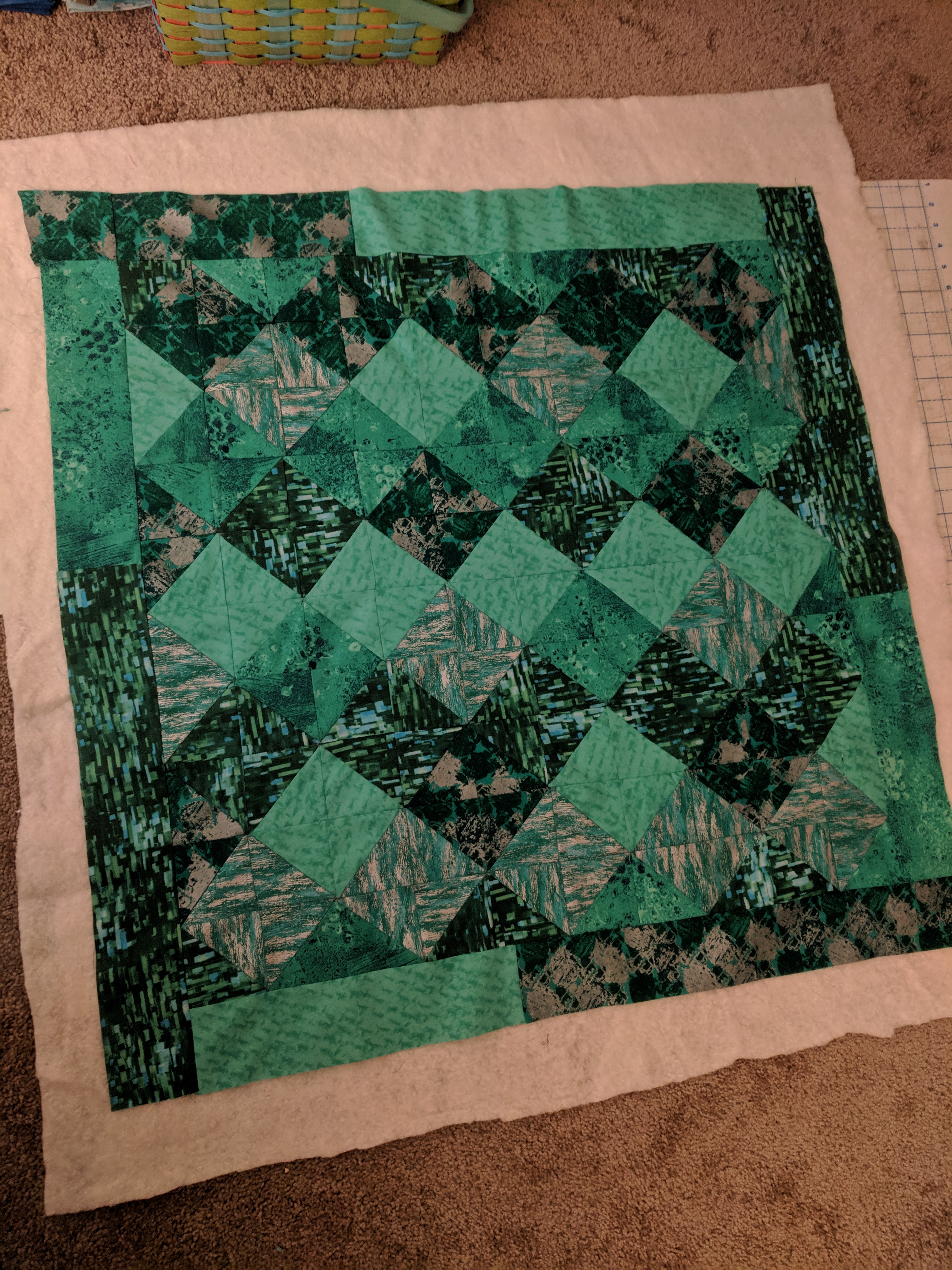
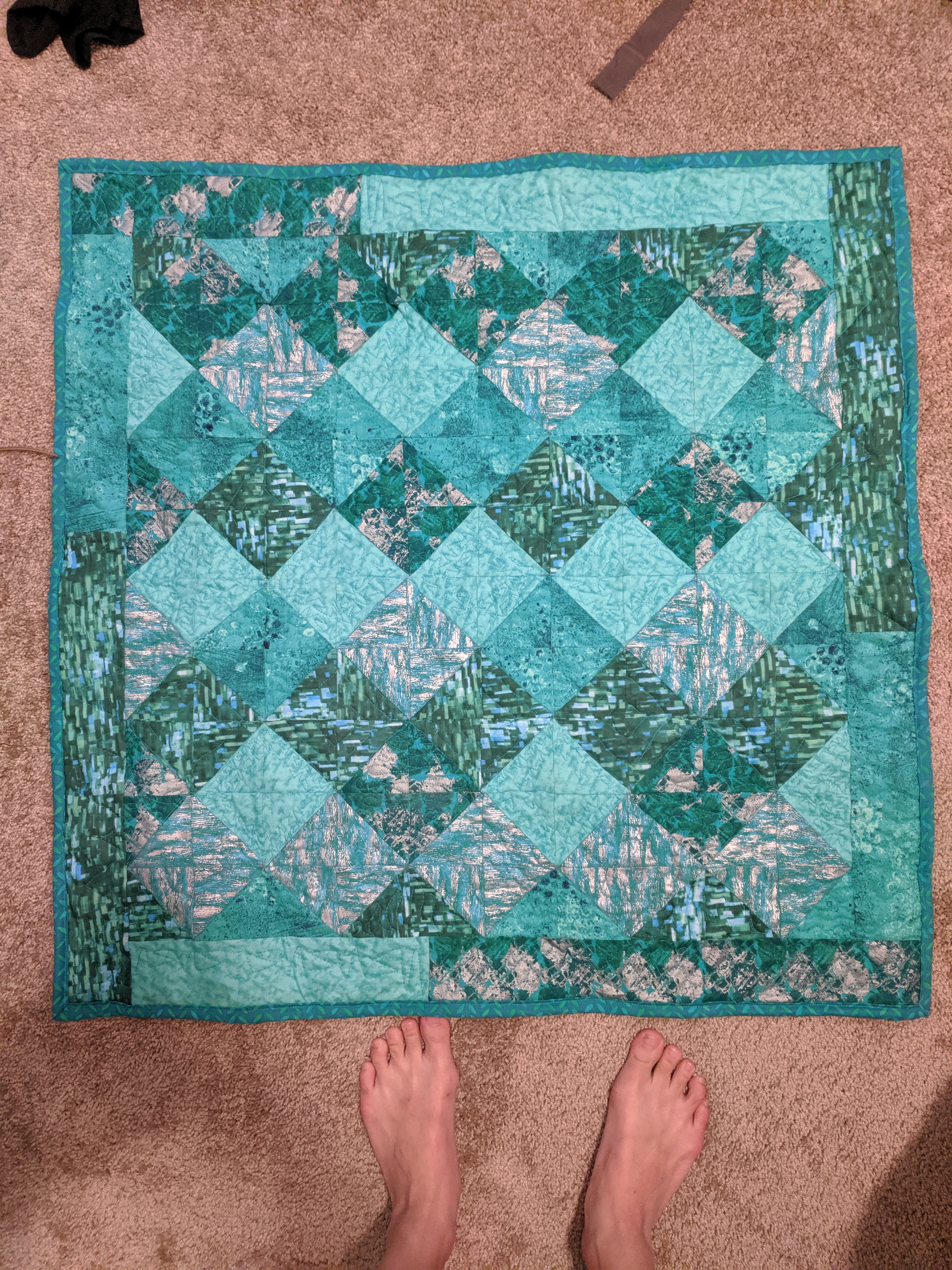
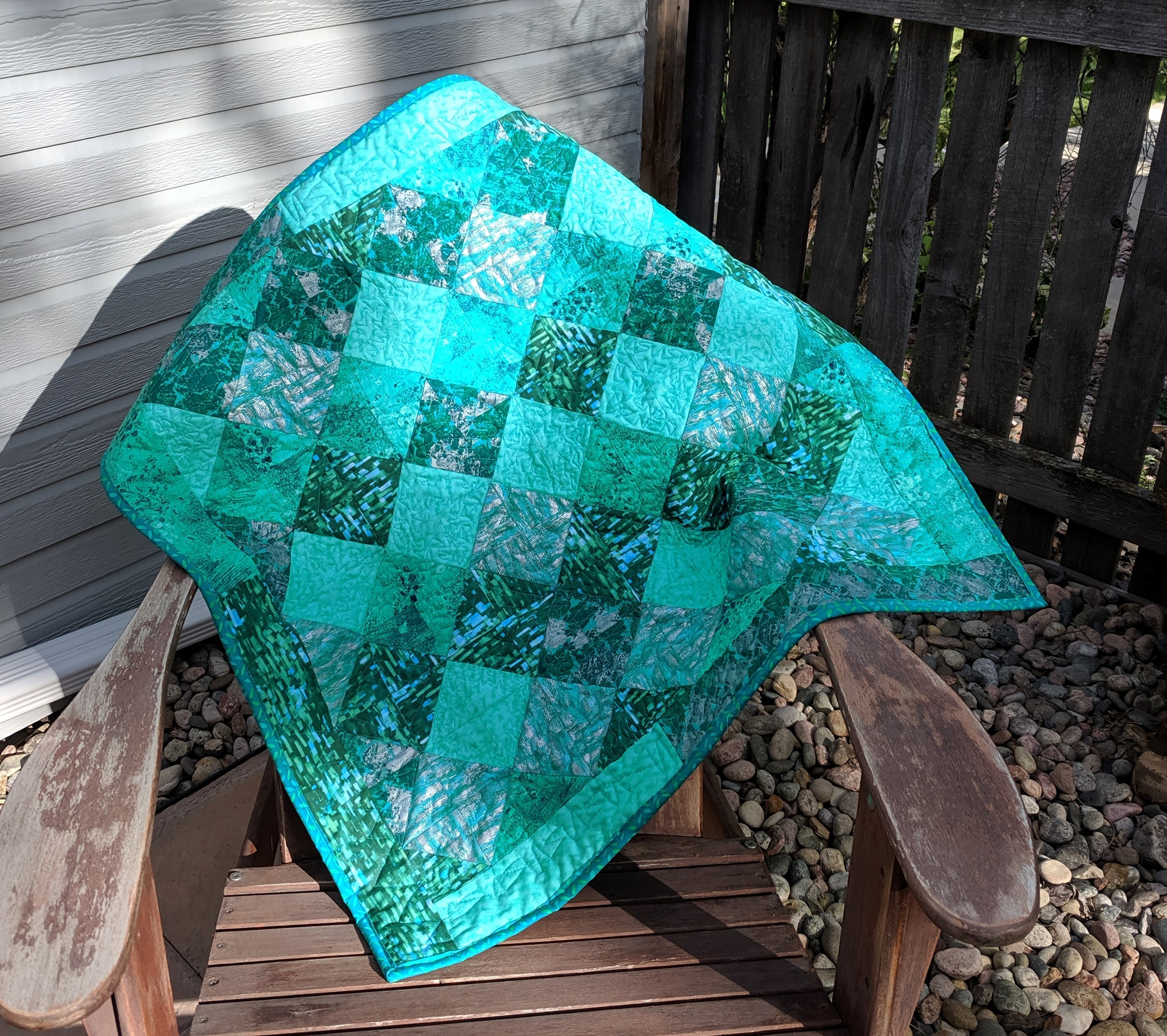
So the Green Diamonds was meant to be a trial “mess up” quilt before I attempted to quilt the rainbow bargello (see next week). I got a cheap 5-fabric fat quarter (18″x21″ piece) bundle from Joann, and cut each fabric into squares. I made half square triangles (HSTs) of each pair of fabrics – so each fabric had a set of HSTs with each other fabric. I decided to lay them out in a fake “on point” design, so that each fabric was represented by a row of diamonds. This created a secondary block, or pattern, between the rows of diamonds that’s diamonds of alternating fabric. I sewed these together in rows, then sewed the rows together. I used some excess fabric for the border.

Let’s take a second to talk about quilting. A quilt, by definition, is a piece of fabric (quilt top), a piece of batting, and another piece of fabric (backing), and at some point those three layers are held together by thread. For the most part, quilters these days use 100% cotton fabric for the quilt top and backing, and there are many different kinds of batting: cotton, polyester, cotton/poly blend, wool, etc. These three layers together are called the quilt sandwich, and the act of putting the thread through all the layers is called quilting. πŸ™‚ Quilting can be done by hand or by machine.

  • Hand Quilting
    • Design: hand sewing a running stitch to make lines or a design across the quilt top.
    • Tying: using a needle to draw thread through all three layers and tying the thread on either side of the sandwich. Can be used with buttons or other baubles.
  • Machine Quilting
    • Walking Foot: usually used for straight line or simple designs, a walking foot is an alternative presser foot (thing that holds the fabric down against the machine as you’re sewing) that helps feed the top of the sandwich through the machine at the same rate as the feed dogs that are moving bottom of the sandwich. Normal presser feet do not bring the top through as effectively, and stitching can become uneven and fabric can get stretched or distorted.
      • Feed dogs are the little strips that come up and down and move the fabric through the machine as the needle moves up and down. In mechanical machines, the needle and feed dogs are moved by the same crankshaft.
    • Free Motion: a free motion foot is used instead of the presser foot, and the feed dogs are lowered so they do not move the fabric. The quilter moves the fabric around the sewing machine space so that the needle travels across the fabric. Can make lines and patterns like hand quilting.
    • Longarm: a special sewing machine where the fabric is held stationary on a large frame, and the quilter moves the machine with the needle around the quilt. Machines like these are very expensive but incredibly effective. Much easier than moving the fabric in free motion.

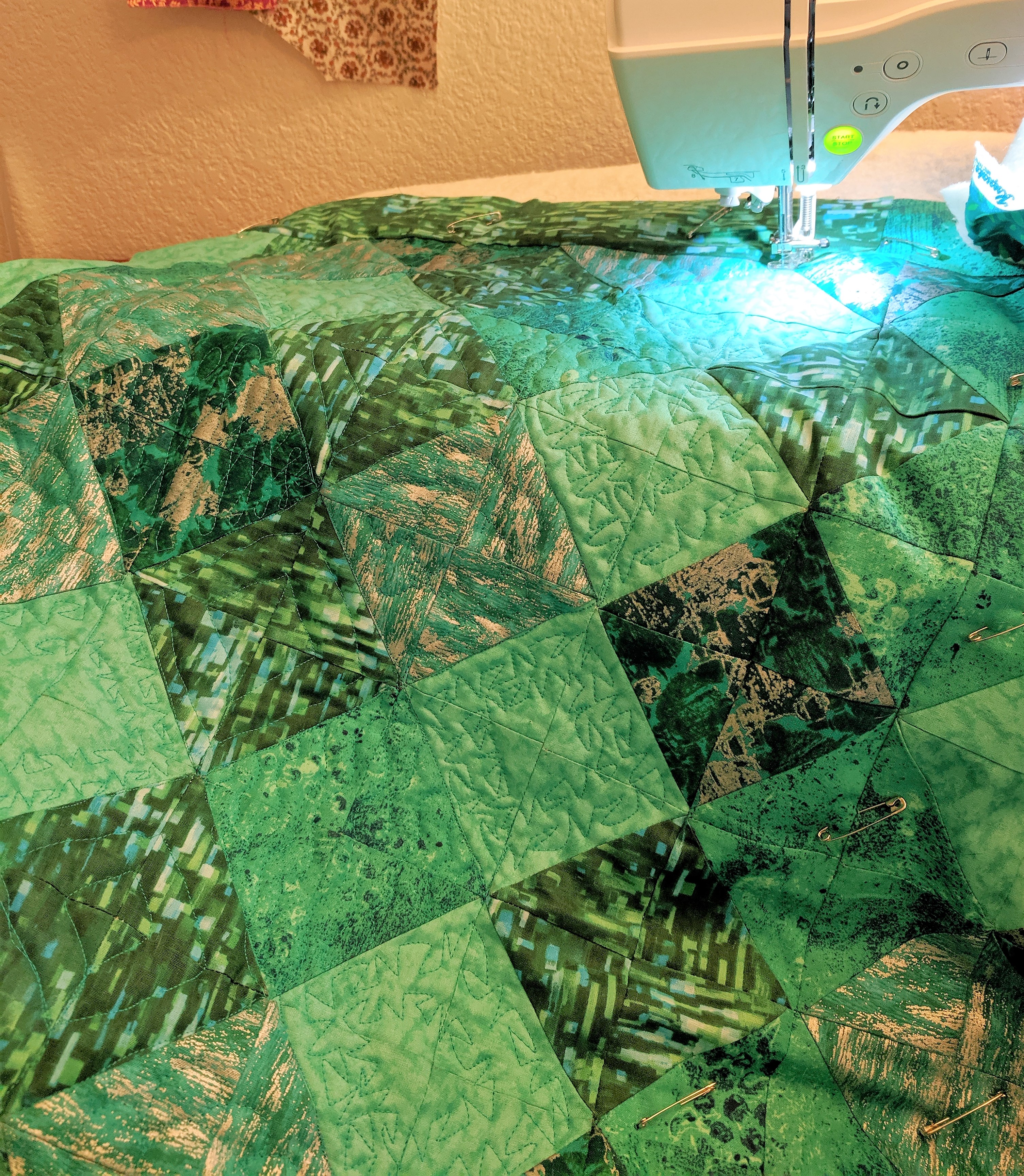
So I knew I wanted to do free motion with this quilt. I did a lot of practice with pen and paper (surprisingly useful) and on scraps. In a fit of ambition, I decided that each fabric would have its own design. There is “dot-to-dot”, NZNZ, swirl with petals, wavy lines, and wishbone. Let me say this now: I didn’t practice enough on all of the designs. I’d done wishbone before on a pillow, so that one turned out pretty nice. And I surprised myself by having some very nice wavy lines, too. Dot-to-dot was the hardest – creating a straight line mid-fabric without any guides (I decided to forego drawing in water soluble marker on my fabric) is really hard.

Before you quilt the sandwich, you have to baste it so that all the layers stay aligned and don’t move around while you’re quilting. You can hand baste with stitches, spray baste with adhesive, or safety pin (my chosen method). You lay your sandwich on a flat surface (preferably not carpet), and I like to tape down the edges of my backing so it doesn’t slide about. Then you start pinning in the center and move outwards, smoothing wrinkles as you go. This also makes sure that you don’t end up with weird wrinkles, pleats, or bunches in your finished product (but more on that later).

So anyway after pinning the living daylights out of my sandwich, I sat down to do some free motion. You always start in the middle and work your way out, just like basting. I decided to work down the rows so that I could keep doing the same design and keep it in my muscle memory. One of my issues with this quilt was moving from diamond to diamond – some of my designs didn’t bring me back to my starting point, or guide me into the next diamond. Also, since this was an HST design, there can be up to 8 layers of fabric at the intersections, which made it bumpy and hard to quilt near the centers and points of each diamond.

It took a bit, but I quilted this in a couple nights and put the binding on (strip of fabric wrapped around the edges of the fabric).

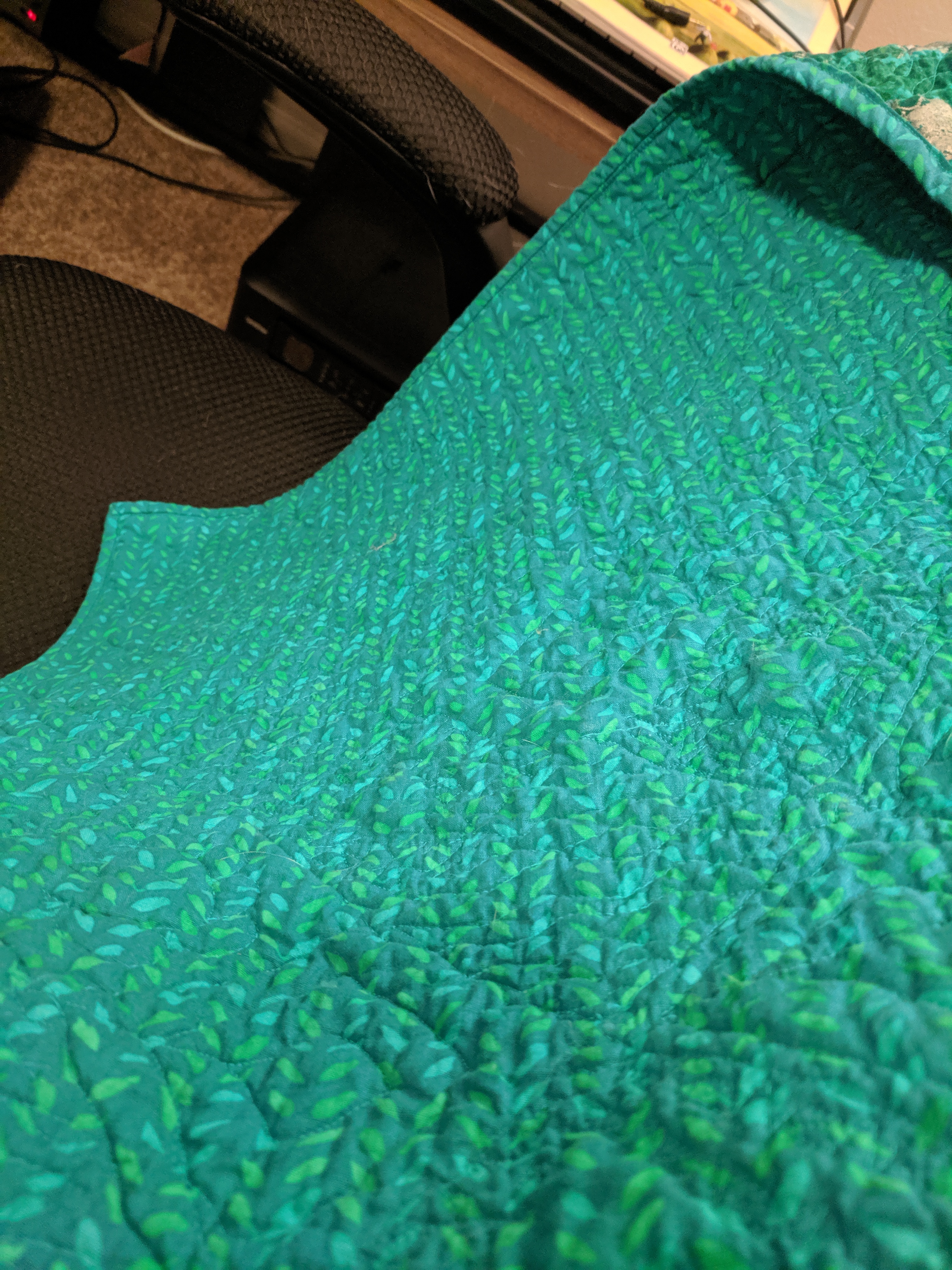
Now – about the wrinkles and bunches. I loved my finished product, but there’s one last step in quiltmaking. Washing and drying. No one likes something they can’t throw in the washer and dryer. I was extremely worried about threads coming loose, or the binding just spontaneously falling off (extremely unlikely), but I threw it in the washer anyway. And when I put it in the dryer, I didn’t even look at it.

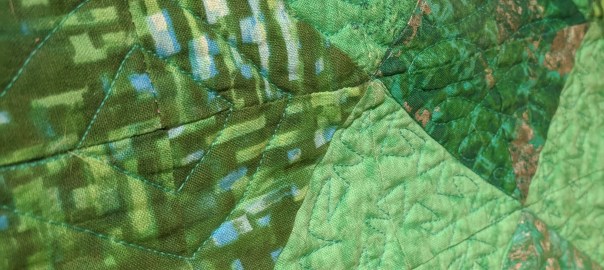
But then it turned out wonderfully crinkly and soft, and nothing bad happened πŸ™‚ Washing your quilt helps the batting fluff up a bit, and the quilting sinks down, making a nice texture that hides mistakes (of which I made many) and bumps (of which there are many) and pretty much everything else. Plus it makes the whole thing soft and cuddly, which is what quilts are (for me) meant to be. I don’t think you’d wash an art quilt, or something with super detailed free motion, but for my purposes, I learned to stop worrying about the tiny things because I can’t even find them anymore when I look at the quilt. And as Angela Walters says, “better finished than perfect”.

Project completed May 24, 2019.