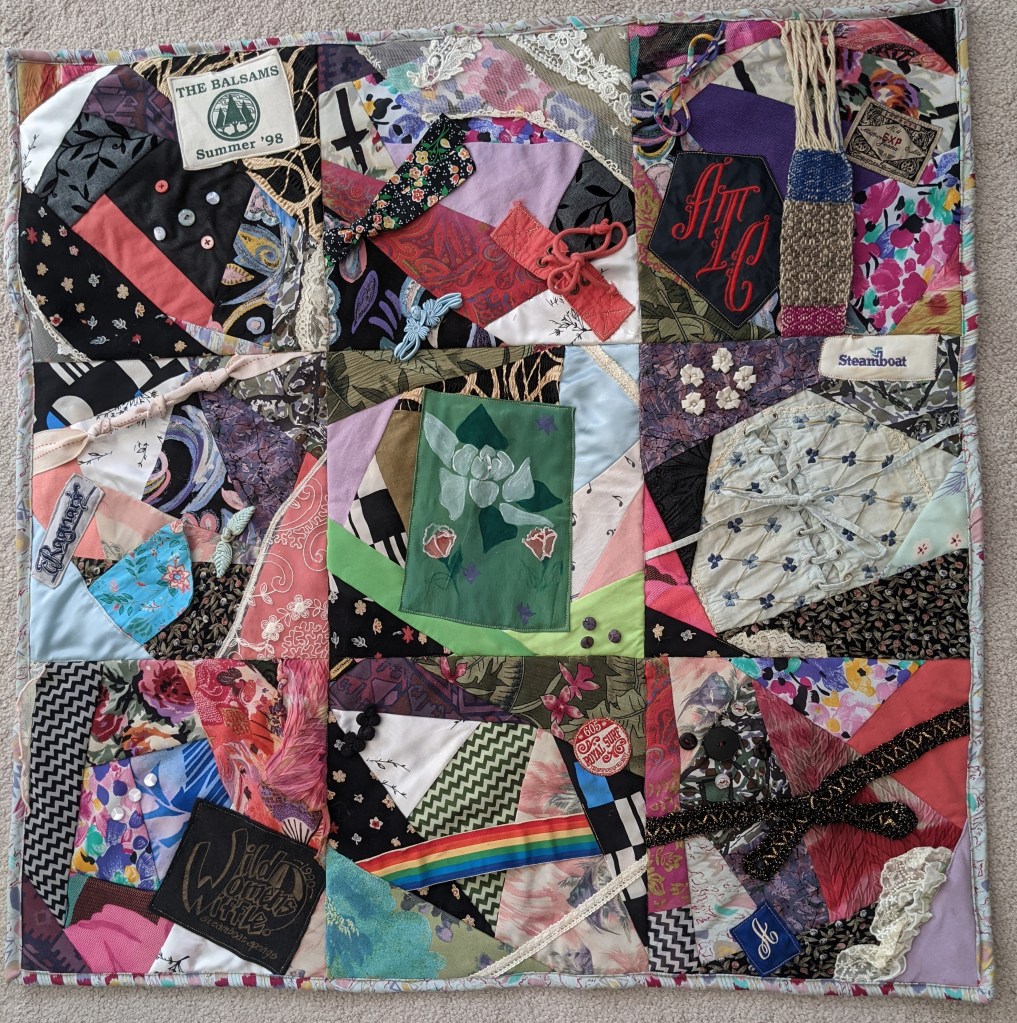
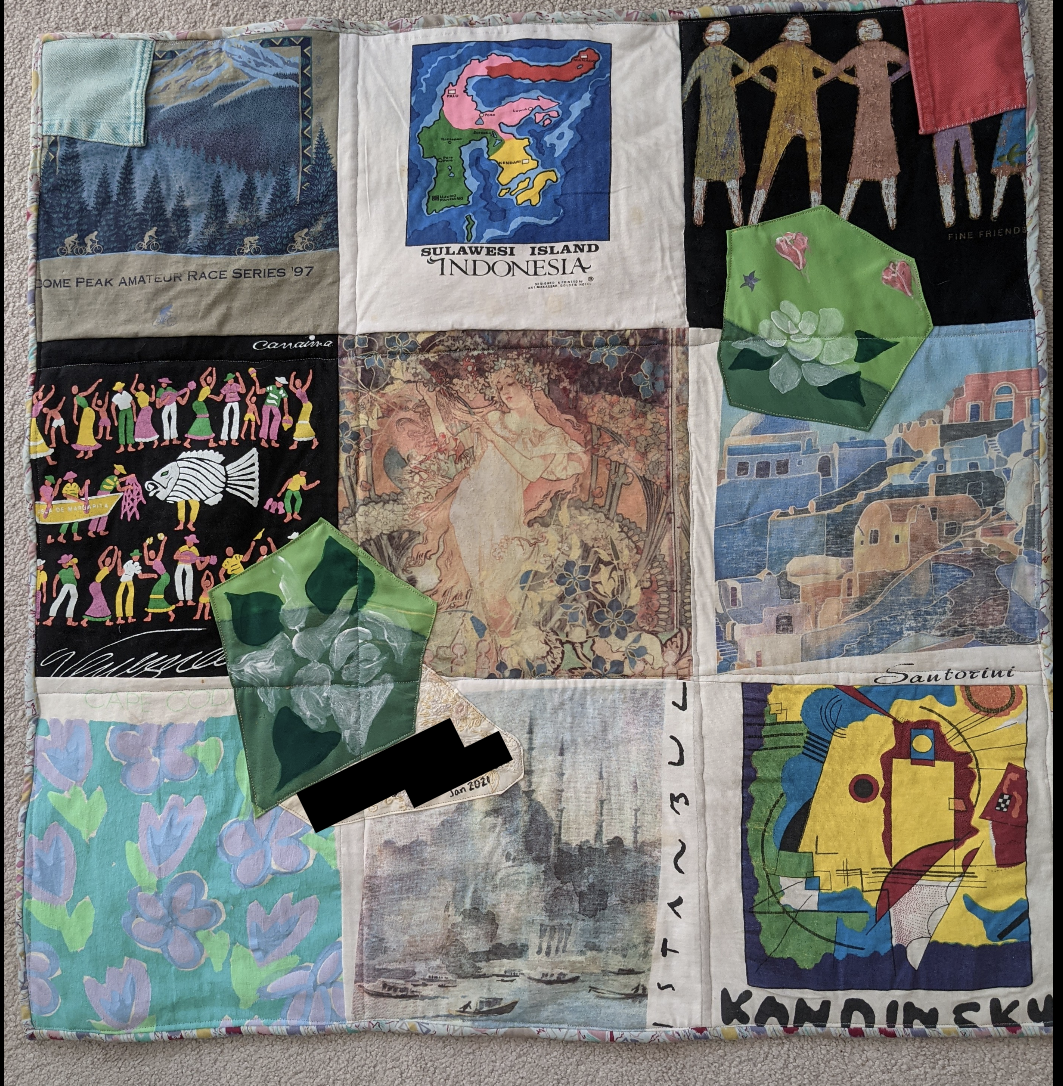
This memory quilt for my cousin was my other big project of 2020, finished in this first month of 2021. My cousin provided her mother’s clothes, which are incredibly fun and colorful. I knew I wanted to do a crazy quilt for my cousin, since she didn’t want something too big, and her mom’s clothes are truly too fun to do something simple with.
First, I inventoried all the fabric and cut off buttons and fasteners and other 3d elements I wanted to include. I chose a 3×3 layout for the back of 9 graphic t-shirts, and figured I’d do the crazy-pieced blocks to match on the front. Through the process, the front blocks ended up a bit smaller but it wasn’t a big deal.
For the piecing, I cut pieces with an uneven number of sides (a tip from the museum employee) for the center piece. Then I added on new fabric to each side, and continued until it was the right size. Since a lot of the fabric was stretchy and textured itself, I used some scrap fabric behind the block to stabilize everything.
I chose some logos to applique, just like my other memory quilt. I appliqued them on the blocks, prior to piecing the 9 blocks together. At this point I also added some lace, belts/scarves, and other ties by machine.
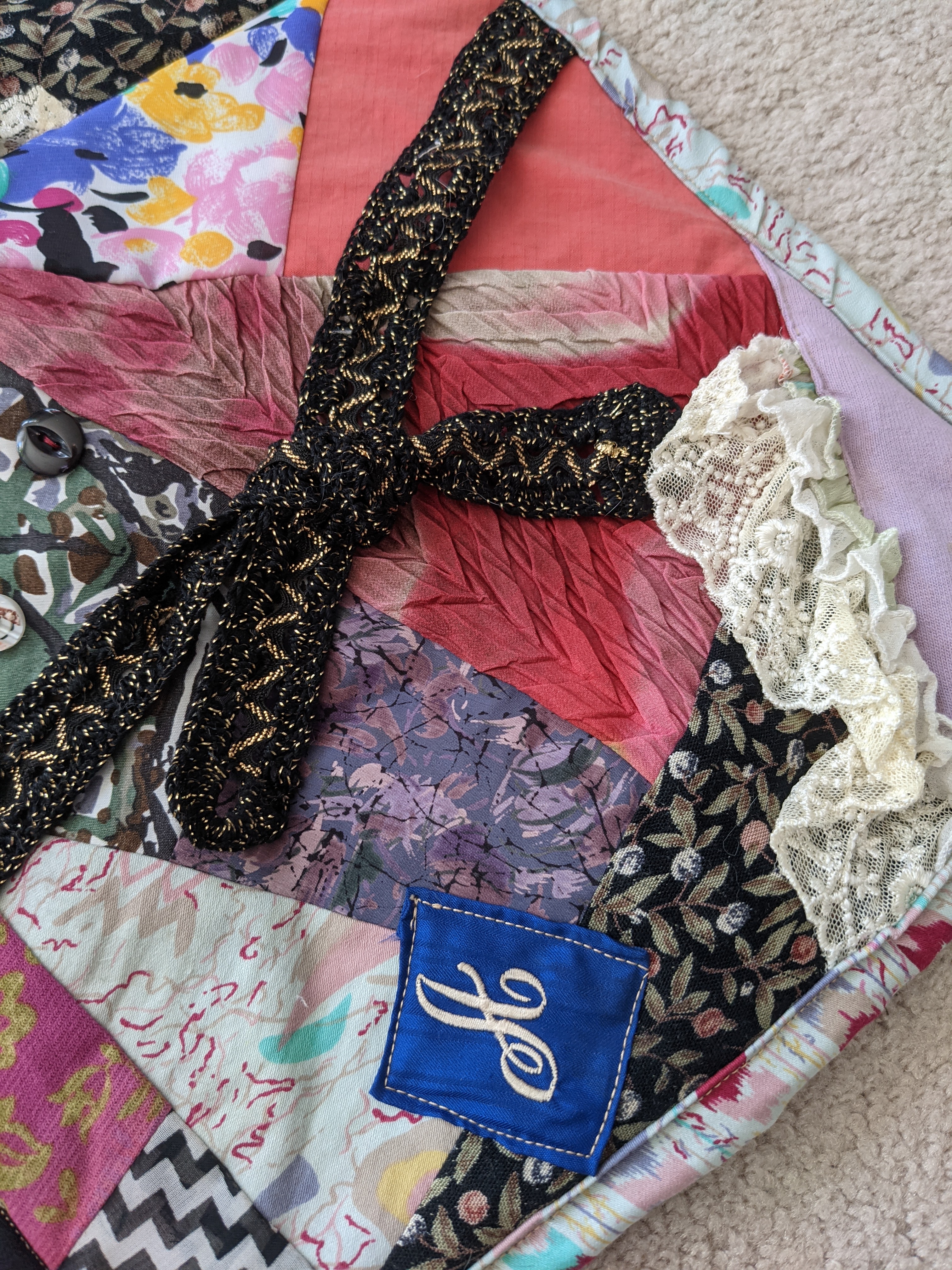
Black and gold belt, some lace, and appliqued logo
Then I pieced it together because I wanted to add the buttons and fasteners between some blocks. I added the buttons and such by hand, since they’re a bit fiddly on the machine.
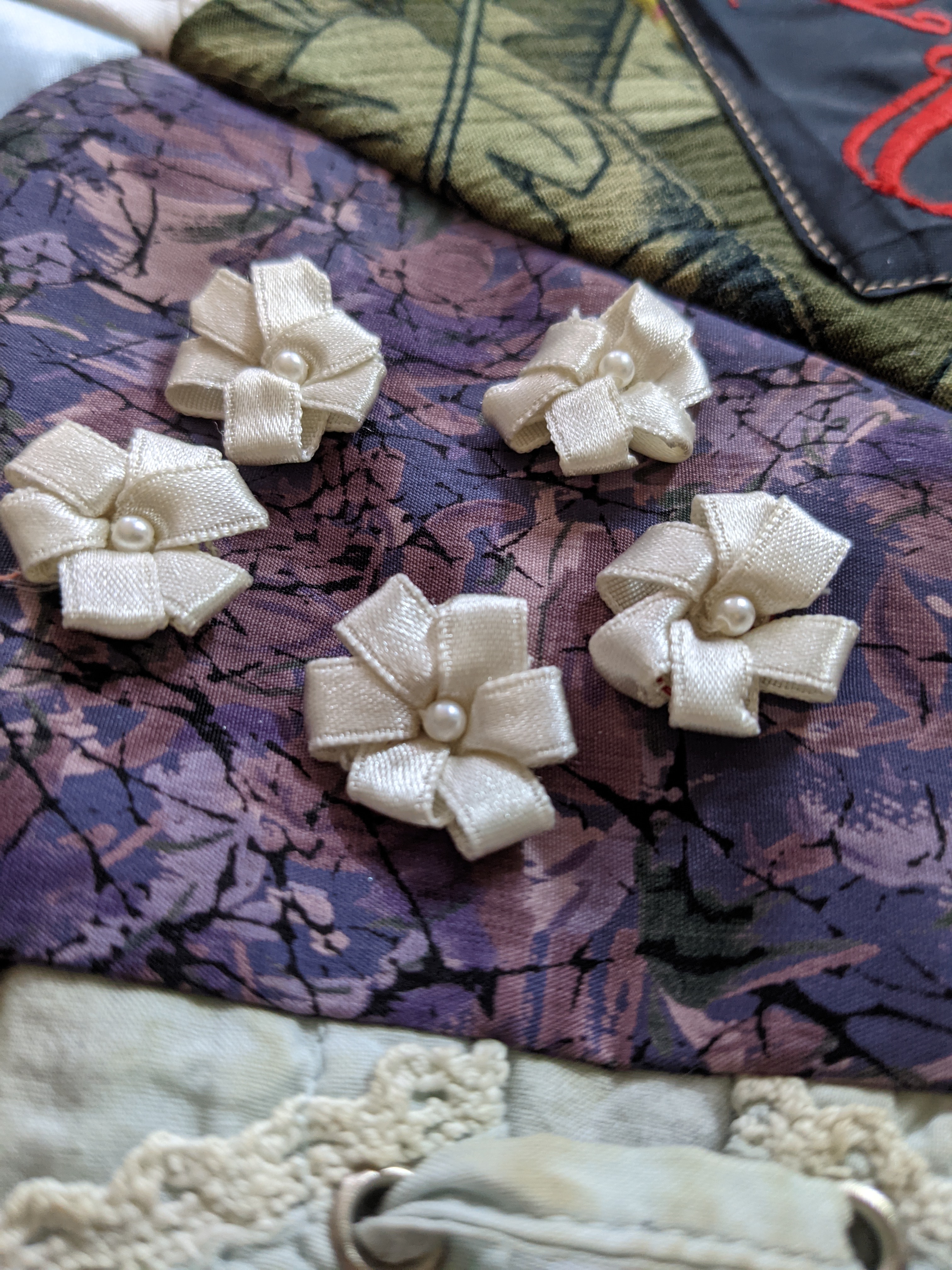
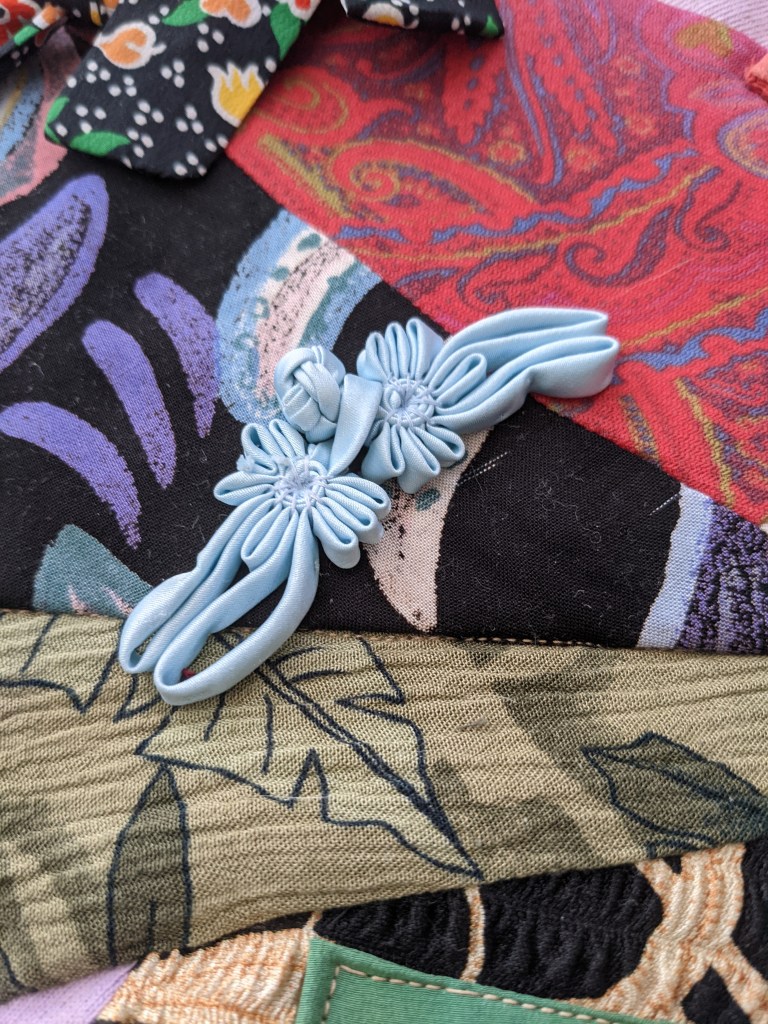
These were the buttons of the shirt seen in the background of the picture below 🙂These ribbon flowers were already part of a sweater, so I extracted them from the sweater and sewed them on! Cute little fastener from the leg of pajama pants
My cousin wanted to feature her mom’s beautifully hand painted wedding dress, so I appliqued one of the main flowers on the middle block and on the back of the quilt. I did simple stitch in the ditch quilting, since the top was already very busy.
I used jean pants pockets to allow my cousin to hang up the quilt if she ever chooses.
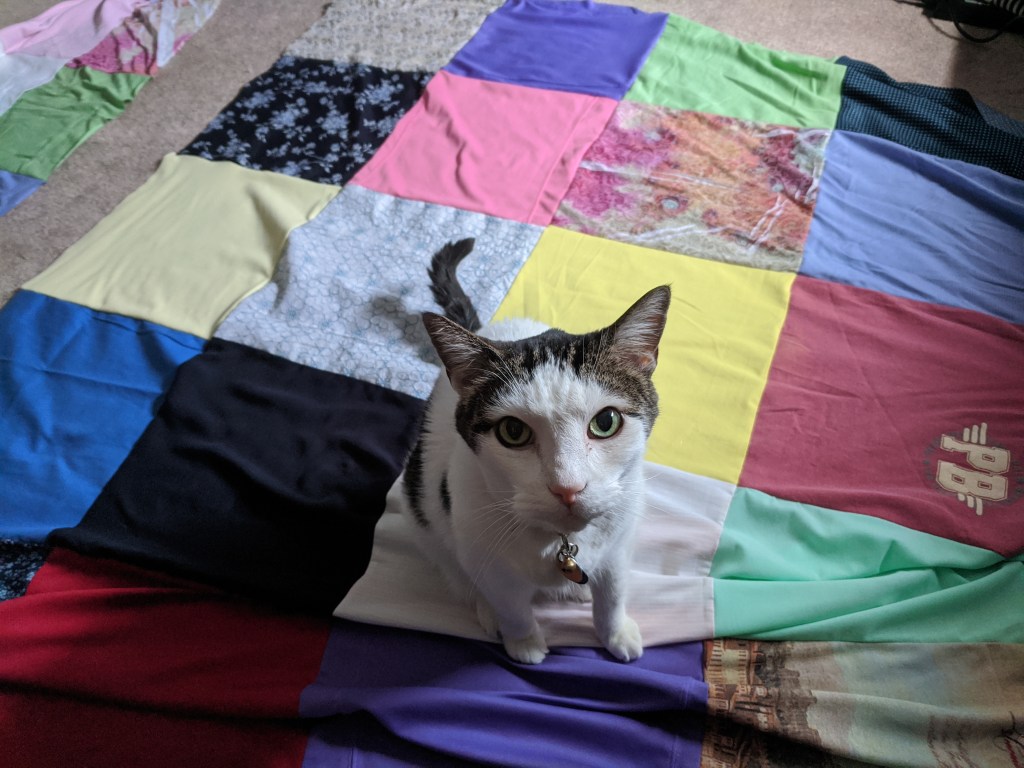
My uncle lost his wife in 2018 and I wanted to honor her with a memory quilt out of her old shirts. My uncle provided a bunch of bright polo shirts and other shirts of hers, which I made into a quilt for him. I wanted to keep it really simple and soft, so I cut out big squares from the shirts and laid them out in a grid pattern.
Layout with my friendly helper
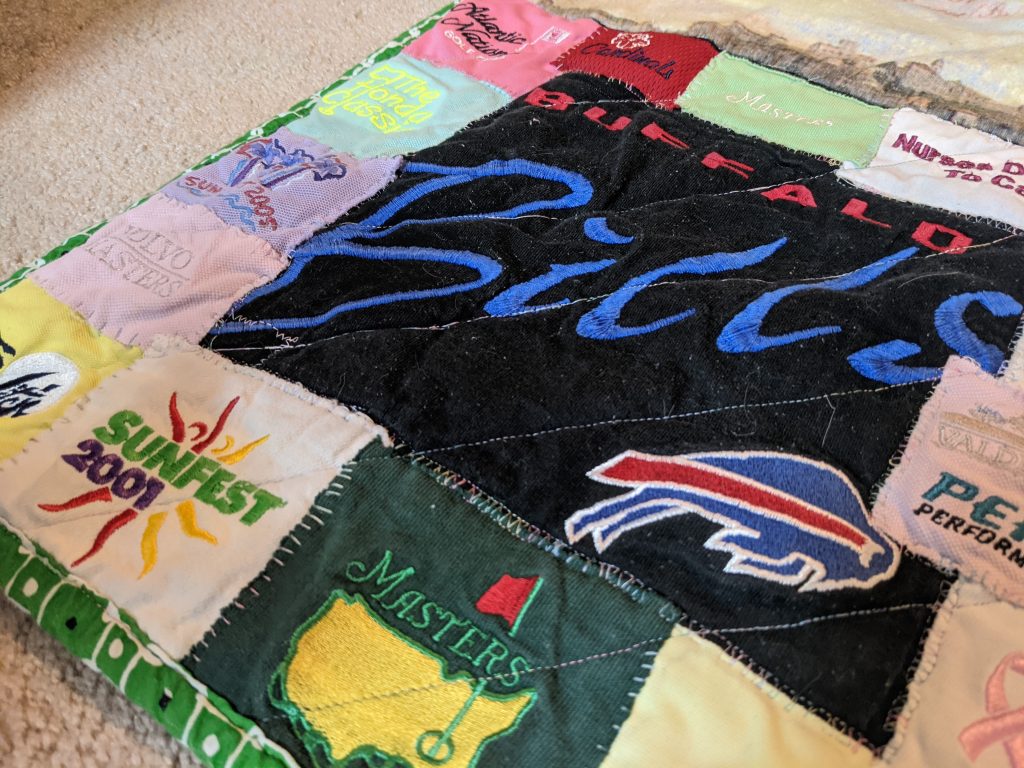
Most of the polos had awesome logos on them, which I wanted to include in some way. I thought a bit about applique-ing them to a border, but I didn’t want there to be lumpy or hard parts throughout the quilt. I decided to put all the logos together in one corner and applique-d them onto a square that already had the Buffalo Bills logo on it. I tacked them down with my sewing machine and then hand stitched around each one to really make sure they don’t go anywhere.
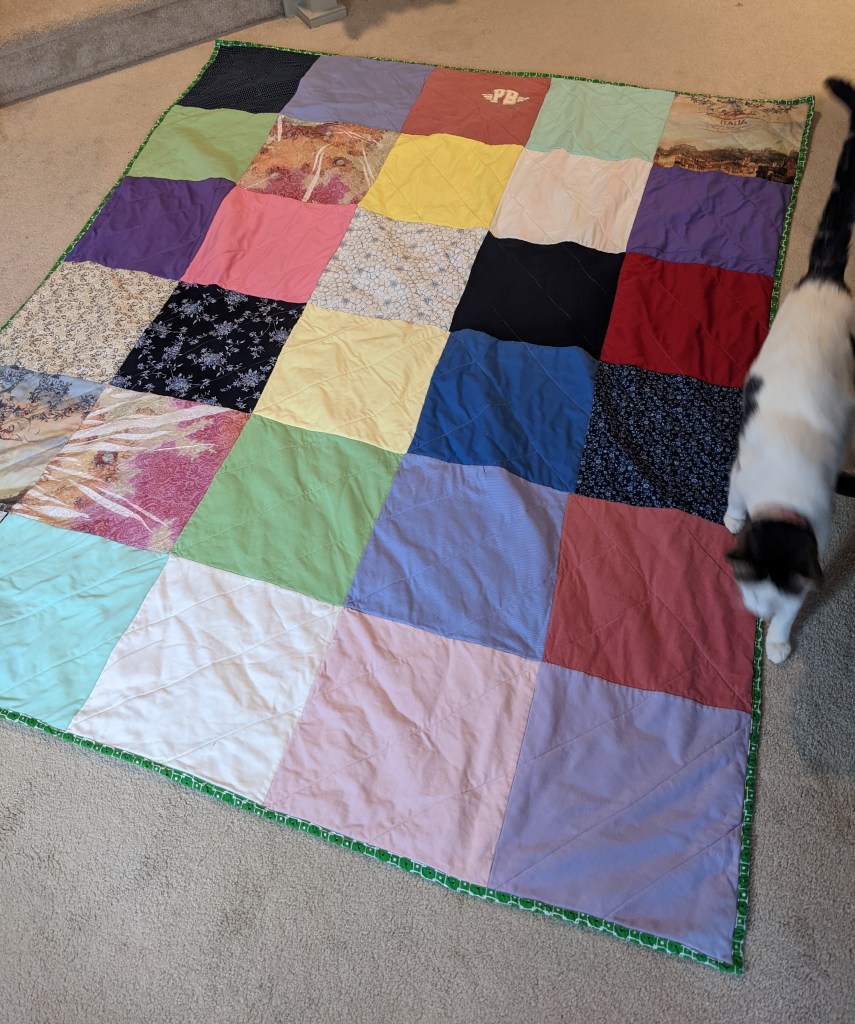
I kept the quilting really simple, two sets of diagonal lines. I used rainbow thread since my aunt was so bright and colorful.
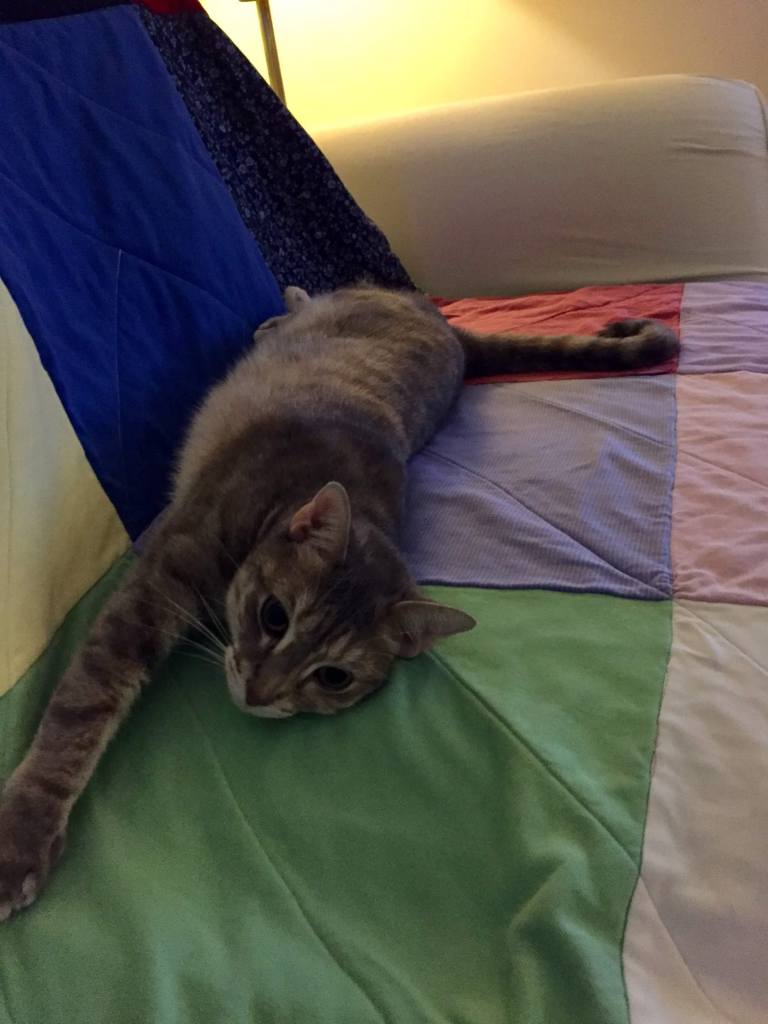
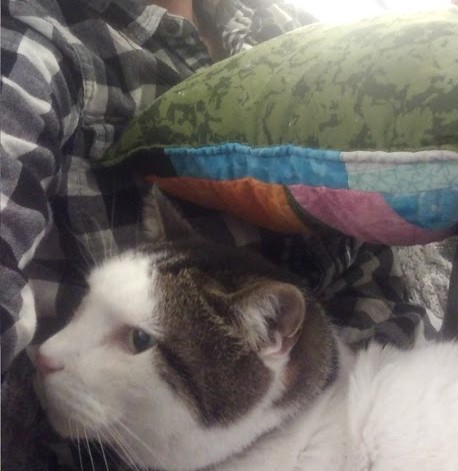
Finished quilt with my cat for scale
This was my big project of 2020 and I’m so glad I was able to deliver it to my uncle before the year’s end. 2020 has been tough on all of us and I’ve struggled to get into my sewing room as often as I’d like, but I chipped away at this project little by little and I’m really happy with the result. I sent it off to my uncle and he sent me back a picture of it with his cat 🙂
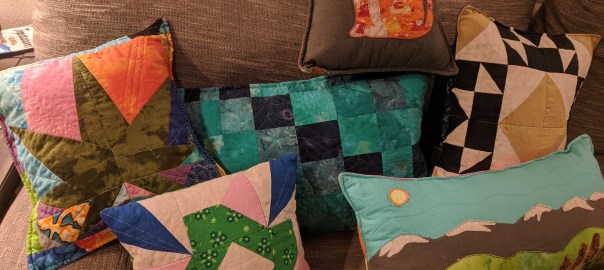
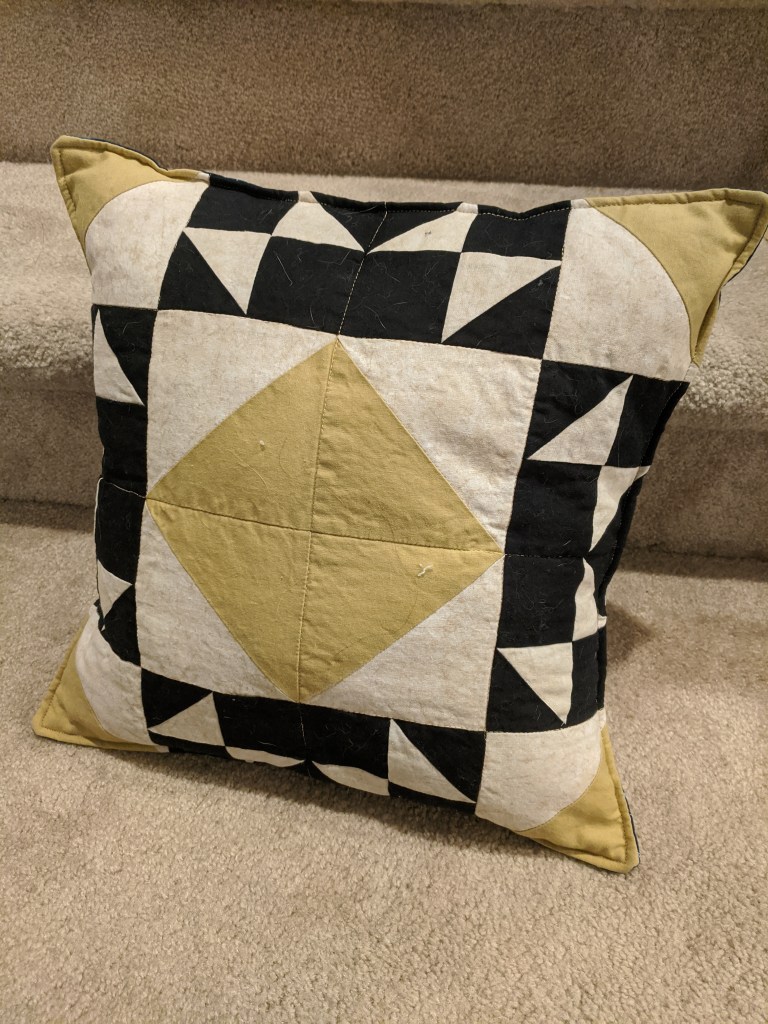
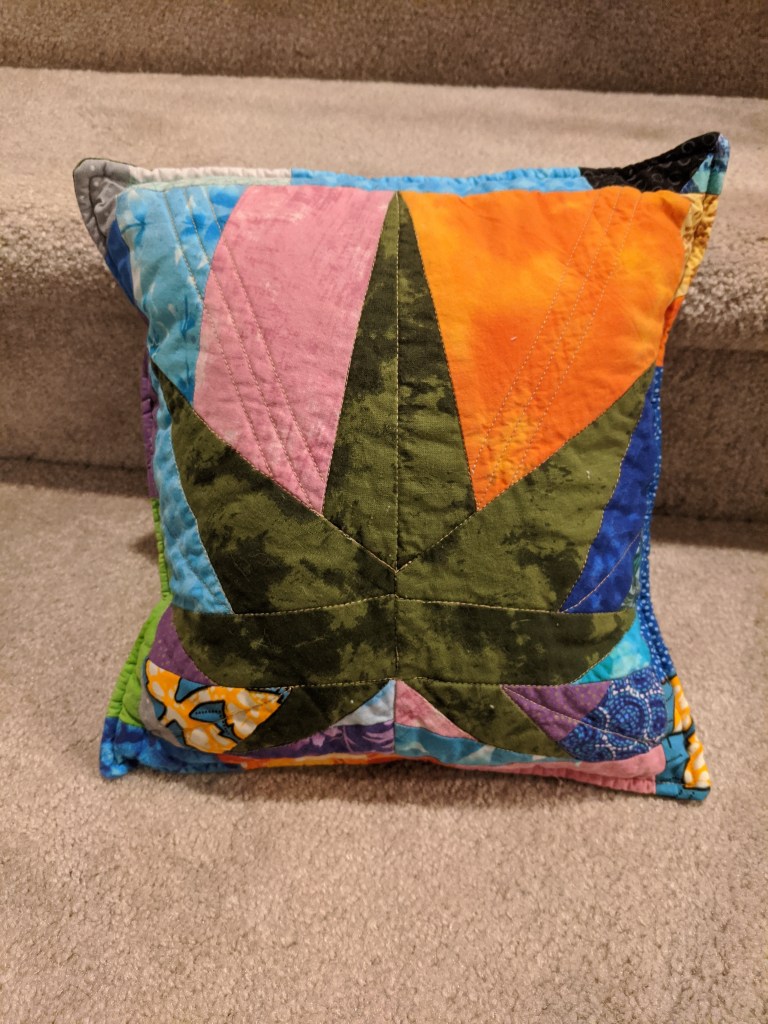
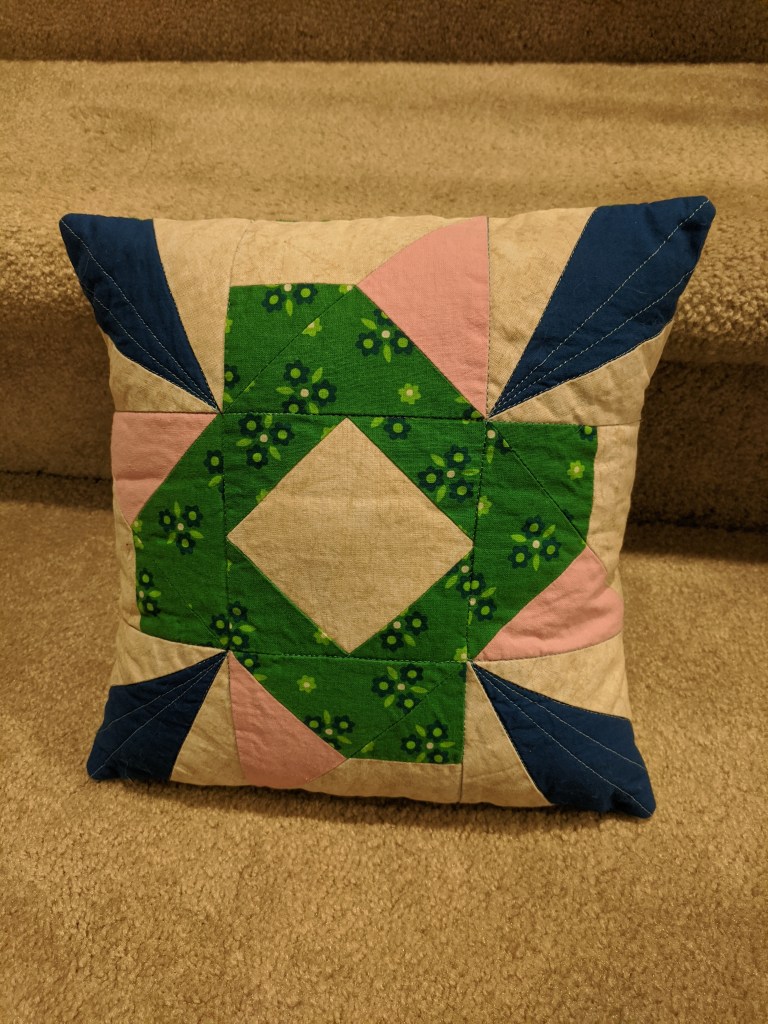
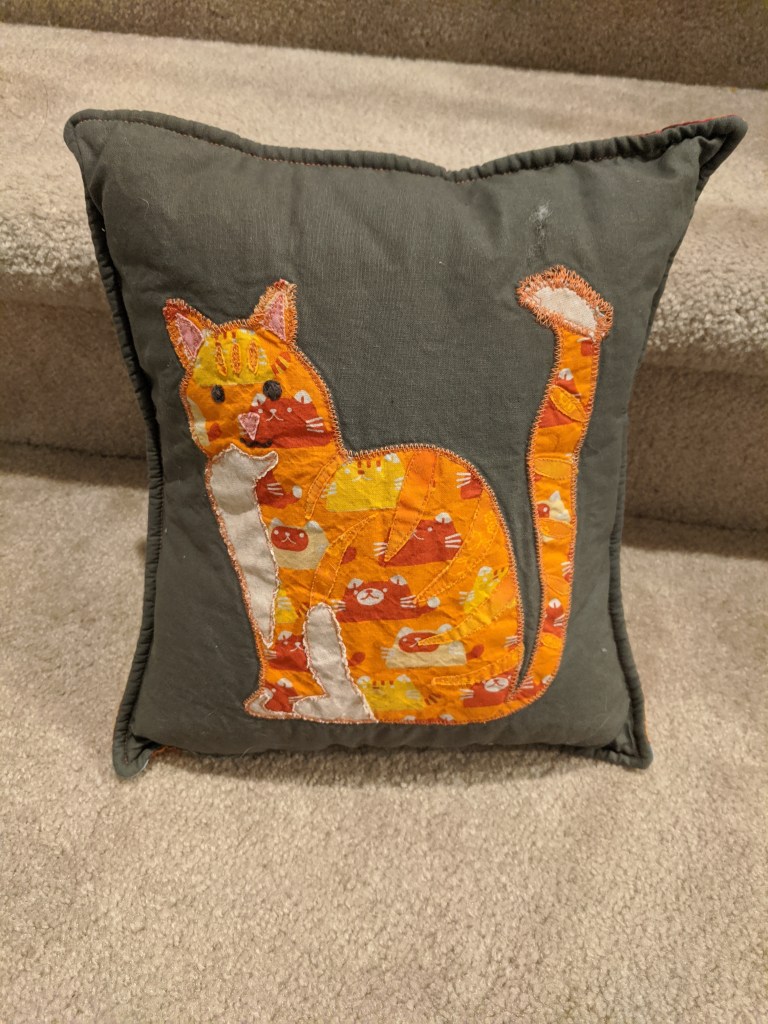
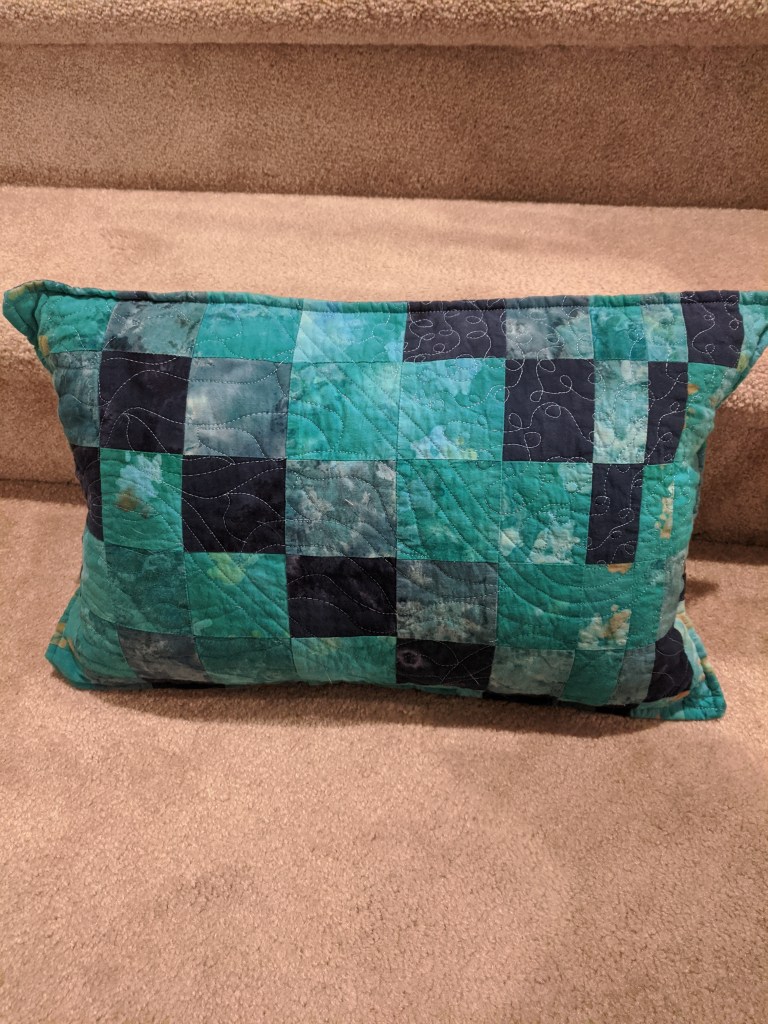
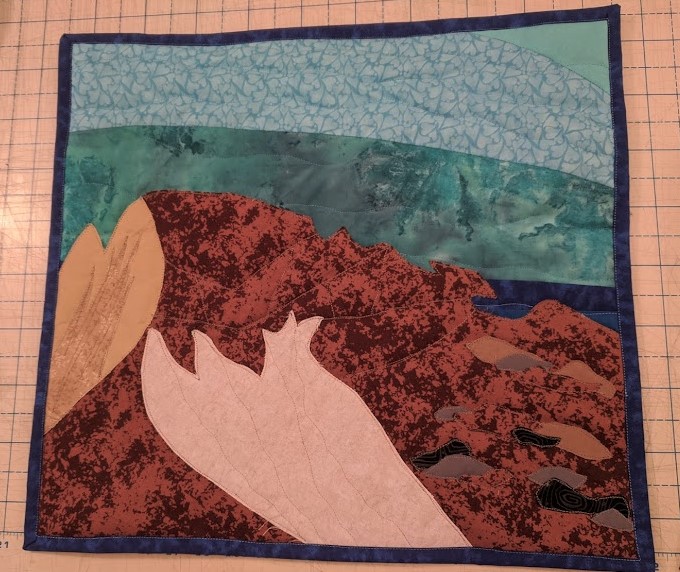
This year I did a bunch of little pillow projects for my friends and family 🙂 I got to learn some different techniques like fusible applique and paper piecing. I used lots of different fat quarters from Joann and scraps from previous projects. I generally used envelope backs and a little label to keep them closed. I stuffed them with some extra stuffing I had from pillows I’d bought previously, unfortunately none of them finished at a normal pillow form size.
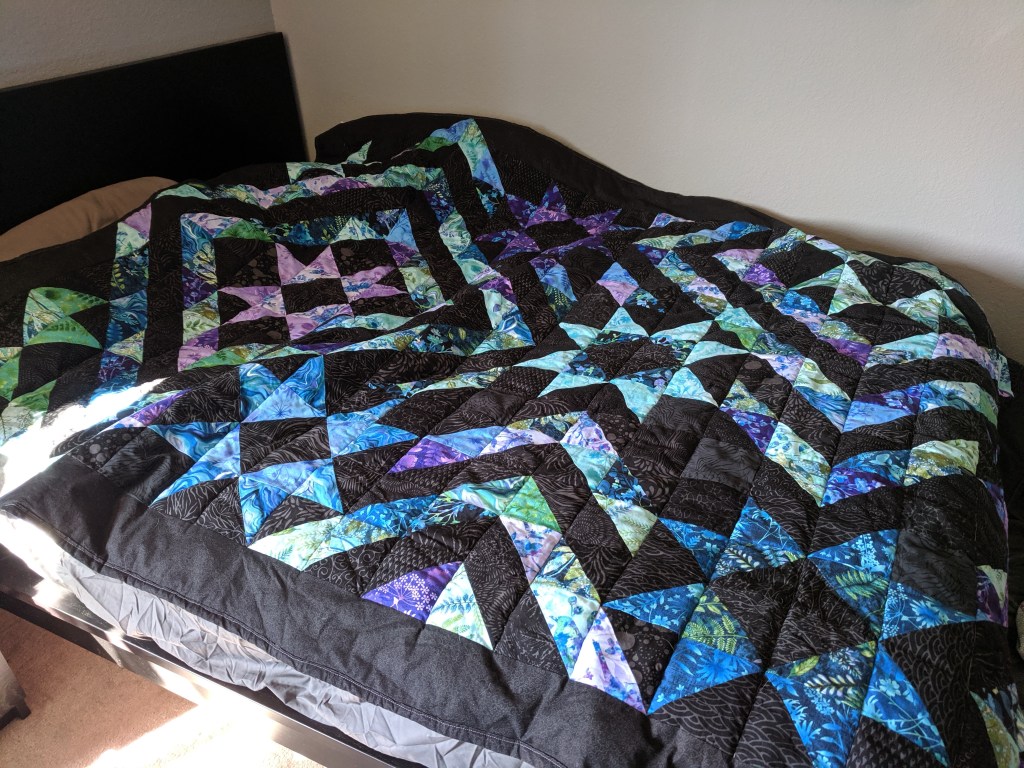
My third big quilt! With the puffy batting I mentioned in the rainbow bargello post. This quilt is based on the MSQC “Night Sky” pattern, but I changed the dimensions a bit to make it rectangular and added more borders.
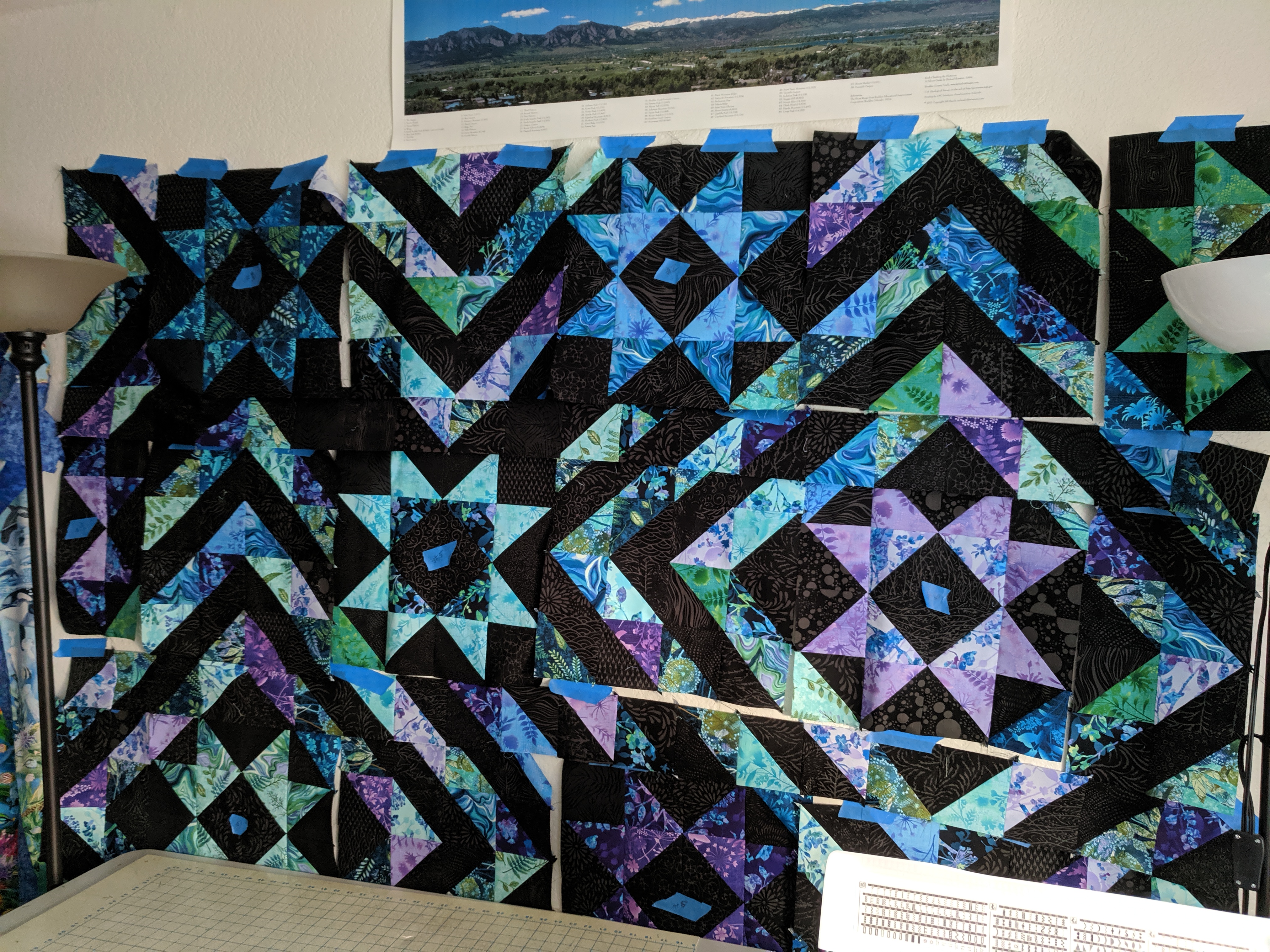
Taped up and planned on the wall
I bought two layer cakes (10″x10″ squares), one in Black Beauty Batik (hand printed high thread count cotton) and one in this whimsical Feather and Flora line from Studio E, and the backing is the Wildflower Toss Eggplant. I had bought the batiks for a different project that I didn’t end up doing, but I think they look great here. I love the black background to go with the stars 🙂 plus I was able to use the magic 8 method that grants you 8 HSTs from two 10″ squares and I didn’t have to cut as much fabric.
I made all the HSTs and squared them to 4.5″. I decided I wanted the insides of the star to be a different pattern than the outside points, like in the original pattern, and then the borders would be scrappy and random. I made a few stars and then figured out how many I would need to make the quilt big enough for my bed. It didn’t quite work, but I went with a general design that would be close enough and then I could add borders to increase the dimensions.
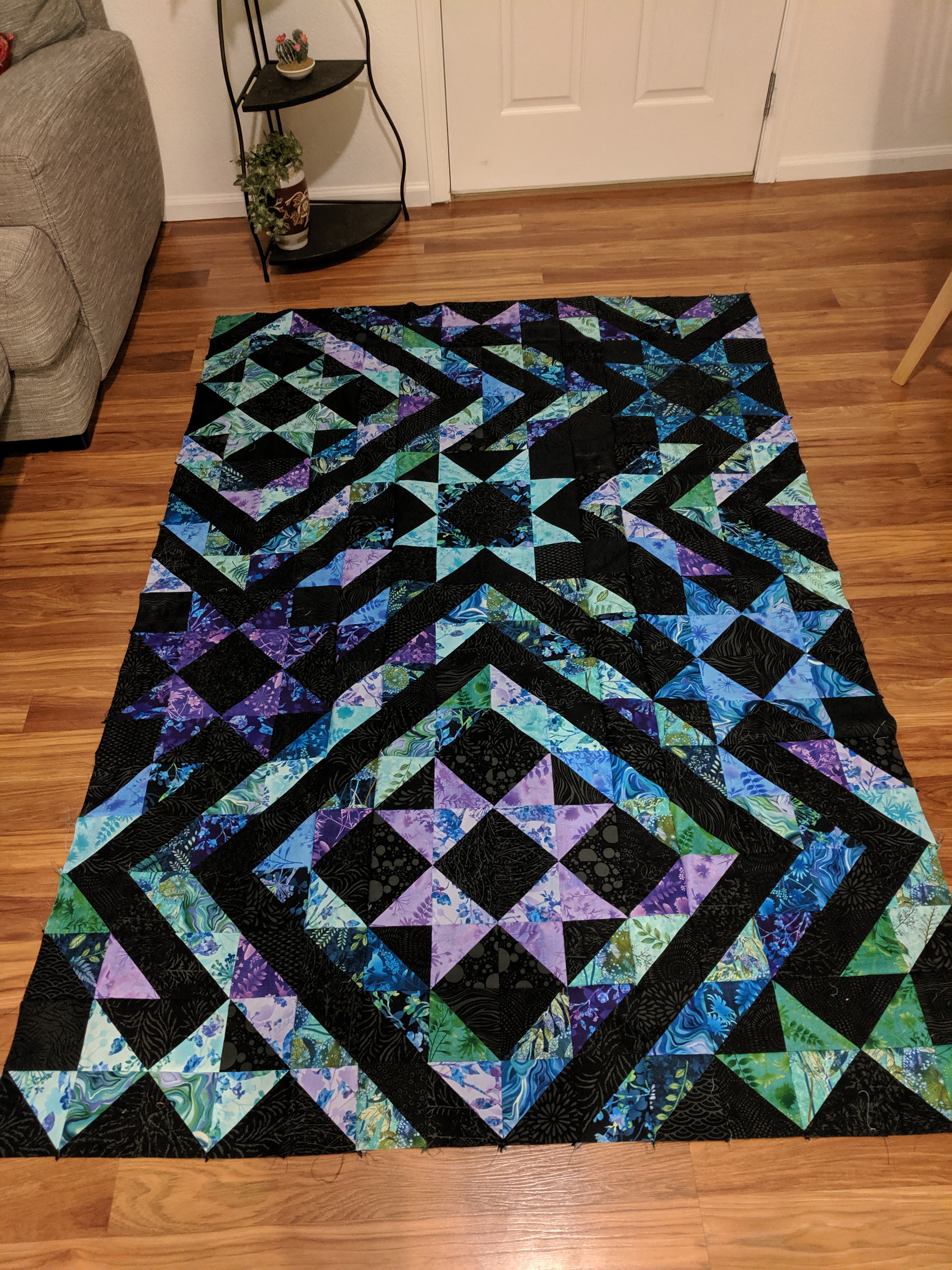
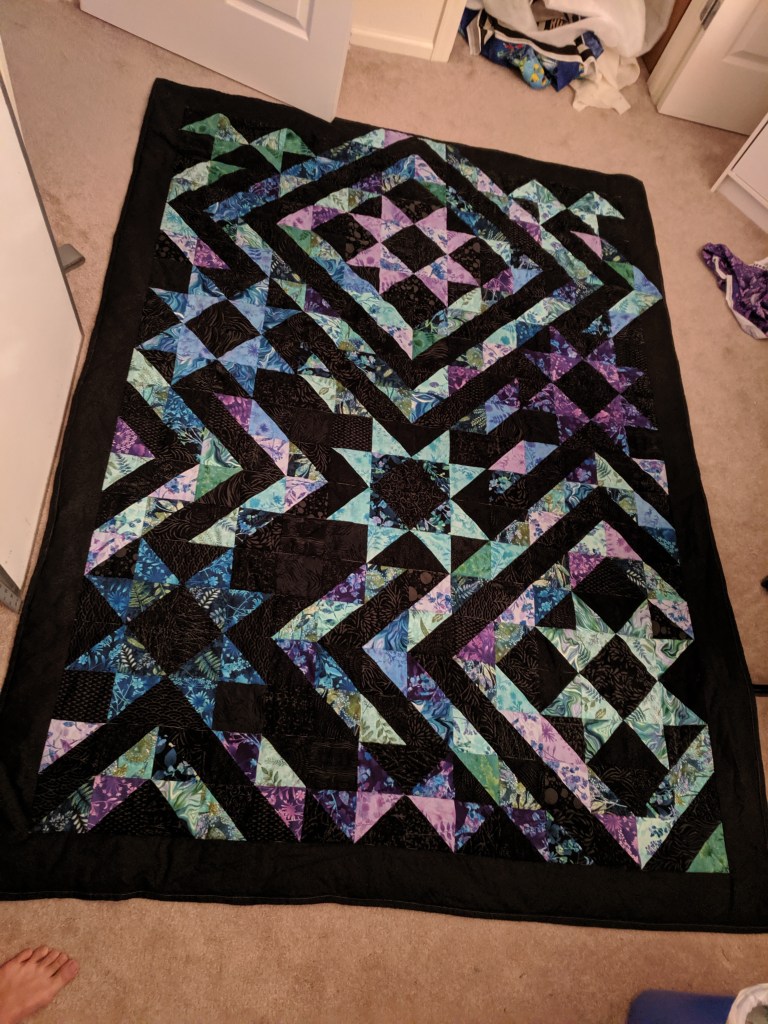
Top without borders – a bit more chaotic than I planned, but I really like it.
It kind of reminds me of ripples on a smooth pond, if you had dropped the stars in. I really wanted to take advantage of the new puffy batting I got, so I decided to quilt it in horizontal lines with my walking foot, which ended up being stitch in the ditch.
Working on SITD – on the right you see the folded up quilt that I will move to next
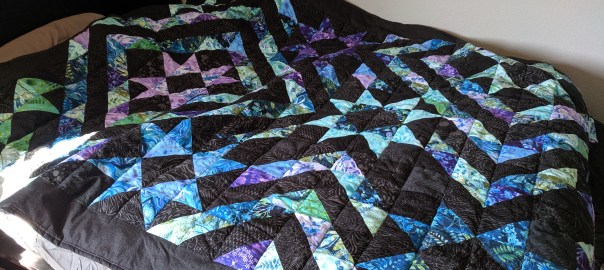
All done! I like it much better with the border
Time check: 5.5 hours to:
Cut fabric for binding (9) 2.5″ strips
Cut fabric for border (6) 4.5″ strips
Sew binding together to make one long strip
Press binding seams open
Iron binding in half hotdog style
Make HSTs for border and sew into border at correct measurements
Sew entire border on
Iron backing fabric
Cut backing fabric and sew middle seam
Iron backing seam and quilt top border seams
Baste quilt sandwich
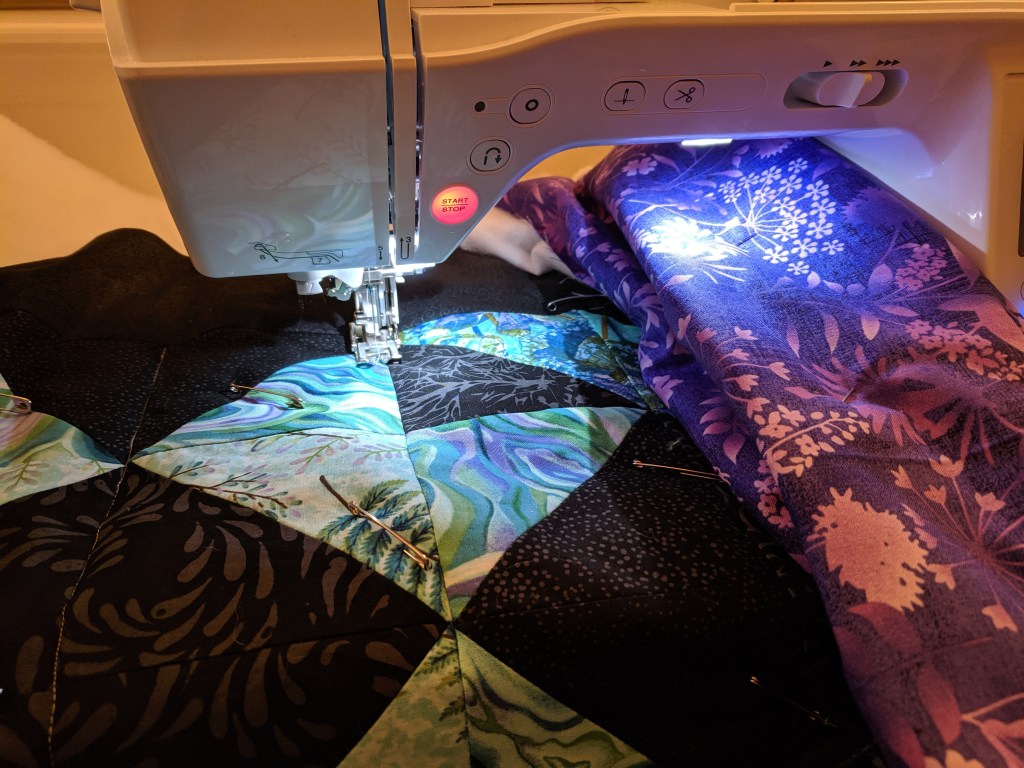
Stitch in the ditch on all horizontal gridlines using walking foot
Sew binding to back
Sew binding to front
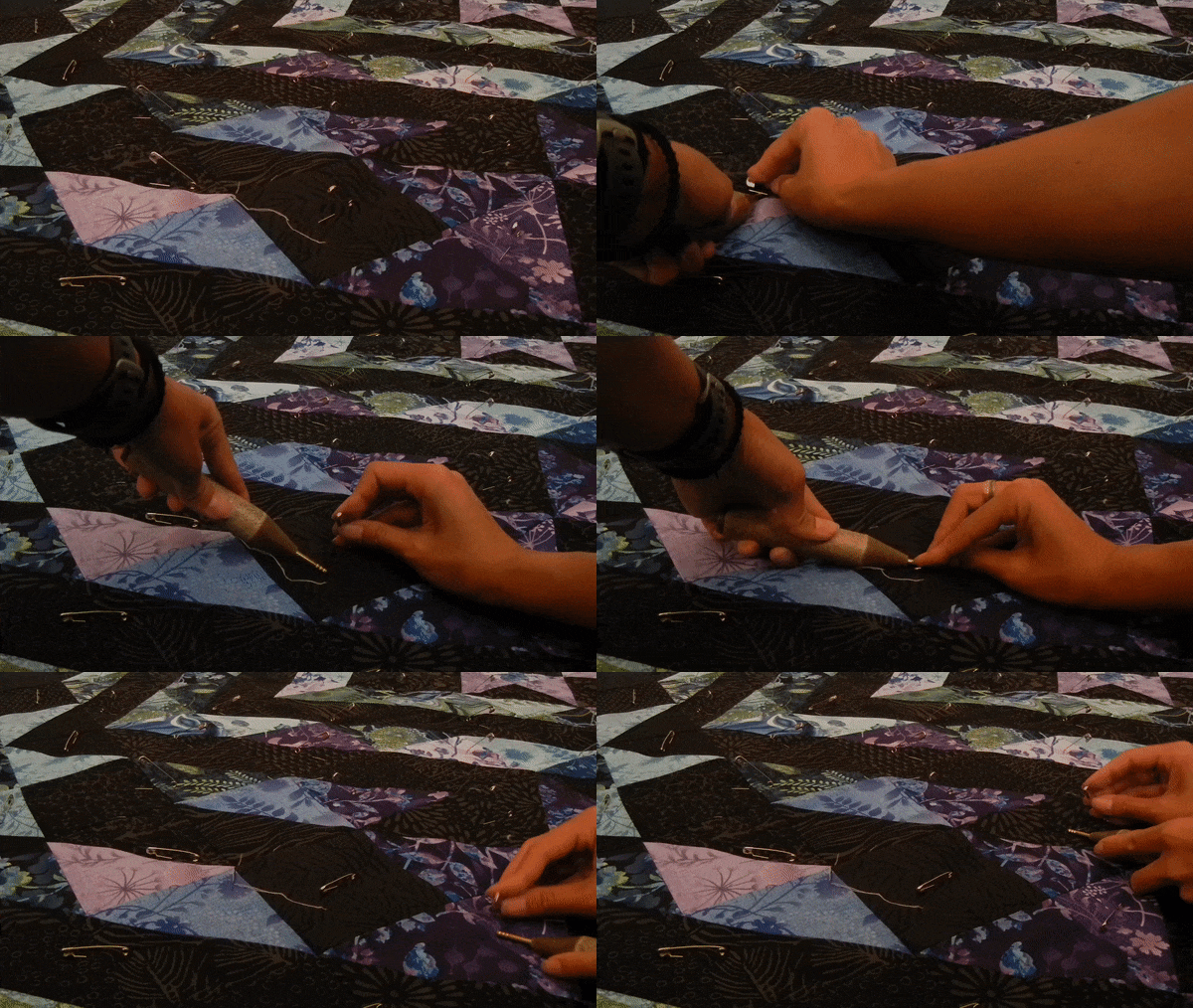
~5min, 16X: laying out quilt sandwich and starting to basteReal time: closing safety pins with Kwik Klip~1min, 4X: stitching in the ditch with walking foot. On the right, see the folded up quilt in the throat.~2min, 8X: putting binding on and turning corner (sealing sandwich together)On the bed 🙂 the rainbow bargello is on the couch now
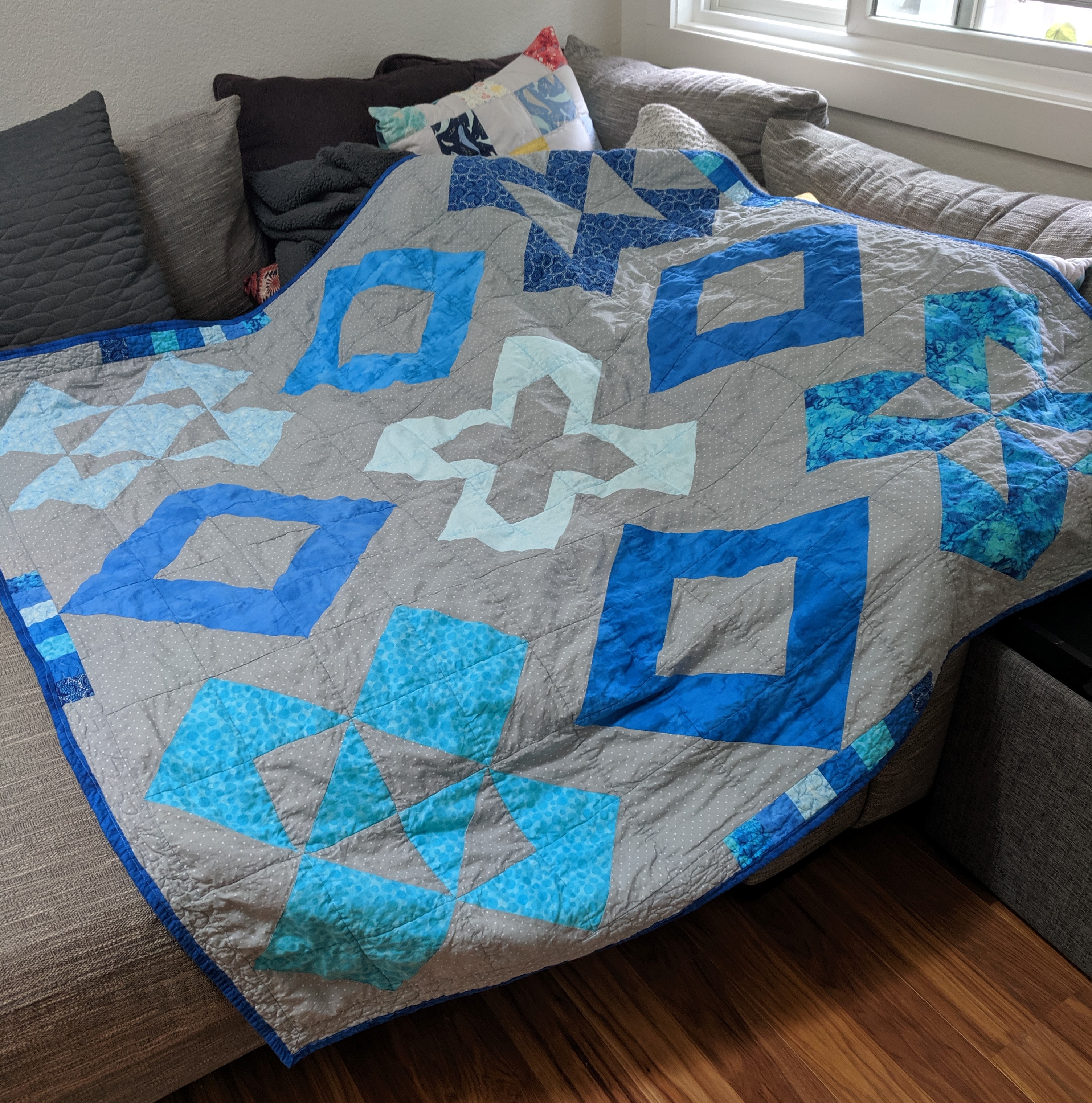
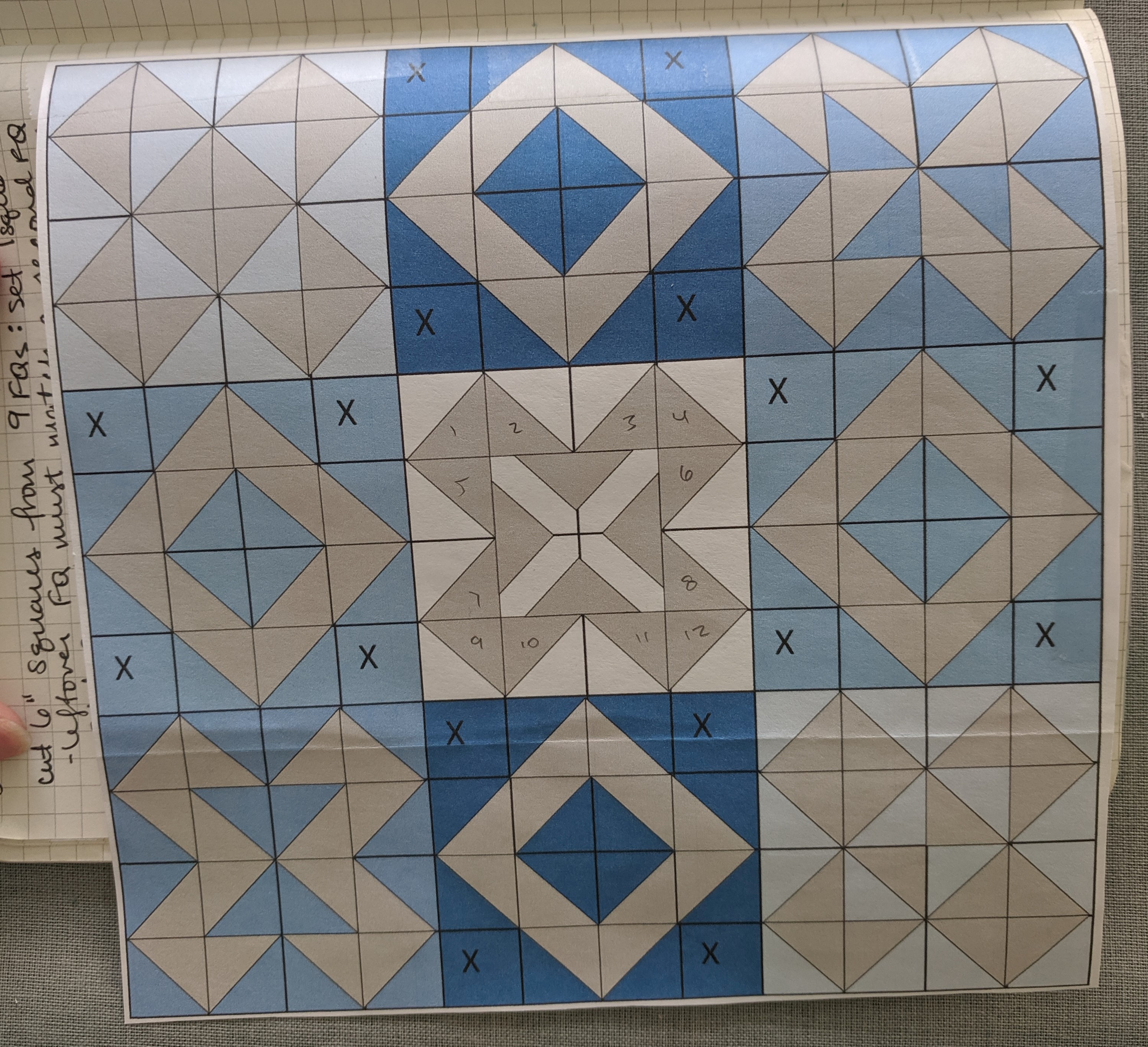
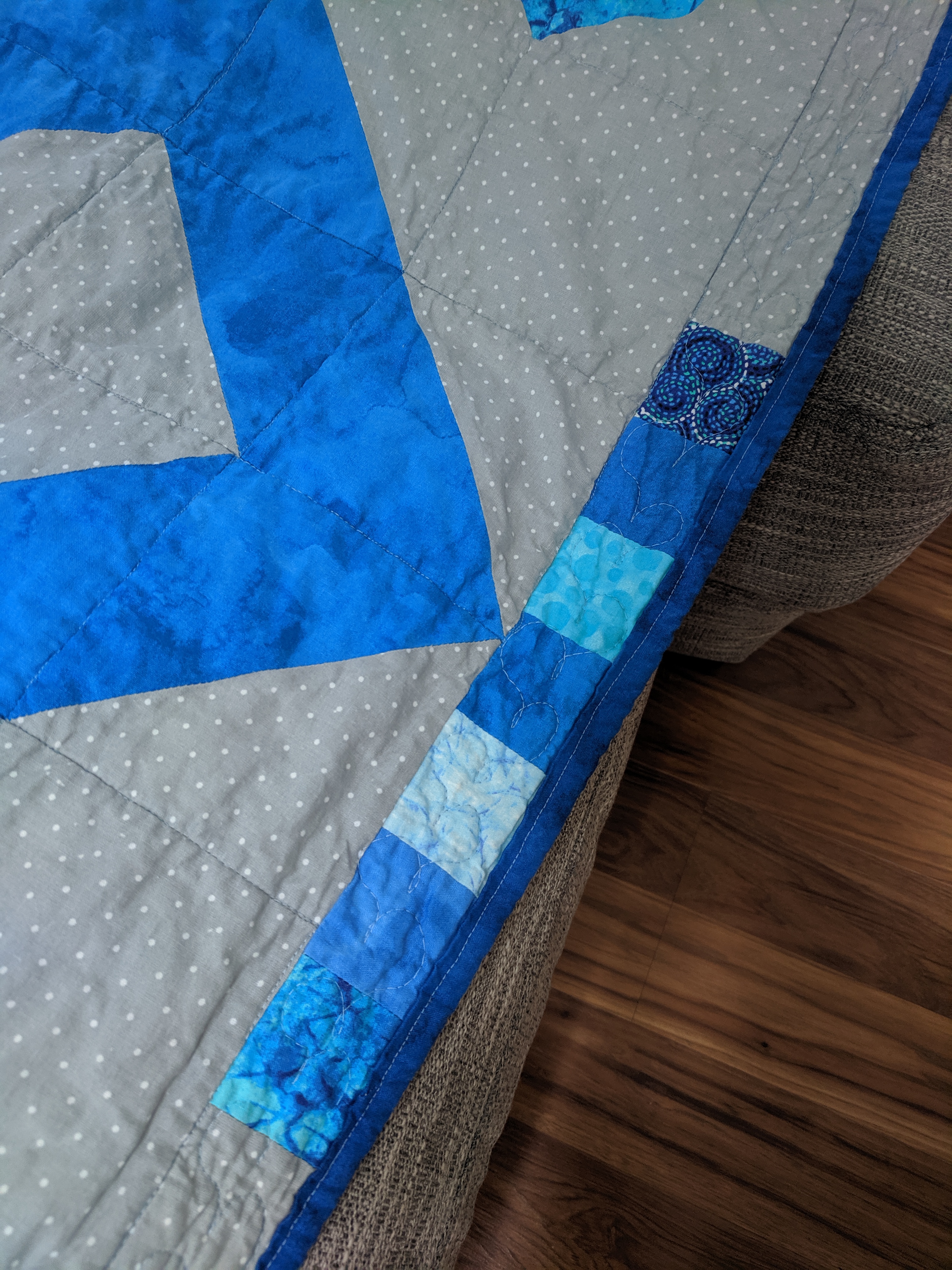
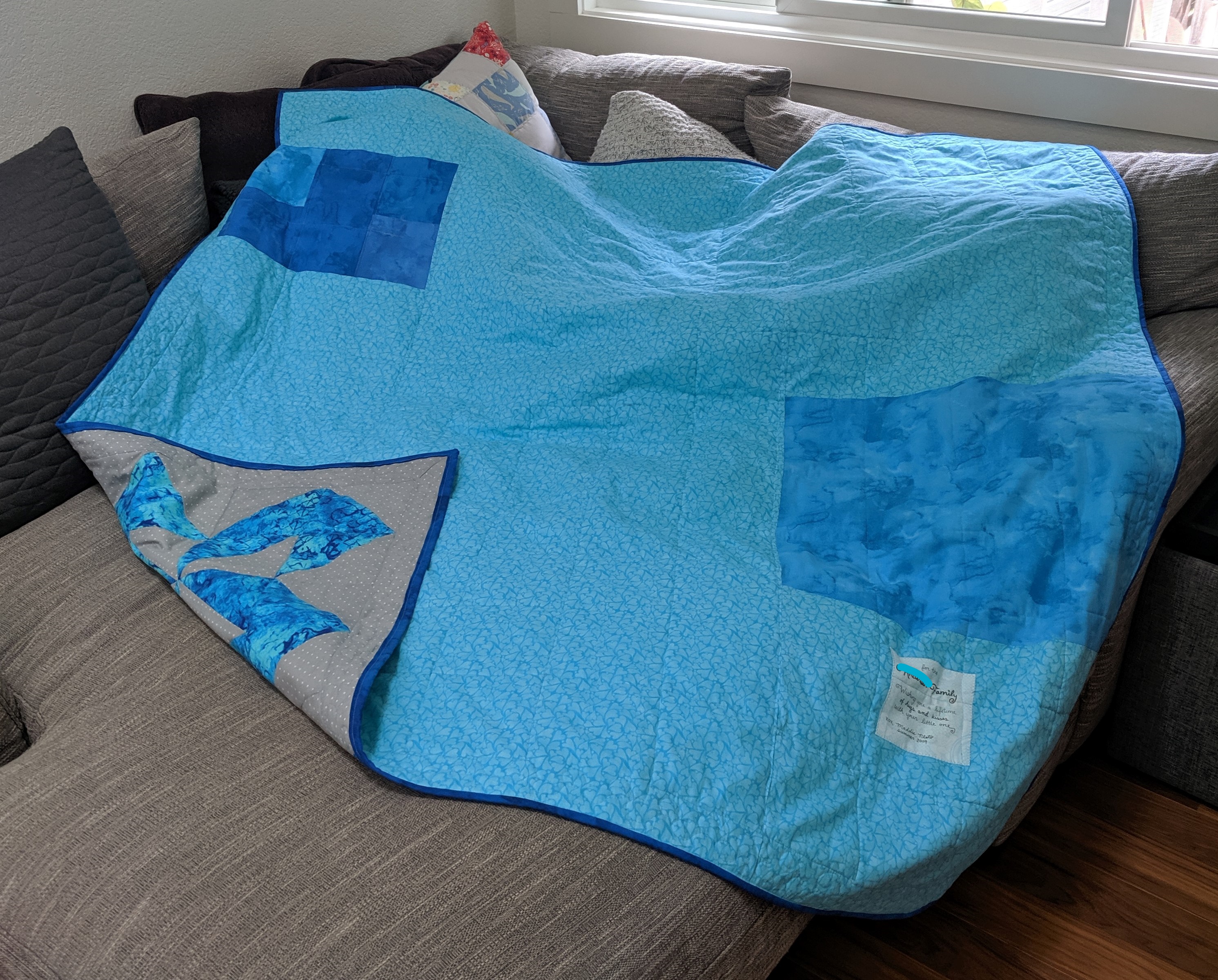
I made this quilt for my wonderful coworker whose wife had a baby 🙂 It is self drafted out of (primarily) HSTs. I based the pattern off “hugs and kisses XOXO” and used a fat quarter bundle from Joann. It ended up ~60″x60″, which is a bit large for a baby quilt but I don’t care.
Powerpoint design
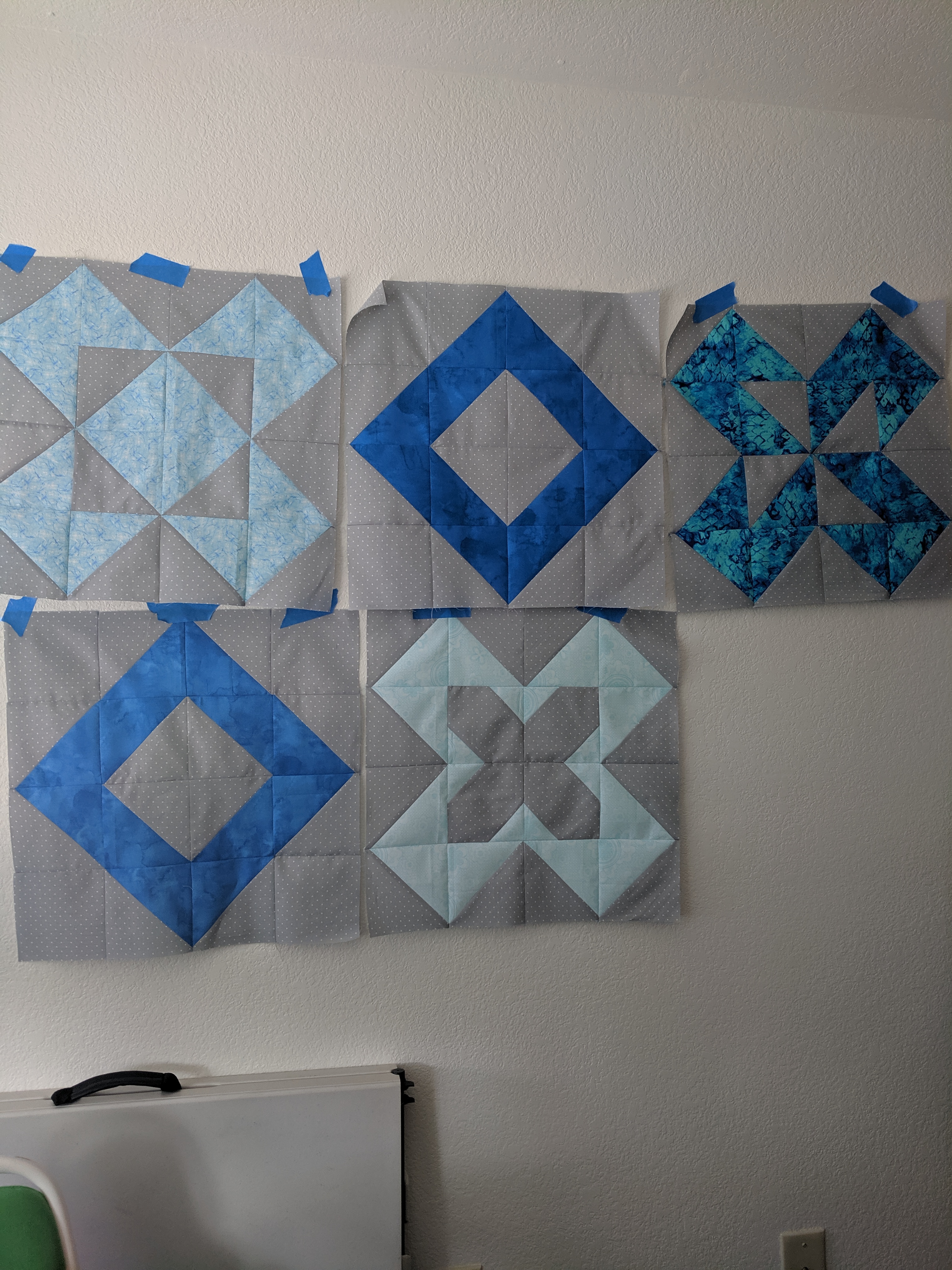
Finished blocks on my wall
HSTs ready to be laid out
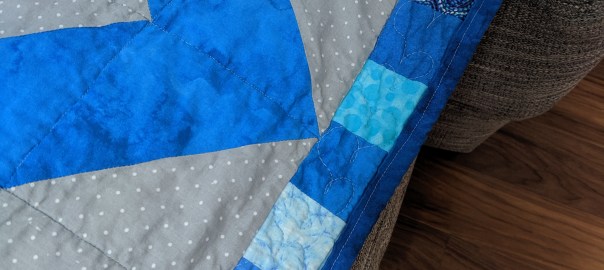
I ended up quilting the whole quilt with “stitch in the ditch”, where you quilt between units along the seam lines. For this to work, you have to iron both seam allowances to one side (instead of open). This makes one side of the seam a bit taller than the other, and the quilting goes on the lower side – the ditch. I used some scraps and the same background for the border, and quilted little heart shapes around the entire thing.
Stitch in the ditch on the left in the main blocks, heart shapes in the border on the right
One Block Wonders were defined by Maxine Rosenthal in her book, which details every step of assembly and tips and advice on choosing fabric and deciding on layouts. Below are a few other resources I used along the way:
One Block Wonder “Design Helper” shows possible combinations of hexagons based on a picture you upload. I encourage you to grab a picture with a pattern (or not!) and try it out – it’s quite fun.
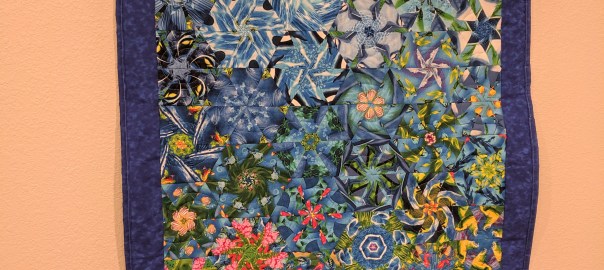
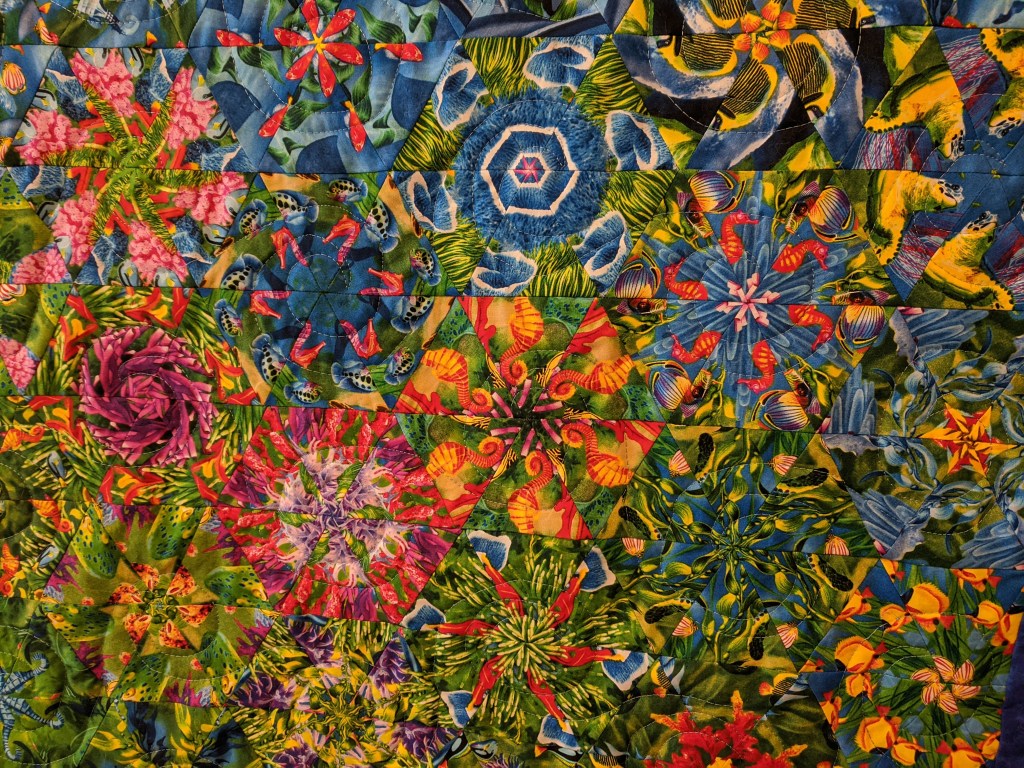
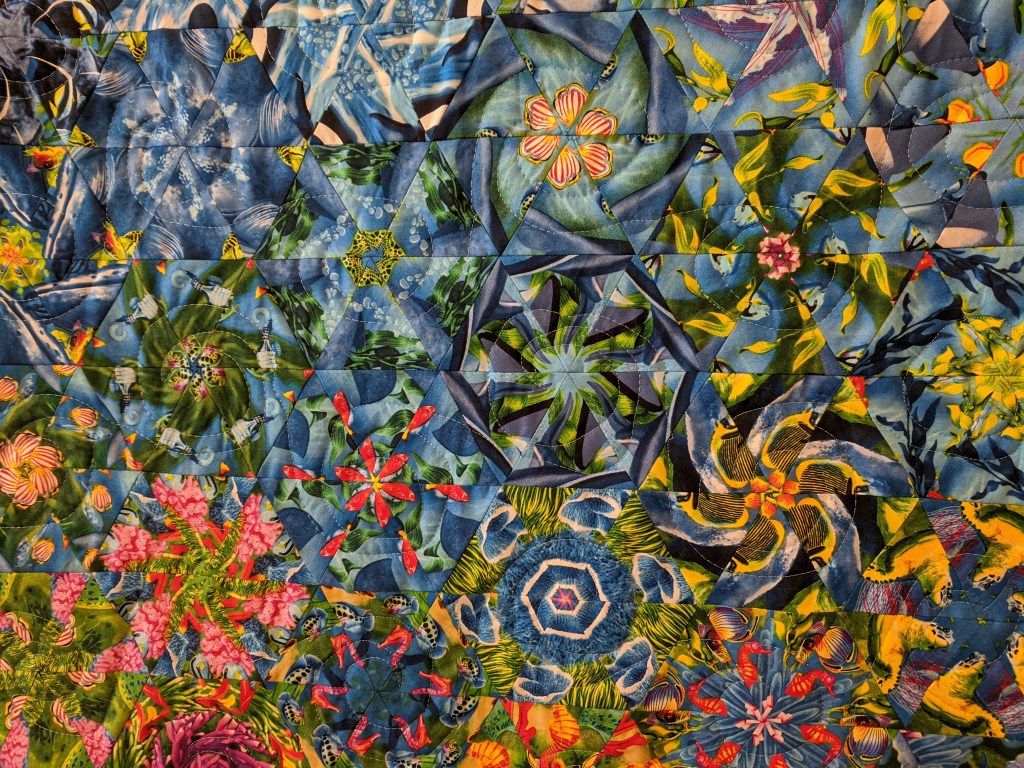
OBWs are constructed using 6 identical pieces of fabric. This can be done using a fabric that repeats the same pattern over and over (usually every 24″) or with a panel (a single image that spans the width of the fabric). Rosenthal suggests using fabric with 2-3 colors, with big and bold design elements with more curves than straight lines. I used the Reef panel by Michael Searle for Timeless Treasures.
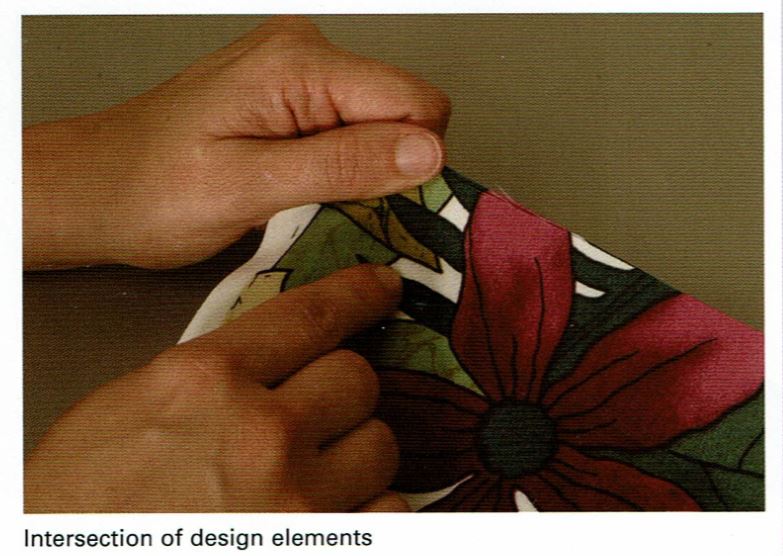
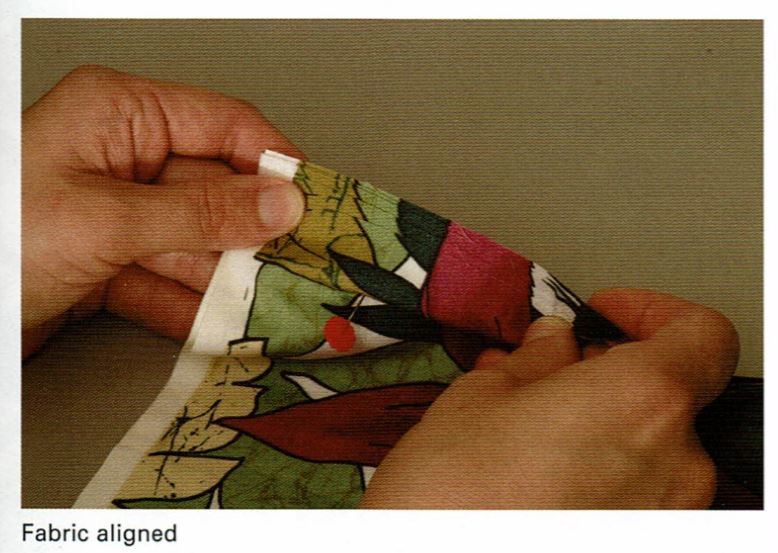
So you cut your 6 identical pieces, and they’re about 44″x24″. Then you stack them up and use pins to pierce the same design element through all 6 layers – so you know that they are aligned vertically (see below for pictures from the book). Rosenthal suggests you do this at 6 different points – each corner and then in the middle on the long sides. Then you shake your fabric by the pins so that the fabric between the pins is also aligned (watch Jackie’s video on this).
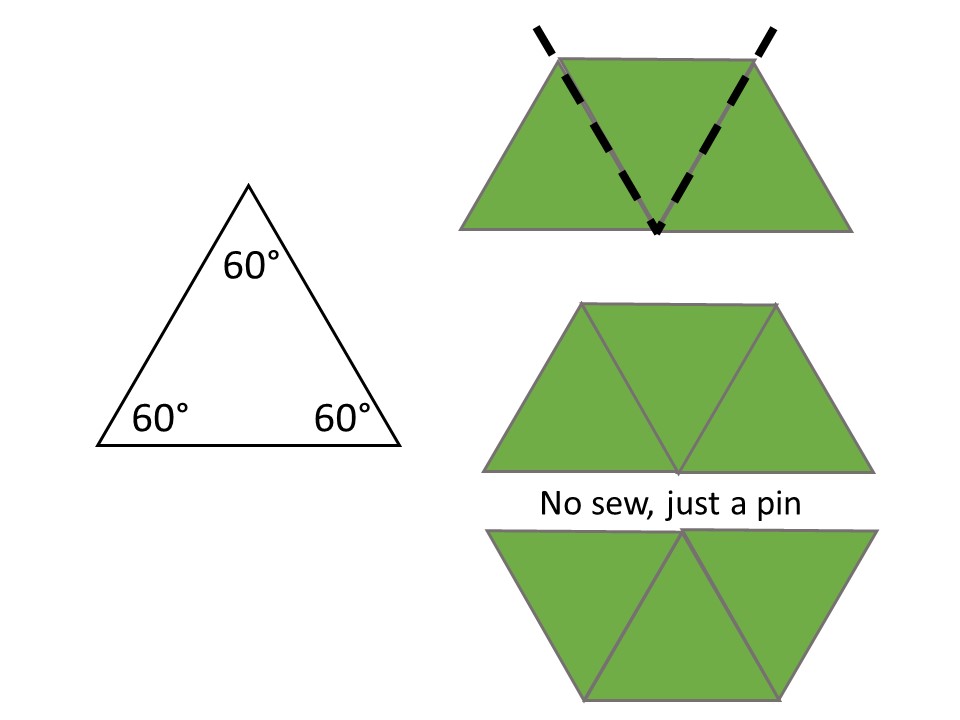
The kaleidoscope effect is created with 6 equilateral triangles arranged in a hexagon shape. Next, you cut your aligned fabric stack into strips, and then into triangles (using a ruler with a 60 ° line). Each triangle is exactly (or… close enough) identical since you aligned your fabric and cut it all at the same time.
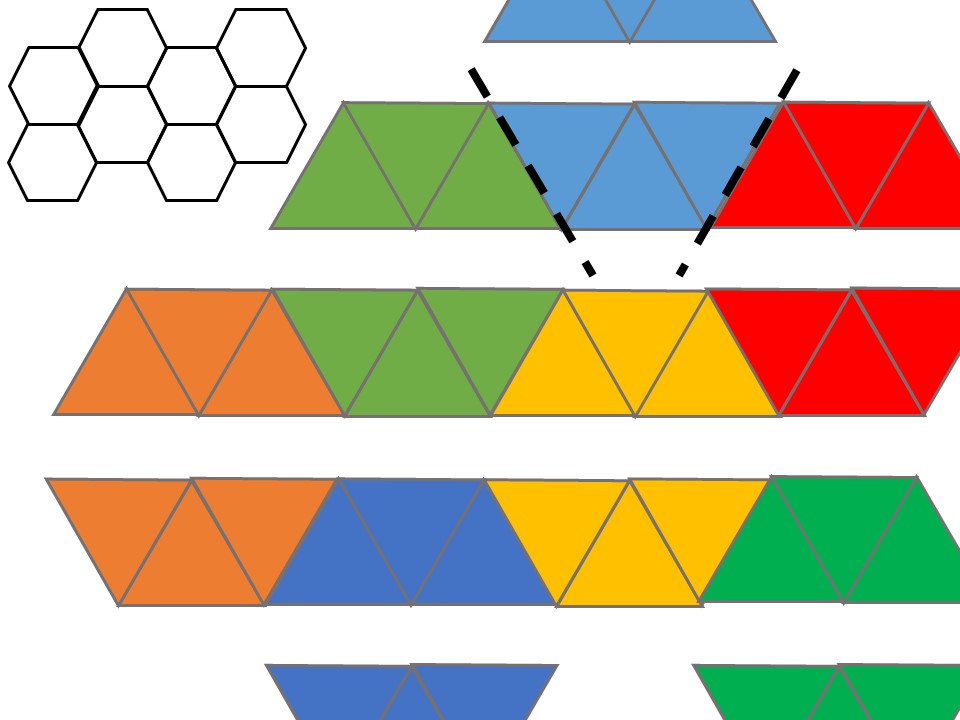
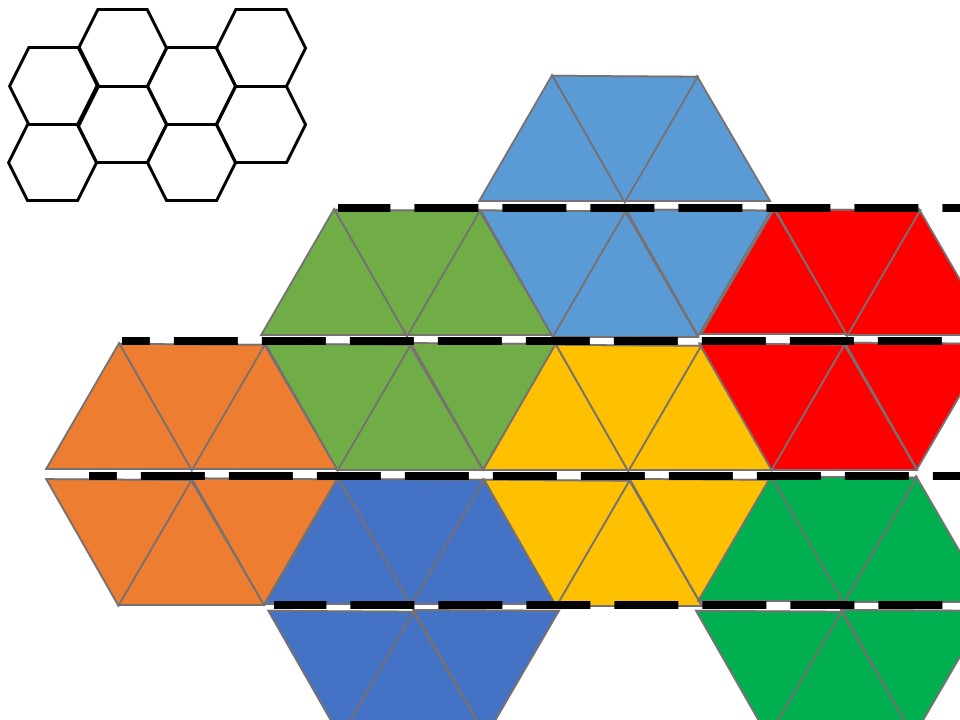
Now here’s the genius part, and what makes the OBW so easy to assemble – all straight seams. Each hexagon takes 6 triangles, but you only sew 3 together at first so you have two halves of a hexagon. During the layout stage, you pin these together so they look like a hexagon, which makes it easier to move them around. So – you only sewed straight seams to put 3 equilateral triangles together.
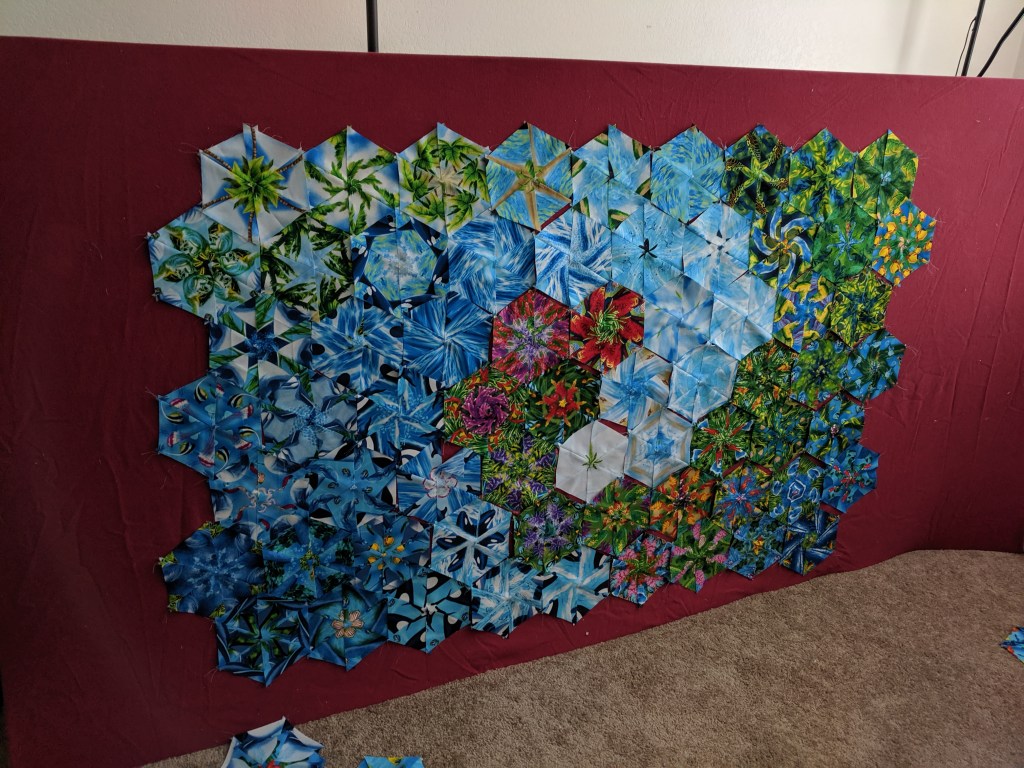
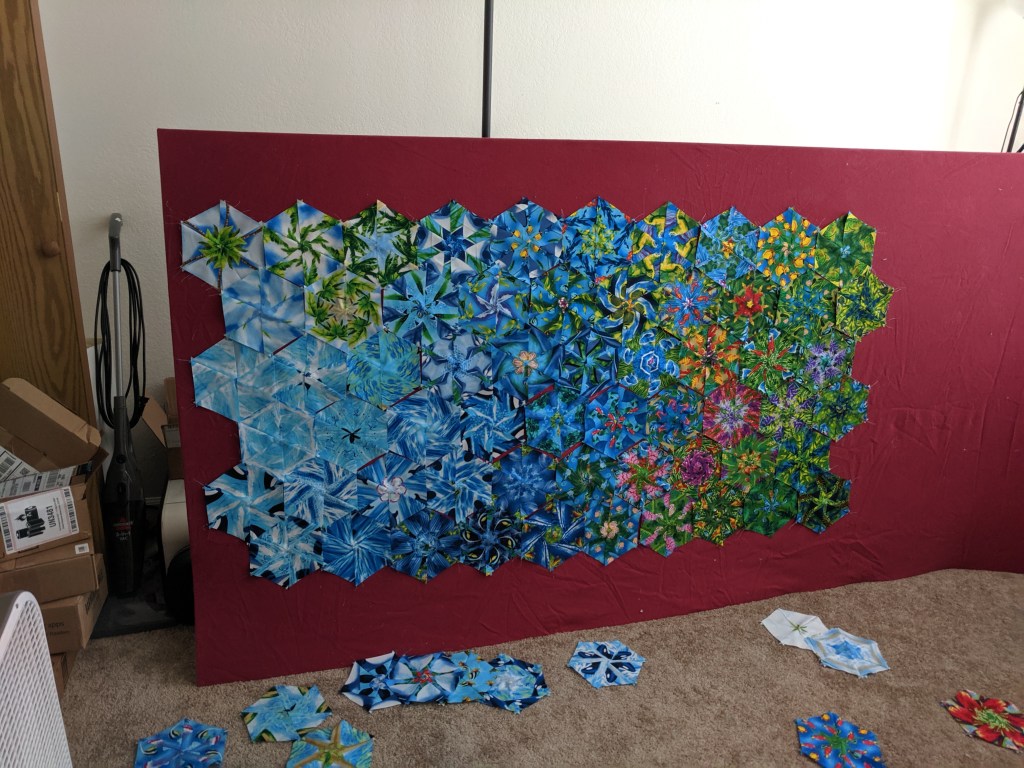
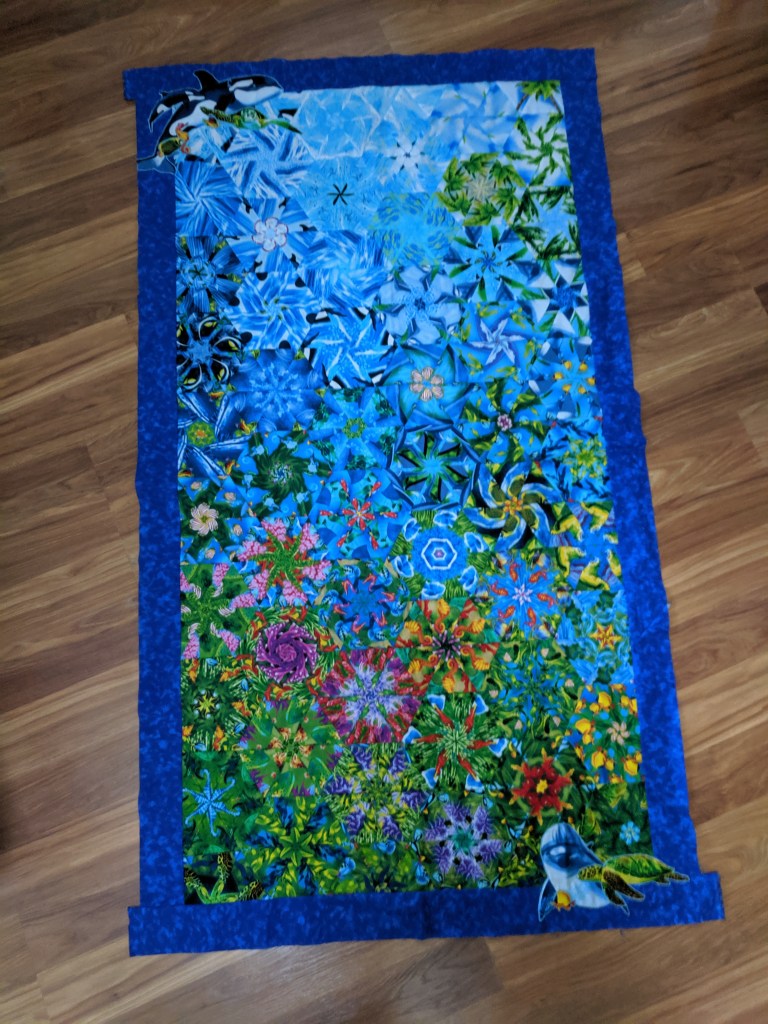
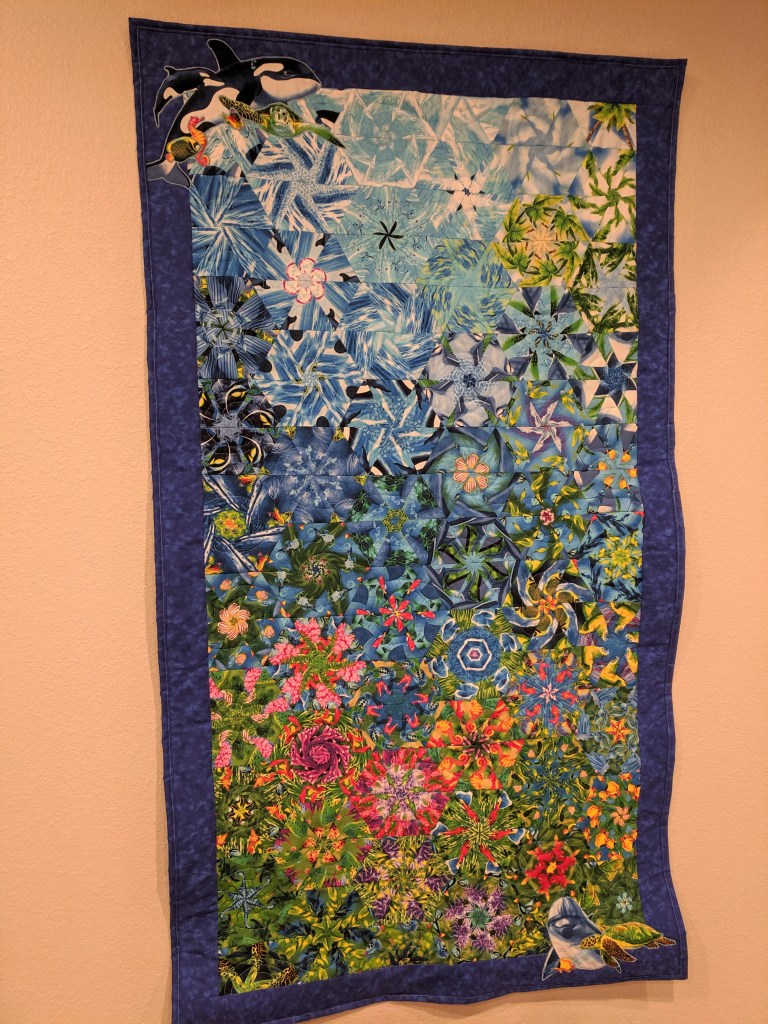
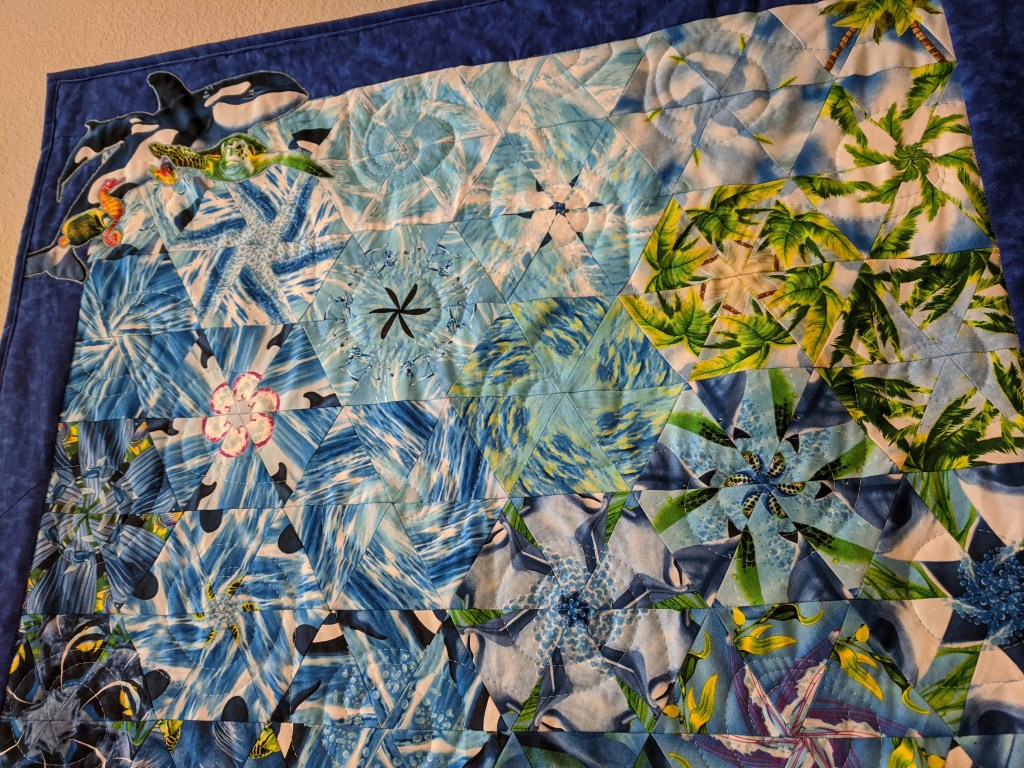
The fun part begins with designing and choosing a layout. This is where my pinterest board (and Polywall from Home Depot) really came in handy. As I laid my hexagons out, I saw that I had: (a) many blue shades, (b) some green shades, (c) some super colorful ones, and (d) hexagons that just did not fit at all. My original idea was to do a blue vs. green type of layout, like a wave or swoosh, to bring in the water theme. I ended up not having enough good hexagons to pull this off, so I went with a gradient design that’s a bit more in line with conventional OBWs.
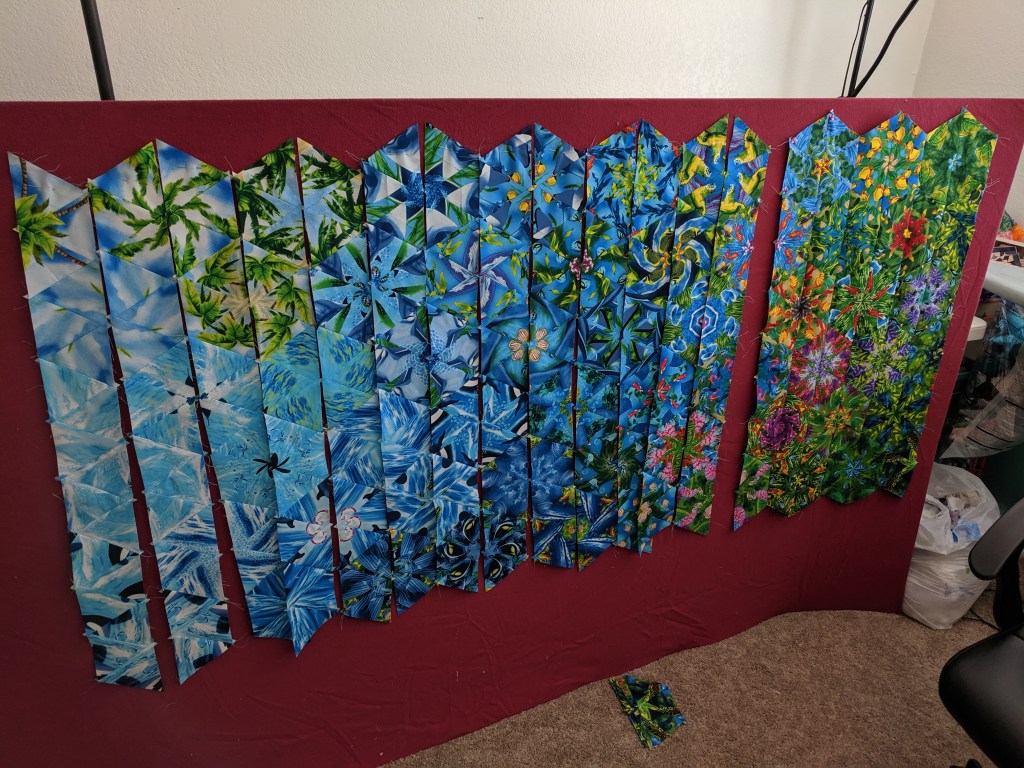
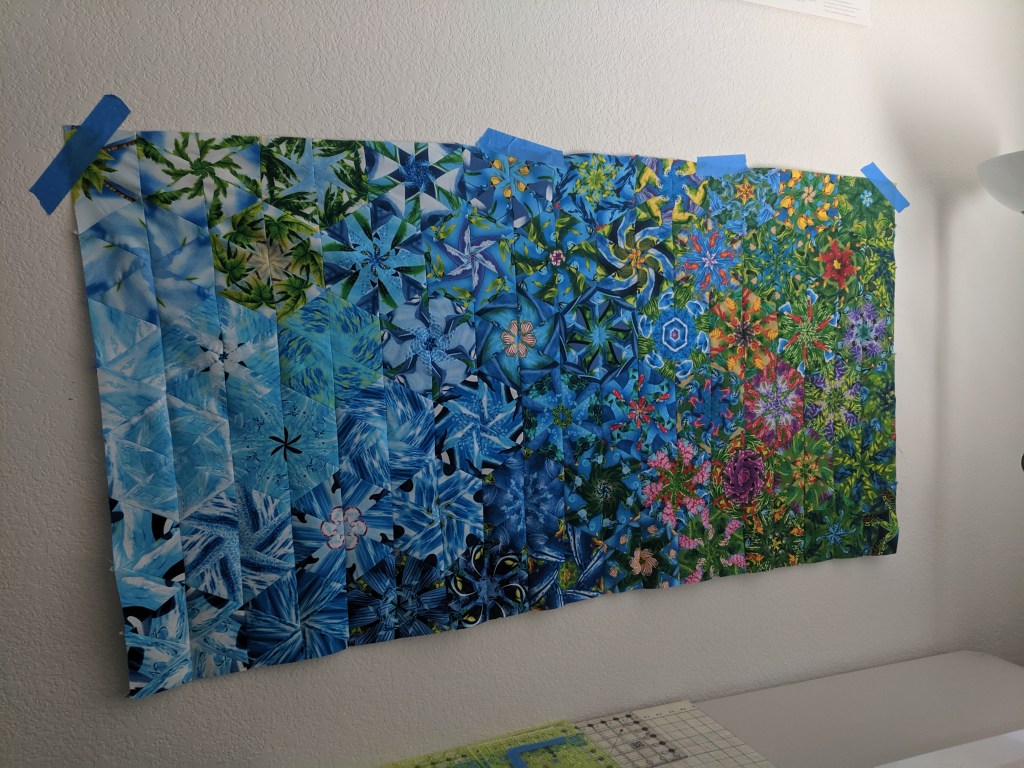
Now remember that we only sewed together halves of hexagons. Due to the grids hexagons create, each half can be sewn to the halves adjacent to it in rows (see below). Then, those rows are sewn together to create the whole grid. The hexagons on the end get cut off a bit so that the finished quilt top ends up rectangular. I used a blue blender from Joann for the border to bring together the ocean theme and give the eye some rest.
Sew into rows
Sew rows together
Individual rows on the left, joined rows on the right
All squared up and ready!
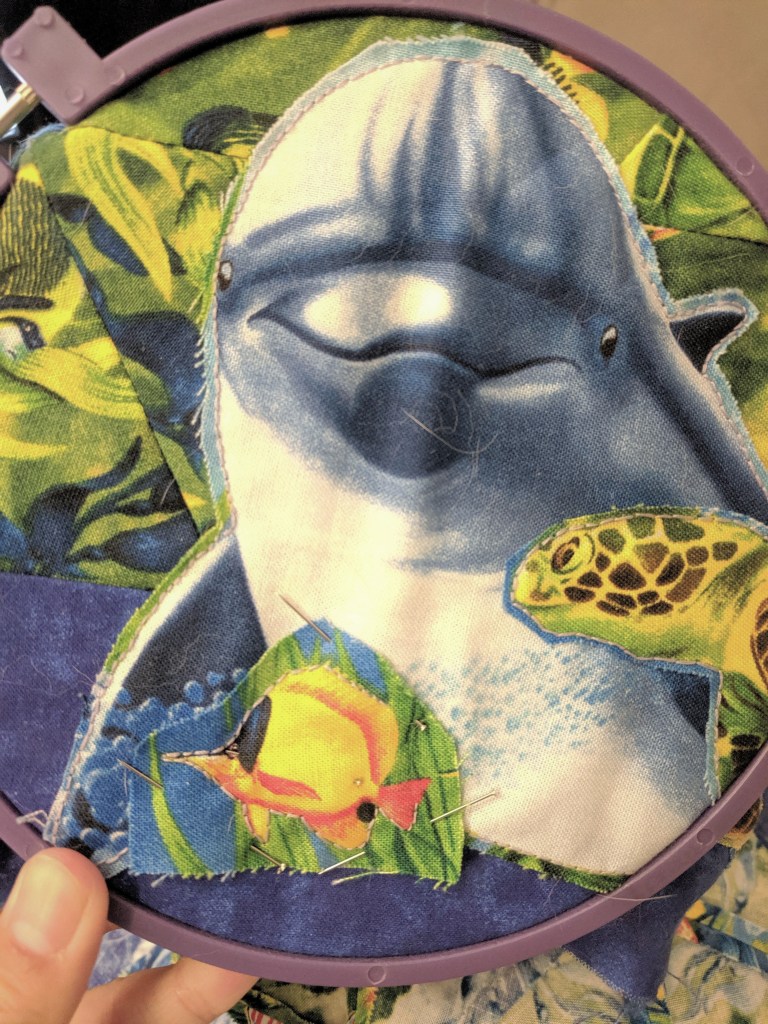
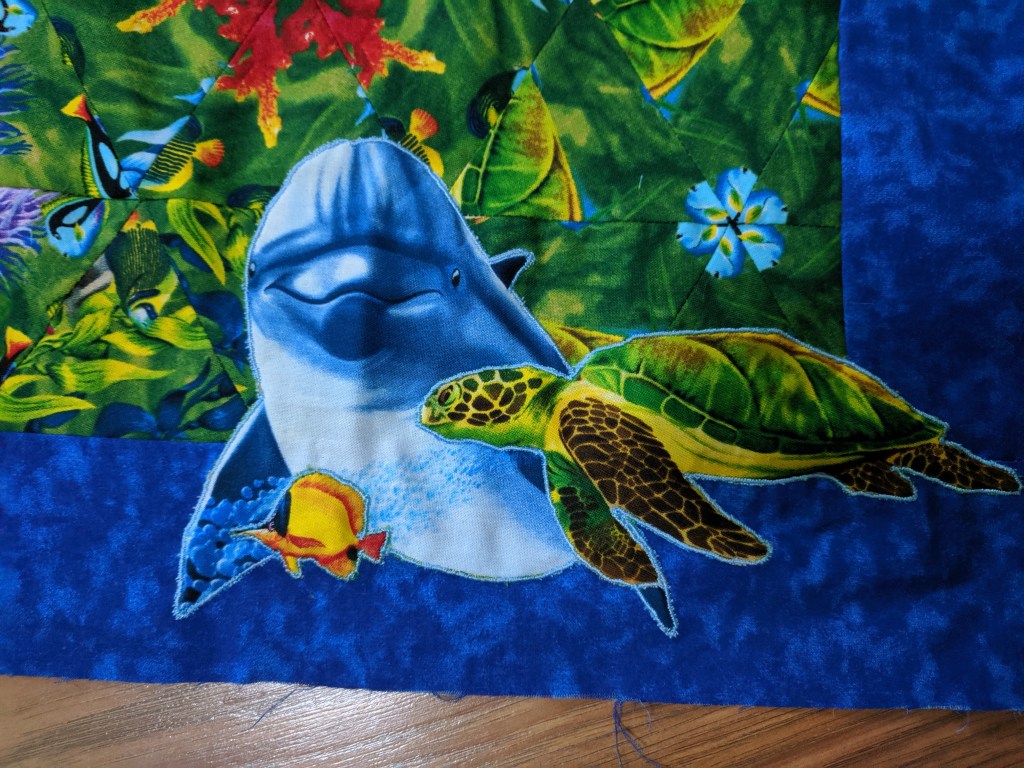
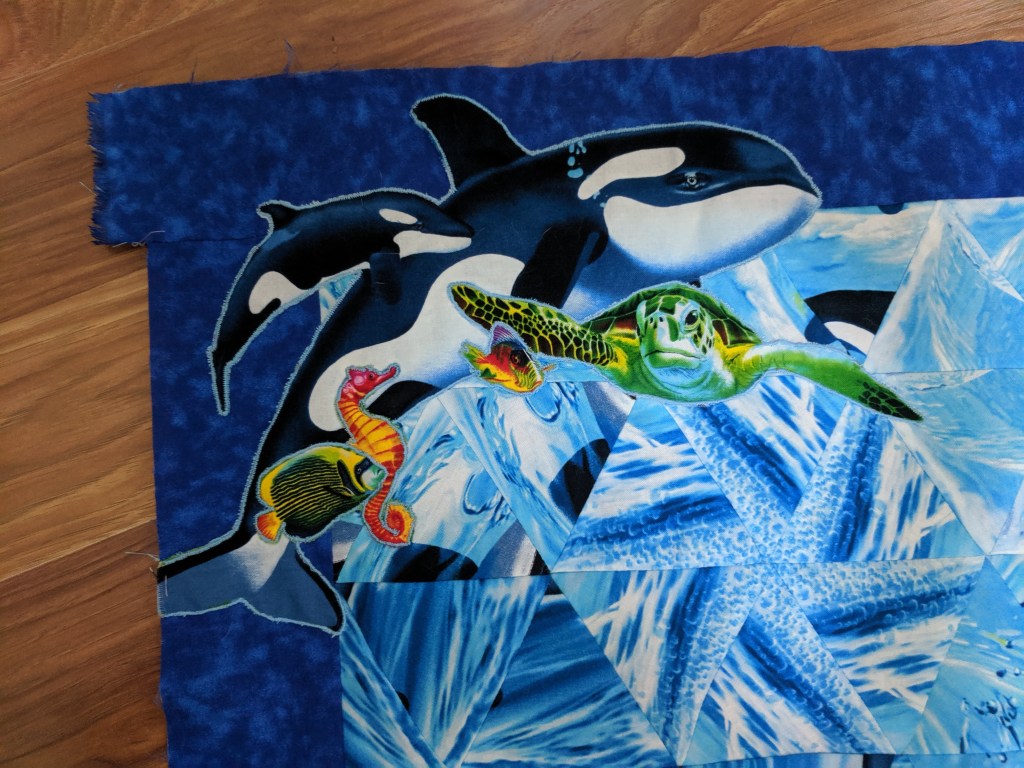
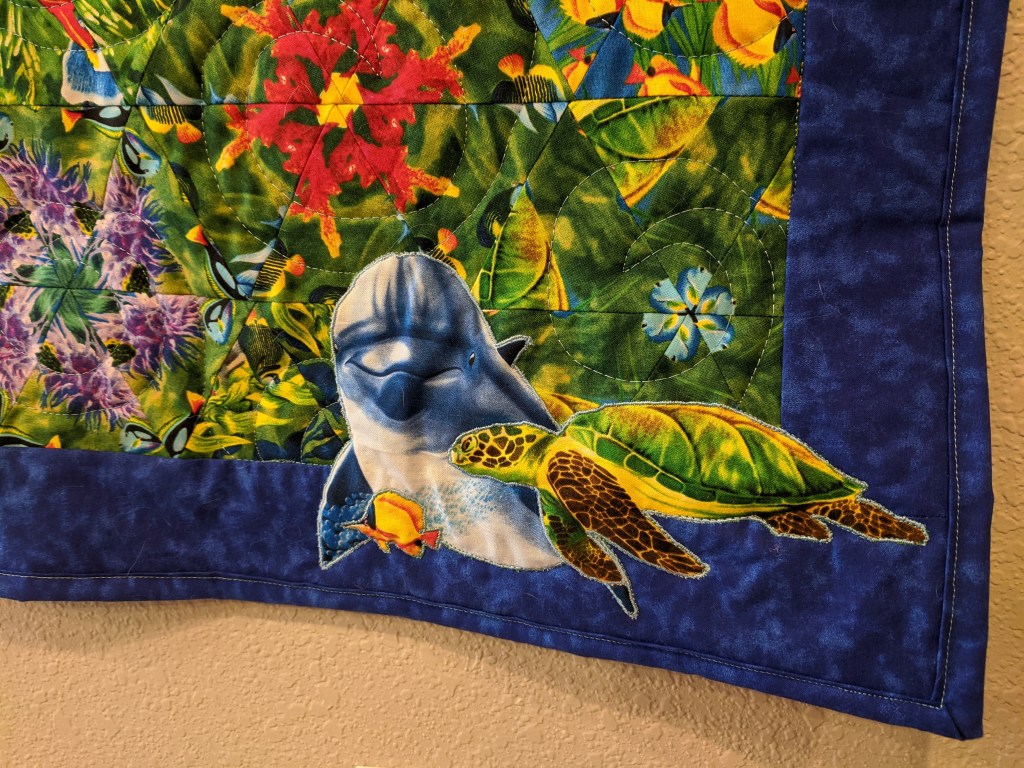
To embellish my OBW, I chose to cut out some of the animals and applique them onto the top. Applique is a technique to sew a patch onto a bigger piece of fabric, and can be done in a ton of ways. I chose to hand baste my animals on and then go over the hand stitches with the machine to clean up the edges. I liked the idea of including some non-kaleidoscope-d bits to help the eye, and plus I love sea creatures so I wanted to feature them, whole, on the front.
Hand basting in the embroidery hoop
I wanted the backing to be the original panel, so I could flip it over and show people the uncut panel. And I added some of hexagons I liked that didn’t fit in the top 🙂
Finished top
Finished backing
In total, making the half-hexagons took a couple days, deciding on the layout took a week, assembling the top took a couple days, applique-ing my animals took a couple weeks, the backing took a couple days, and then I let it sit… and sit…
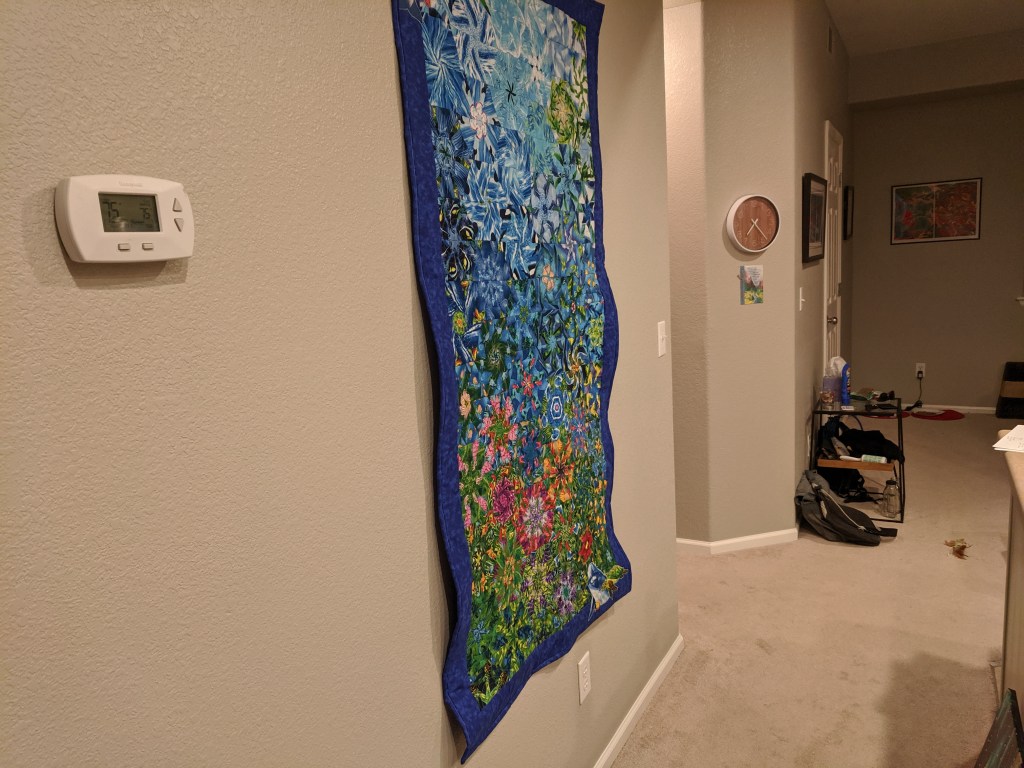
And finally, I decided on a quilting design and quilted it up. 🙂 I added a little tube on the back to help me hang it up, bought a little dowel at Home Depot, and hung it up. I’m so happy to have this done and finally hanging up in my kitchen where I imagined it.
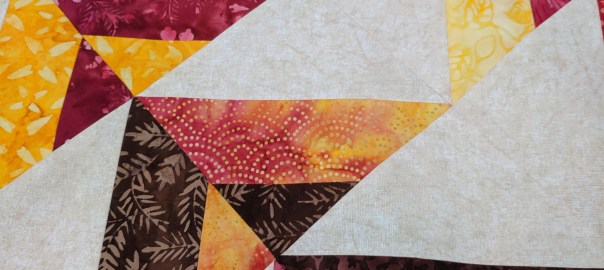
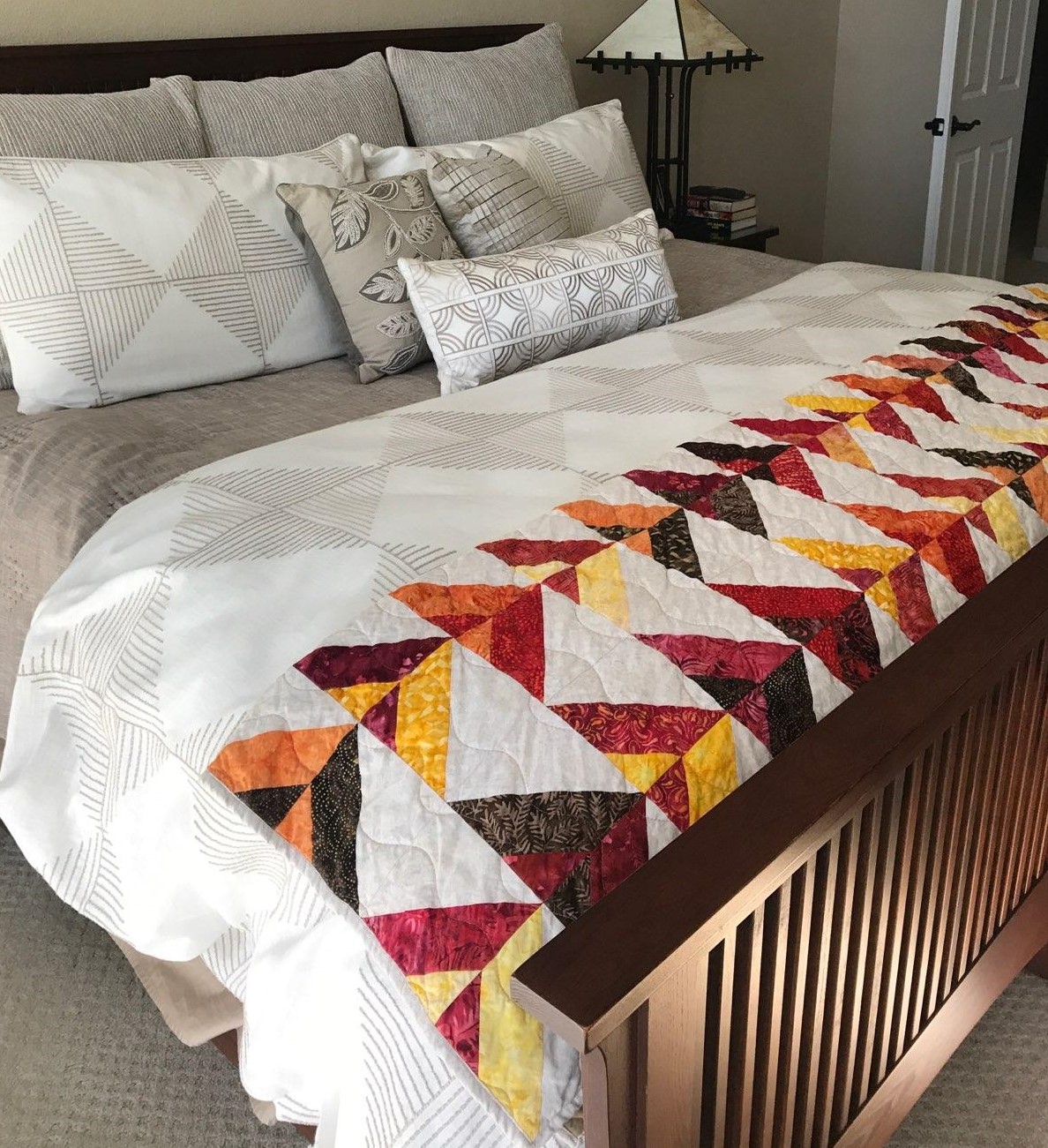
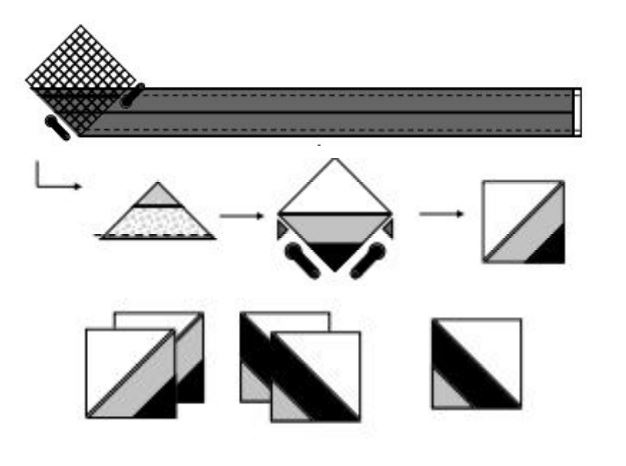
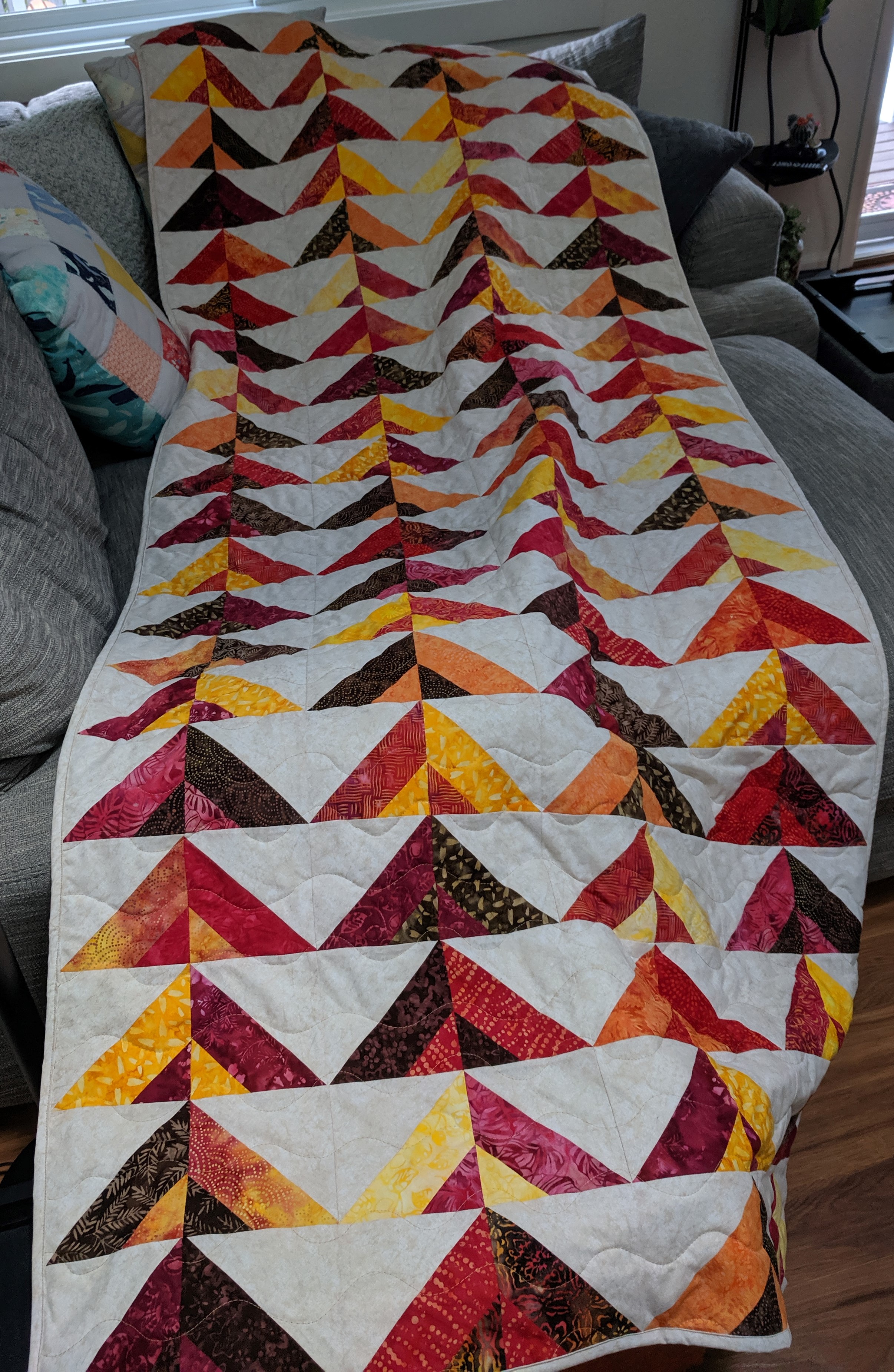
I made this bed runner for my parents! It’s from the On Point pattern from Bluprint/Midnight Quilt Show. It’s another HST type of design, but with a twist. I used the Boundless Batiks Fireside jelly roll to bring in some autumnal/southwestern colors. I sewed pairs of strips together down the long end to create 20 strip pairs, which were then sewn to my background fabric. Now here’s the magical and efficient part: the strip pairs and background fabric is now a tube, right sides in. I used a square ruler to cut out triangles from the fabric, lining up the 5.5″ marks with the sew line. Then you iron them open and it’s a HST!
Actual diagram from the pattern about cutting the tubes to make HSTs
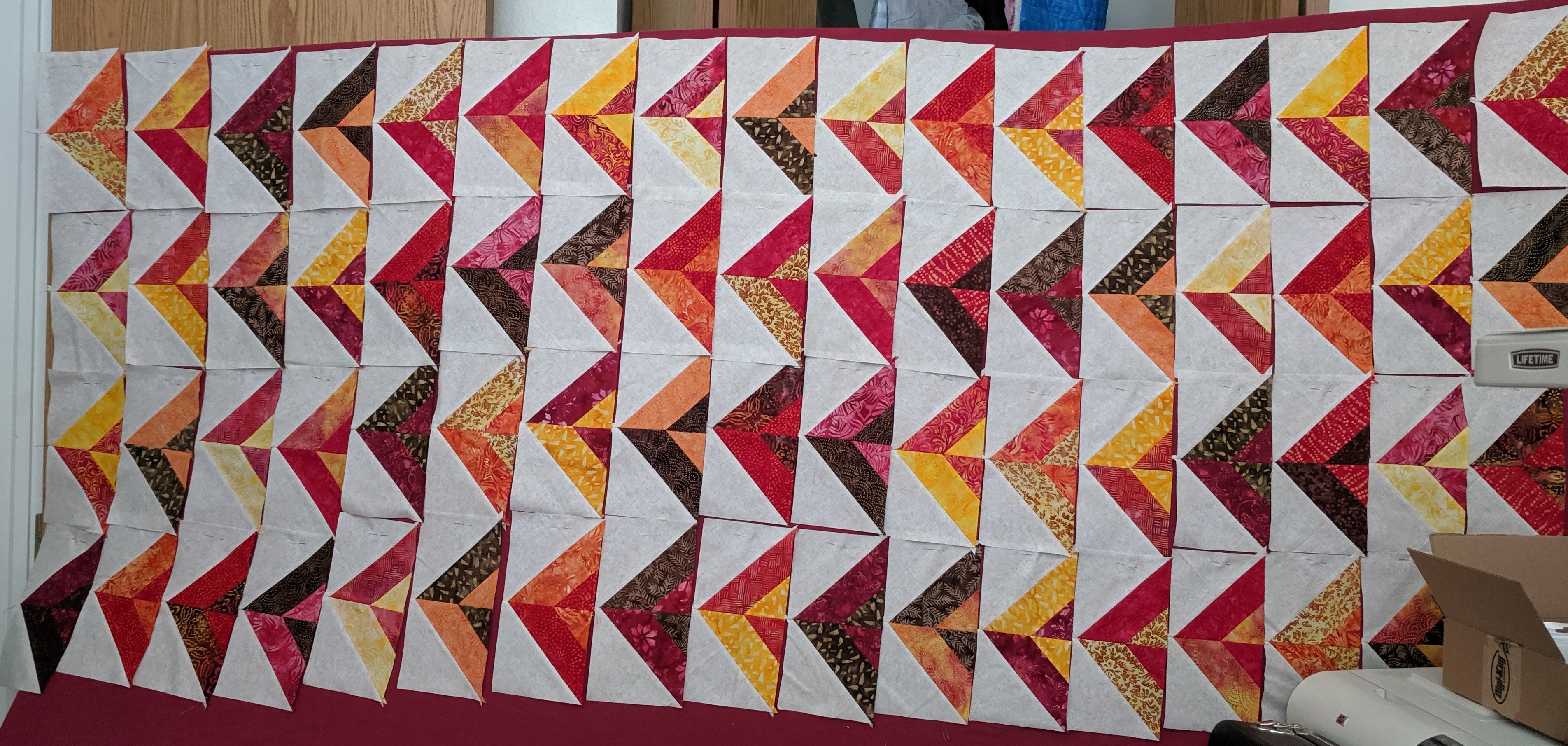
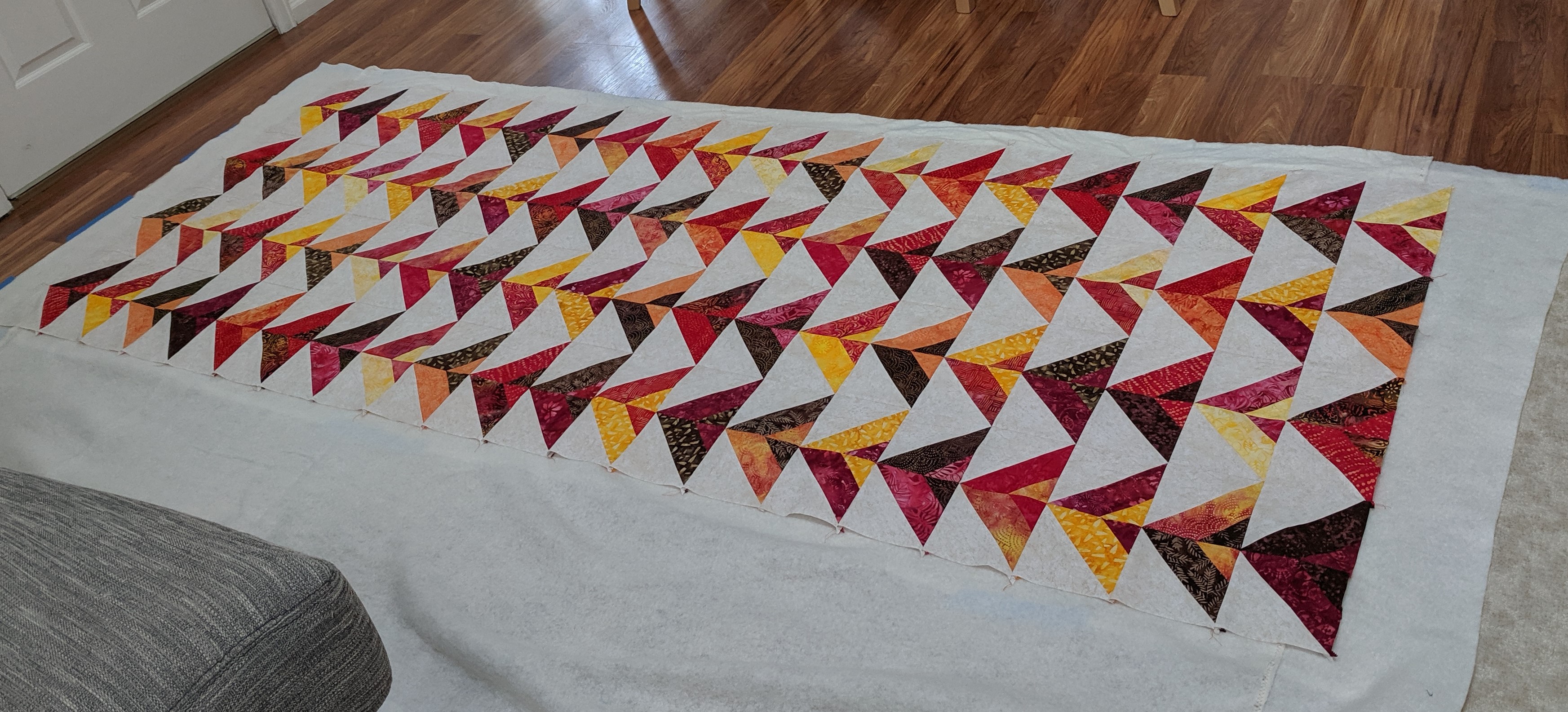
The pattern calls for matching the strips to create triangles inside of triangles, but my mom liked the mismatched strip layout, which I think brings a lot of movement and visual interest to the quilt. I assembled all my HSTs and paired them together to make the mismatched rectangular units. Then I laid them out on my new design wall (a piece of Polywall from Home Depot covered in an old flannel sheet) so that no fabric was touching the same fabric in any direction.
Designing took a bit of fiddling, and my wall fell down at one point – this isn’t even close to the final layout, haha
I wanted to quilt it in a way that minimized the harsh geometry, and since I’d had previous success with wavy lines, I decided to go for it. I chose a tan-ish thread to quilt with that ended up having a bit of sheen to it which makes it look almost gold.
Ready to be basted
Maybe one day I’ll take pictures in a better place than my couch, but it works
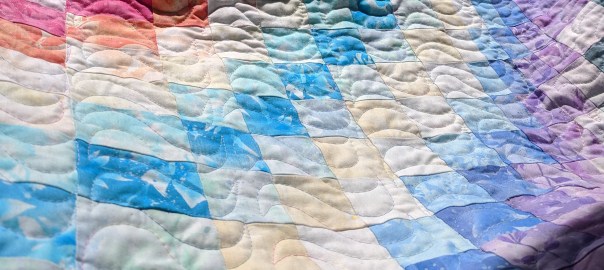
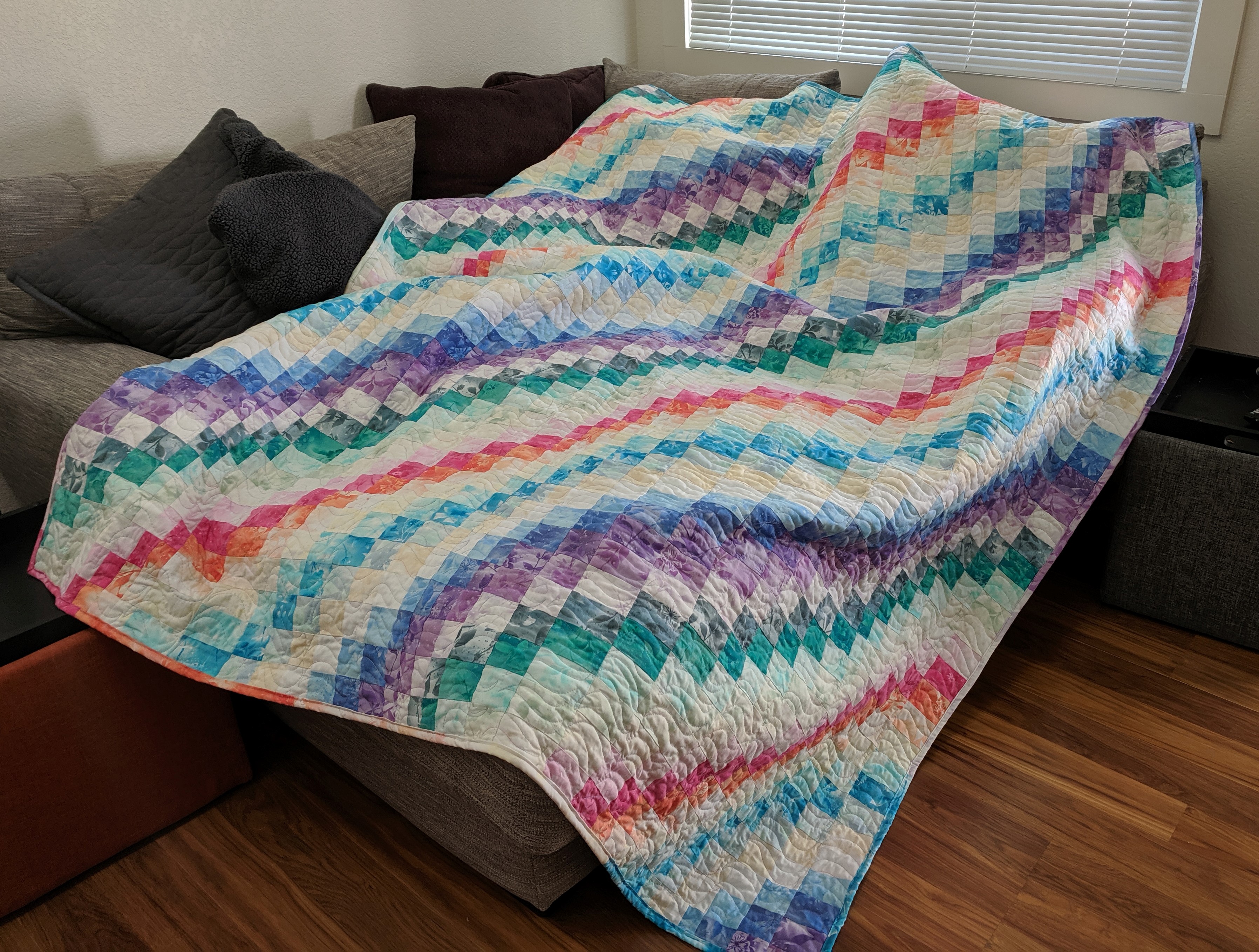
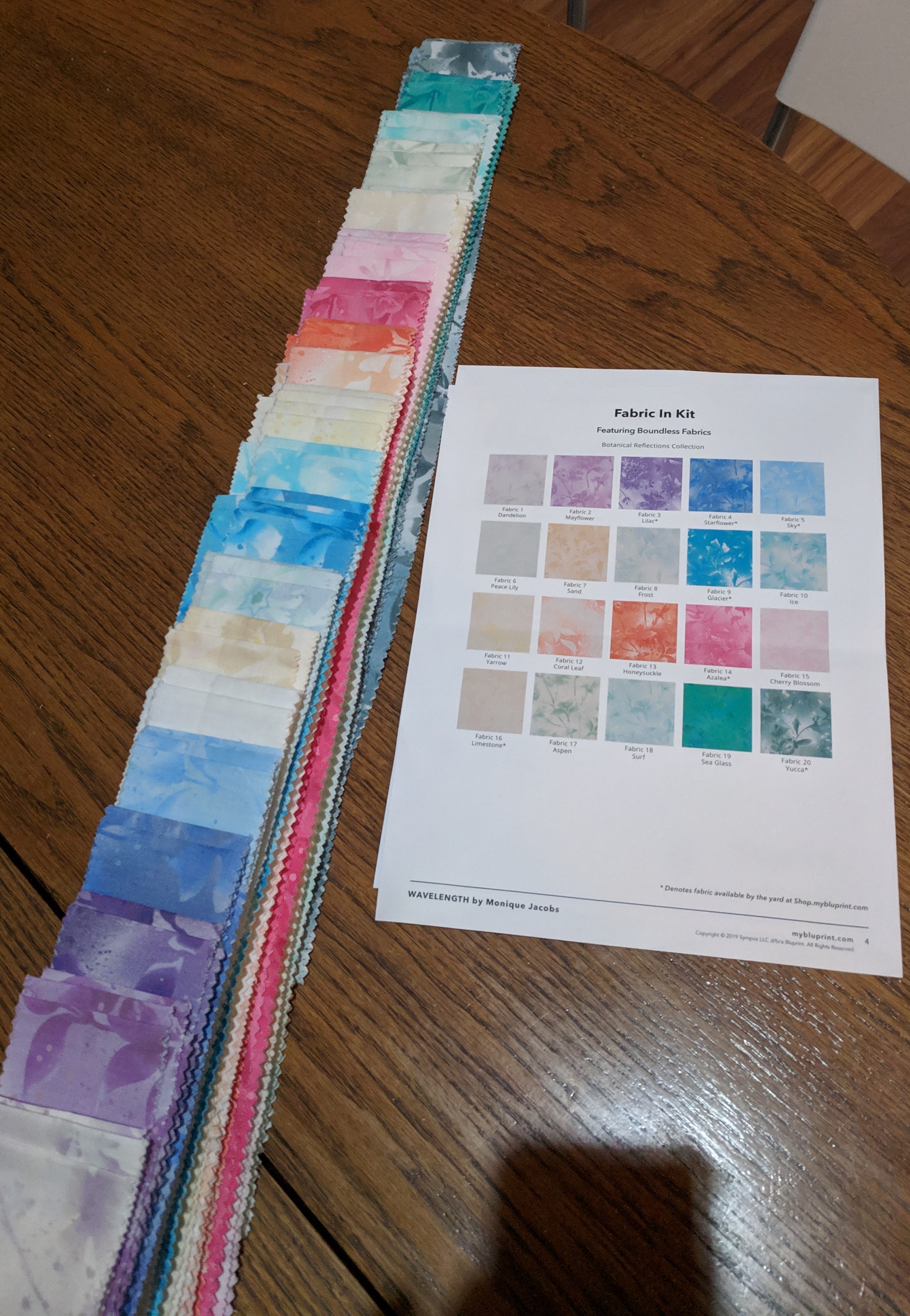
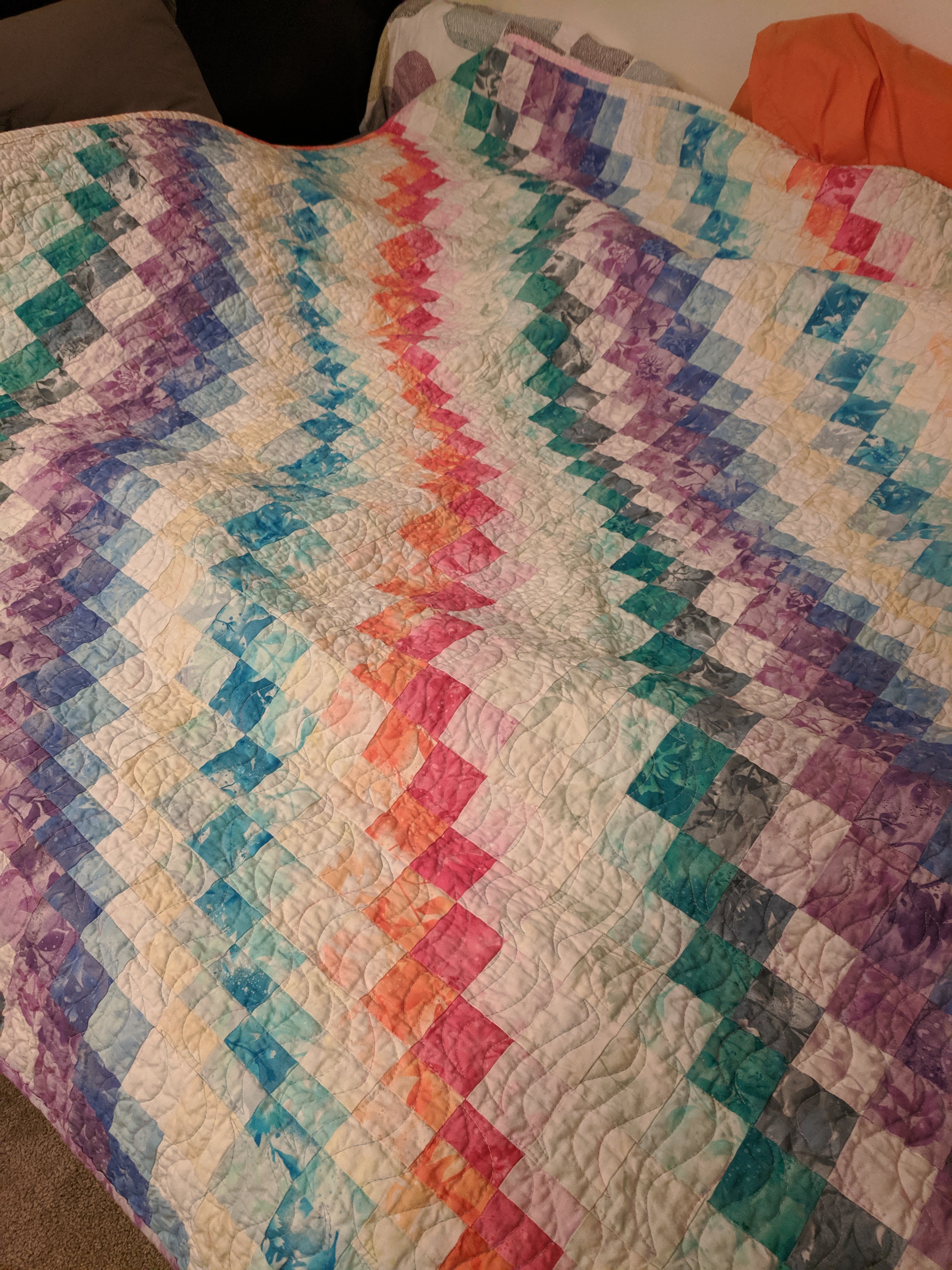
My second quilt! I loved making this quilt. It’s a kit from Bluprint that came with everything I needed to make the quilt top (and I bought yardage of one of the fabrics for the backing, and some 80% cotton/20% polyester batting). A bargello is a type of quilt that’s made using strip sets. This bargello needed 3 jelly rolls (6 strips of each of the 20 colors) and that made the entire 76″x92″ (technically a twin but fits on my queen bed) quilt top and I had some left over for a pillow.
The pattern tells you the order of the strip set, and in this bargello there’s only one set that you make 5 times (the 6th strip was cut up into baby rectangles to make a small portion of the quilt). Other bargellos can be made with more than one strip set to make ribbons that play together. So you sew all those strips together for five big striped rectangles. Then you cut your rectangles into strips of varying widths, each with all 20 colors in order.
It would be prudent to explain now that some people sew their rectangles into tubes, so the 1st color and 20th color are sewn together. While efficient (see next paragraph), this method didn’t work for me because my strip sets didn’t turn into perfect rectangles and were, in fact, wonky. Very wonky. Like not even close to parallel sides wonky. But! It still worked, I just didn’t sew my rectangles into tubes.
Also, this video about putting bargellos together may be easier to understand than the paragraph you’re about to read. 😉
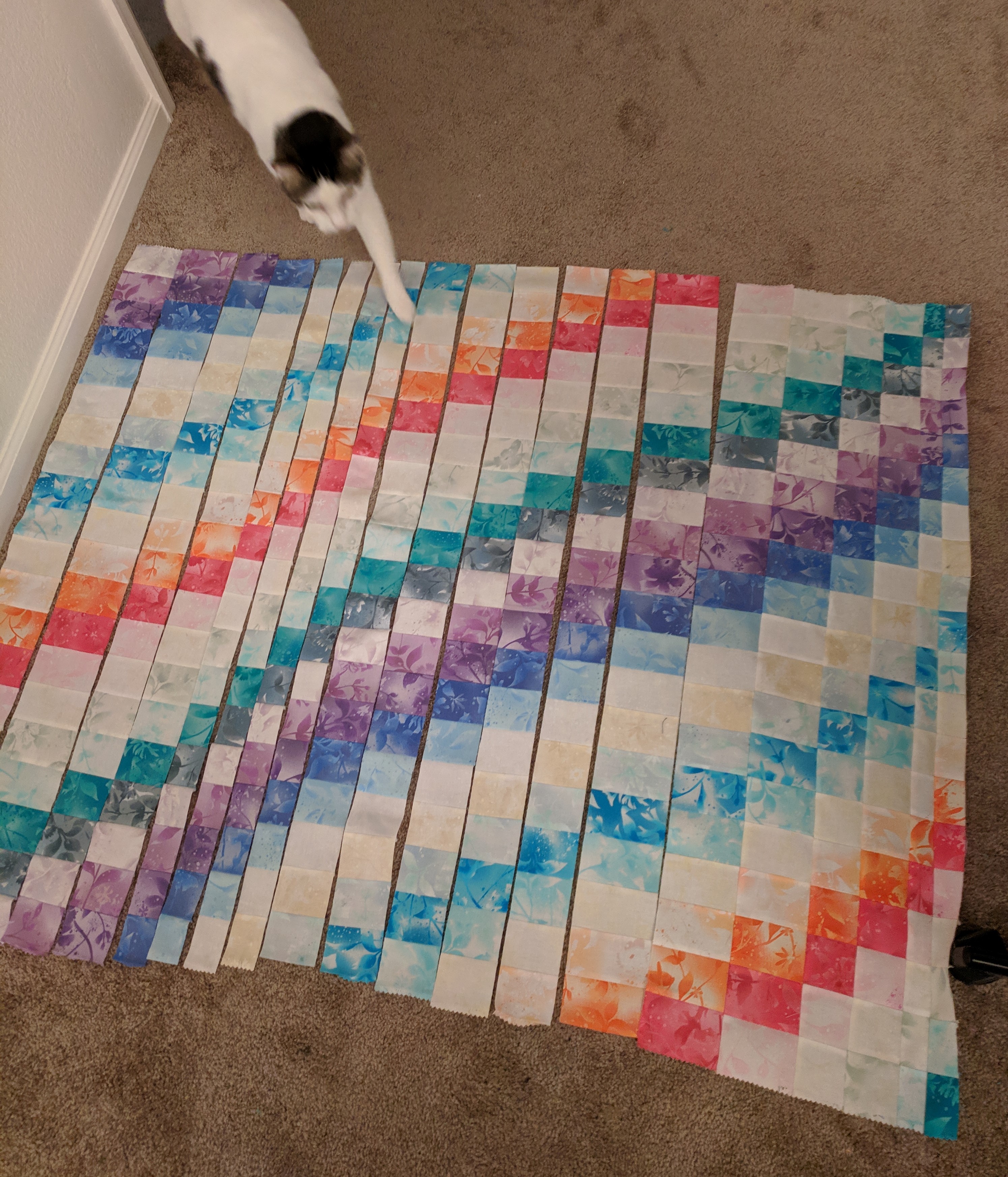
Okay, so now you have your long strips and the colors are all in the same order. And you know that the 3″ strip goes first, then a 2″ strip, etc. etc. So let’s say the order of the strips is A, B, C, D (to you know, the width of your quilt or section) and the order of the colors is 1, 2, 3 (to 20). Strip A stays with the top color as 1 and the last color as 20. For Strip B, you cut the seam between fabrics 1 and 2, remove fabric 1, and add fabric 1 to the bottom – so your strip goes 2 to 20 and then 1. For Strip C, you seam rip between 2 and 3, and add the top to the bottom – and your strip goes 3 to 20, then 1, then 2. On an on until you get to Strip T (the 20th strip) that goes 20, then 1 to 19.
Strips in order per the pattern – 1 is at the bottom, 20 is the dark gray at the top
Partially constructed block – excuse the furry helper
Then you sew your strips together, and it makes the wonderful bargello effect. The key to making it look wavy is to have the strips be different widths – otherwise it would just be diagonal lines like a checkerboard. I really want to design my own bargello (perhaps on a smaller scale) to look like a river or something, with overlapping waves and stuff.
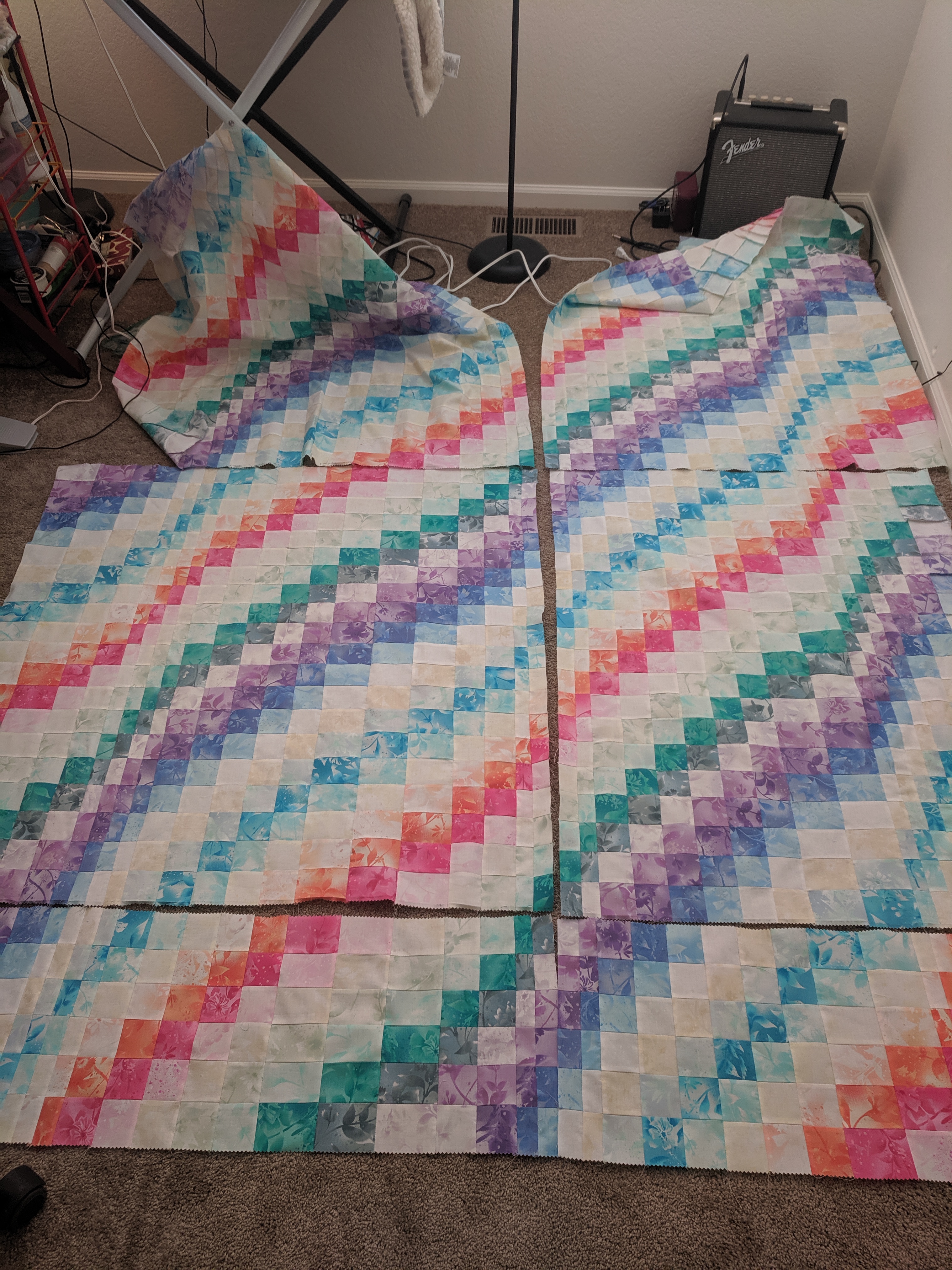
The two blocks at the bottom were made out of individual baby rectangles, the rest is strip sets
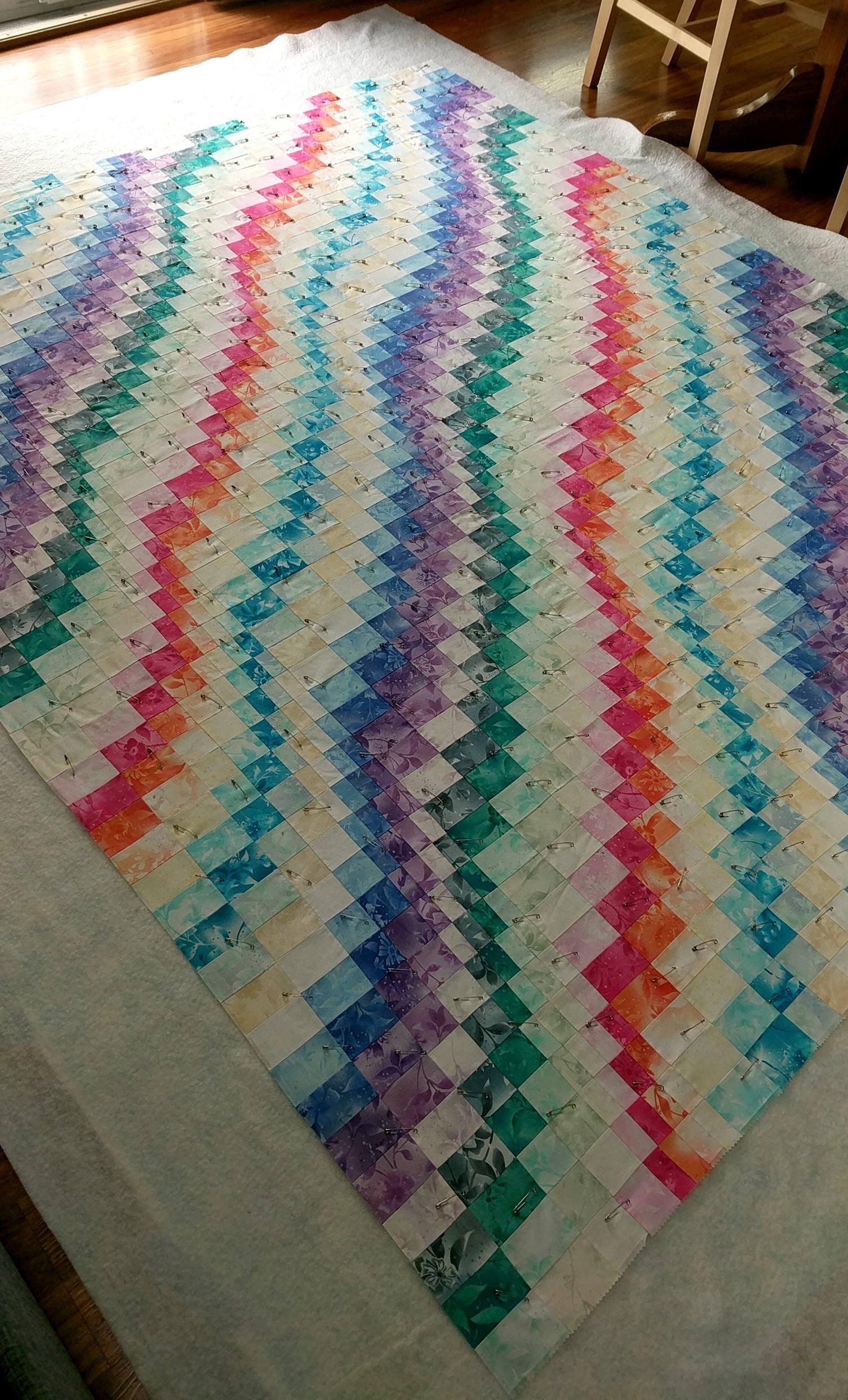
All pinned up in my family/dining room!
Approximately 400 safety pins later…. (a Kwik Klip helps close all the pins)
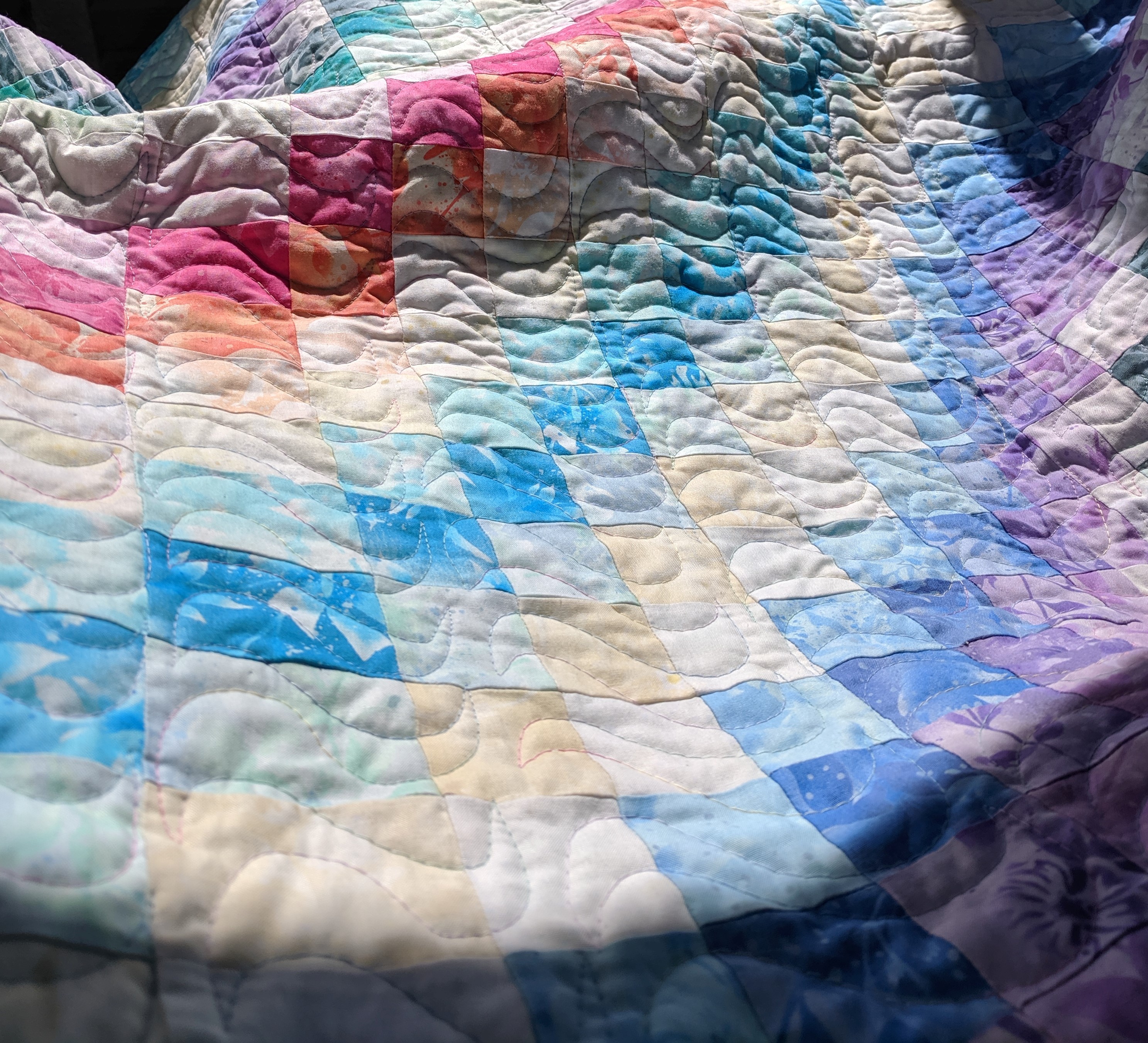
Then I basted and quilted it with my little “toothpaste” designs! Doesn’t it look like little squeezes of toothpaste? 🙂 I wanted a design that was flowy like the bargello itself, but possible to do in an all-over fashion. After doing the “custom” quilting on the Green Diamond Quilt, I wanted to see what would happen if I did the same thing on the entire quilt – and save myself some brain energy. I couldn’t decide what color thread to use, so I opted for variegated rainbow pastel thread that blends in pretty well to both the quilt top and the backing. Plus it’s another level of colorfulness that is fun.
Some free motion in real-time! Remember that the fabric is moving, not the needle 🙂
The toothpaste design is done in columns, so I started in the true middle, and worked up and down as I moved to the right (which gradually decreases how much sandwich is in the throat of your machine – between the needle and the case), then flipped it around and did the exact same thing to the other side. Since I’d practiced a lot on pen and paper and with scraps – more practice than last time! – the quilting came together pretty easily. Plus, each intersection is only 4 pieces of fabric coming together instead of 8, so it was significantly less bumpy than the Green Diamond Quilt.
But still, this quilt was a beast to wrangle with my machine. It has decent throat space but a bunch of cotton is heavy, and the quilt would fall into my lap as I moved up, which made it harder to control since I was working against gravity. I was only able to drape so much on myself before it would fall down, but I have a big enough table that the quilt could sit on the table in the other directions. I understood immediately why those set-in sewing machine tables are super popular, and why a longarm would change the game completely. But I’m not there yet – I still have many smaller scale projects I’m excited to work on, and twin-ish/queen-ish size quilts are still possible for me.
Glamour shot outside before washing – look at the cool shadows!
On my bed after washing
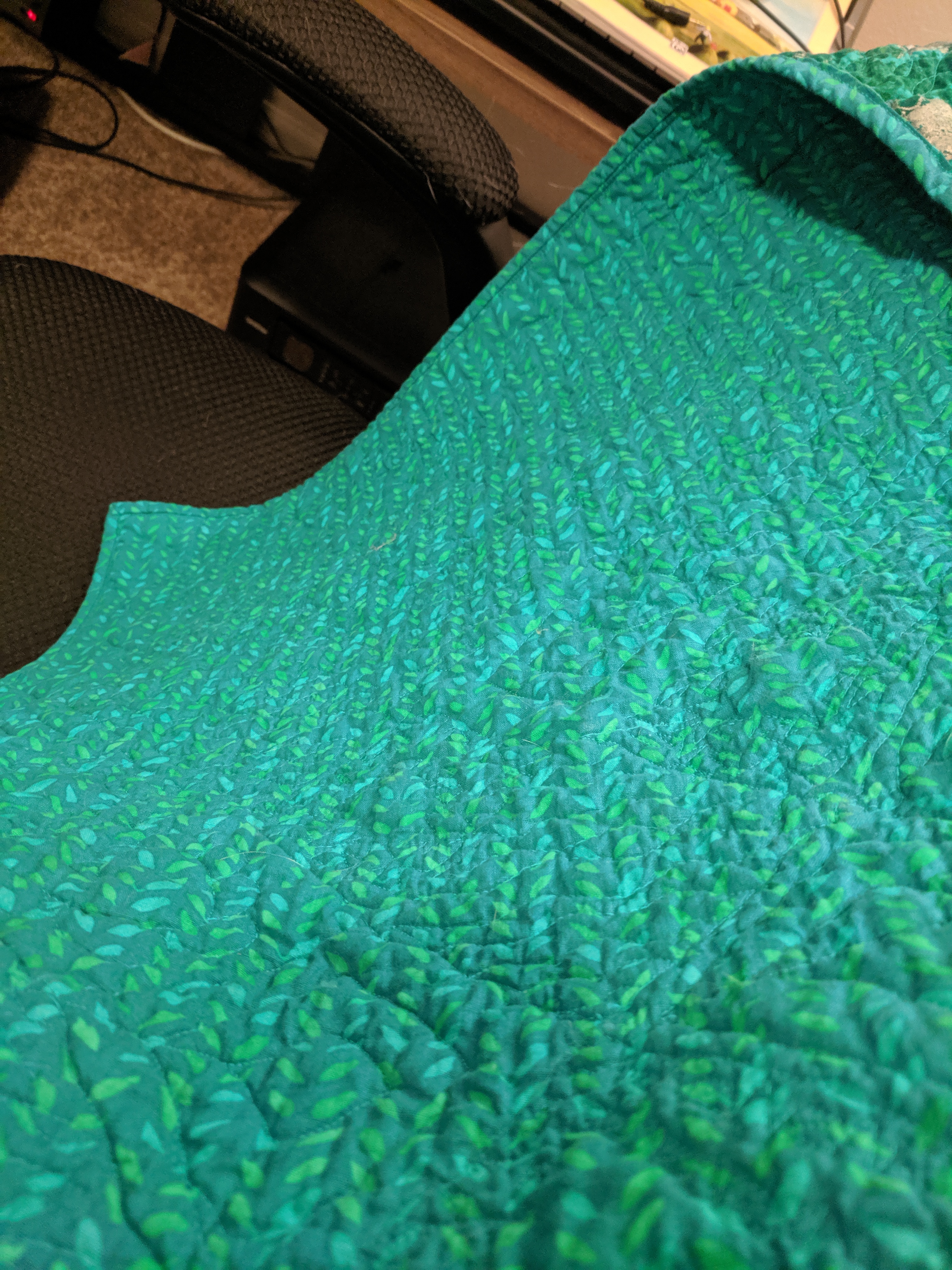
That said, I got the quilting done in three nights and am super pleased with the results. After washing my Green Diamond Quilt, I knew it would only look better after washing, and it does. 🙂 It’s crinkly and soft and puffy in all the right ways. Plus because it’s cotton, it feels cool to the touch. I have it on my bed right now, but because it’s primarily thin cotton batting, there isn’t as much warmth as I’d like – I’m naturally a 3 blanket person. So I bought this “dream puff” polyester batting for my next bed quilt that claims it’s twice as warm as down, so we’ll see 🙂
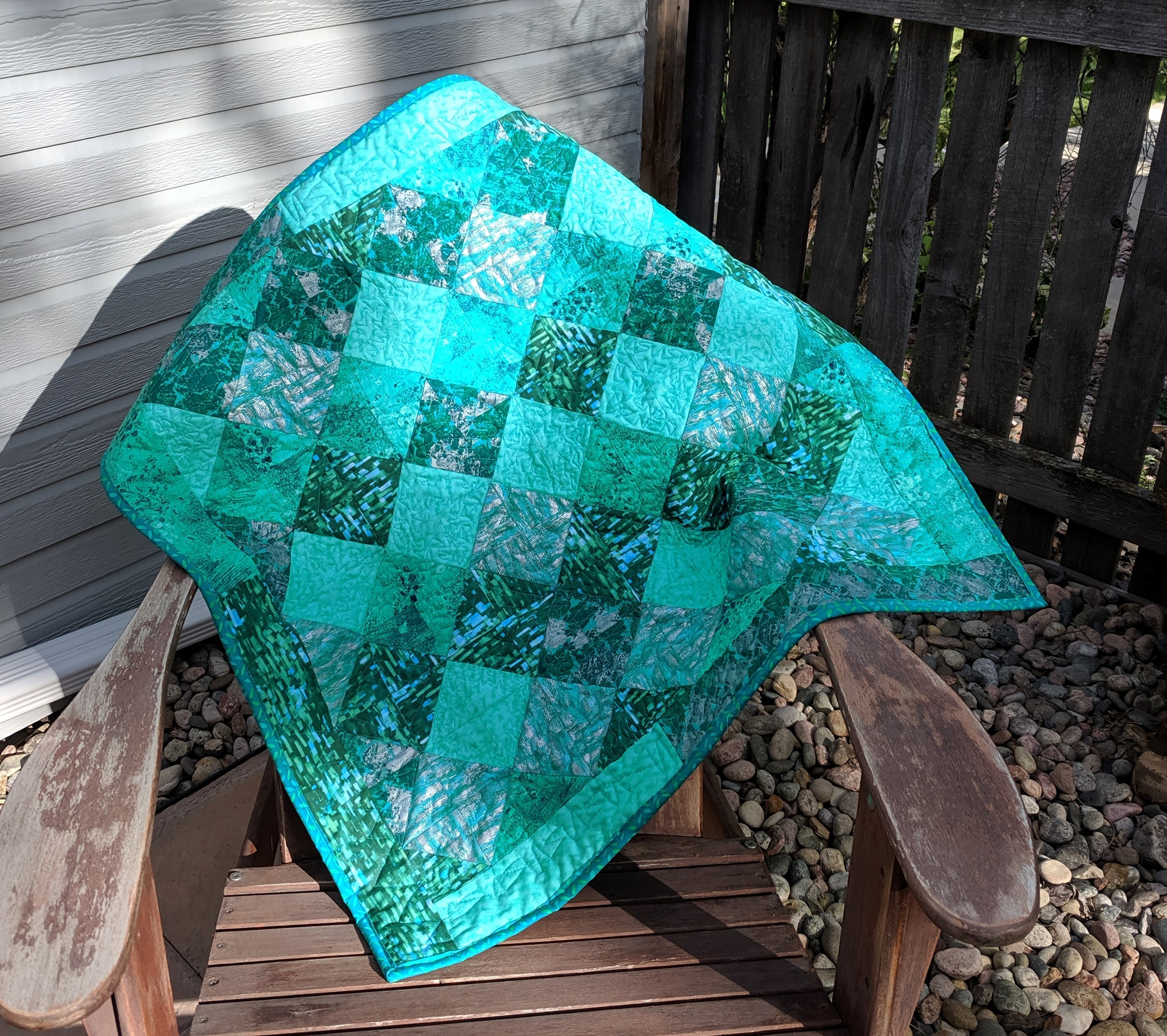
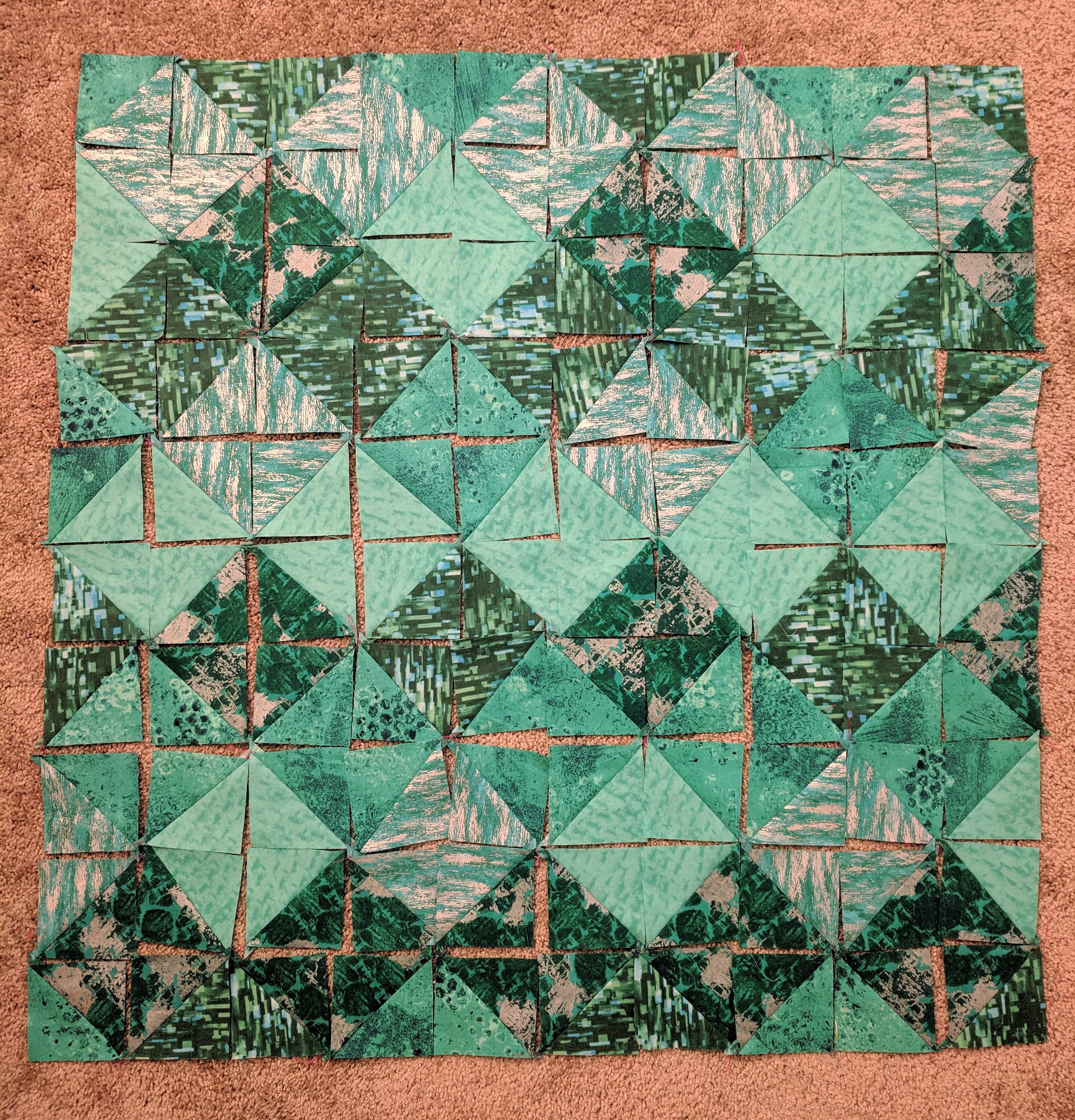
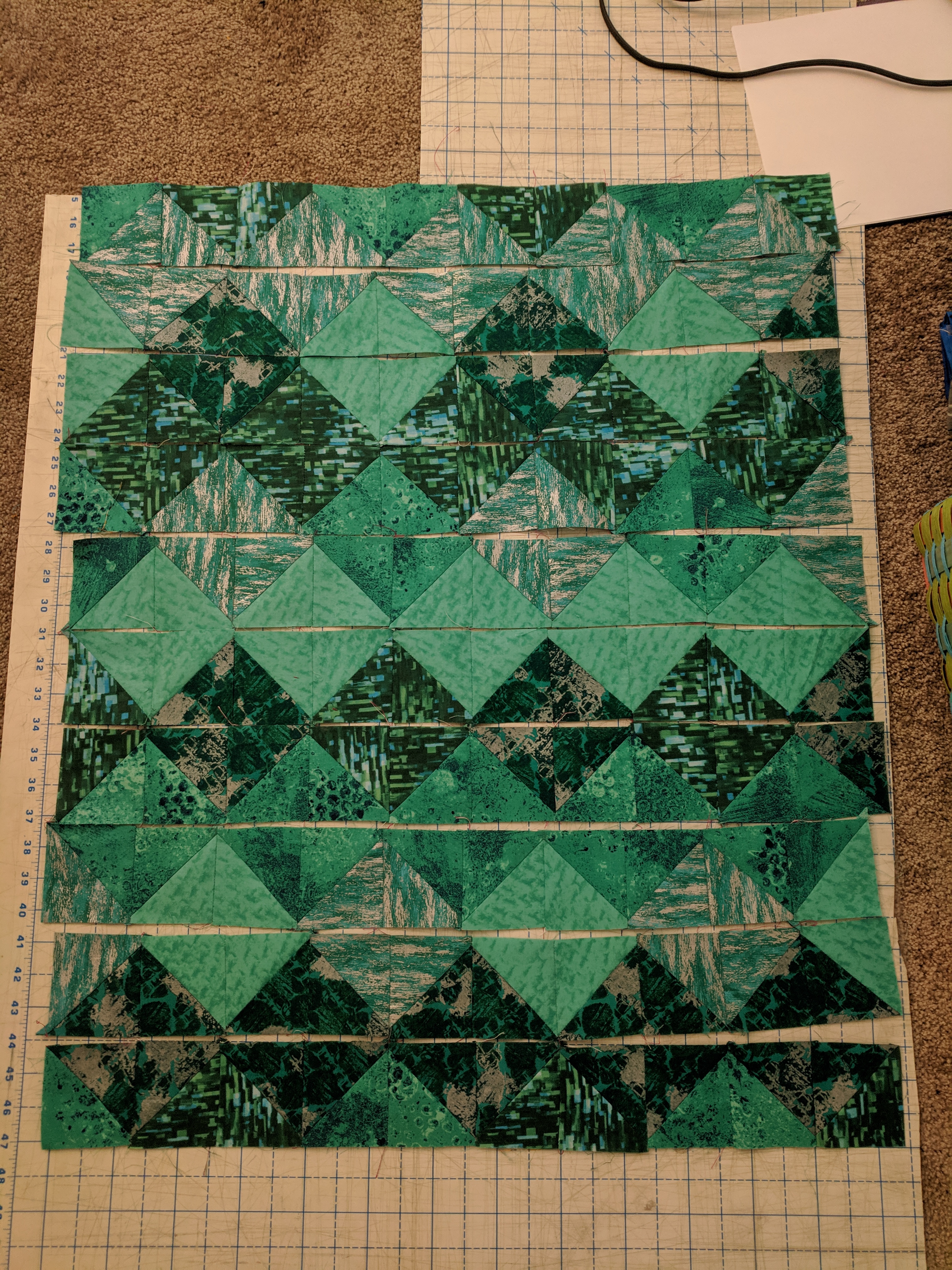
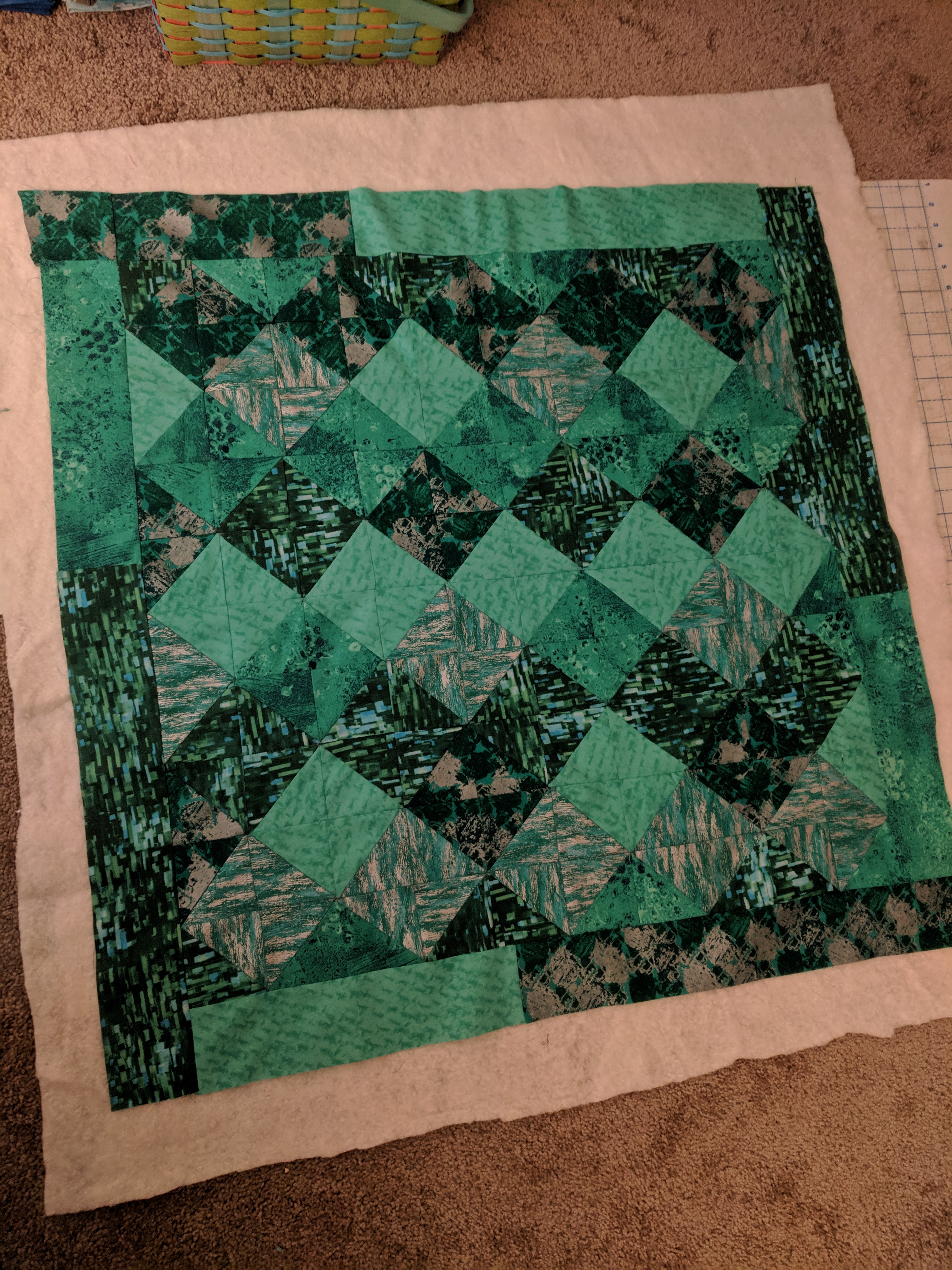
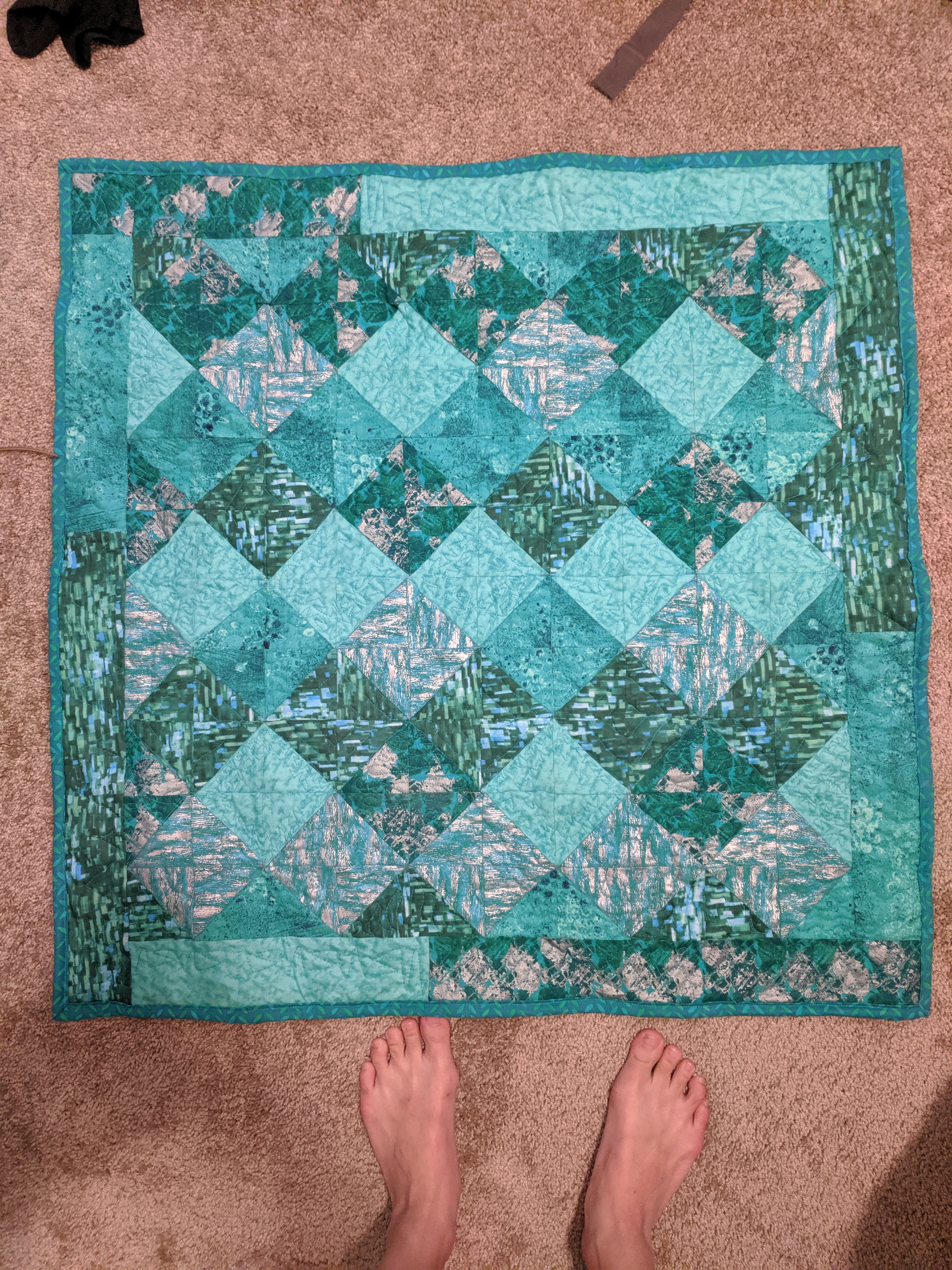
So the Green Diamonds was meant to be a trial “mess up” quilt before I attempted to quilt the rainbow bargello (see next week). I got a cheap 5-fabric fat quarter (18″x21″ piece) bundle from Joann, and cut each fabric into squares. I made half square triangles (HSTs) of each pair of fabrics – so each fabric had a set of HSTs with each other fabric. I decided to lay them out in a fake “on point” design, so that each fabric was represented by a row of diamonds. This created a secondary block, or pattern, between the rows of diamonds that’s diamonds of alternating fabric. I sewed these together in rows, then sewed the rows together. I used some excess fabric for the border.
Let’s take a second to talk about quilting. A quilt, by definition, is a piece of fabric (quilt top), a piece of batting, and another piece of fabric (backing), and at some point those three layers are held together by thread. For the most part, quilters these days use 100% cotton fabric for the quilt top and backing, and there are many different kinds of batting: cotton, polyester, cotton/poly blend, wool, etc. These three layers together are called the quilt sandwich, and the act of putting the thread through all the layers is called quilting. 🙂 Quilting can be done by hand or by machine.
Hand Quilting
Design: hand sewing a running stitch to make lines or a design across the quilt top.
Tying: using a needle to draw thread through all three layers and tying the thread on either side of the sandwich. Can be used with buttons or other baubles.
Machine Quilting
Walking Foot: usually used for straight line or simple designs, a walking foot is an alternative presser foot (thing that holds the fabric down against the machine as you’re sewing) that helps feed the top of the sandwich through the machine at the same rate as the feed dogs that are moving bottom of the sandwich. Normal presser feet do not bring the top through as effectively, and stitching can become uneven and fabric can get stretched or distorted.
Feed dogs are the little strips that come up and down and move the fabric through the machine as the needle moves up and down. In mechanical machines, the needle and feed dogs are moved by the same crankshaft.
Free Motion: a free motion foot is used instead of the presser foot, and the feed dogs are lowered so they do not move the fabric. The quilter moves the fabric around the sewing machine space so that the needle travels across the fabric. Can make lines and patterns like hand quilting.
Longarm: a special sewing machine where the fabric is held stationary on a large frame, and the quilter moves the machine with the needle around the quilt. Machines like these are very expensive but incredibly effective. Much easier than moving the fabric in free motion.
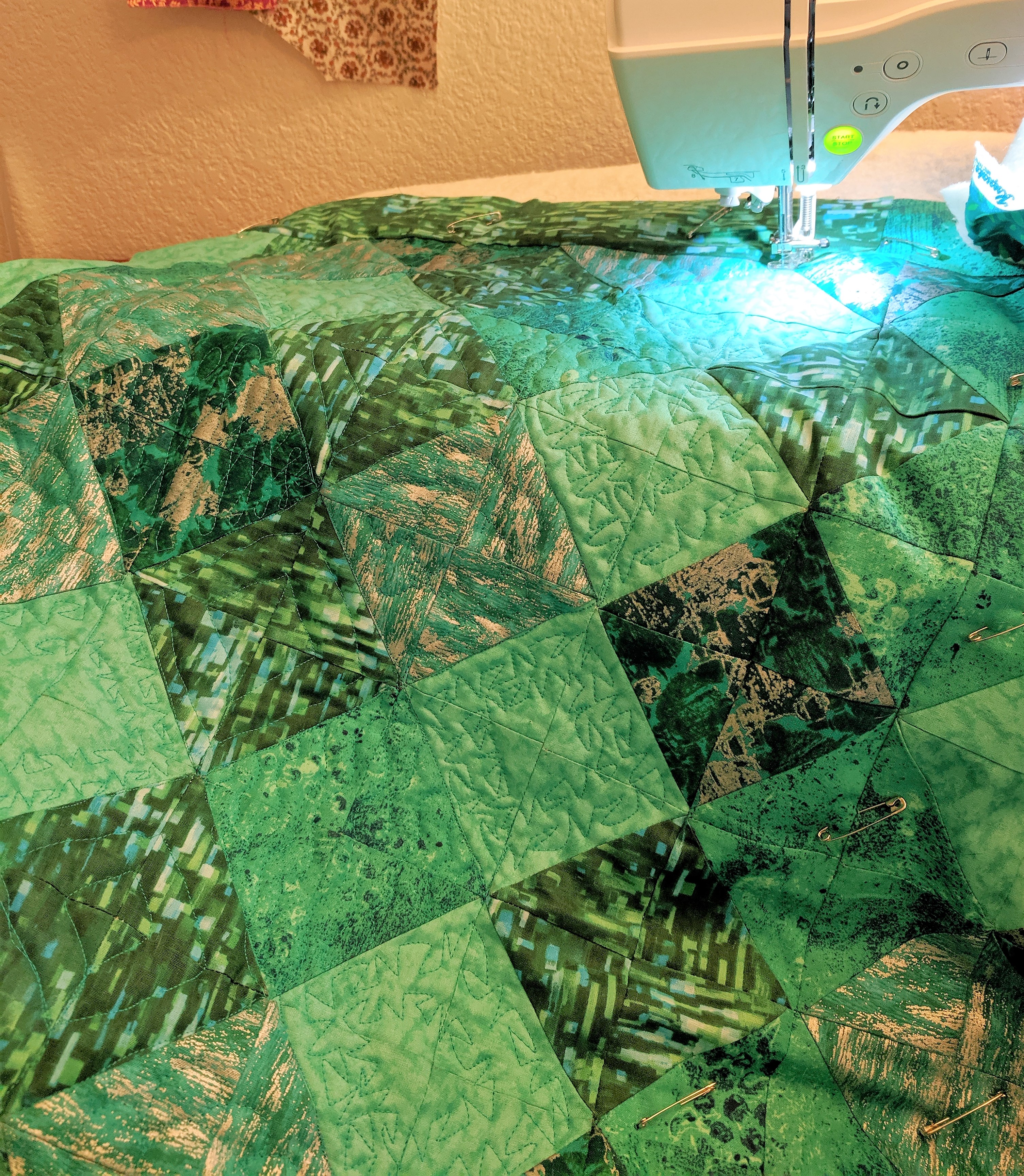
So I knew I wanted to do free motion with this quilt. I did a lot of practice with pen and paper (surprisingly useful) and on scraps. In a fit of ambition, I decided that each fabric would have its own design. There is “dot-to-dot”, NZNZ, swirl with petals, wavy lines, and wishbone. Let me say this now: I didn’t practice enough on all of the designs. I’d done wishbone before on a pillow, so that one turned out pretty nice. And I surprised myself by having some very nice wavy lines, too. Dot-to-dot was the hardest – creating a straight line mid-fabric without any guides (I decided to forego drawing in water soluble marker on my fabric) is really hard.
Before you quilt the sandwich, you have to baste it so that all the layers stay aligned and don’t move around while you’re quilting. You can hand baste with stitches, spray baste with adhesive, or safety pin (my chosen method). You lay your sandwich on a flat surface (preferably not carpet), and I like to tape down the edges of my backing so it doesn’t slide about. Then you start pinning in the center and move outwards, smoothing wrinkles as you go. This also makes sure that you don’t end up with weird wrinkles, pleats, or bunches in your finished product (but more on that later).
So anyway after pinning the living daylights out of my sandwich, I sat down to do some free motion. You always start in the middle and work your way out, just like basting. I decided to work down the rows so that I could keep doing the same design and keep it in my muscle memory. One of my issues with this quilt was moving from diamond to diamond – some of my designs didn’t bring me back to my starting point, or guide me into the next diamond. Also, since this was an HST design, there can be up to 8 layers of fabric at the intersections, which made it bumpy and hard to quilt near the centers and points of each diamond.
It took a bit, but I quilted this in a couple nights and put the binding on (strip of fabric wrapped around the edges of the fabric).
Now – about the wrinkles and bunches. I loved my finished product, but there’s one last step in quiltmaking. Washing and drying. No one likes something they can’t throw in the washer and dryer. I was extremely worried about threads coming loose, or the binding just spontaneously falling off (extremely unlikely), but I threw it in the washer anyway. And when I put it in the dryer, I didn’t even look at it.
But then it turned out wonderfully crinkly and soft, and nothing bad happened 🙂 Washing your quilt helps the batting fluff up a bit, and the quilting sinks down, making a nice texture that hides mistakes (of which I made many) and bumps (of which there are many) and pretty much everything else. Plus it makes the whole thing soft and cuddly, which is what quilts are (for me) meant to be. I don’t think you’d wash an art quilt, or something with super detailed free motion, but for my purposes, I learned to stop worrying about the tiny things because I can’t even find them anymore when I look at the quilt. And as Angela Walters says, “better finished than perfect”.
I finally got around to adding the borders and finishing up the back. The hardest part has been preparing and planning how to quilt this bad boy. I’ve had the top done for some weeks now, but agonizing over what to quilt. I want to honor the kaleidoscope effect while doing something simple that won’t detract from the coolness nor add to the chaos. I think I’ve finally got it and hopefully my next post about this quilt will be the completed version.
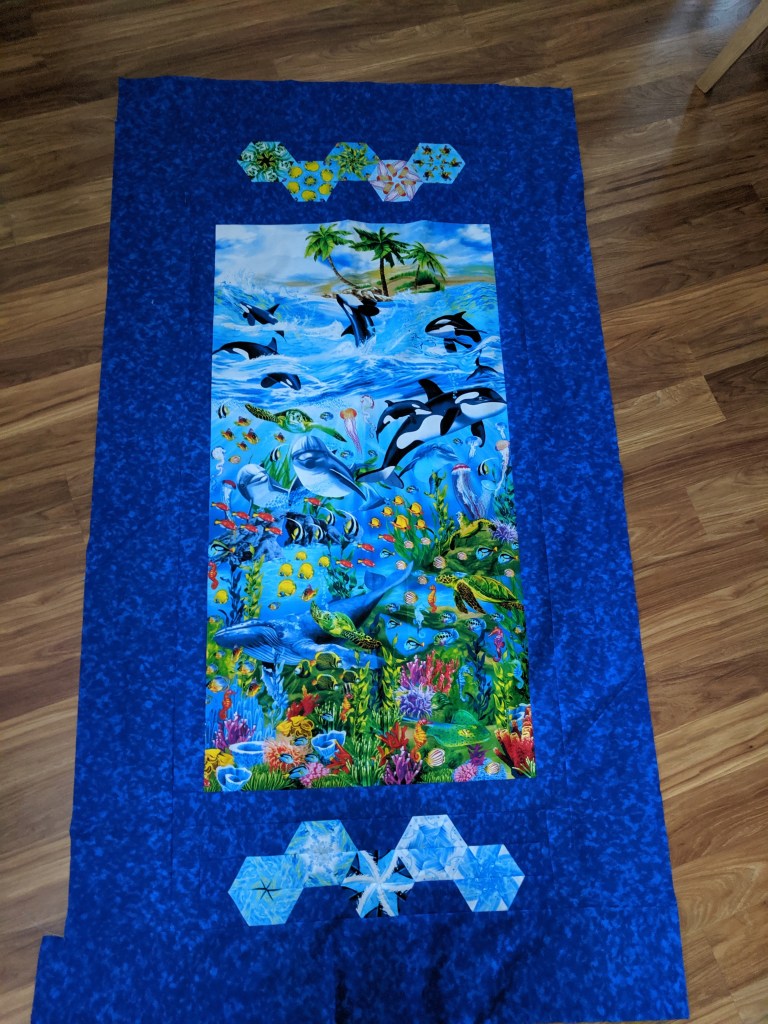
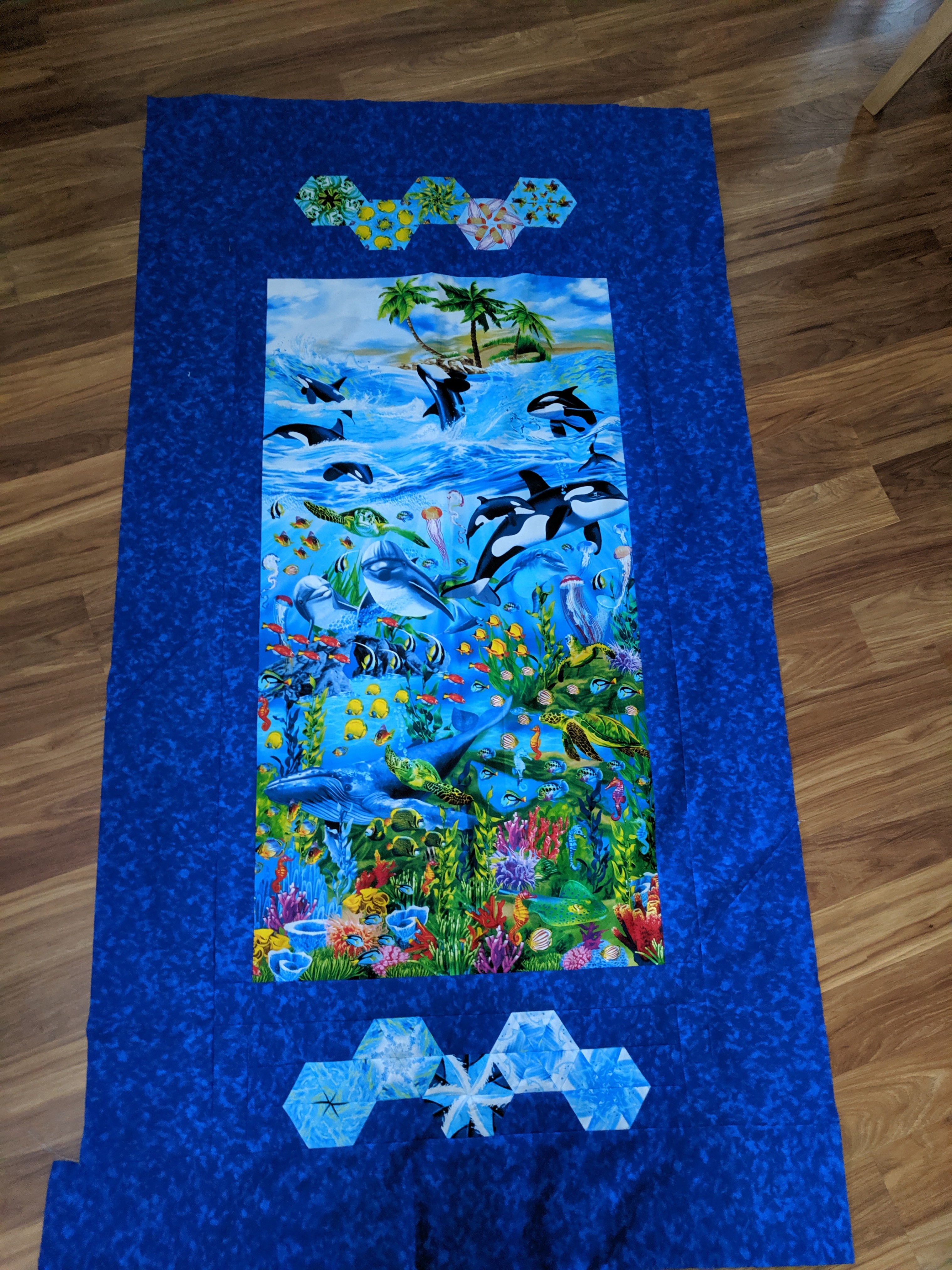
The backing! I’m using a full panel and some leftover hexagons that didn’t make it into the top.
Now you can see the full beauty of the original panel. I wanted to put the full panel on the back so I could (a) easily show people the original fabric and (b) display it with the panel side showing. The layout on the front kind of mimics the colors of the panel too, with blues on the top and greens on the bottom. And you can see why I, a lifelong whale lover, chose this fabric 🙂









 Finch's Creative Endeavors