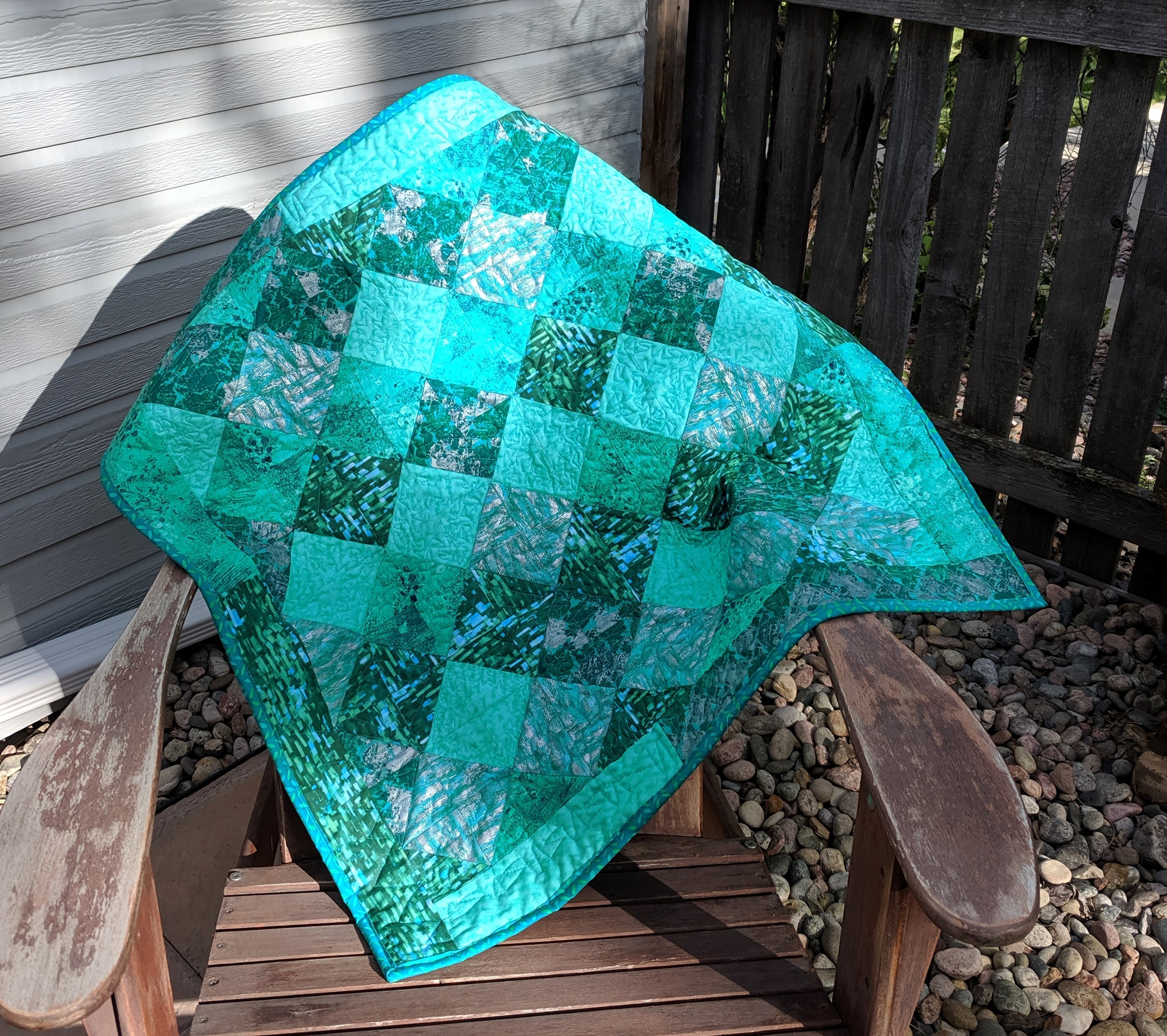
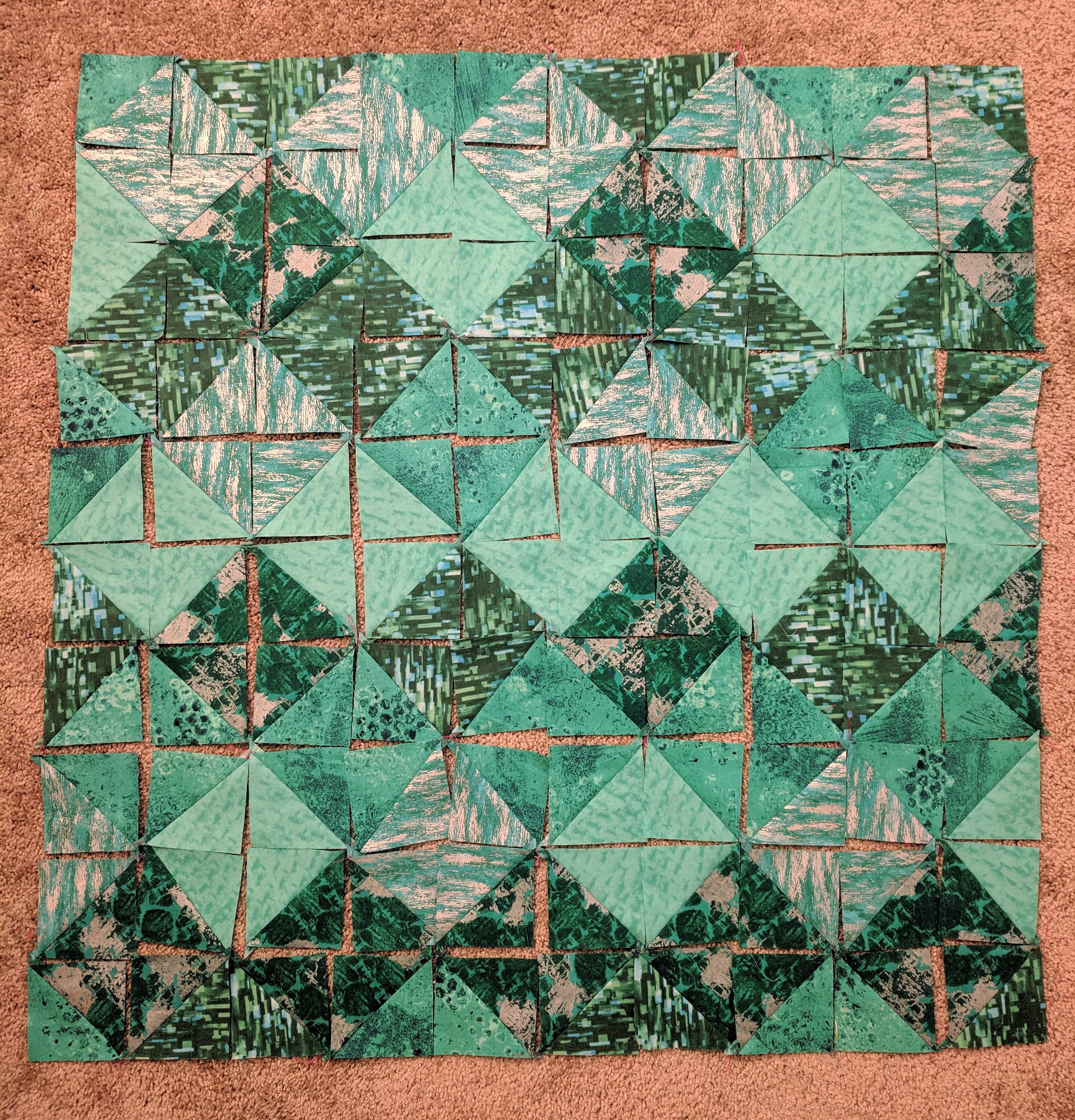
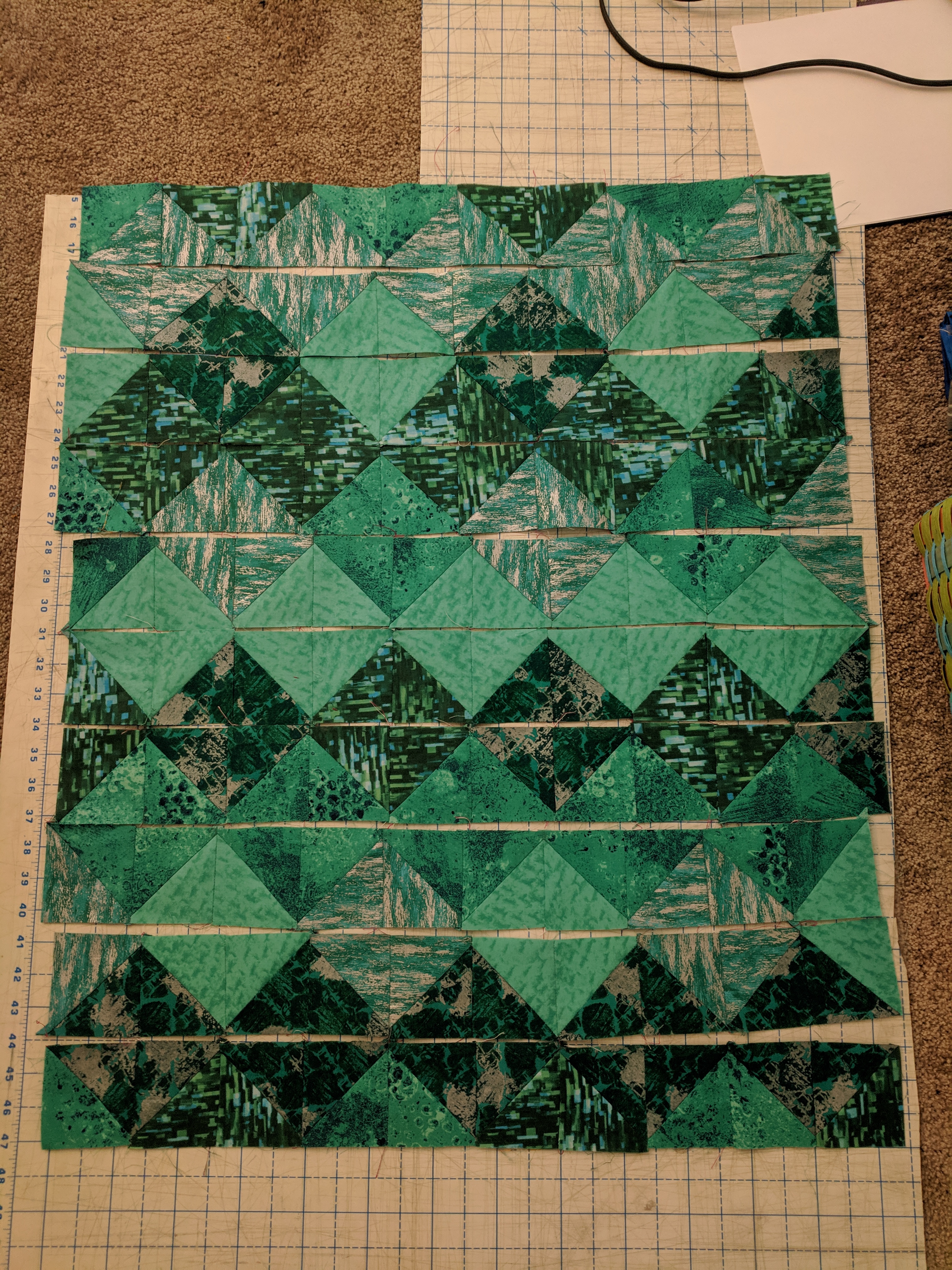
So the Green Diamonds was meant to be a trial “mess up” quilt before I attempted to quilt the rainbow bargello (see next week). I got a cheap 5-fabric fat quarter (18″x21″ piece) bundle from Joann, and cut each fabric into squares. I made half square triangles (HSTs) of each pair of fabrics – so each fabric had a set of HSTs with each other fabric. I decided to lay them out in a fake “on point” design, so that each fabric was represented by a row of diamonds. This created a secondary block, or pattern, between the rows of diamonds that’s diamonds of alternating fabric. I sewed these together in rows, then sewed the rows together. I used some excess fabric for the border.
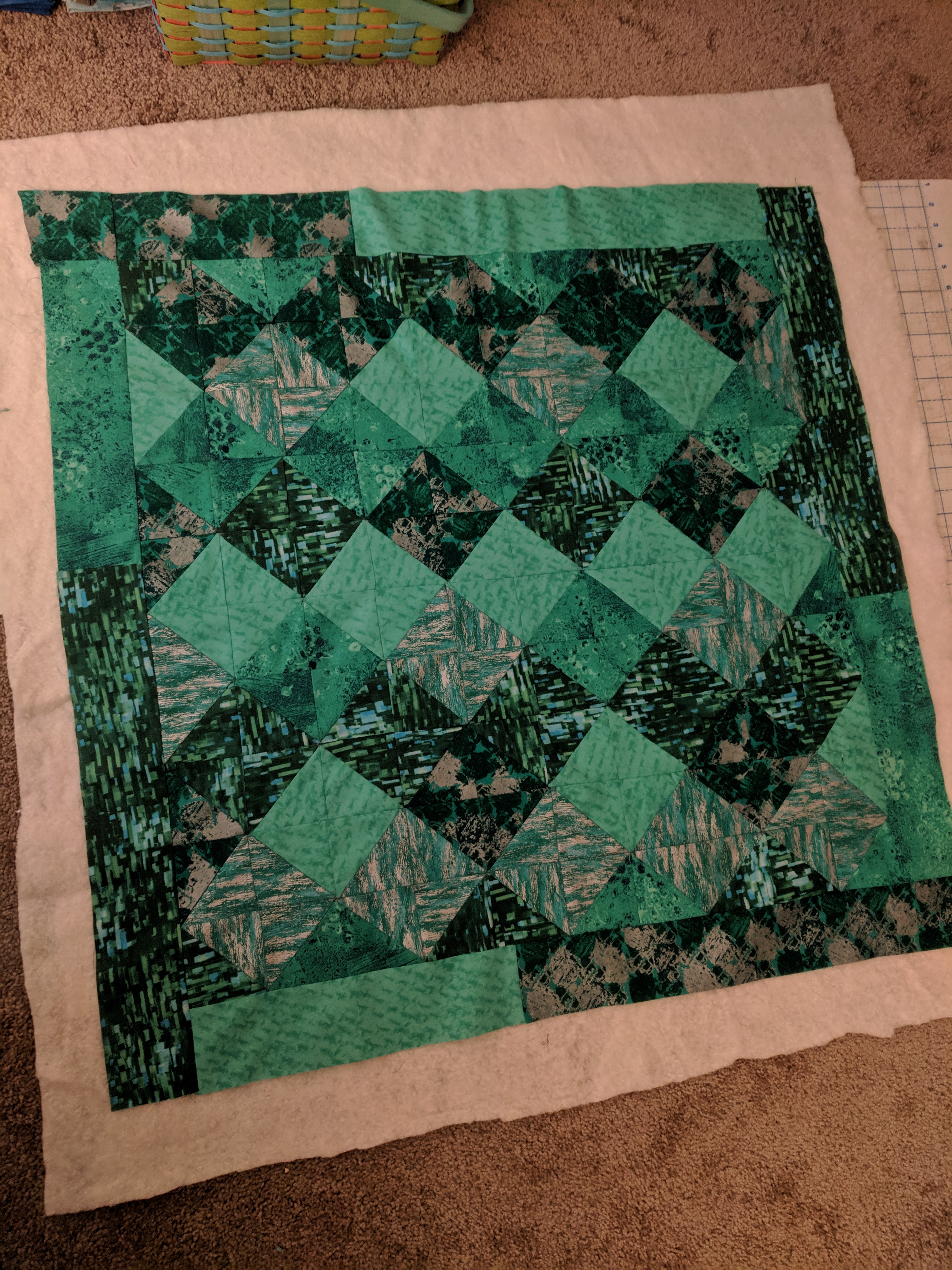
Let’s take a second to talk about quilting. A quilt, by definition, is a piece of fabric (quilt top), a piece of batting, and another piece of fabric (backing), and at some point those three layers are held together by thread. For the most part, quilters these days use 100% cotton fabric for the quilt top and backing, and there are many different kinds of batting: cotton, polyester, cotton/poly blend, wool, etc. These three layers together are called the quilt sandwich, and the act of putting the thread through all the layers is called quilting. 🙂 Quilting can be done by hand or by machine.
- Hand Quilting
- Design: hand sewing a running stitch to make lines or a design across the quilt top.
- Tying: using a needle to draw thread through all three layers and tying the thread on either side of the sandwich. Can be used with buttons or other baubles.
- Machine Quilting
- Walking Foot: usually used for straight line or simple designs, a walking foot is an alternative presser foot (thing that holds the fabric down against the machine as you’re sewing) that helps feed the top of the sandwich through the machine at the same rate as the feed dogs that are moving bottom of the sandwich. Normal presser feet do not bring the top through as effectively, and stitching can become uneven and fabric can get stretched or distorted.
- Feed dogs are the little strips that come up and down and move the fabric through the machine as the needle moves up and down. In mechanical machines, the needle and feed dogs are moved by the same crankshaft.
- Free Motion: a free motion foot is used instead of the presser foot, and the feed dogs are lowered so they do not move the fabric. The quilter moves the fabric around the sewing machine space so that the needle travels across the fabric. Can make lines and patterns like hand quilting.
- Longarm: a special sewing machine where the fabric is held stationary on a large frame, and the quilter moves the machine with the needle around the quilt. Machines like these are very expensive but incredibly effective. Much easier than moving the fabric in free motion.
- Walking Foot: usually used for straight line or simple designs, a walking foot is an alternative presser foot (thing that holds the fabric down against the machine as you’re sewing) that helps feed the top of the sandwich through the machine at the same rate as the feed dogs that are moving bottom of the sandwich. Normal presser feet do not bring the top through as effectively, and stitching can become uneven and fabric can get stretched or distorted.
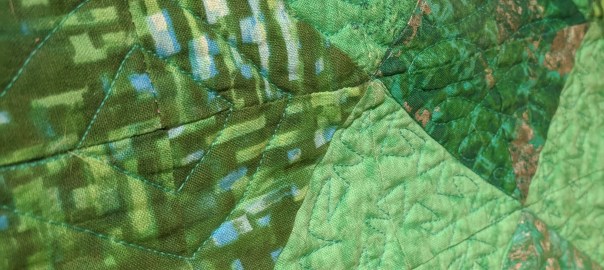
So I knew I wanted to do free motion with this quilt. I did a lot of practice with pen and paper (surprisingly useful) and on scraps. In a fit of ambition, I decided that each fabric would have its own design. There is “dot-to-dot”, NZNZ, swirl with petals, wavy lines, and wishbone. Let me say this now: I didn’t practice enough on all of the designs. I’d done wishbone before on a pillow, so that one turned out pretty nice. And I surprised myself by having some very nice wavy lines, too. Dot-to-dot was the hardest – creating a straight line mid-fabric without any guides (I decided to forego drawing in water soluble marker on my fabric) is really hard.
Before you quilt the sandwich, you have to baste it so that all the layers stay aligned and don’t move around while you’re quilting. You can hand baste with stitches, spray baste with adhesive, or safety pin (my chosen method). You lay your sandwich on a flat surface (preferably not carpet), and I like to tape down the edges of my backing so it doesn’t slide about. Then you start pinning in the center and move outwards, smoothing wrinkles as you go. This also makes sure that you don’t end up with weird wrinkles, pleats, or bunches in your finished product (but more on that later).
So anyway after pinning the living daylights out of my sandwich, I sat down to do some free motion. You always start in the middle and work your way out, just like basting. I decided to work down the rows so that I could keep doing the same design and keep it in my muscle memory. One of my issues with this quilt was moving from diamond to diamond – some of my designs didn’t bring me back to my starting point, or guide me into the next diamond. Also, since this was an HST design, there can be up to 8 layers of fabric at the intersections, which made it bumpy and hard to quilt near the centers and points of each diamond.
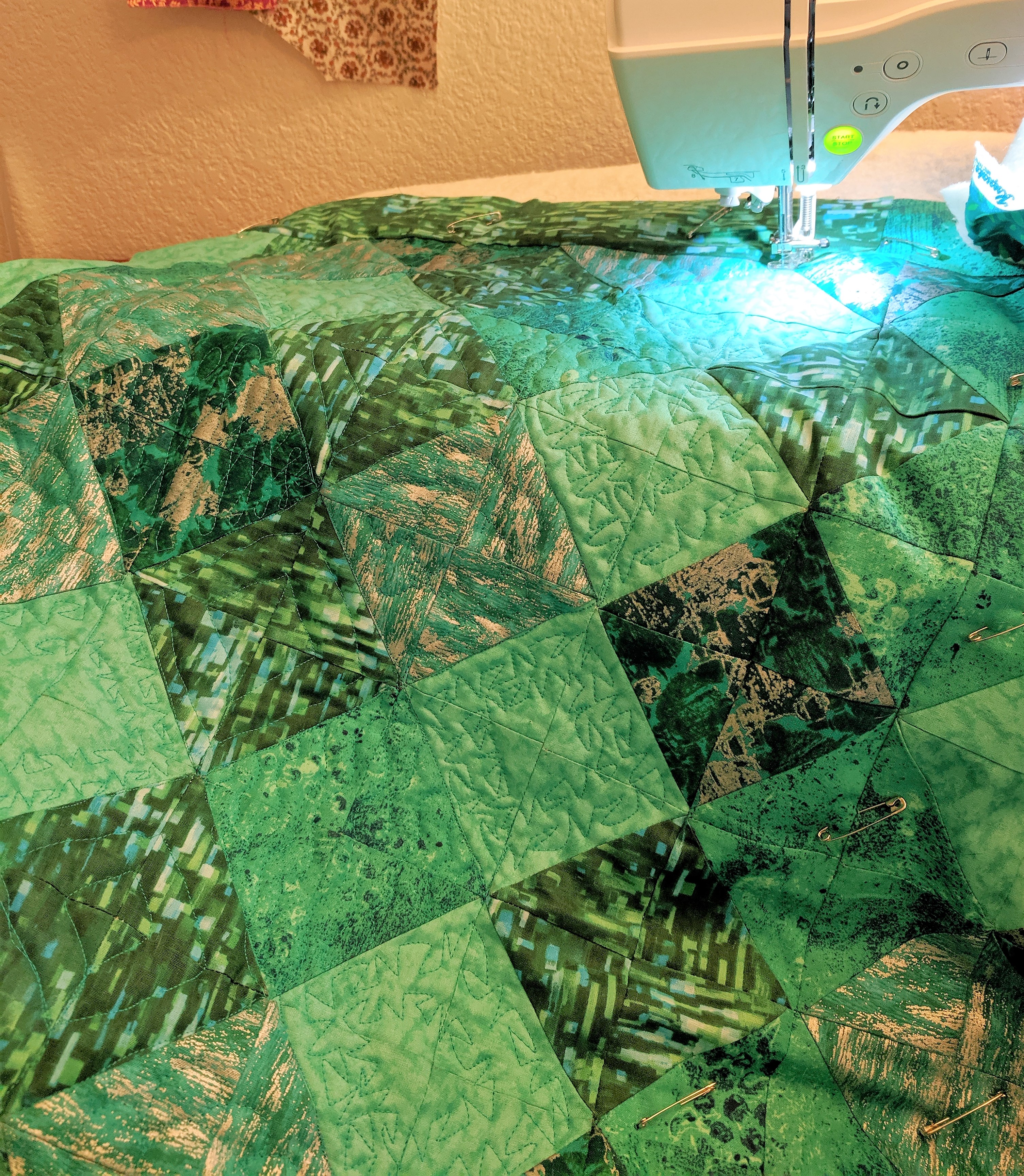
It took a bit, but I quilted this in a couple nights and put the binding on (strip of fabric wrapped around the edges of the fabric).
Now – about the wrinkles and bunches. I loved my finished product, but there’s one last step in quiltmaking. Washing and drying. No one likes something they can’t throw in the washer and dryer. I was extremely worried about threads coming loose, or the binding just spontaneously falling off (extremely unlikely), but I threw it in the washer anyway. And when I put it in the dryer, I didn’t even look at it.
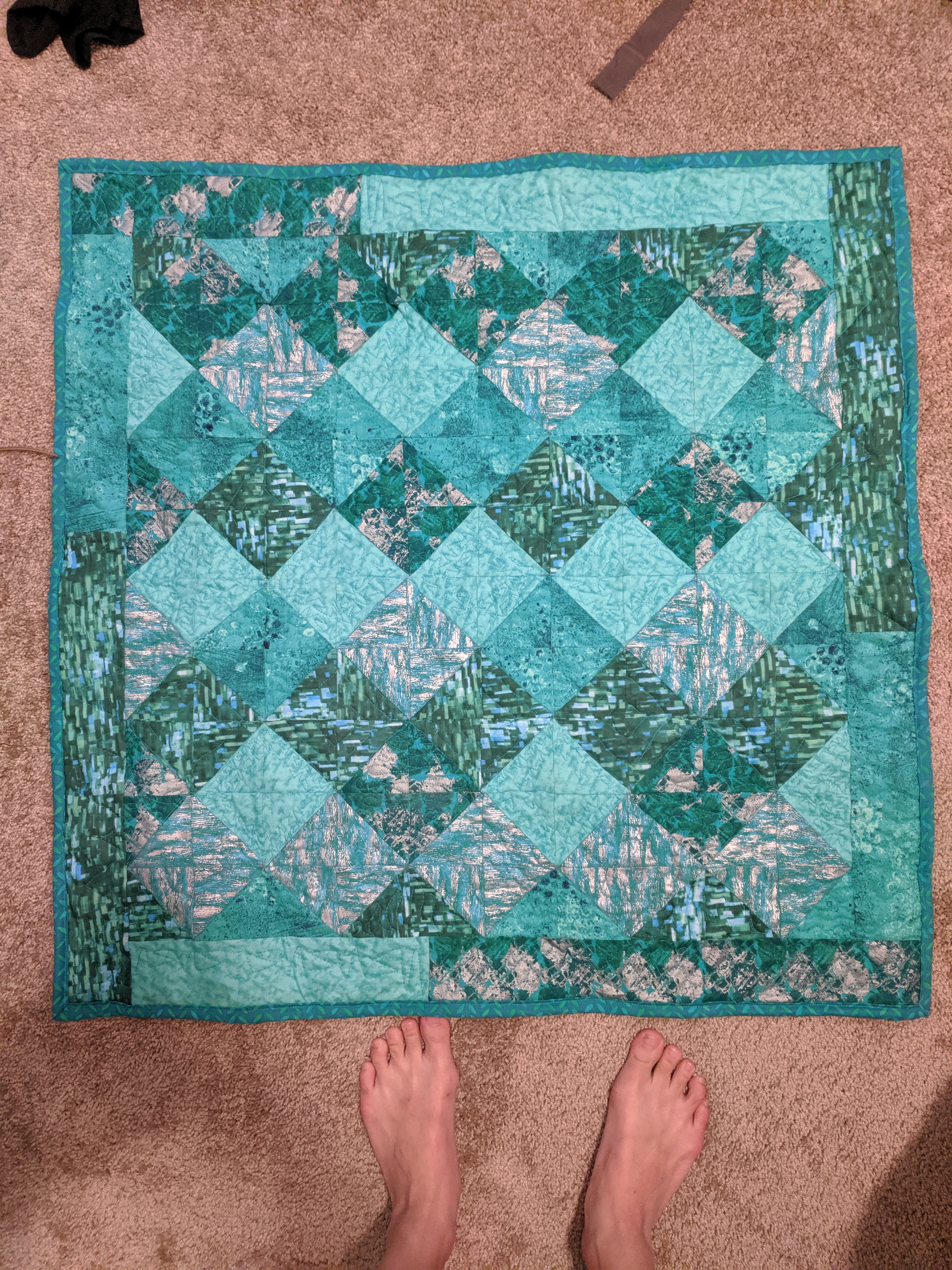
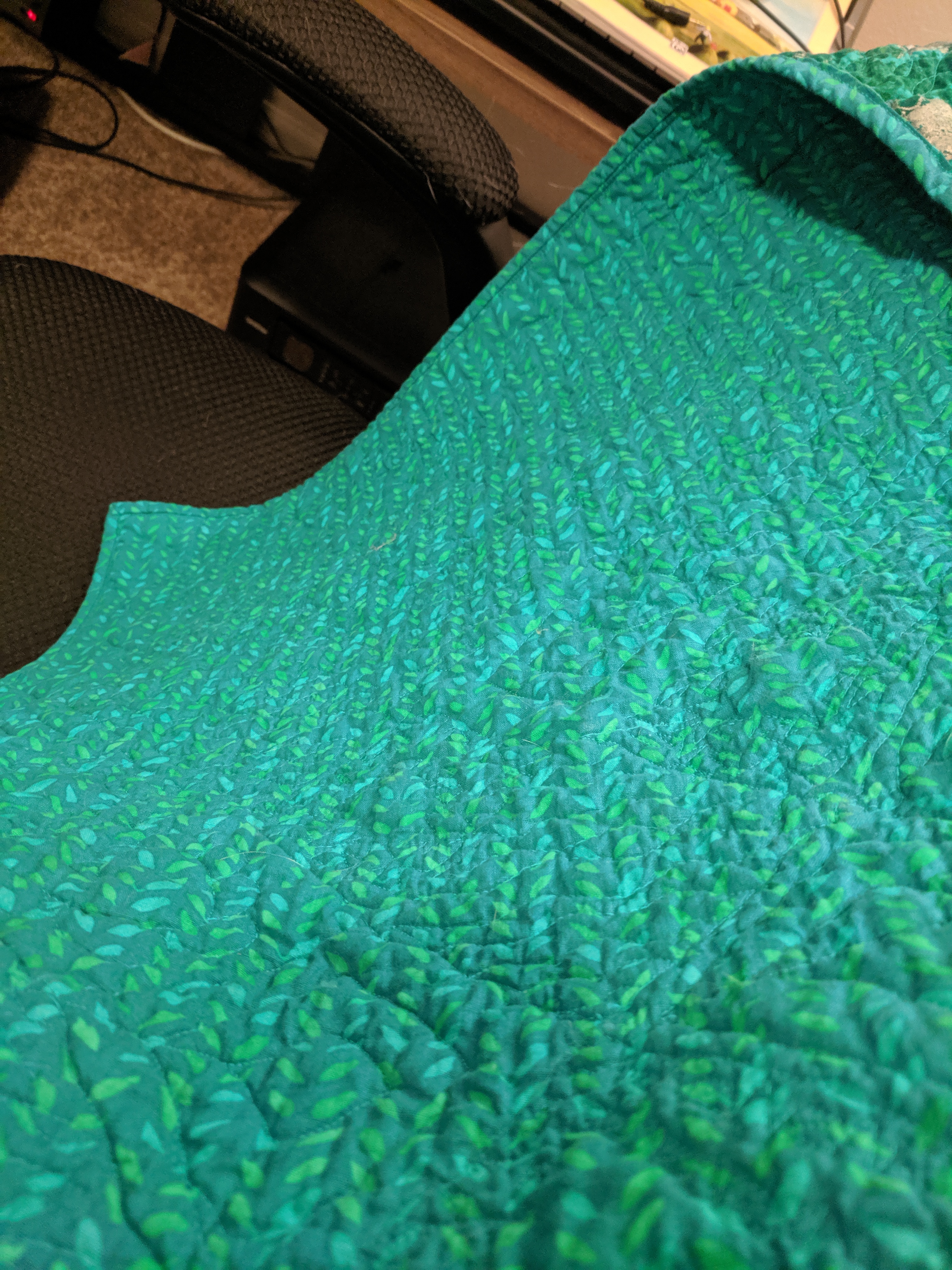
But then it turned out wonderfully crinkly and soft, and nothing bad happened 🙂 Washing your quilt helps the batting fluff up a bit, and the quilting sinks down, making a nice texture that hides mistakes (of which I made many) and bumps (of which there are many) and pretty much everything else. Plus it makes the whole thing soft and cuddly, which is what quilts are (for me) meant to be. I don’t think you’d wash an art quilt, or something with super detailed free motion, but for my purposes, I learned to stop worrying about the tiny things because I can’t even find them anymore when I look at the quilt. And as Angela Walters says, “better finished than perfect”.
Project completed May 24, 2019.
 Finch's Creative Endeavors