Tag Archives: adventure

Colorado River Art Retreat

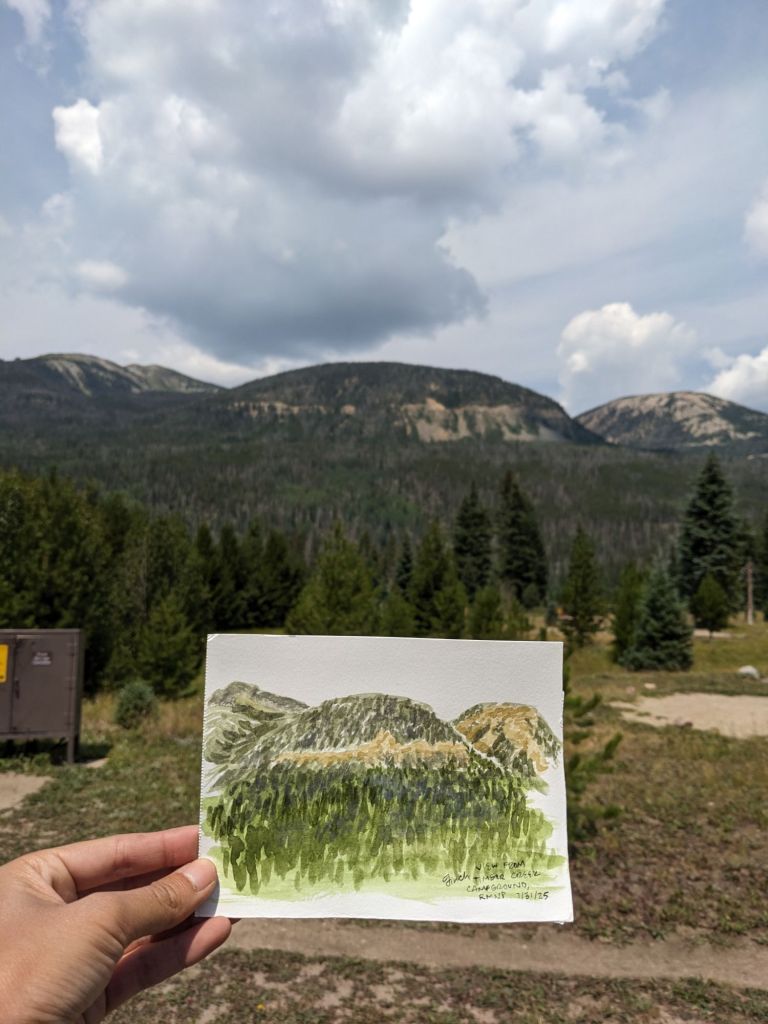
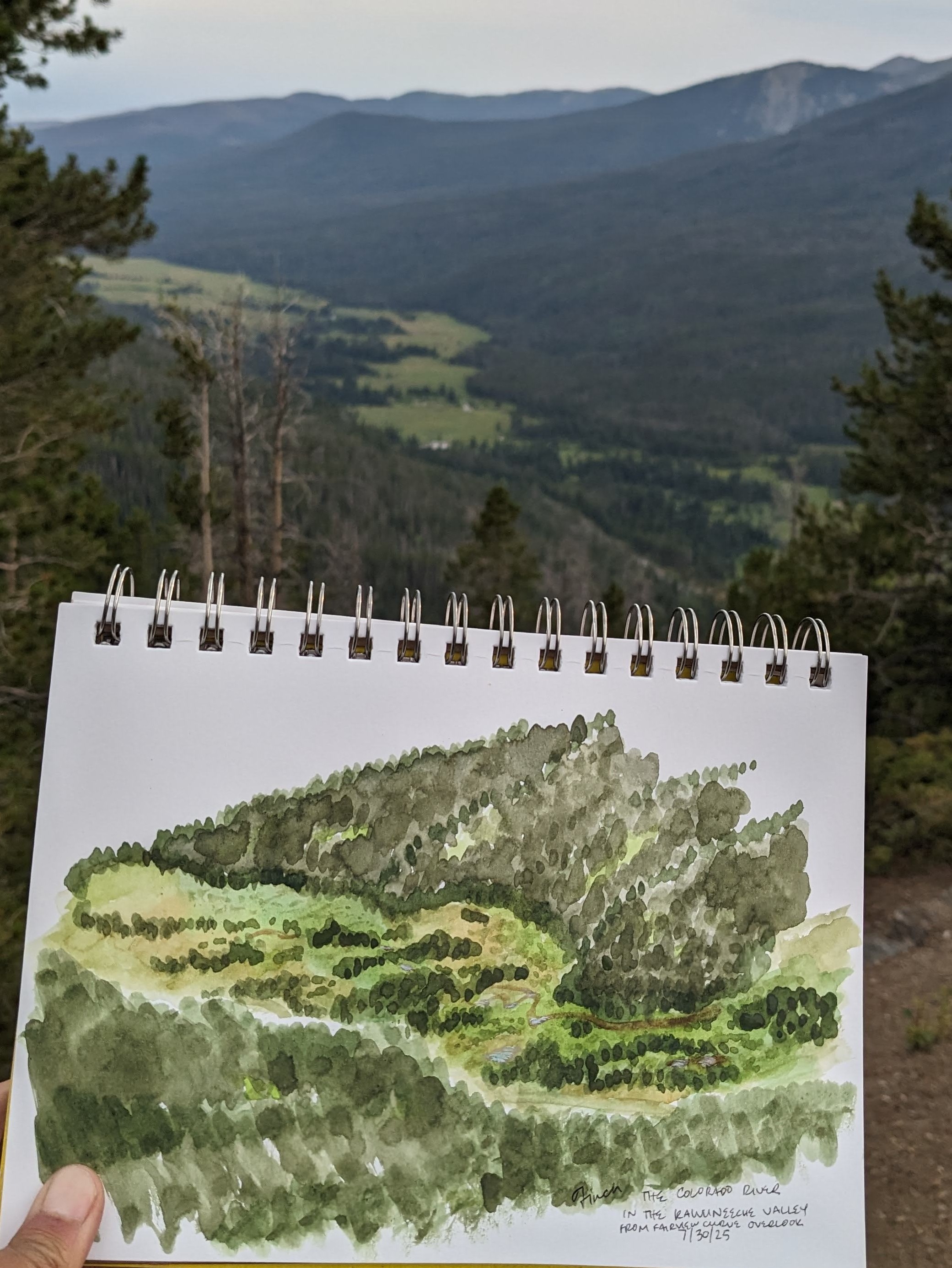
Watercolor of hills held in front of the hills; horizontal line of tan on the hills and watercolor represents the Grand Ditch

This lil postcard features the Grand Ditch, a water diversion structure that takes water from the tops of the Never Summer Mountains on the *west* side of the Continental Divide and ports it to the Cache la Poudre River, leading to the South Platte River. Part of this trip was dedicated to feeling some civil-engineering-and-climate-change-related feelings about the Colorado River and the development of Colorado. The Grand Ditch and Colorado-Big Thompson project enabled and continue to supply water for agriculture, industry, and municipalities on the *east* side of the Continental Divide, and these diversions have significant impacts on the Colorado River watershed by reducing the flow that would have been there.
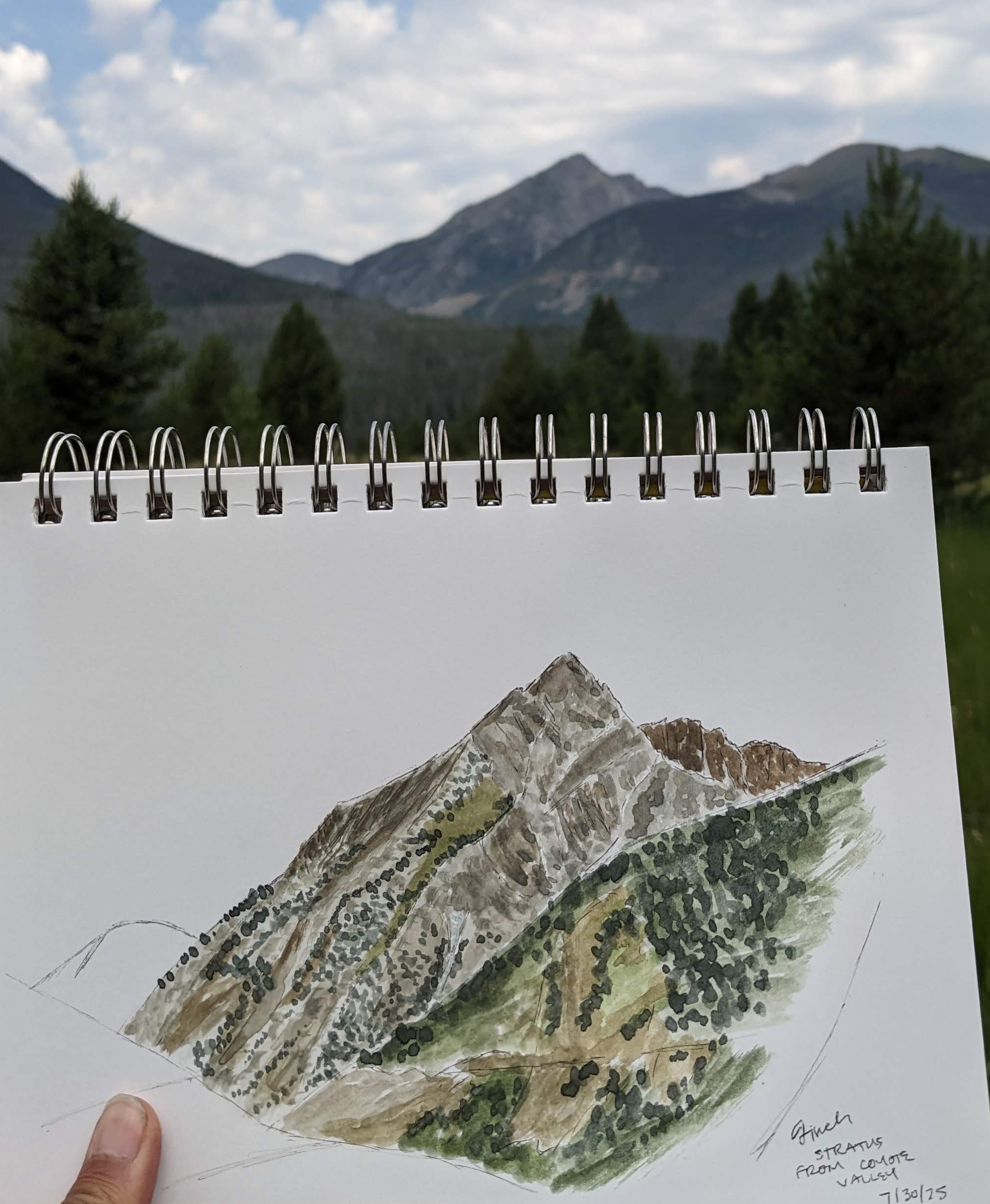
On the left, I did the pen sketch first, and then the watercolor – I kind of like the differences between the paintings I do with pen and without, the pen ones end up more… tiny and detailed? But somehow feel restrained, or constrained? On the right I did a watercolor sketch underneath the color, and it ends up bold, and colorful, and not quite “accurate”, I focus more on color zones instead of lines.

I wanted to do a painting that had less detail and focused on big blocks of color to minimize all the painting of trees (my least favorite and least satisfying step). From the initial marker drawing (top right), it took me 2 minutes to add the pen details, and then 16 minutes to add the watercolor.

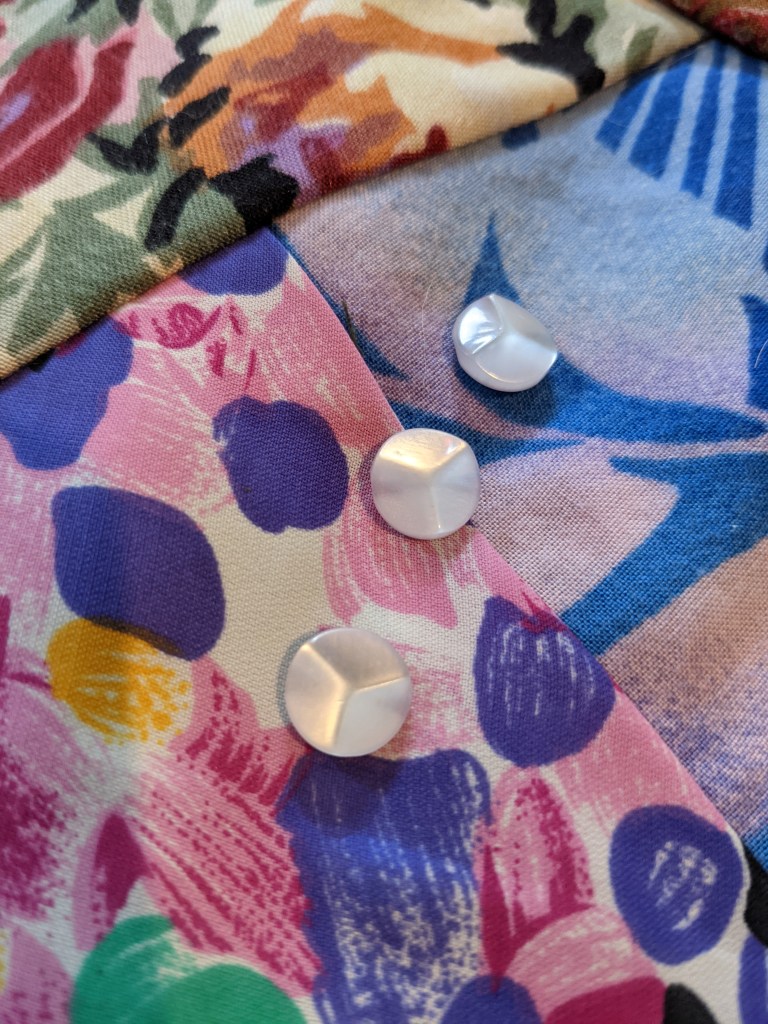
After visiting the quilt store in Grand Lake and picking up some fabric, I decided my trip to Inspired Art Experiences in Estes would be a fabric acquisition trip as well! I chose to do a batik again, silk marbling, and tie dye.
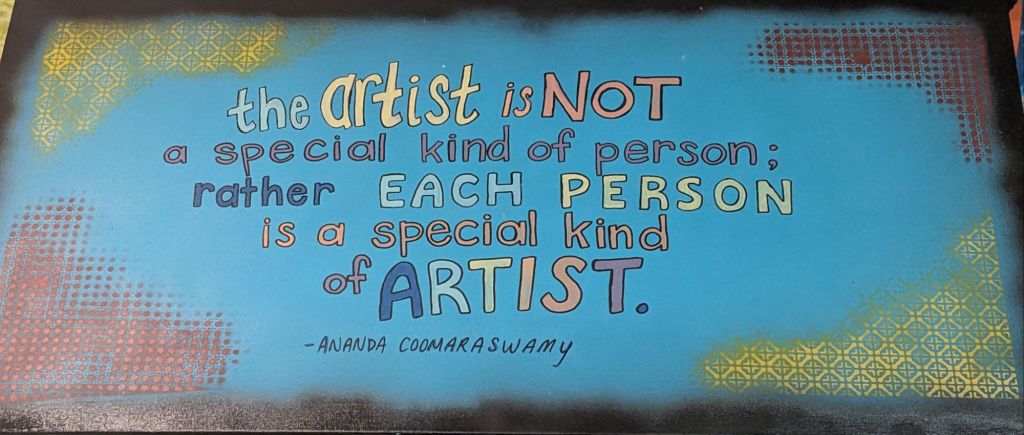
Sign with quote: the artist is not a special kind of person; rather each person is a special kind of artist. -Ananda Coomaraswamy
I loved this sign they have in their back room.

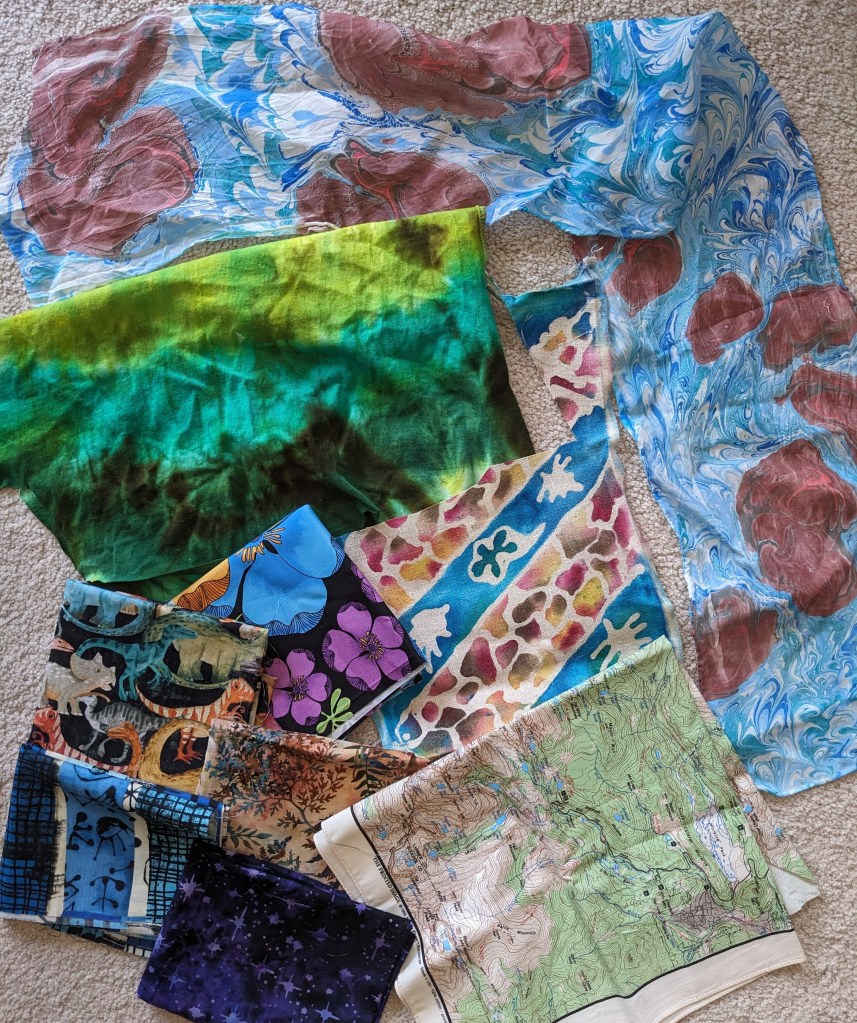
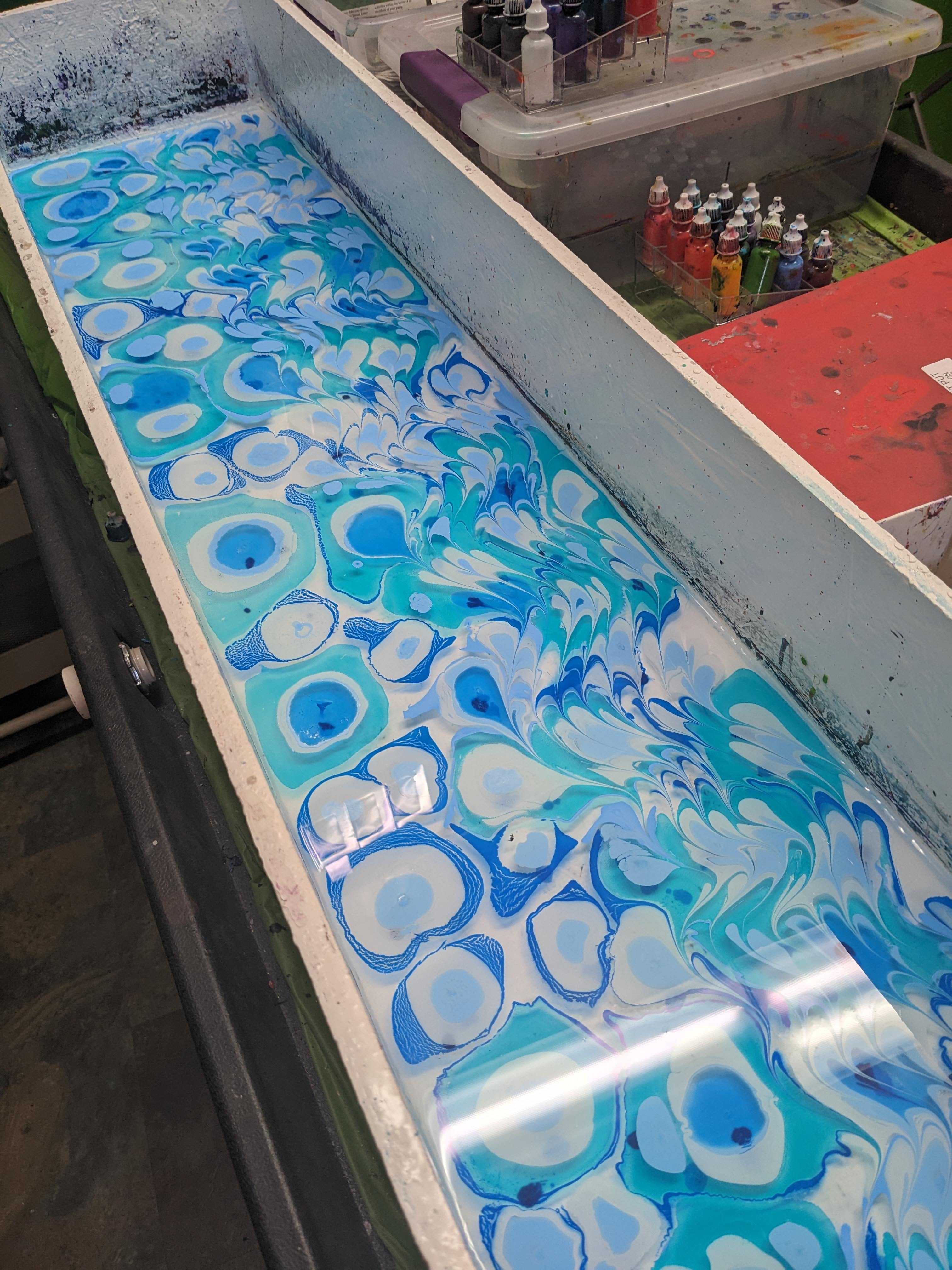
The silk marbling was incredibly meditative and calming, just dropping in the colors and swirling them together. I was going for a “river rocks” type of design and I think I really got it.
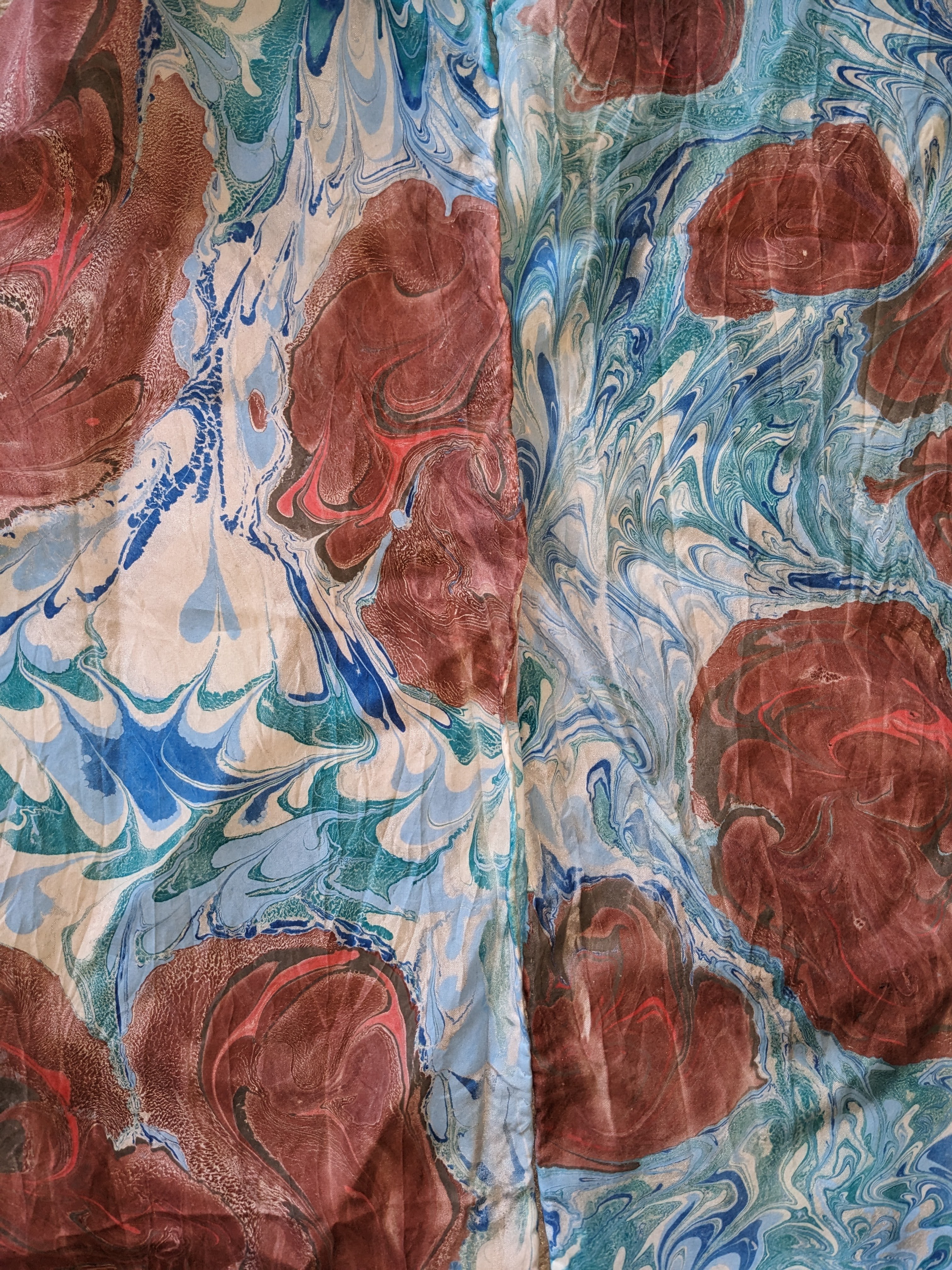
Many different fabrics
Finished river rocks marbling on the top and right, sleeve of the tie dyed shirt on the left, batik inspired by the Grand Ditch in the middle, fabric from Grand Lake on the bottom left, and the RMNP map bandana on the bottom right.

And I added my new fabric into my current project, an English Paper Piecing quilt of trapezoids for my bathroom 🙂 which now, of course, vaguely smells like campfire, but that’ll fade.
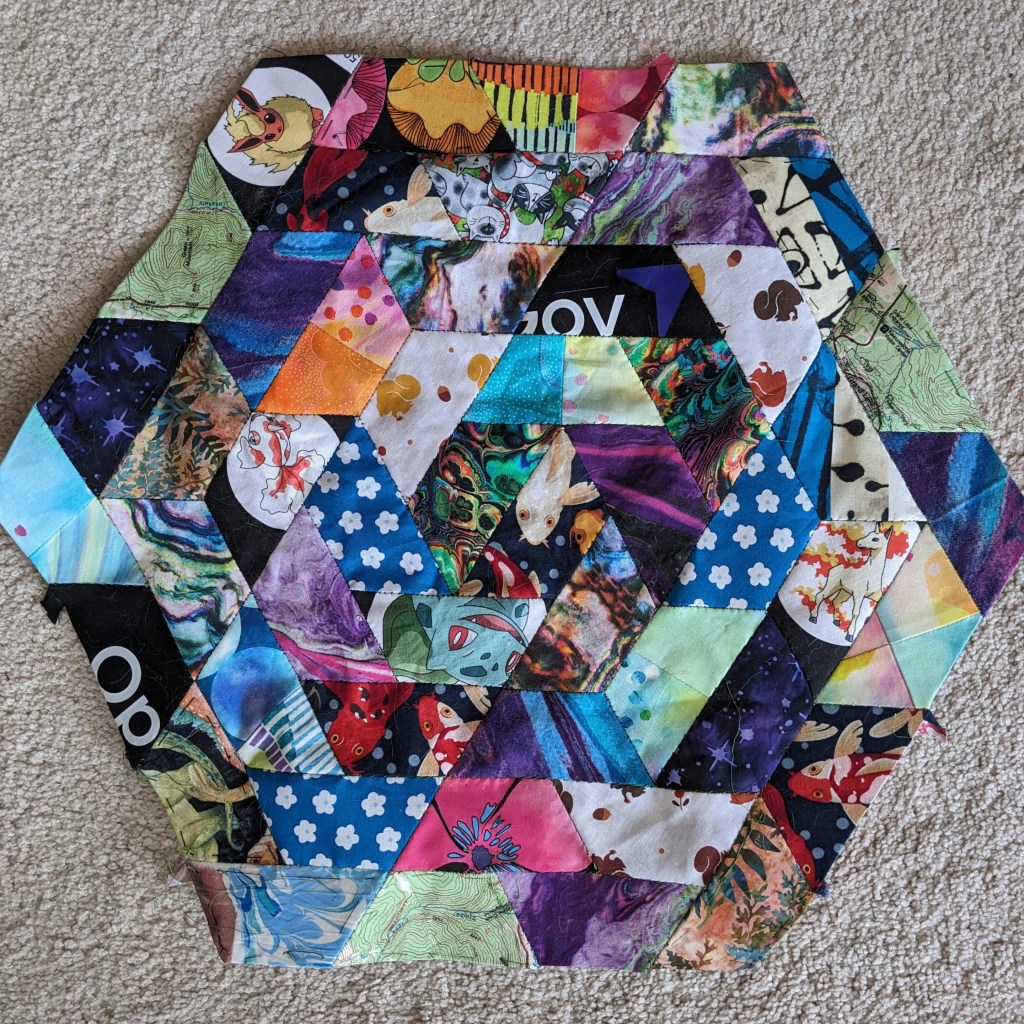
Hexagon made of trapezoids of many different fabrics, it is colorful and mismatched. Some fabrics are repeated but not next to each other.

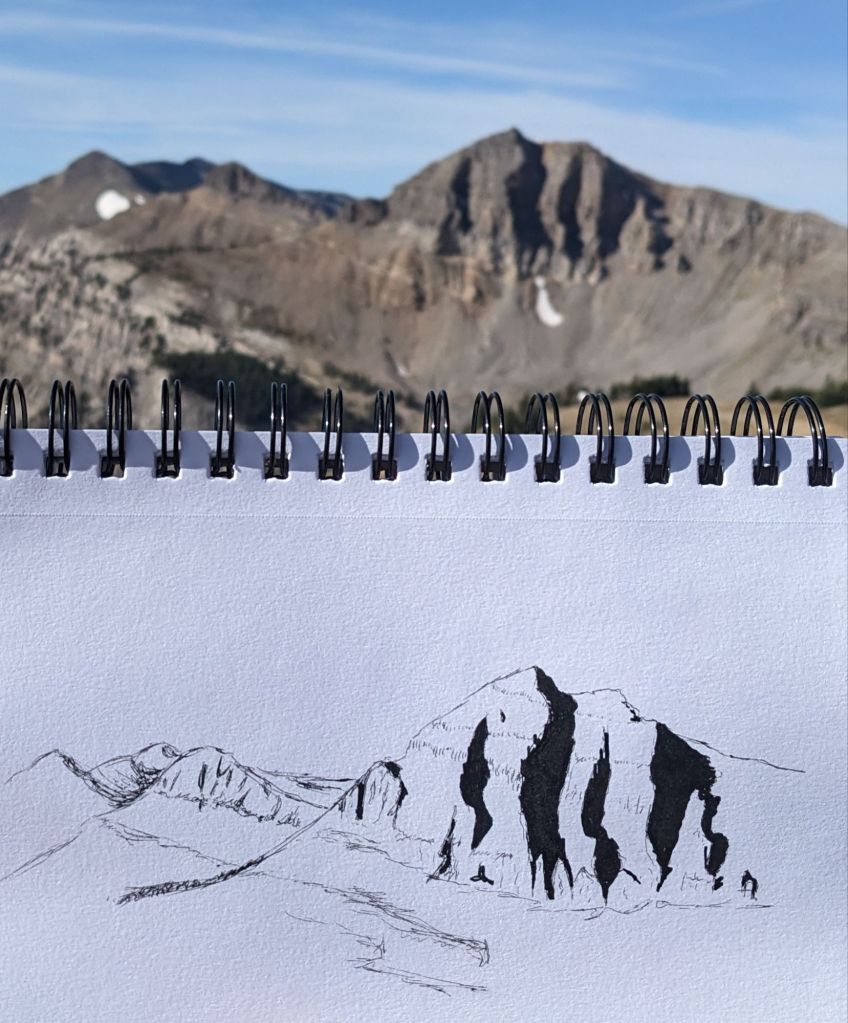
This is the painting I went to do, and I hiked a new trail to do it! Adding the color to the sketch from the left took 40 minutes 🙂 And a few people stopped to comment and talk to me, which I usually appreciate as long as they are respectful and treat me like a person instead of content.
Teewinot Art Retreat

Last year, I spent one day in Grand Teton National Park, most of it yelling and pointing at the mountains… So I had to go back, specifically to sit and enjoy and look and make art 🙂

Teewinot is the original Shoshone name for this range and translates to many pinnacles, which I find much more fitting than the French name.

I had vague plans, but let my art heart lead and followed the rising and setting sun. It was stunning. I felt a little like Thomas Moran, walking about doing artwork, though I had the luxury of a car and like… A nice, developed campsite. I also saw two bears and a double rainbow, so it was a very good weekend.

From the Jackson Hole Aerial Tram, which was a bit underwhelming and extremely windy, but there was a great view of the whole valley and I got to see Corbett’s Couloir (the one the pros do backflips off) and I was stunned. It’s much bigger than in videos.
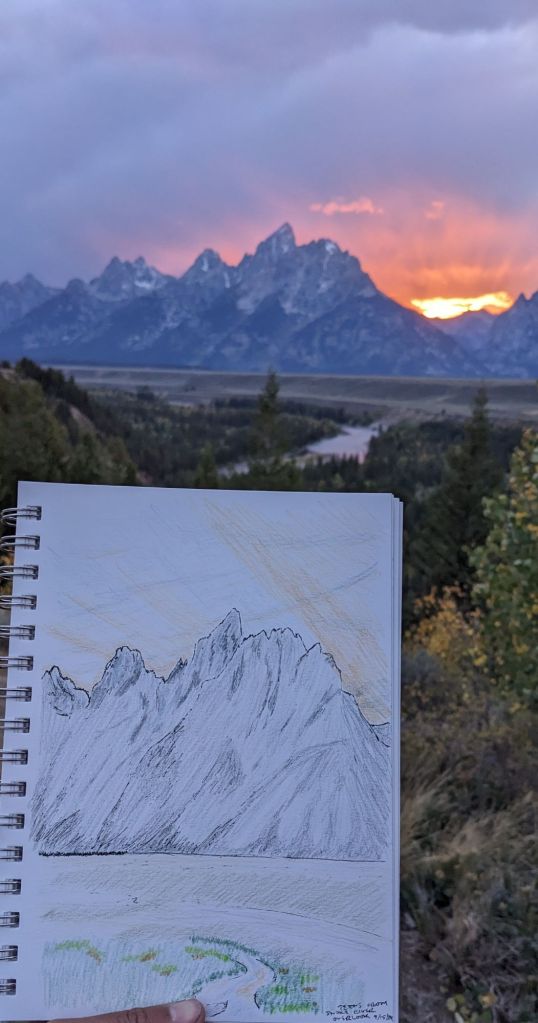
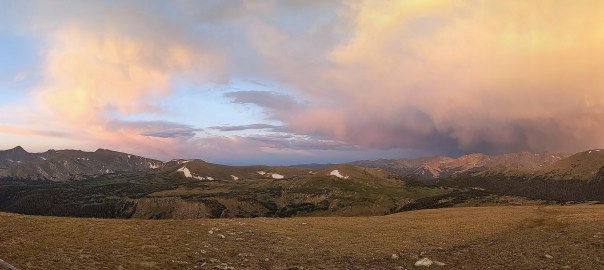
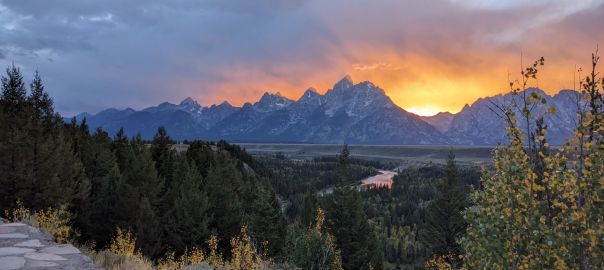
From Snake River Overlook, where Ansel Adams took his famous picture. The drama of this sunset lasted about thirty minutes and each moment was just as beautiful as the last. I liked the idea of using watercolor pencils and then maybe going back later with water, but I kind of like it just in pencil. This is also my first piece in my second sketchbook, since I finished the first one I bought in 2021! Not pictured: the lineup of photographers with fancy tripods that I was sitting next to.
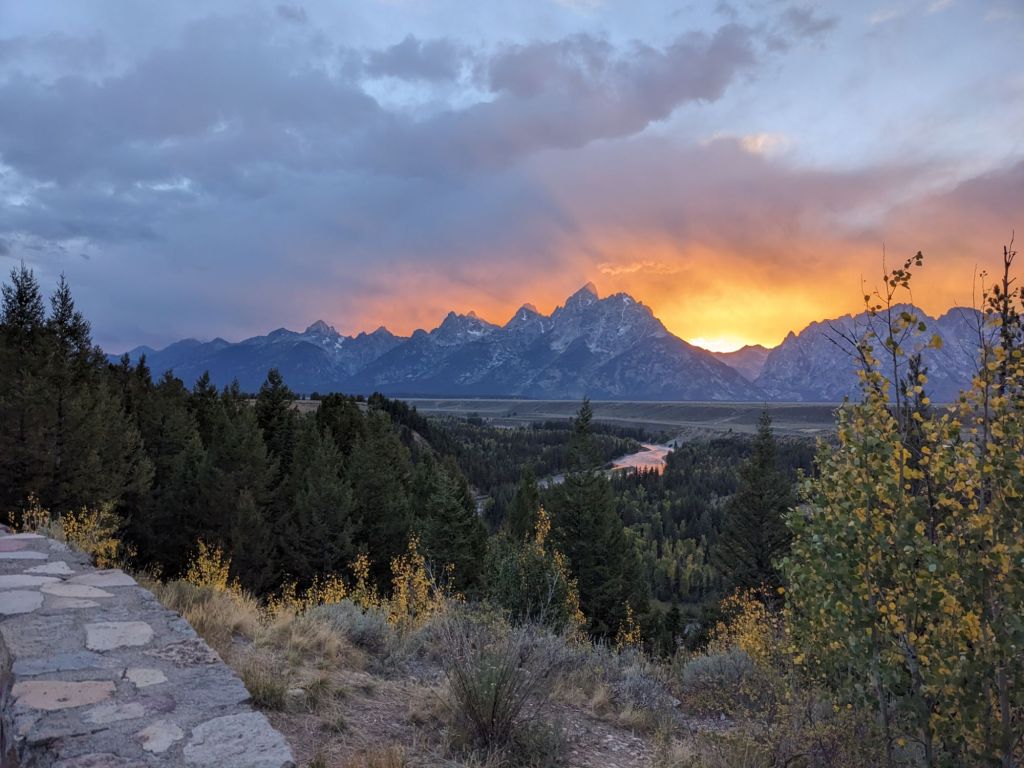
Bonus: sunset from Snake River Overlook.
This one I tried using my watercolor pencils and then going back with pen. I liked it, though my pen didn’t mark over the pencil so well. Maybe the pigment is a bit hydrophobic?
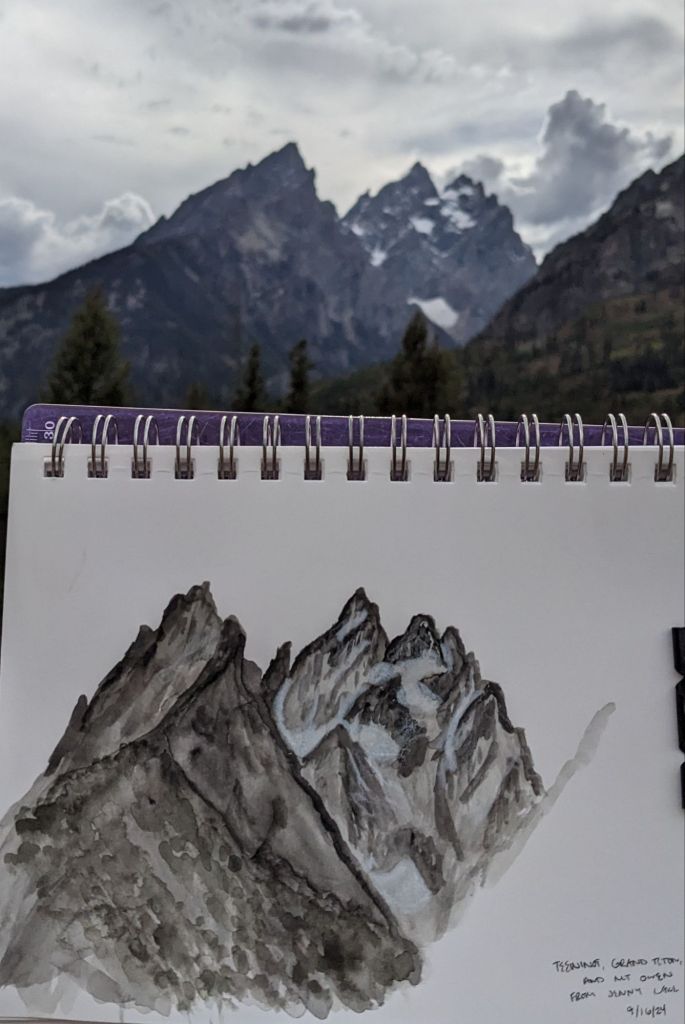
Little black and black-green watercolor from Jenny Lake. Plus some white watercolor pencil for the permanent snowfields. I liked the bold style of the watercolors without pen, but it was a bit nerve-wracking to put down so much color at once.
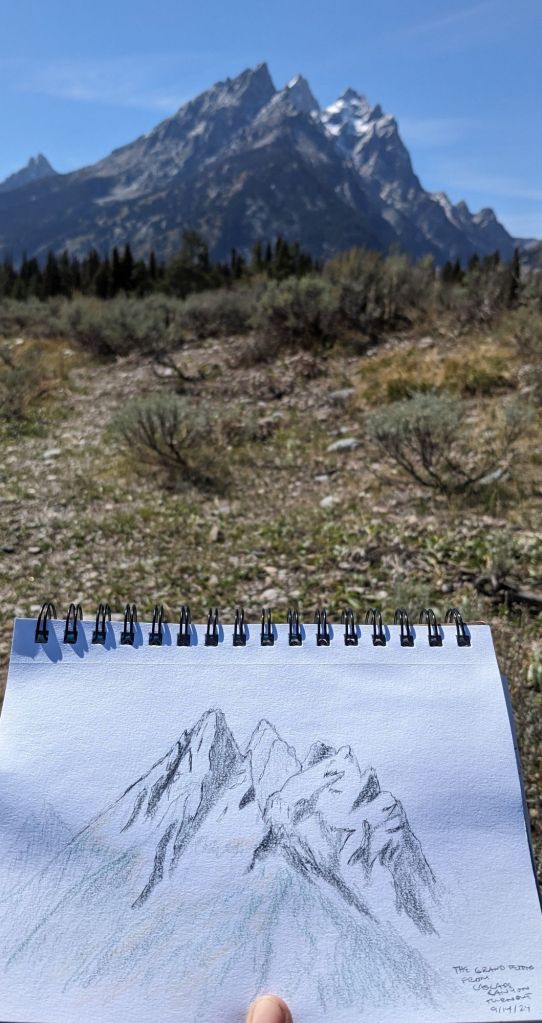
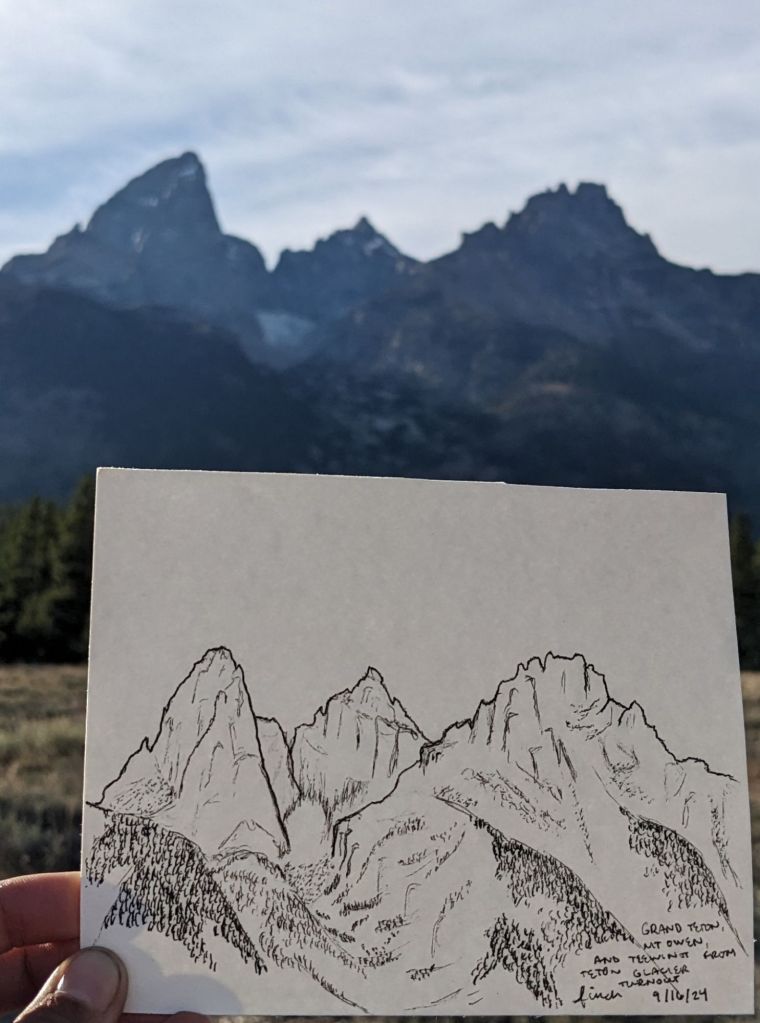
One of my favorites of the trip, drawn as a postcard for a friend from Teton Glacier Turnout. I need to figure out how to draw trees in a way that doesn’t hurt my hand though. So. Many. Little. Lines. Not pictured: the couple that got engaged on the other side of the parking lot while I was doing this.
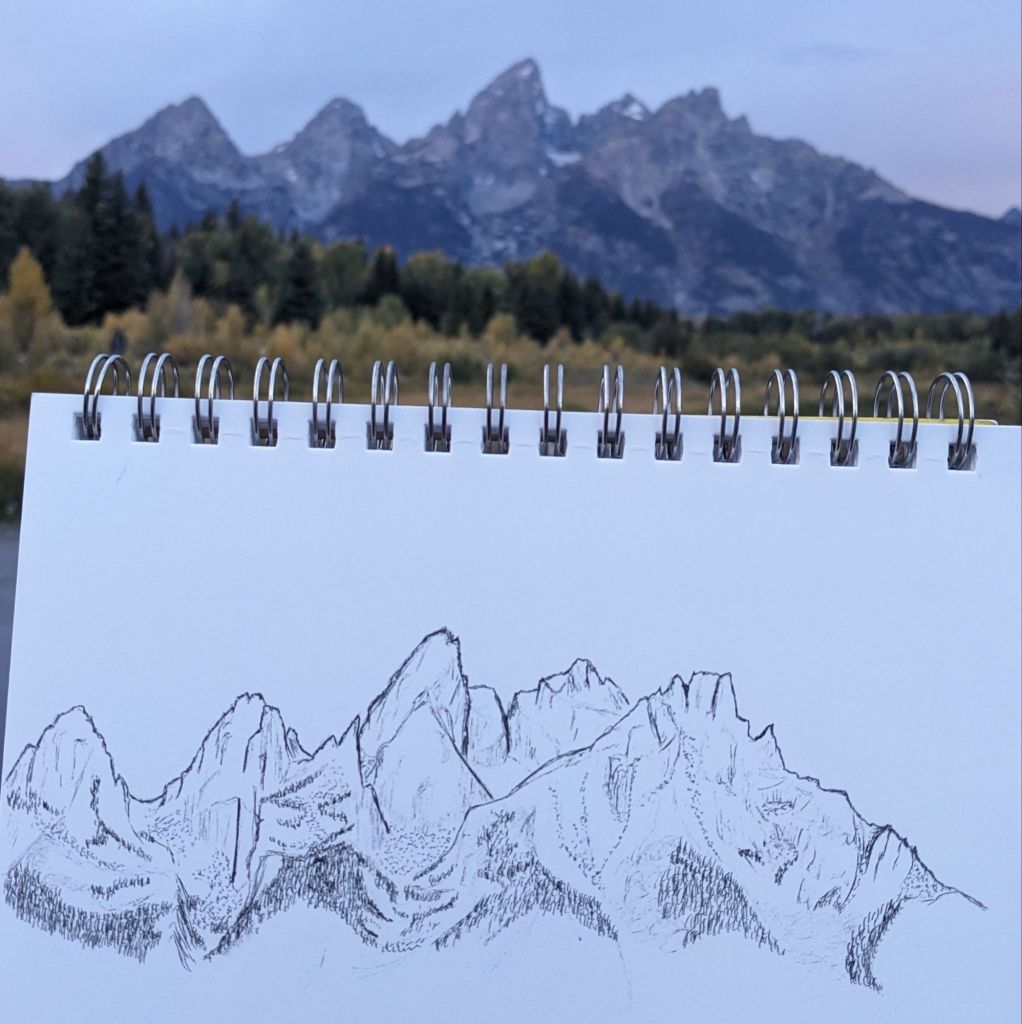
From Schwabacher Landing. I kind of knew this as I was starting this piece, but this is the piece I set out to draw, and I spent the weekend working up to it. It took me about an hour as I waited for the sunset, which was pretty but not as dramatic as the other one. Not pictured: the couple who sat and chatted with me as we waited for the sunset.

Crazy Quilts at RMQM

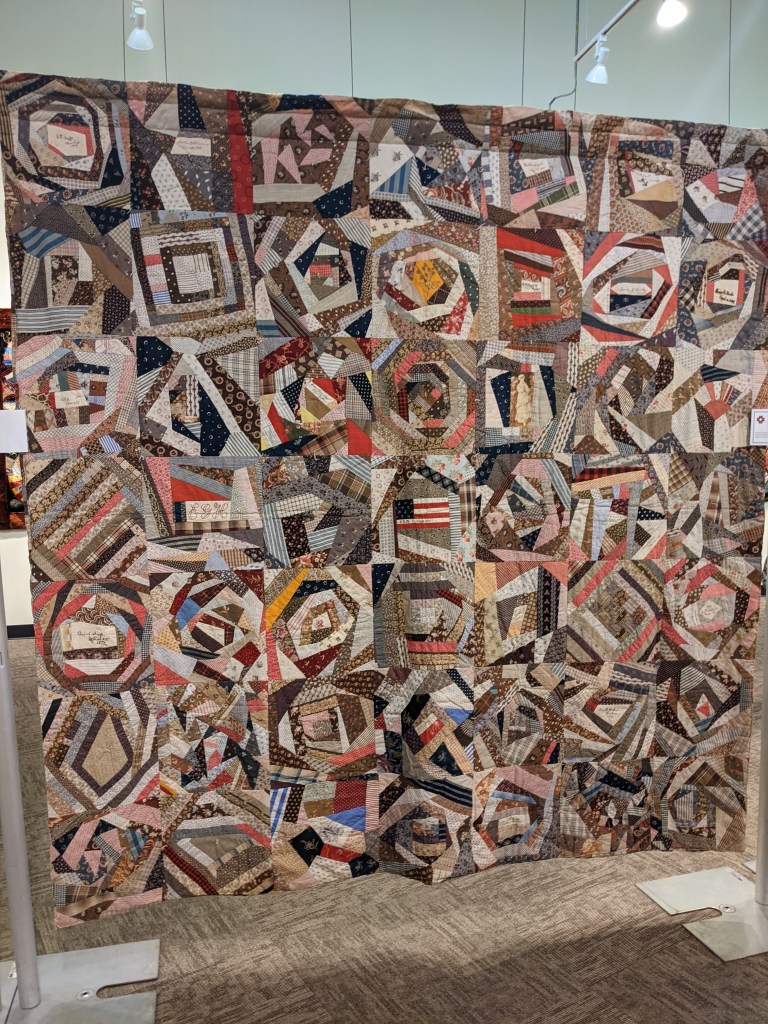
I knew I wanted to do a crazy quilt for my cousin’s memory quilt, and RMQM did a whole crazy quilt exhibit this past fall! Crazy quilts became popular in the late 1800s and generally include colorful scraps of cotton and silk and velvet, ribbons, buttons, other baubles, and embroidery. They vary in the level of complexity of course, and I wanted to find a style or inspiration that I was comfortable using for my crazy quilt.

I went on a Saturday morning, and if you go right when it opens, usually one of the employees will walk around with you and tell you about the quilts. I was the only one there for a while, and a very nice employee walked around with me and we talked about the quilts. As a note, this post won’t have many credits because I forgot to take pictures of most the signs.

One thing I loved was that not all the quilts had borders. I struggle with borders and knowing what fabric to choose, how to quilt it, and it’s an optional step that stands between me and finishing the quilt so I tend to skip them. So I was instantly inspired by border-less quilts.

It also made so much more sense to create crazy-pieced square blocks and then put the blocks together instead of trying to crazy-piece an entire quilt. I also went into this knowing my cousin wanted a small-ish lap quilt, so I wasn’t overly intimidated by the size and scale of most of these quilts.

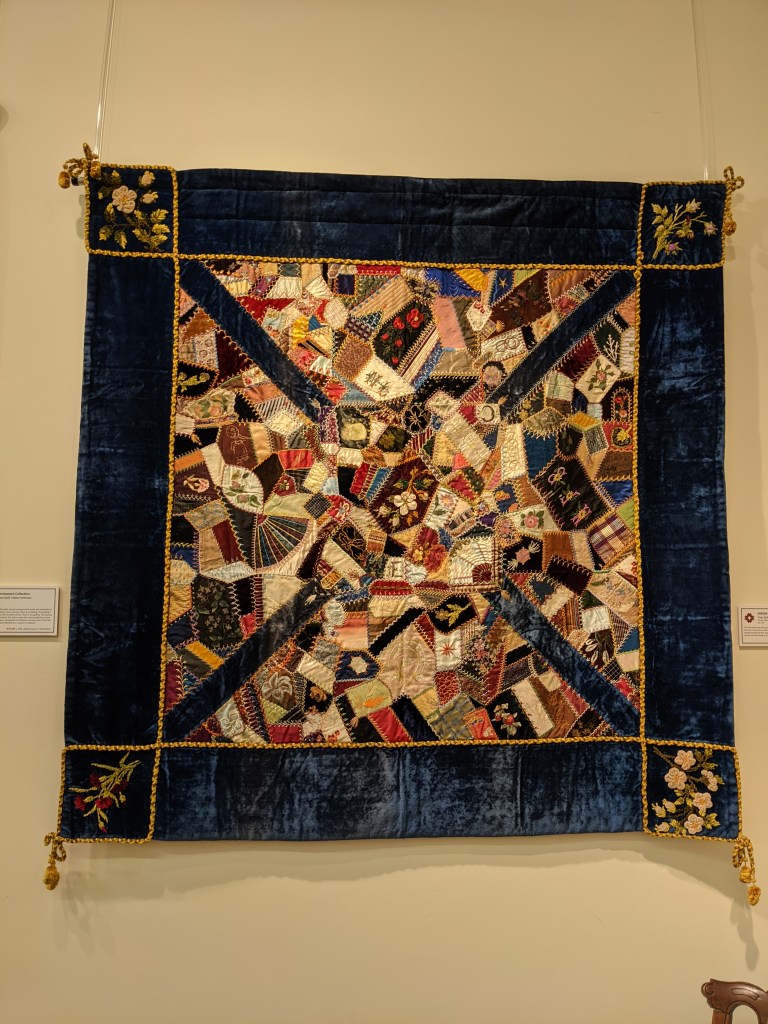
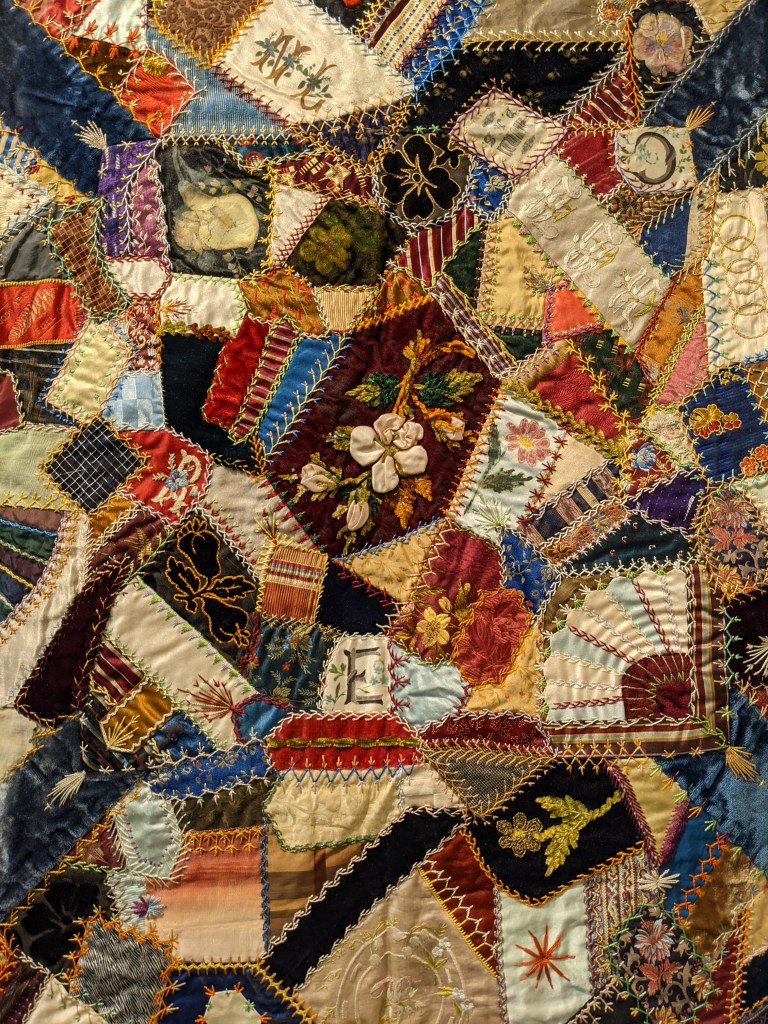
I liked this one that was kind of a medallion type of quilt, and you’ll see the very typical embroidery with that fun ribbon flower in the very center.

I loved this twisting and twirling quilt. It’s pieced rhombi, where each rhombus is one of the arcs.

Star Crazy Quilt, Maker Unknown

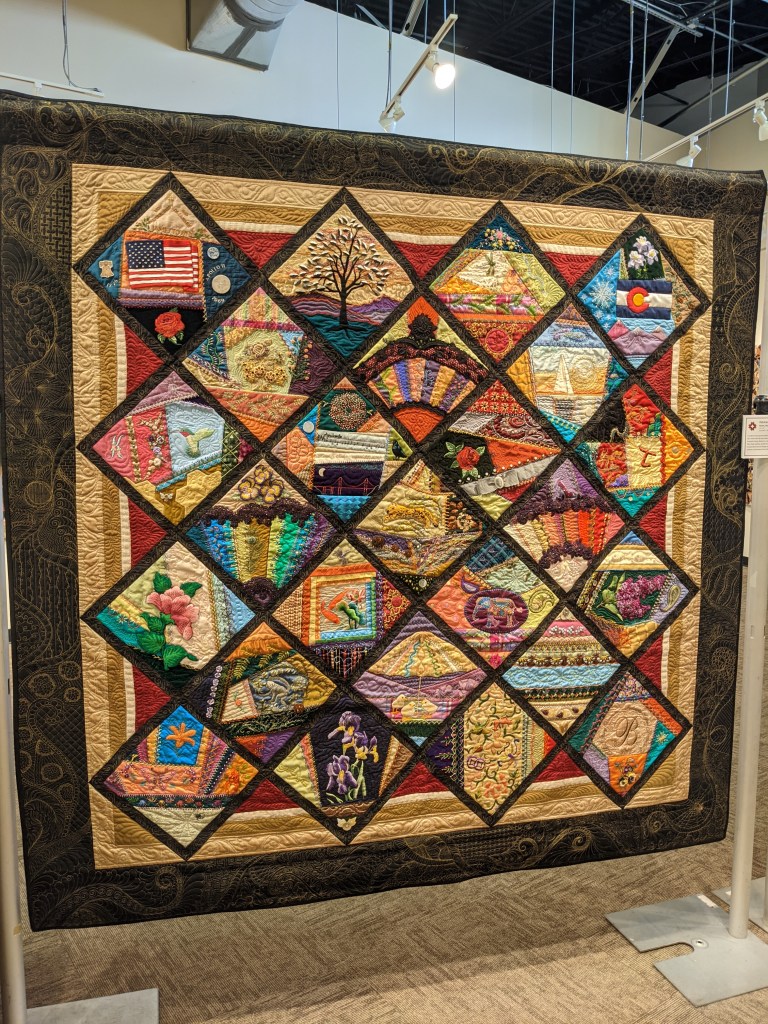
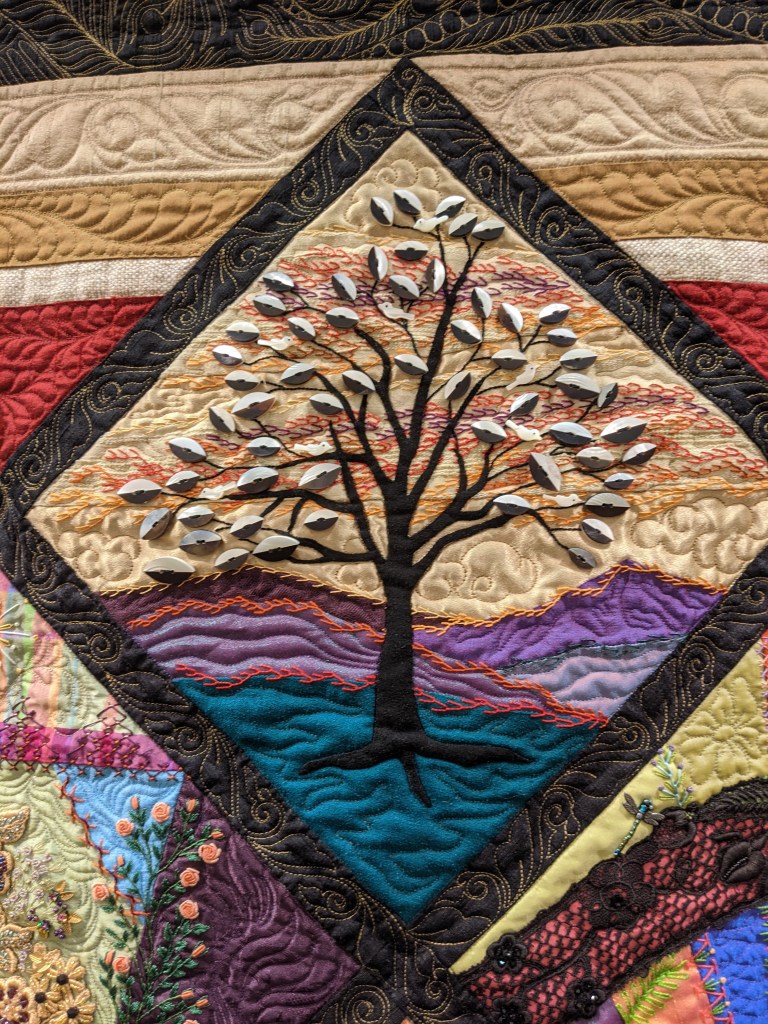
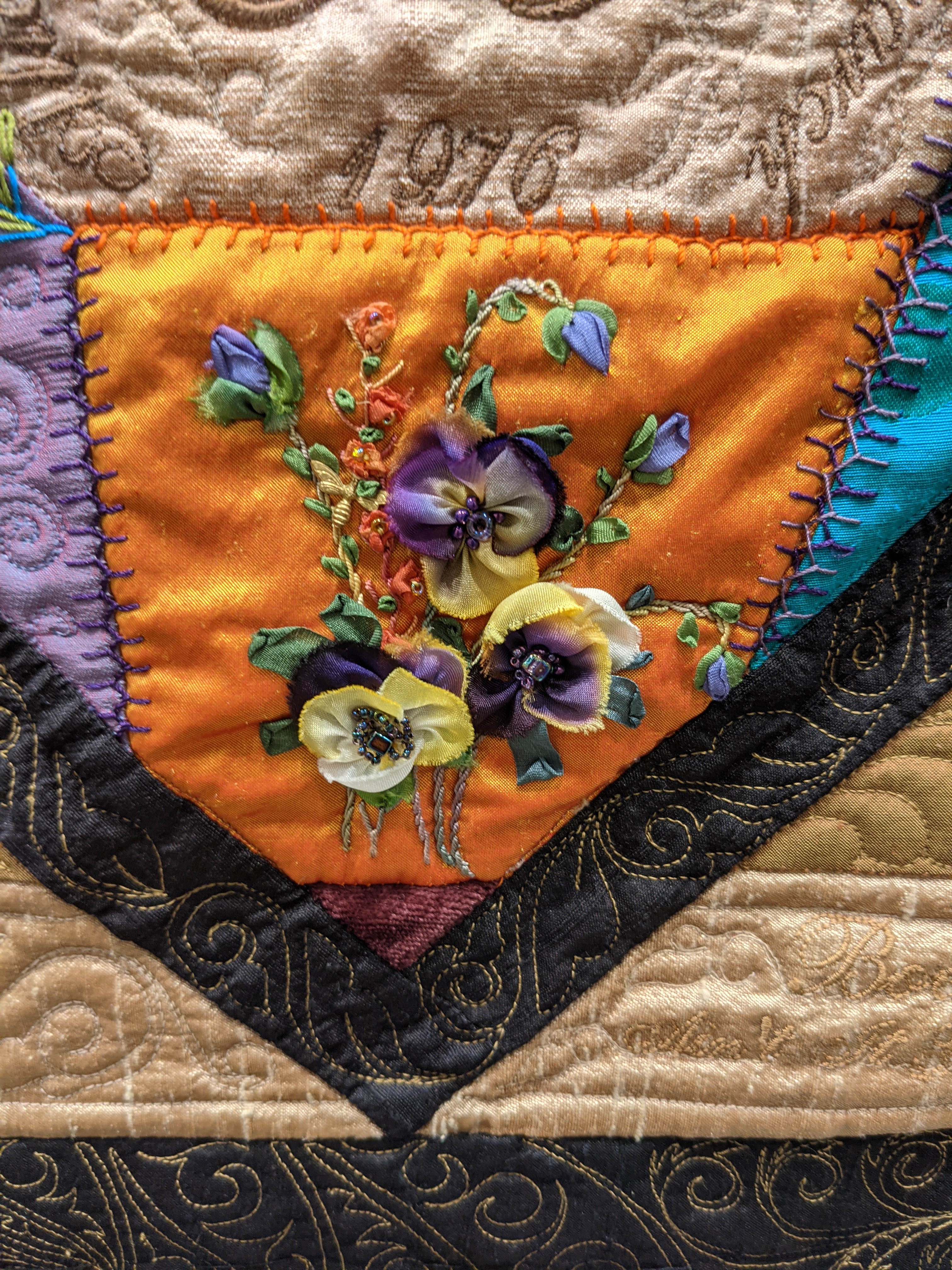
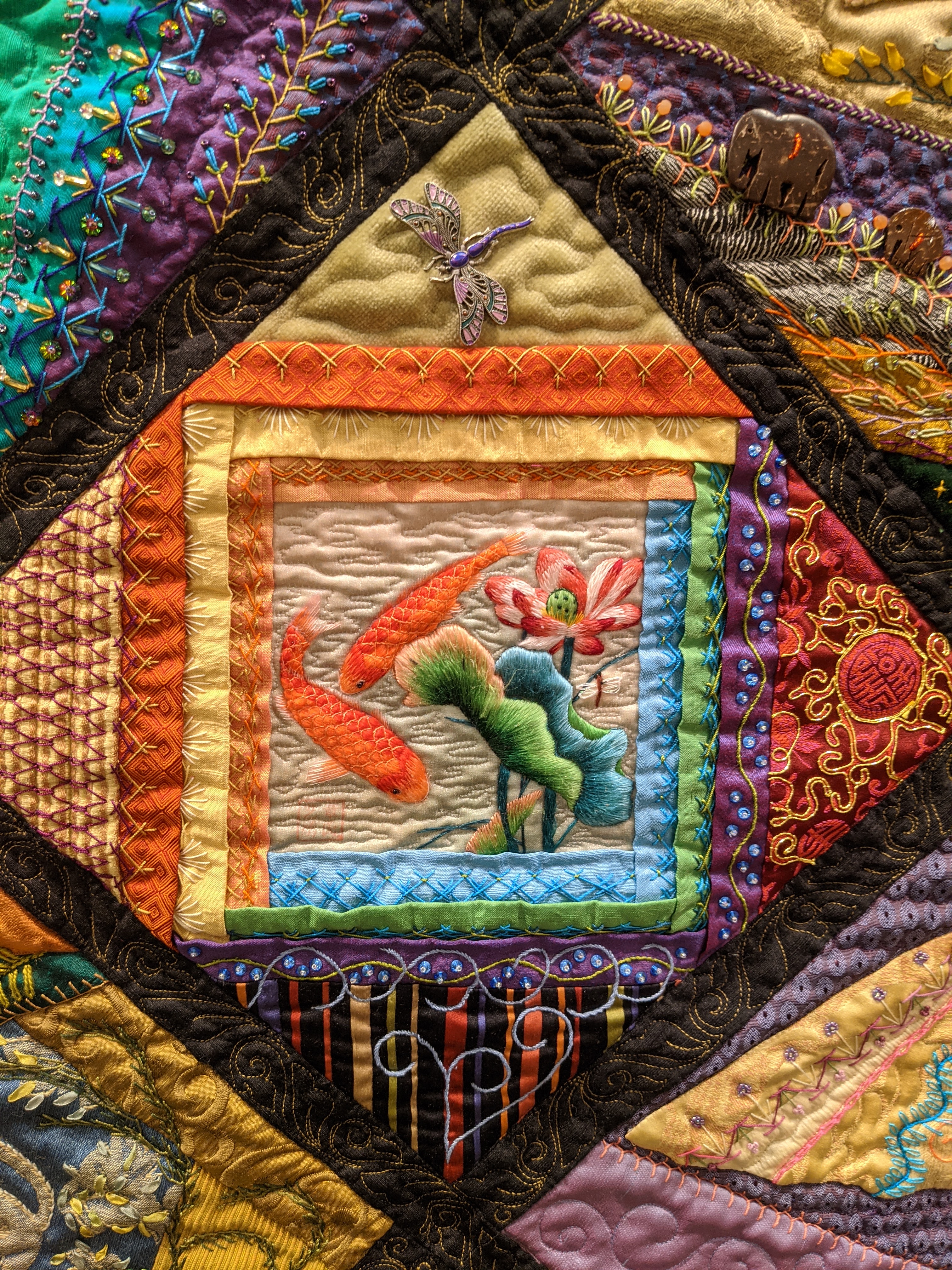
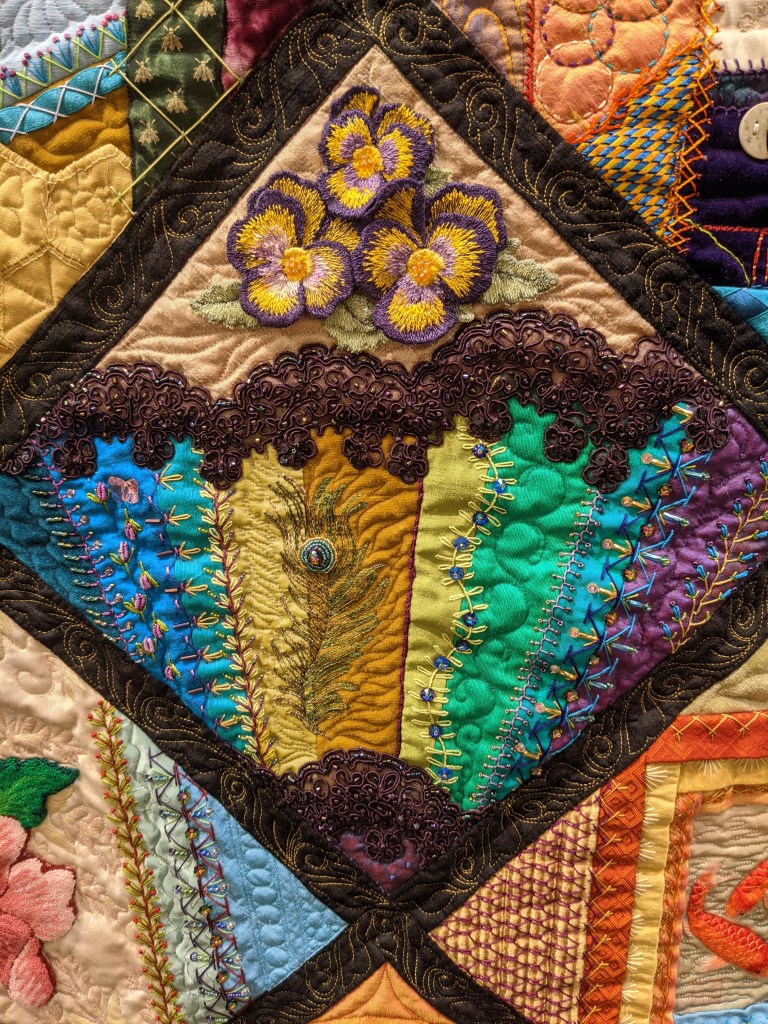
This next quilt was my favorite of the entire exhibit. I loved the on point blocks, each with its own story. This quilt was made by Patricia and Allen Brown of Colorado Springs, Colorado.

Boom, Boom! Ain’t it Great to be Crazy? by Patricia and Allen Brown
Those adorable leaf and bird buttons!!!
More ribbon flowers
Really awesome embroidered fish and leaves
Stumpwork (3d embroidery) flowers, really cool lace, and some intricate embroidery

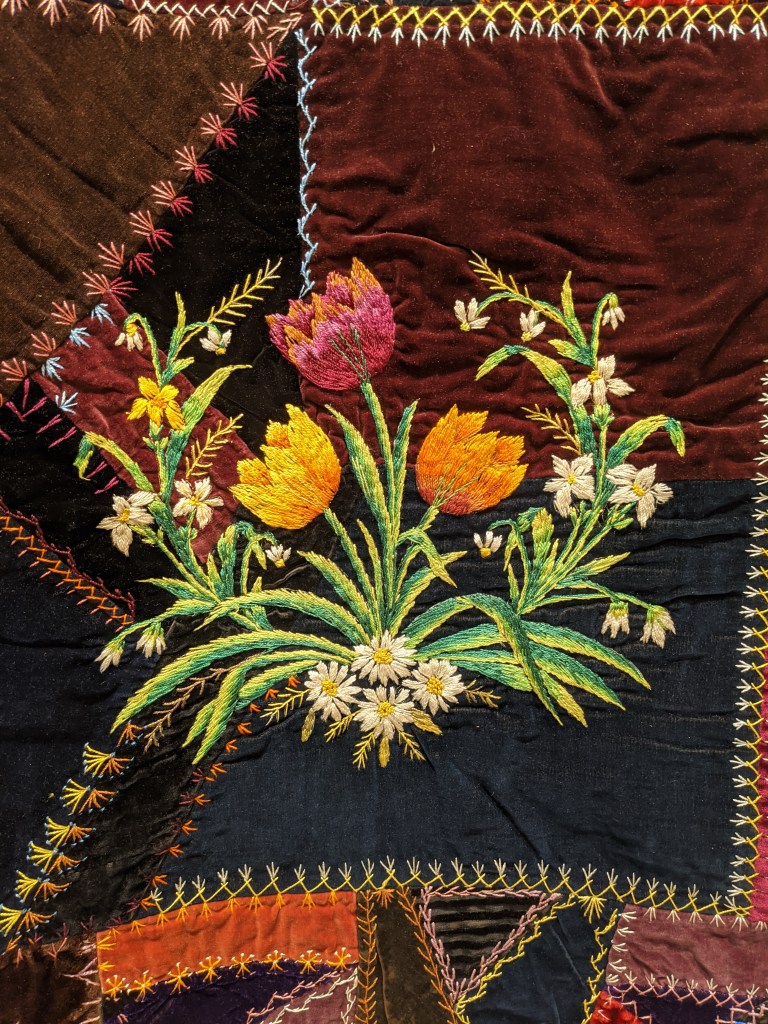
And here are some other up-close inspirations!

Super detailed flowers
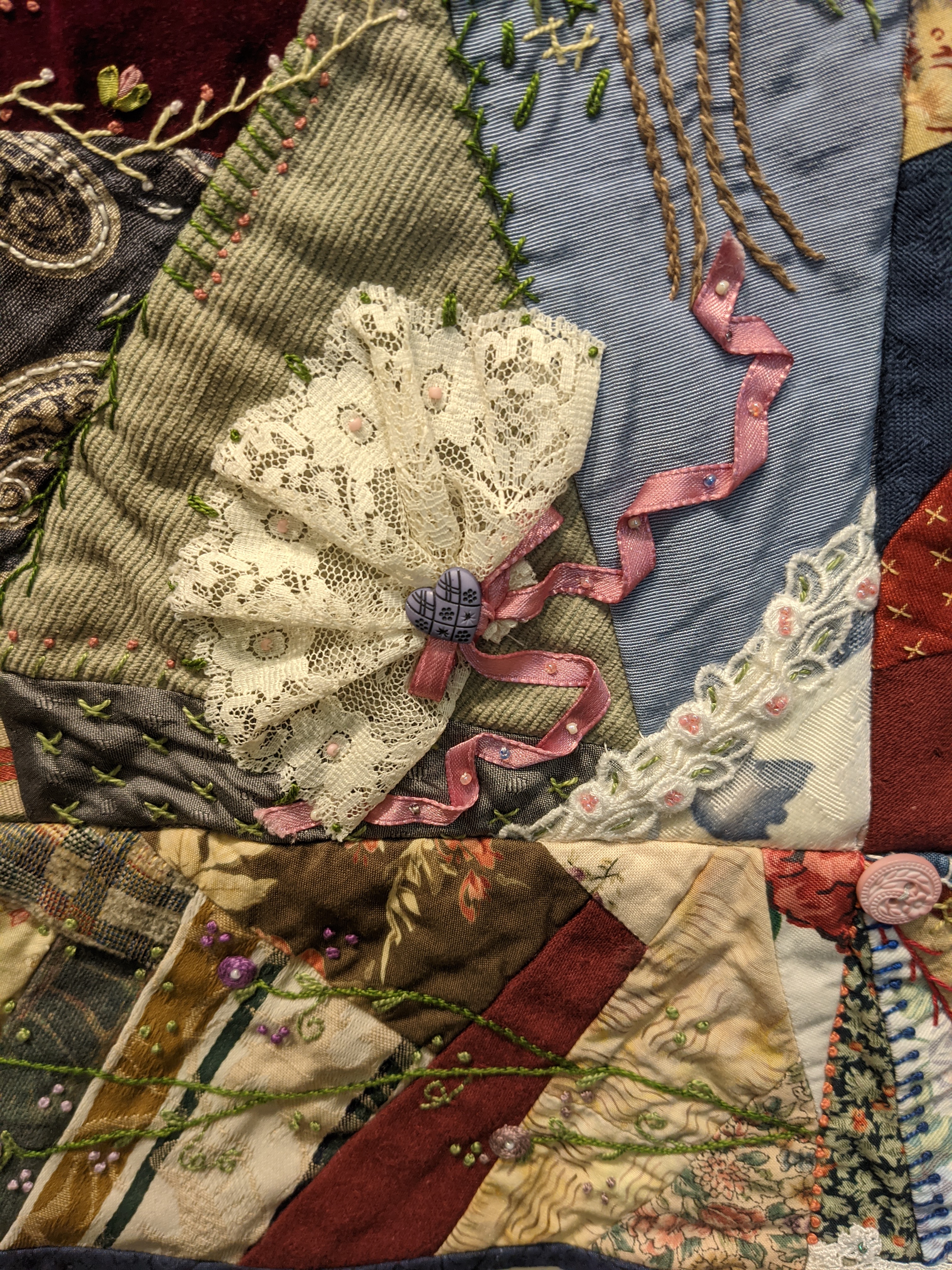
A lace fan! Plus a cute heart button, ribbon, and tiny beads
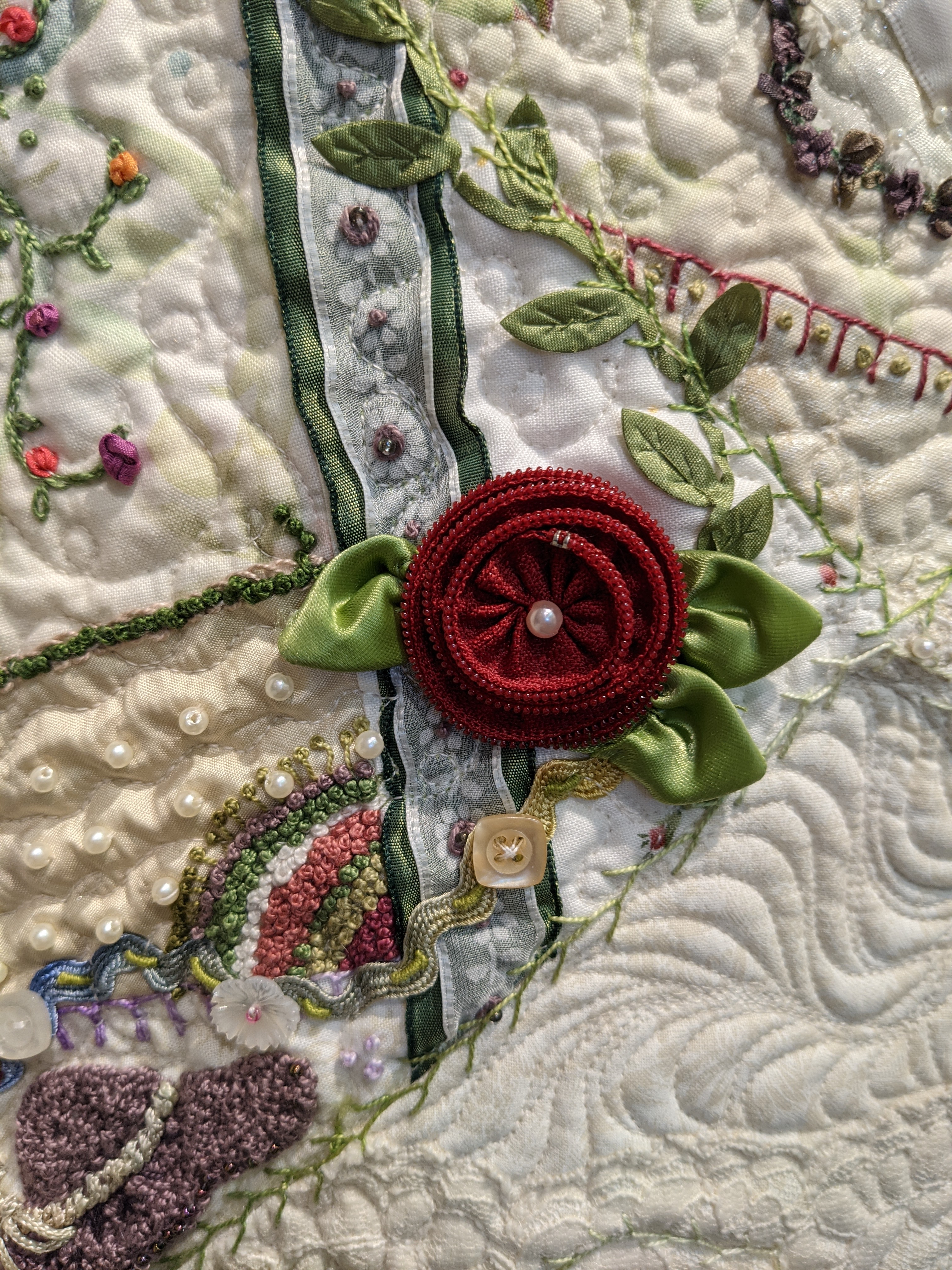
A zipper flower!
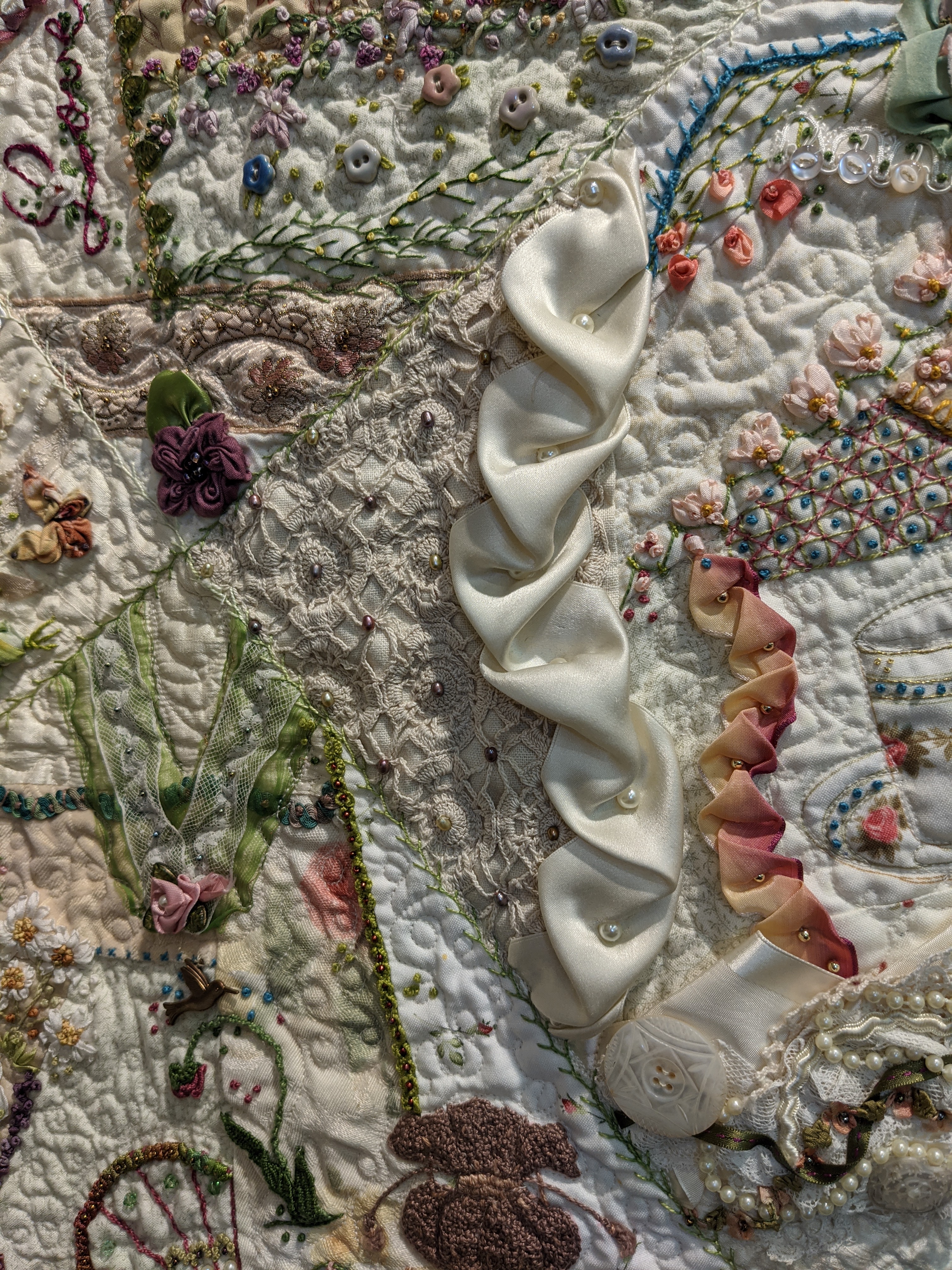
Wavy ribbons and beads, embroidery, and lace
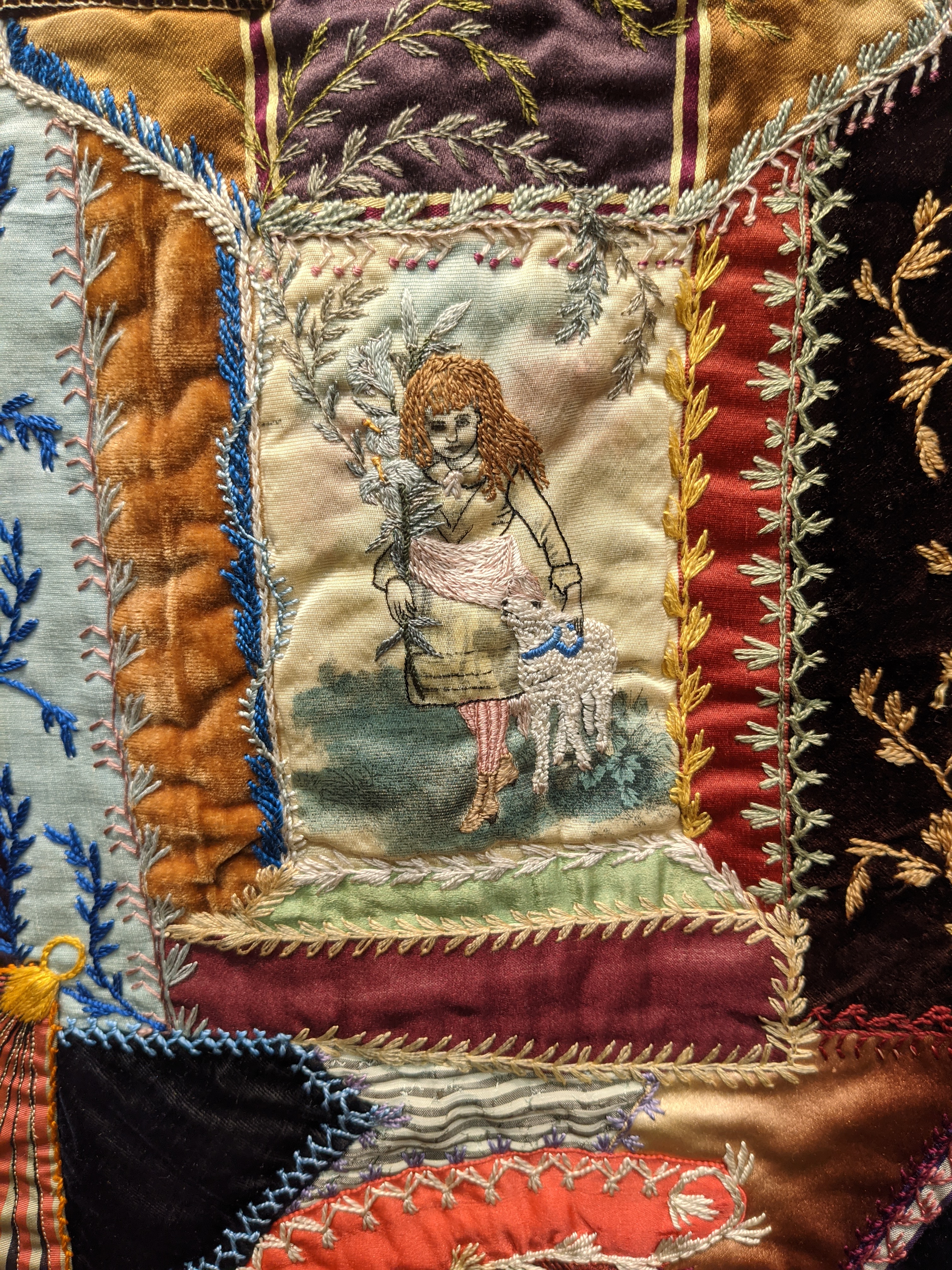
Embroidery over a printed fabric to create a little scene
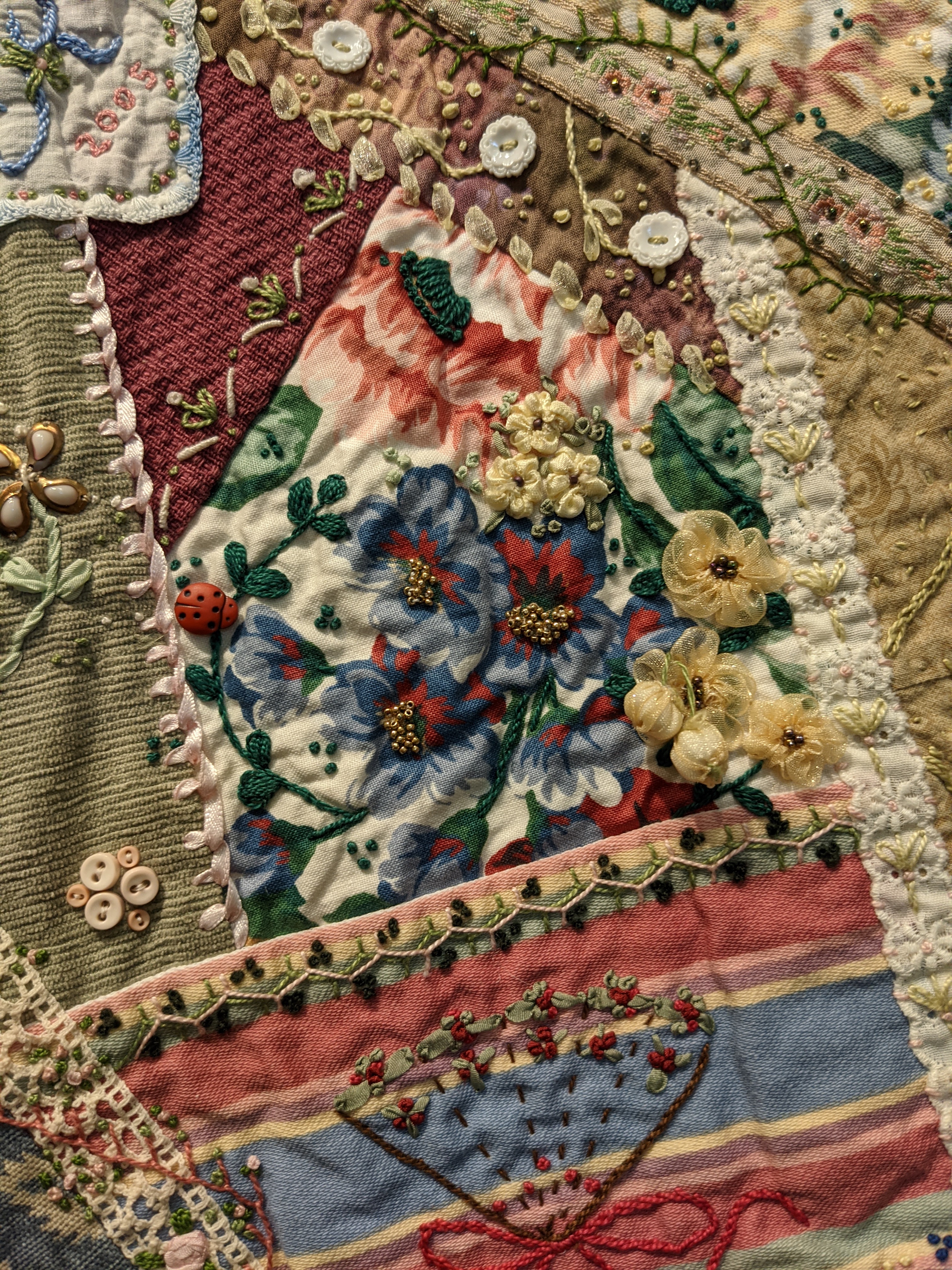
Printed fabric with flowers, ribbon flowers, and that adorable ladybug button!

I definitely walked away with a better idea of what I wanted to do with my cousin’s quilt, and so much inspiration for future projects. I don’t think I’d do a whole embroidered crazy quilt, but maybe something more like a mini art quilt. I really liked the idea of embroidering over printed fabric to enhance or create a new picture, and making little flowers with ribbon and zippers. Could be a fun mini project!

Stay tuned for the post on my second memory quilt coming up soon 🙂

Little close up of my own crazy quilt 🙂

Rocky Mountain Quilt Museum (Jan 2020)

I went to the museum again! Their exhibition was all English paper pieced quilts, which are pieced by hand. Traditionally, only hexagons are used: a paper hexagon is cut out, the fabric is wrapped around it and basted (or glued), then each hexagon is sewn to the others. Mostly the older ones are cute flower designs, with the modern ones (as you’ll see below) branching out into all different directions with more shapes and sizes. The paper template (we use cardstock now because it’s reusable) helps all the seams to be perfect and sharp, and then the paper is removed before quilting.

I have great respect for the people who make these large scale hand pieced quilts! Now that I have a sewing machine, hand sewing is extremely low on my priority and desire list, and I can’t even imagine the work and time (and stabbed fingers, probably) necessary to get quilts like these finished. I’ve heard that people like to work on EPP on road trips or plane rides, which makes a ton of sense. Also, just the sheer organizational nightmare putting this together must be – all those tiny pieces! I suppose it would be a great way to get rid of tiny scraps – they make hexagon templates down to 1/4″ on each side.

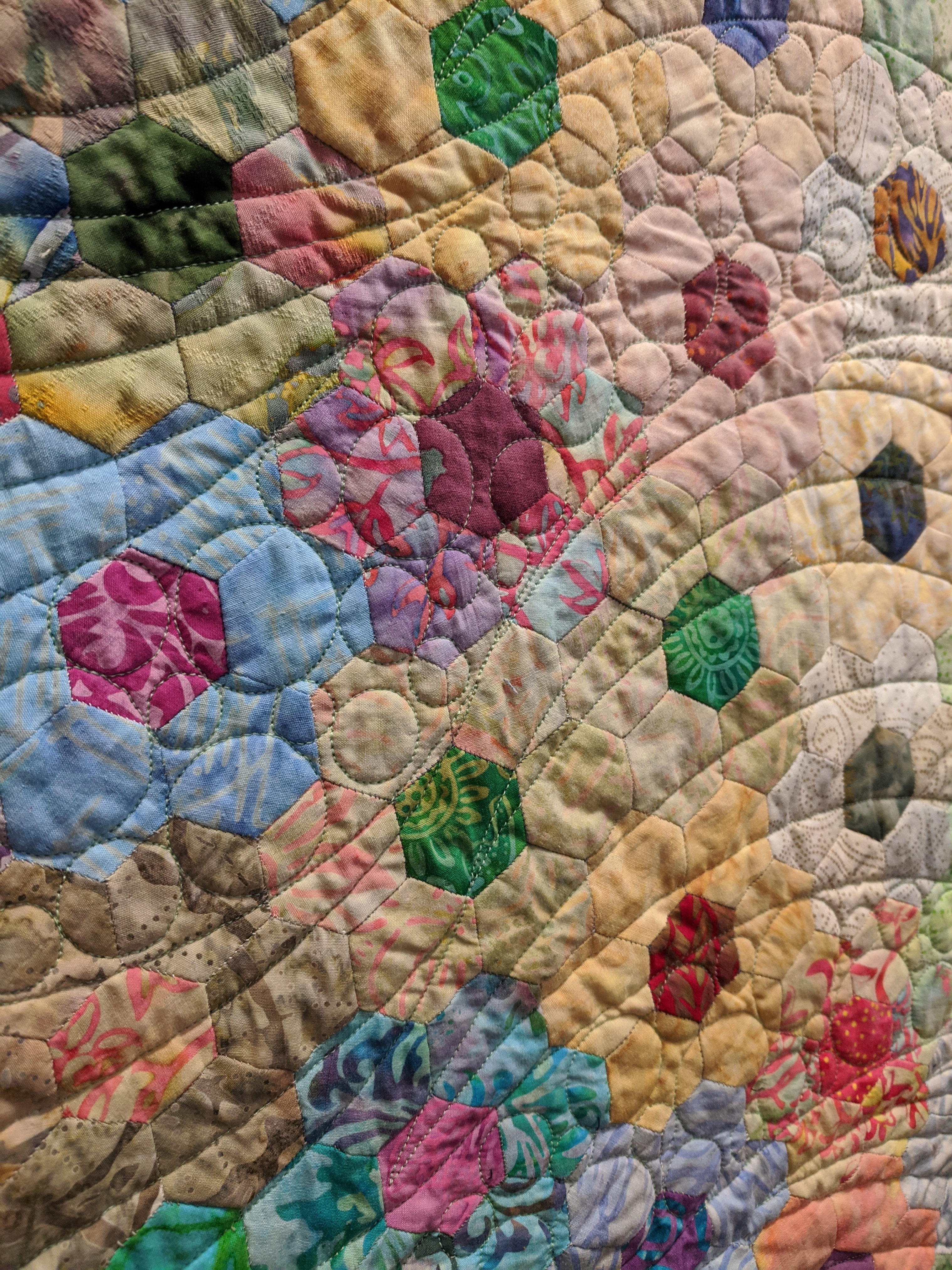
Below is G’Ma’s English Garden by Beverly Miller, it’s a full grid of hexagons, but the center of each flower or star is a different color. This layout is not super interesting at first glance, but the quilting truly makes this quilt pop. The wavy lines give so much movement and texture, and take this colorful quilt to the next level. I also love the embroidered details on the top and bottom rows.

Long wavy lines and some pebbles in the quilting; here you can see the hexagons that have been pieced together (by hand, remember)

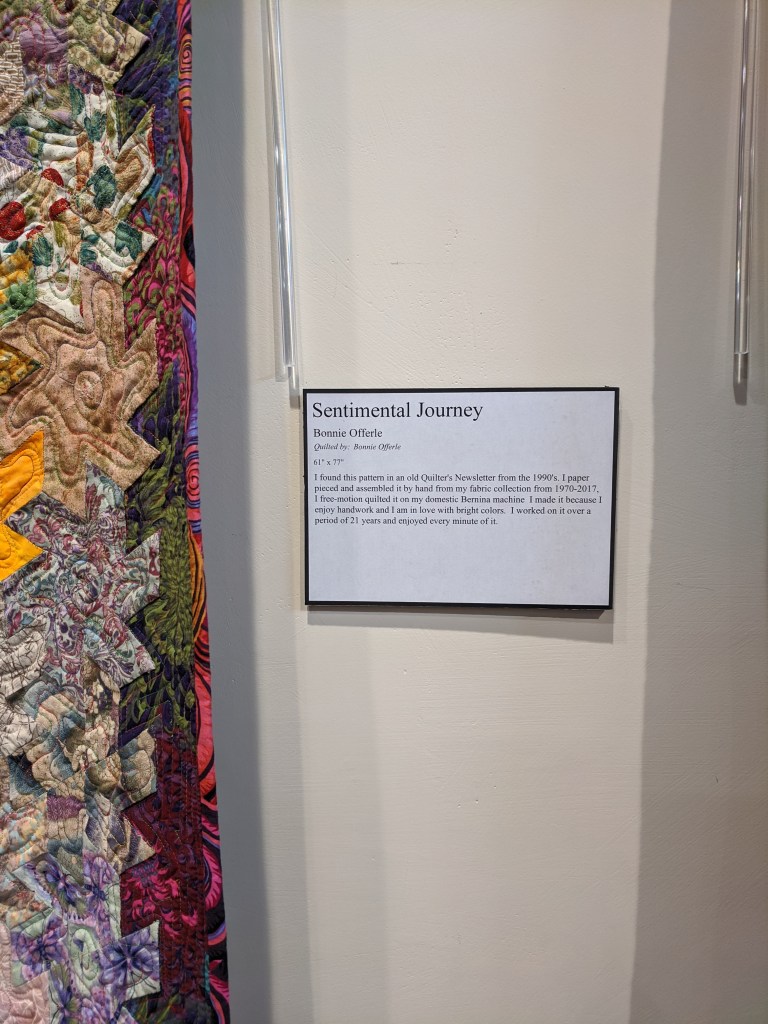
This next quilt, Sentimental Journey by Bonnie Offerle, features trapezoidal pieces instead of hexagons! I love the explosive star-like effect this creates, and she topped it off with swirly quilting.

Take a look at the trapezoidal pieces but also – she took 21 years to make this!! A great lesson to us all that you don’t have to finish things on anyone’s timeline but your own.

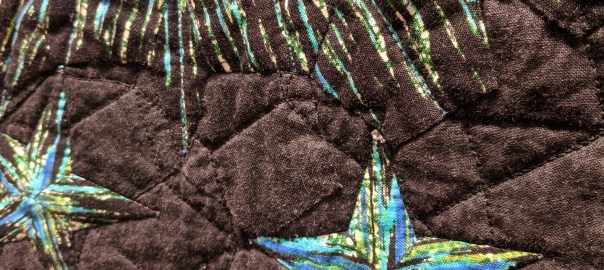
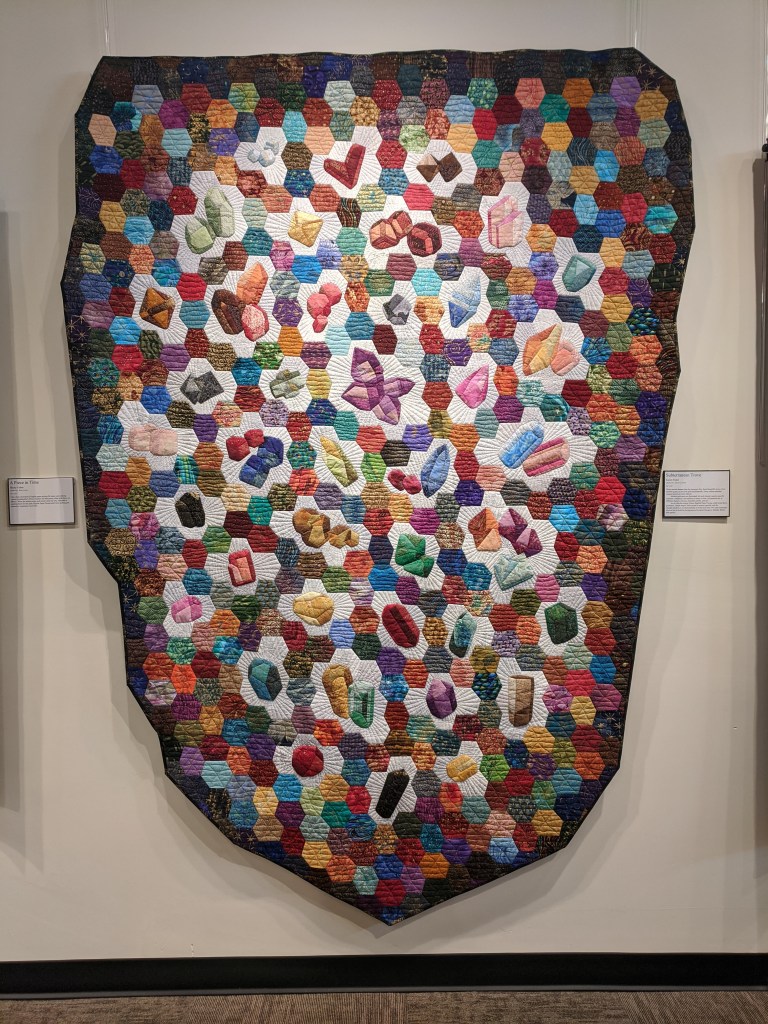
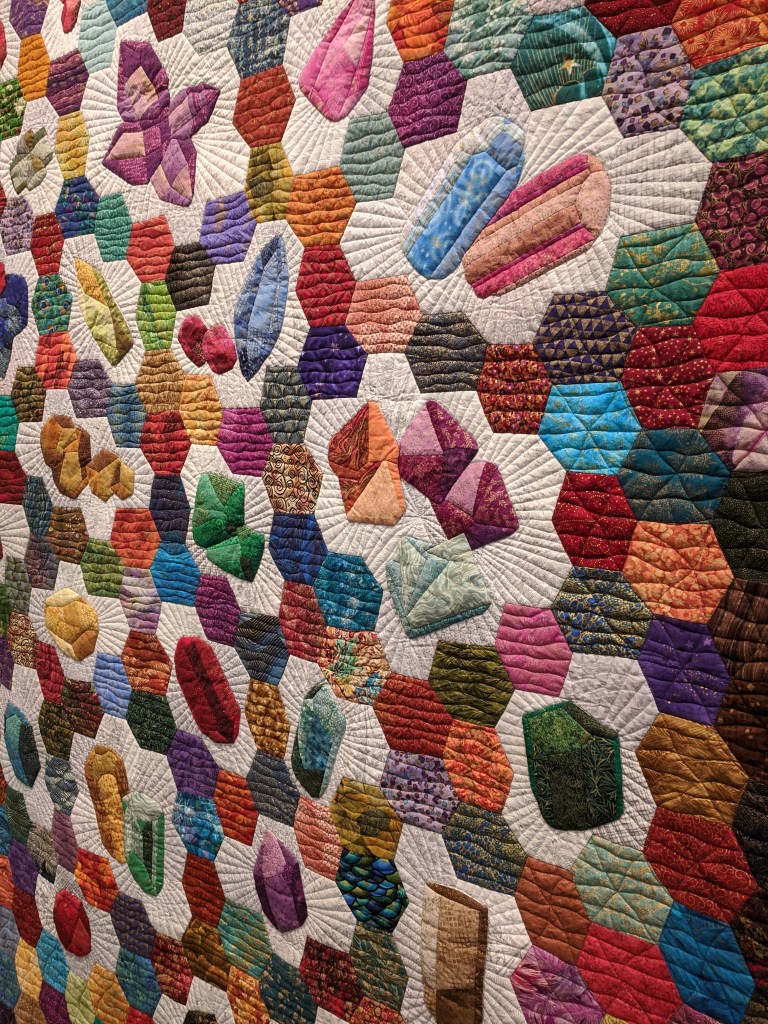
Subterranean Trove by Karen Fisher, below, totally captivated me. I love the bright colors, the fabrics are so bold and unique. It isn’t a squared up quilt, it has an organic shape. Even the hexagons aren’t perfect, some are tallish, some are fatter, but they all fit together. It’s so cool that the border is just as bright and bold as the “main body” of the quilt, I like that it is just as visually important. Each of the gems has many different fabrics that showcase the crystalline faces, and the quilting highlights every gem so much. The gems pop out of the texture because Karen used the trapunto technique to stuff each gem with more batting than the areas around it, plus she quilted those great lines that radiate from the gems to squish that batting down.
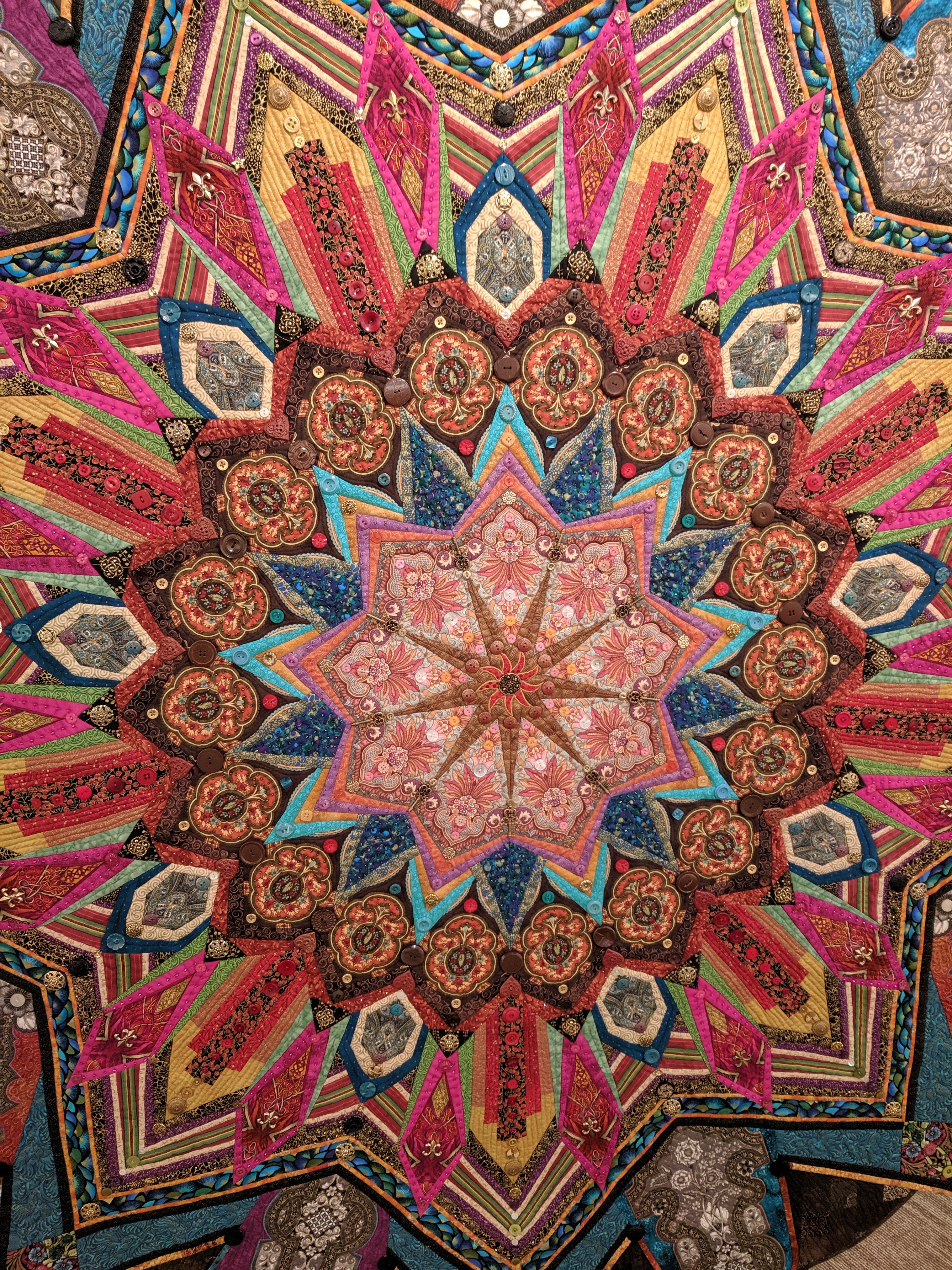
I spent a while with this quilt and met some other nice quilters in the process! We were all kind of drawn to the irregularities in this quilt together with the really fun crystals (especially the heart at the top!). One of the women suspected each of the gems might be based on a real mineral, but we were hard pressed to guess any other than the bluish quartz crystal towards the center right (and below).

Detail for the trapunto! Loved the texture so much.

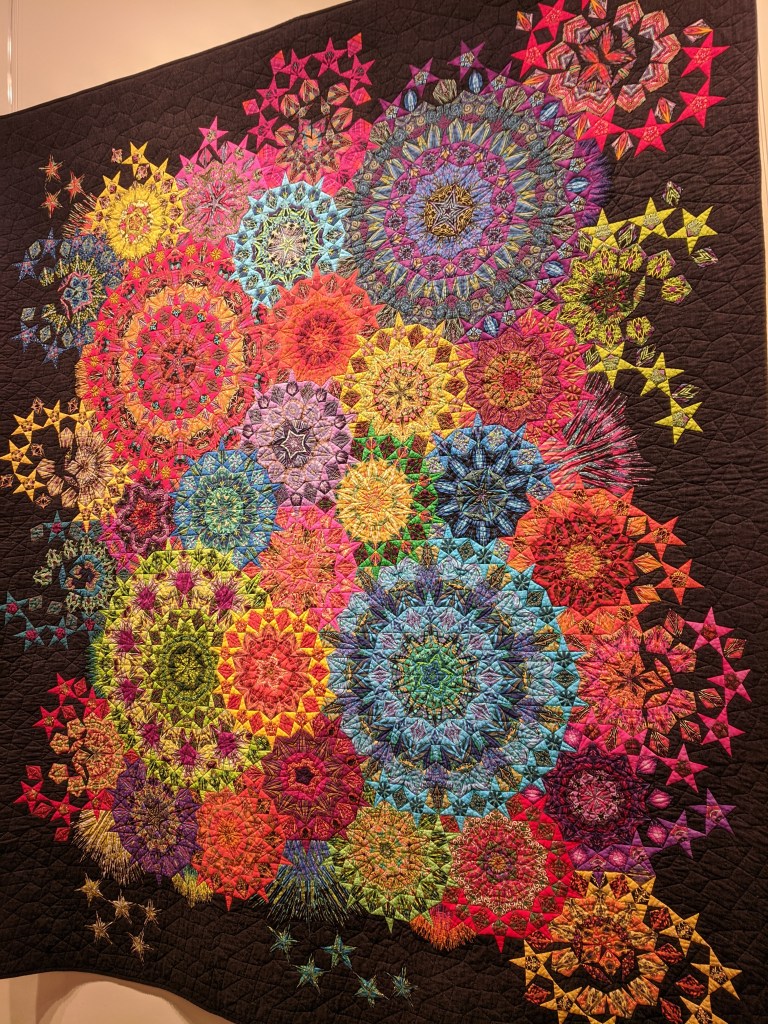
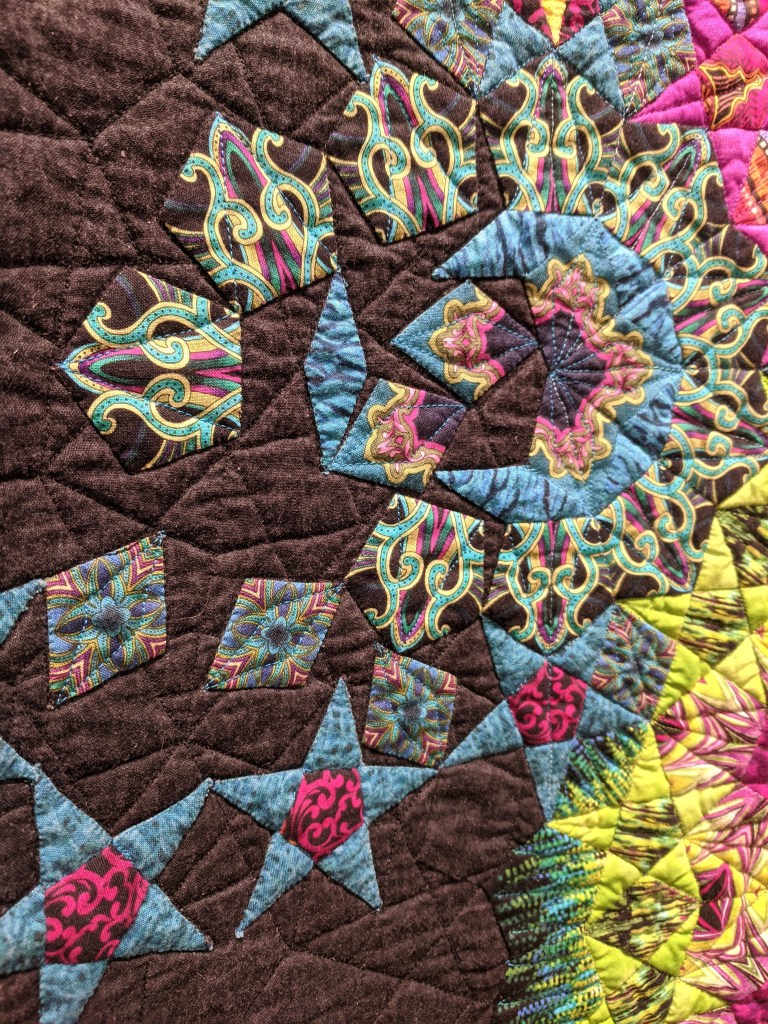
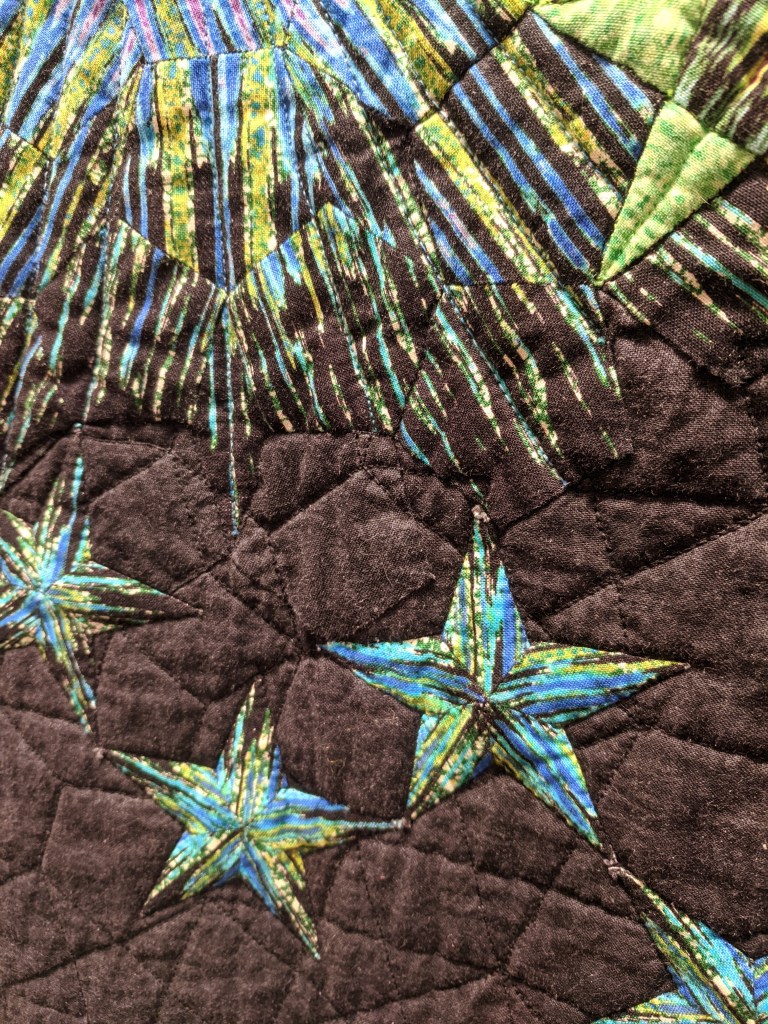
And finally, my favorite quilt of the exhibition – chaotic, wild, striped, and so, so bold: La Passacaglia Unravels by Randa Mulford. She writes that this was her first time doing English Paper Piecing, and she produced a truly incredible result. Passacaglia quilts are EPP in a circular design, using hexagons, triangles, parallelograms, and other shapes to make a symmetrical sort of radial design.
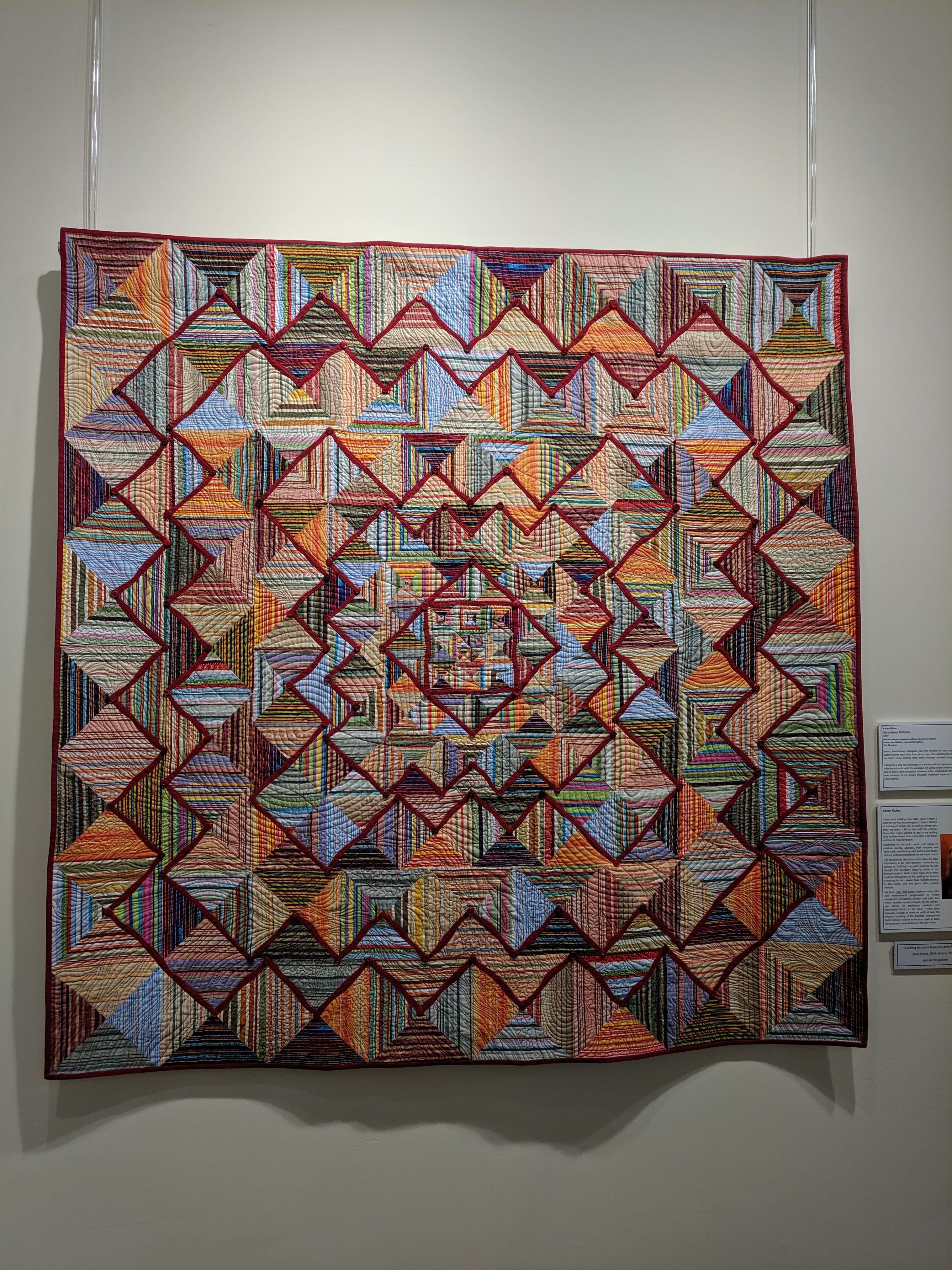
I love how she used striped fabric in such a brave way – it’s so much detail for the eye, but it really adds to the explosive “unraveling” or firework effect. We use the term “fussy cutting” to explain that she cut out her tiny pieces in very specific parts of the fabric, she didn’t just cut a row and divide it into pieces like we usually do. She targeted specific elements of the fabric design to include. This adds a ton of time while you’re cutting things out, as you have to cut each piece by itself instead of subdividing strips.

Yes, I’m telling you that she had to cut out each of those cute swirly pentagons by finding that element in the fabric and cutting the tiny pentagon out.
Then she hand sewed each pentagon to each triangle, to each diamond…. and on and on…. 🙂

English paper piecing can be done in traditional ways with hexagons, or as a way to create mosaics 🙂

Rocky Mountain Quilt Museum

Yesterday my mom and I went to the Rocky Mountain Quilt Museum (check out their search feature, they have tons of pictures of quilts). It was so cool. The main exhibition they had was called Evolution, so all the quilts were art quilts meant to reflect that theme. These were truly works of art with mixed media (lots of painting), and machine and hand quilting together. It showed me the more artistic limit of what quilting can be – meanwhile I’m hanging out on the more “function over form” side. We saw some really intricate strip piecing (some strips were 1/10th of an inch wide, which is crazy thin) and some cool improv/random piecing. Some people included different types of threads, types of fabric – like cotton with silk and organza, and lots of fun applique. There was an incredible mandala type quilt with buttons, a piece that looked like an abstract painting, and improv/cut up strip piecing to recreate geologic formations.

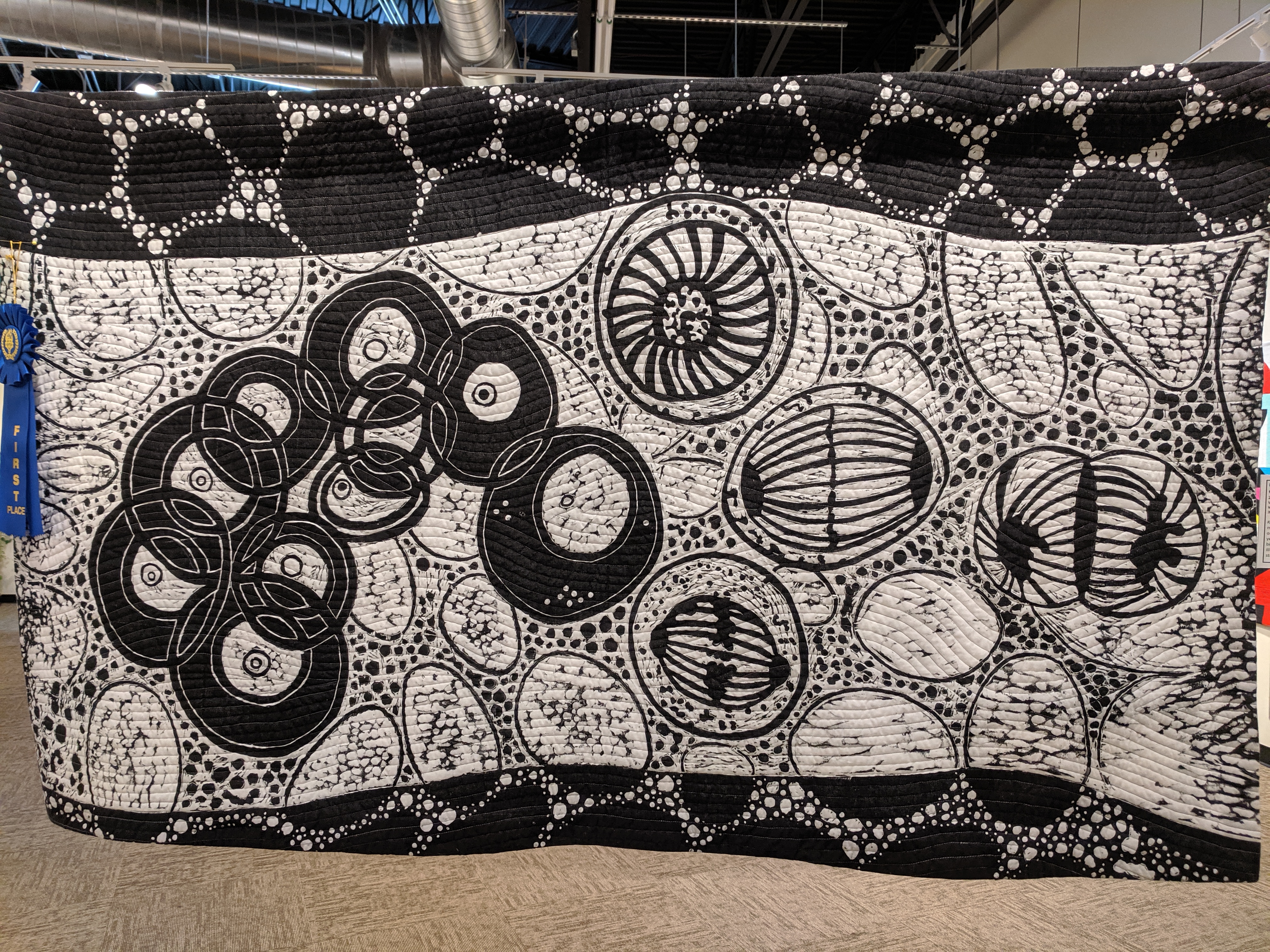
What my mom and I noticed, apart from the art, was that a lot of the quilters hailed from scientific fields – the quilt that won the exhibition was a former molecular bioscientist, she carved a wood block depicting mitosis, printed it on her fabric, and then quilted it (below).

CELL-ebration – Kathy Suprenant

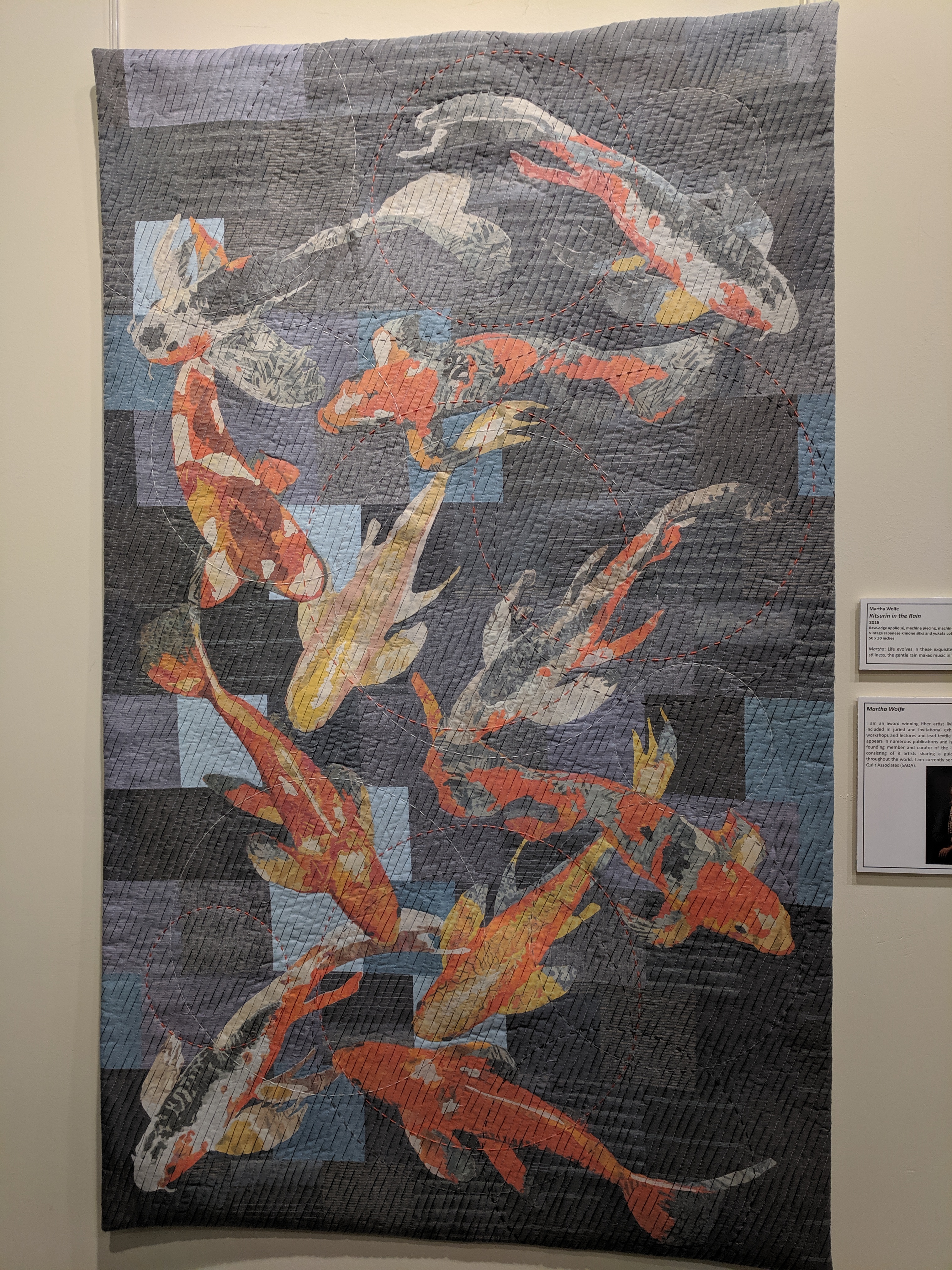
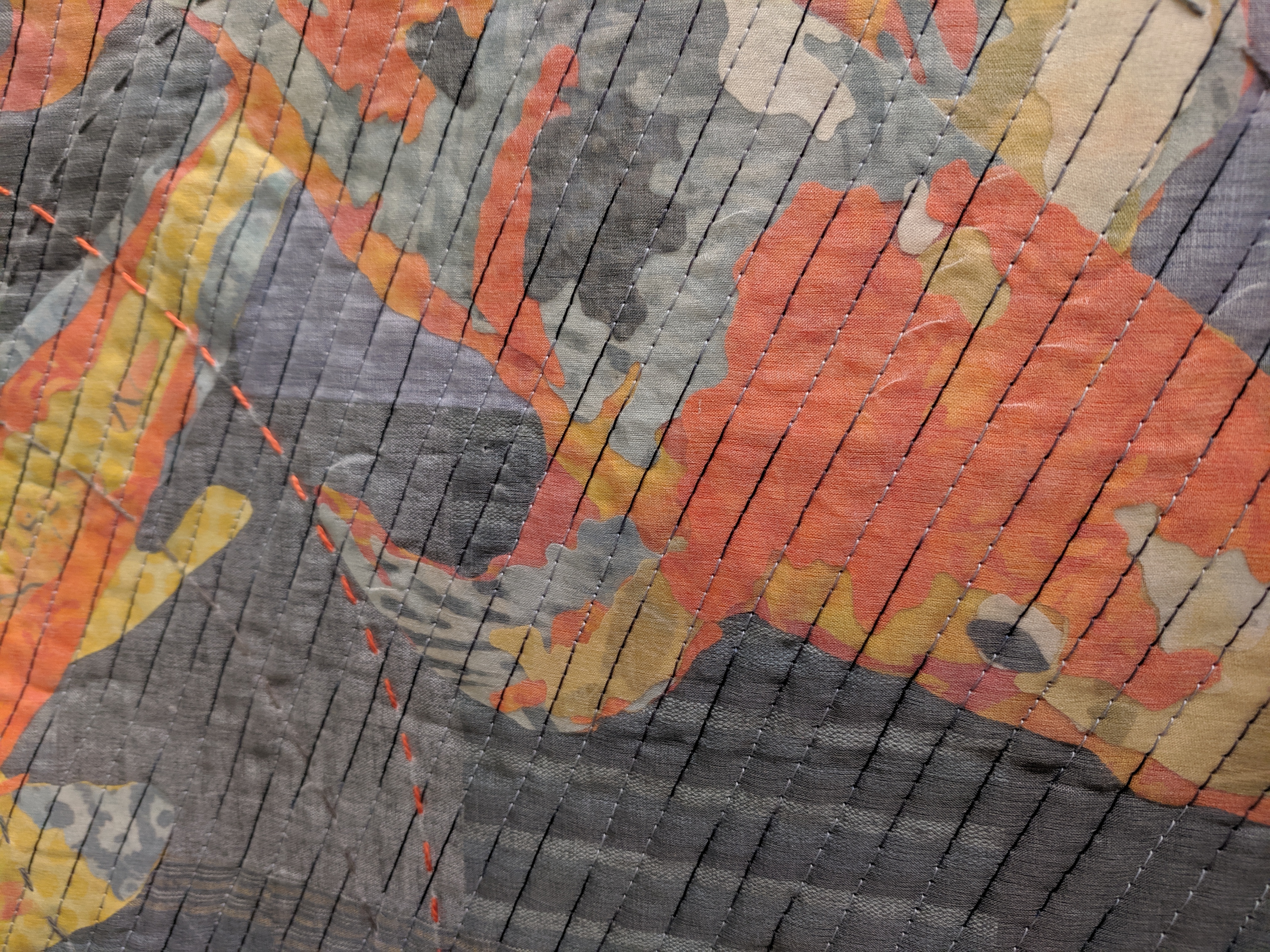
The one that struck me the most was this koi fish quilt called Ritsurin in the Rain by Martha Wolfe. It has a pieced background with appliqued fish, covered with organza, then quilted with “rain” lines and “ripples”. I’ve been thinking about using organza over a landscape applique to mimic a sunbeam, and seeing it in person confirmed that it could work. And the fish! They’re made with layered applique, so each of the patches on the fish is a different piece of fabric, all (I assume) fused together and then placed on the background.

The sign indicated the techniques included: raw-edge applique, machine piecing, machine quilting, hand quilting
Look at the layers of fabric – they’re raw edge, she cut those out and layered them to make it look like a fish

Needless to say, I will definitely be going back when they rotate exhibitions. The talent – and vision – of these artists is insane.