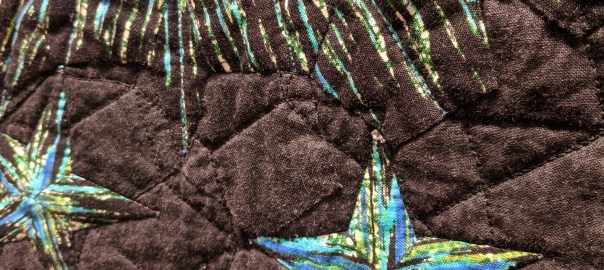
I went to the museum again! Their exhibition was all English paper pieced quilts, which are pieced by hand. Traditionally, only hexagons are used: a paper hexagon is cut out, the fabric is wrapped around it and basted (or glued), then each hexagon is sewn to the others. Mostly the older ones are cute flower designs, with the modern ones (as you’ll see below) branching out into all different directions with more shapes and sizes. The paper template (we use cardstock now because it’s reusable) helps all the seams to be perfect and sharp, and then the paper is removed before quilting.
I have great respect for the people who make these large scale hand pieced quilts! Now that I have a sewing machine, hand sewing is extremely low on my priority and desire list, and I can’t even imagine the work and time (and stabbed fingers, probably) necessary to get quilts like these finished. I’ve heard that people like to work on EPP on road trips or plane rides, which makes a ton of sense. Also, just the sheer organizational nightmare putting this together must be – all those tiny pieces! I suppose it would be a great way to get rid of tiny scraps – they make hexagon templates down to 1/4″ on each side.
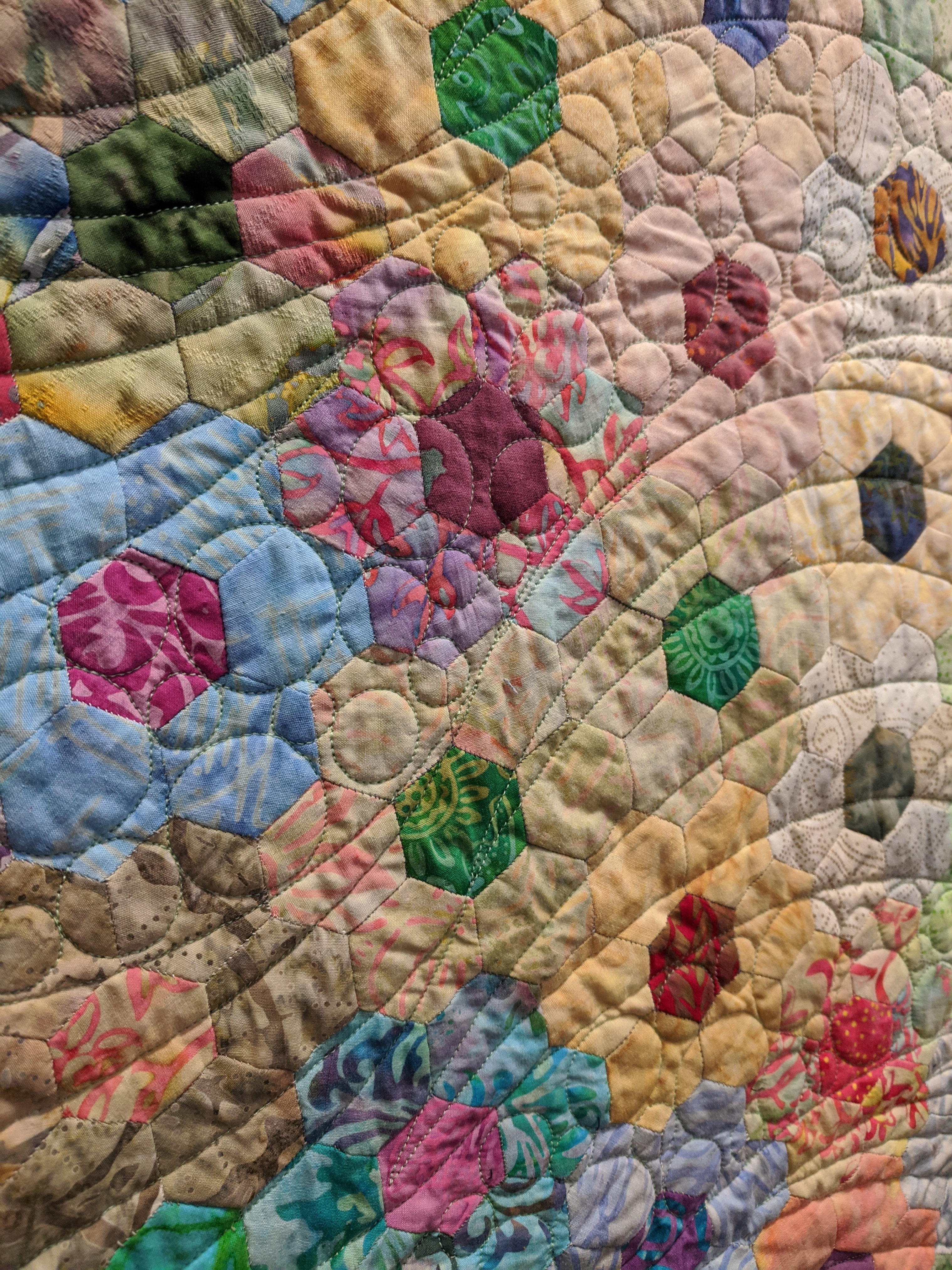
Below is G’Ma’s English Garden by Beverly Miller, it’s a full grid of hexagons, but the center of each flower or star is a different color. This layout is not super interesting at first glance, but the quilting truly makes this quilt pop. The wavy lines give so much movement and texture, and take this colorful quilt to the next level. I also love the embroidered details on the top and bottom rows.

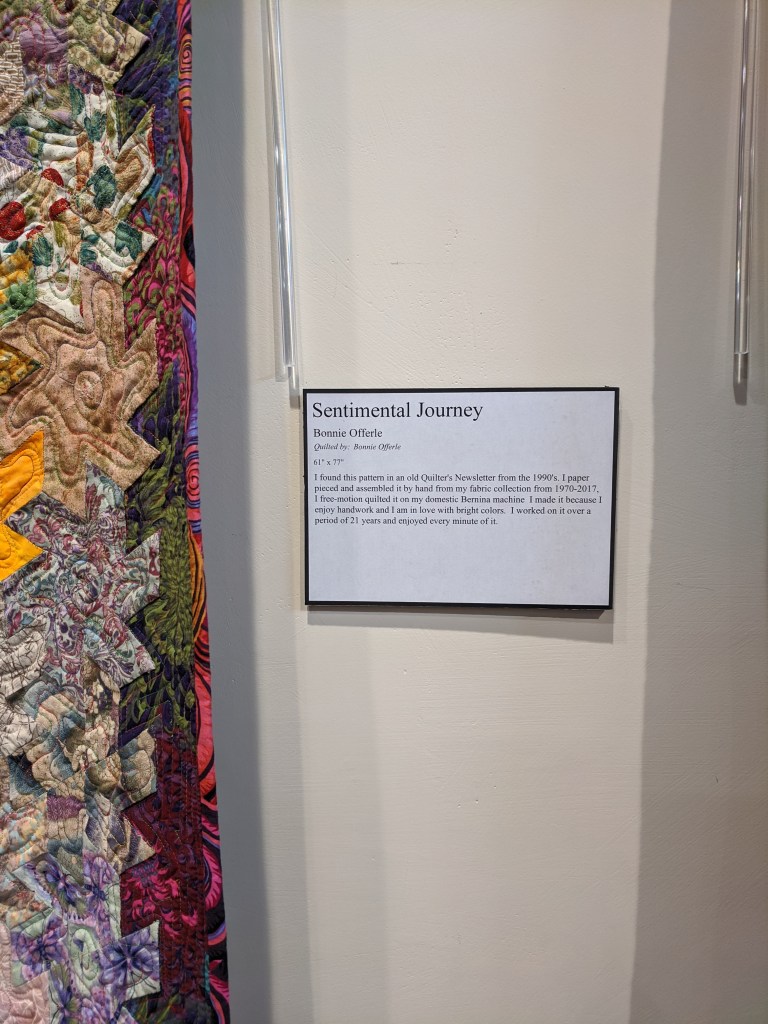
This next quilt, Sentimental Journey by Bonnie Offerle, features trapezoidal pieces instead of hexagons! I love the explosive star-like effect this creates, and she topped it off with swirly quilting.

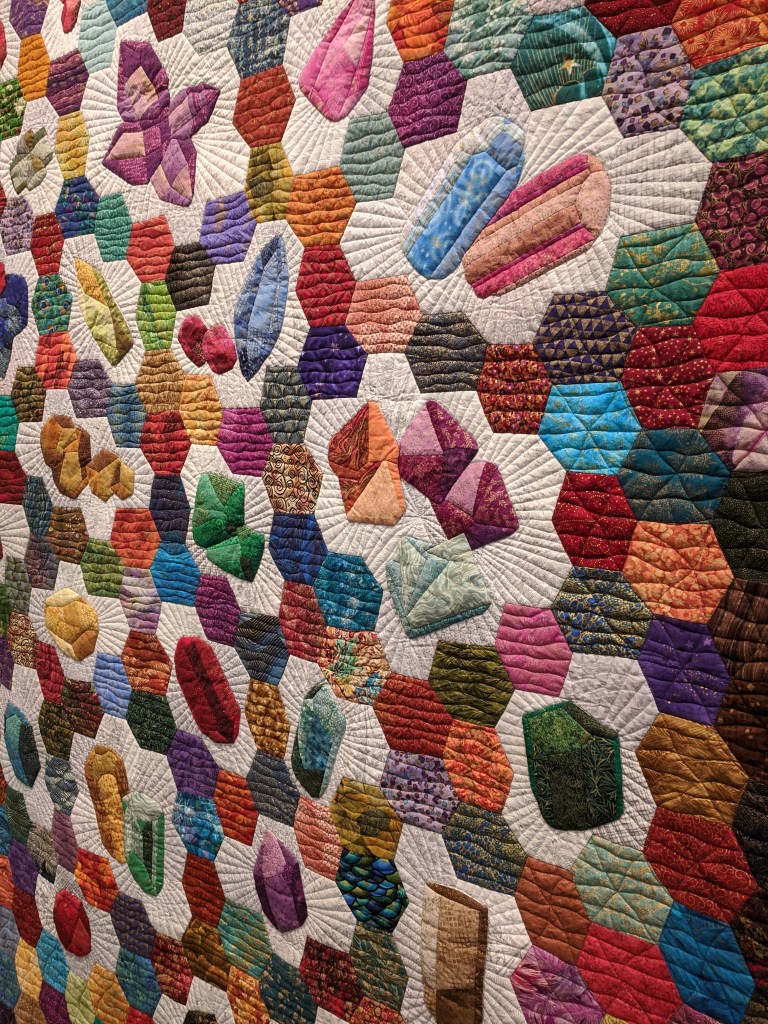
Subterranean Trove by Karen Fisher, below, totally captivated me. I love the bright colors, the fabrics are so bold and unique. It isn’t a squared up quilt, it has an organic shape. Even the hexagons aren’t perfect, some are tallish, some are fatter, but they all fit together. It’s so cool that the border is just as bright and bold as the “main body” of the quilt, I like that it is just as visually important. Each of the gems has many different fabrics that showcase the crystalline faces, and the quilting highlights every gem so much. The gems pop out of the texture because Karen used the trapunto technique to stuff each gem with more batting than the areas around it, plus she quilted those great lines that radiate from the gems to squish that batting down.
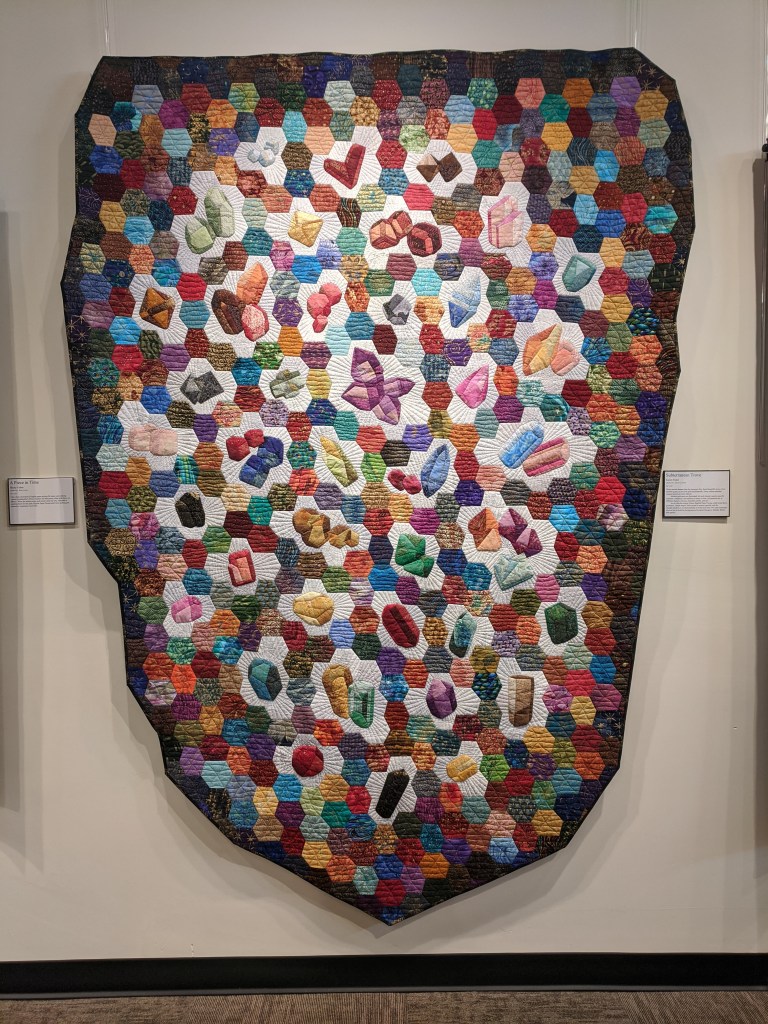
I spent a while with this quilt and met some other nice quilters in the process! We were all kind of drawn to the irregularities in this quilt together with the really fun crystals (especially the heart at the top!). One of the women suspected each of the gems might be based on a real mineral, but we were hard pressed to guess any other than the bluish quartz crystal towards the center right (and below).
And finally, my favorite quilt of the exhibition – chaotic, wild, striped, and so, so bold: La Passacaglia Unravels by Randa Mulford. She writes that this was her first time doing English Paper Piecing, and she produced a truly incredible result. Passacaglia quilts are EPP in a circular design, using hexagons, triangles, parallelograms, and other shapes to make a symmetrical sort of radial design.
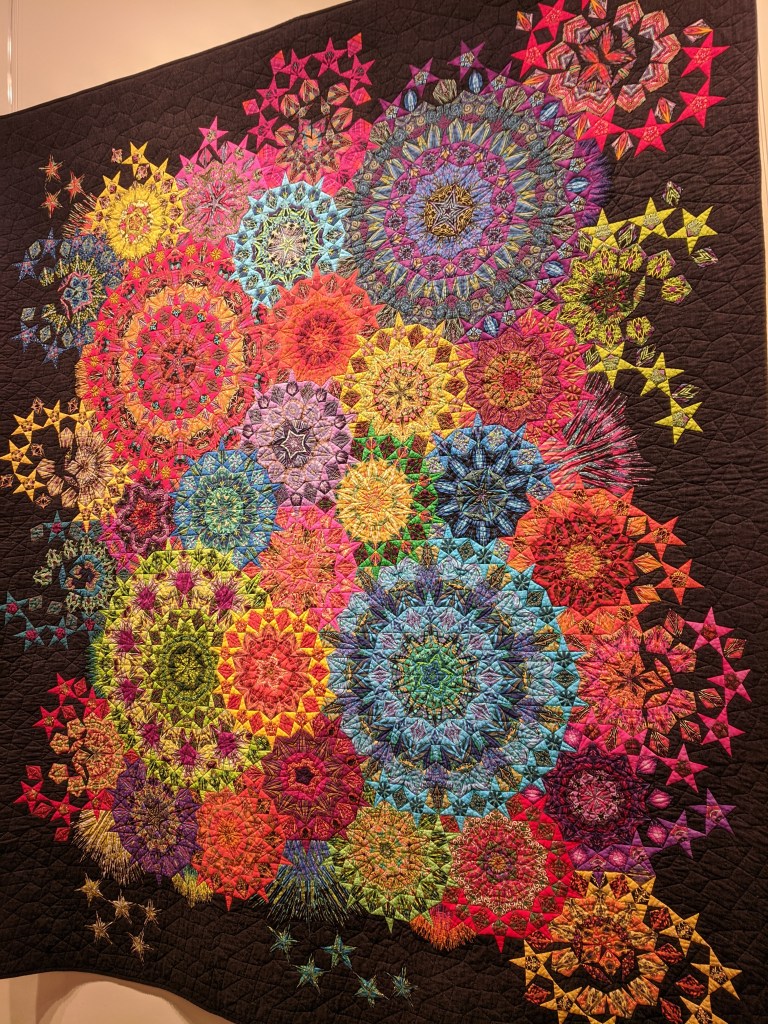
I love how she used striped fabric in such a brave way – it’s so much detail for the eye, but it really adds to the explosive “unraveling” or firework effect. We use the term “fussy cutting” to explain that she cut out her tiny pieces in very specific parts of the fabric, she didn’t just cut a row and divide it into pieces like we usually do. She targeted specific elements of the fabric design to include. This adds a ton of time while you’re cutting things out, as you have to cut each piece by itself instead of subdividing strips.
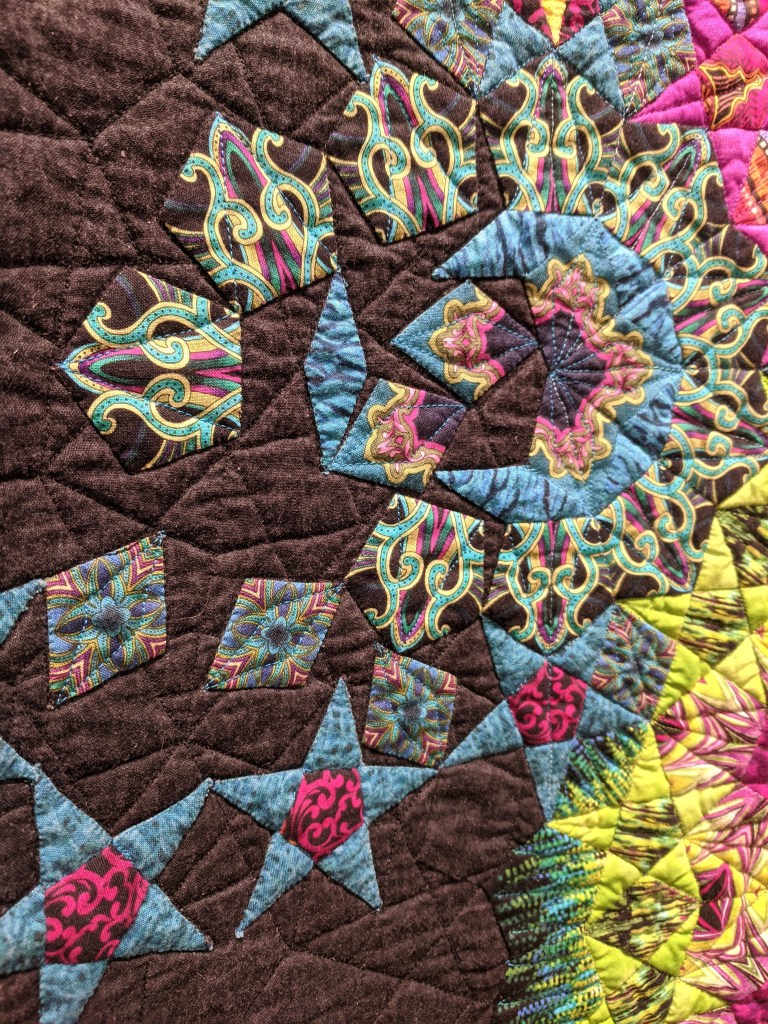
Then she hand sewed each pentagon to each triangle, to each diamond…. and on and on…. 🙂
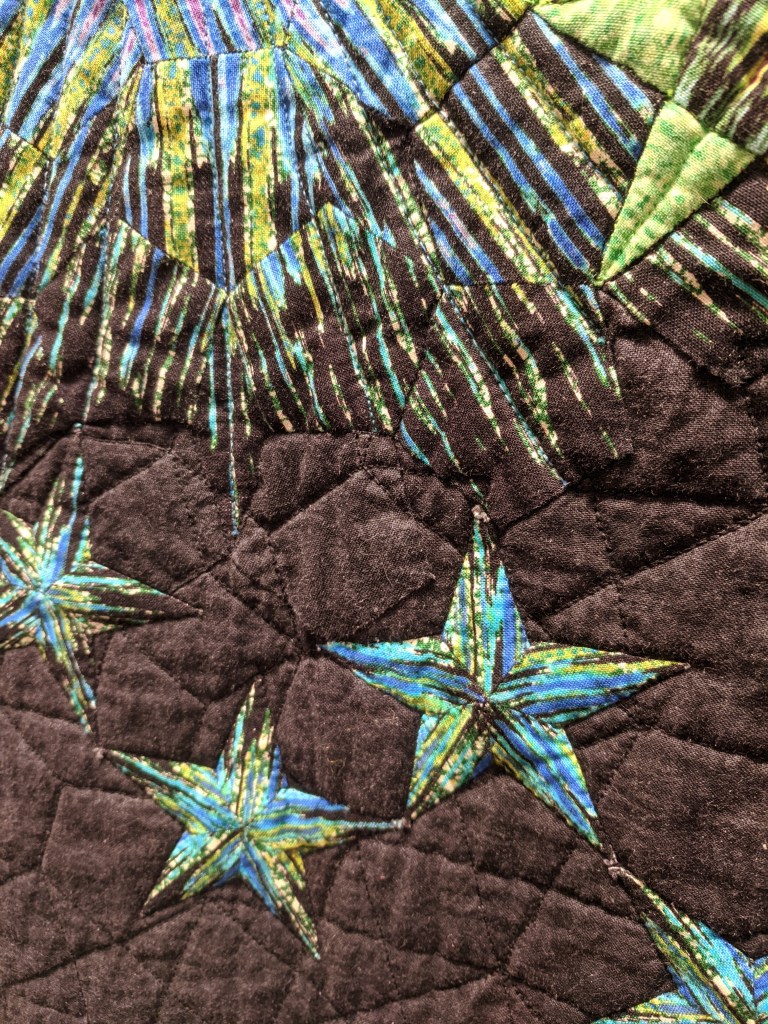
English paper piecing can be done in traditional ways with hexagons, or as a way to create mosaics 🙂
 Finch's Creative Endeavors
These are amazing. I am sorry I missed this exhibit but you captured the art and artists very well
LikeLike
I’m with you Maddie. My favorite is also the fireworks one. What a piece of art!!
LikeLike
It was so impressive, so bold. I love how it’s a new take on an old technique/pattern. I am also a huge fan of black backgrounds.
LikeLike